
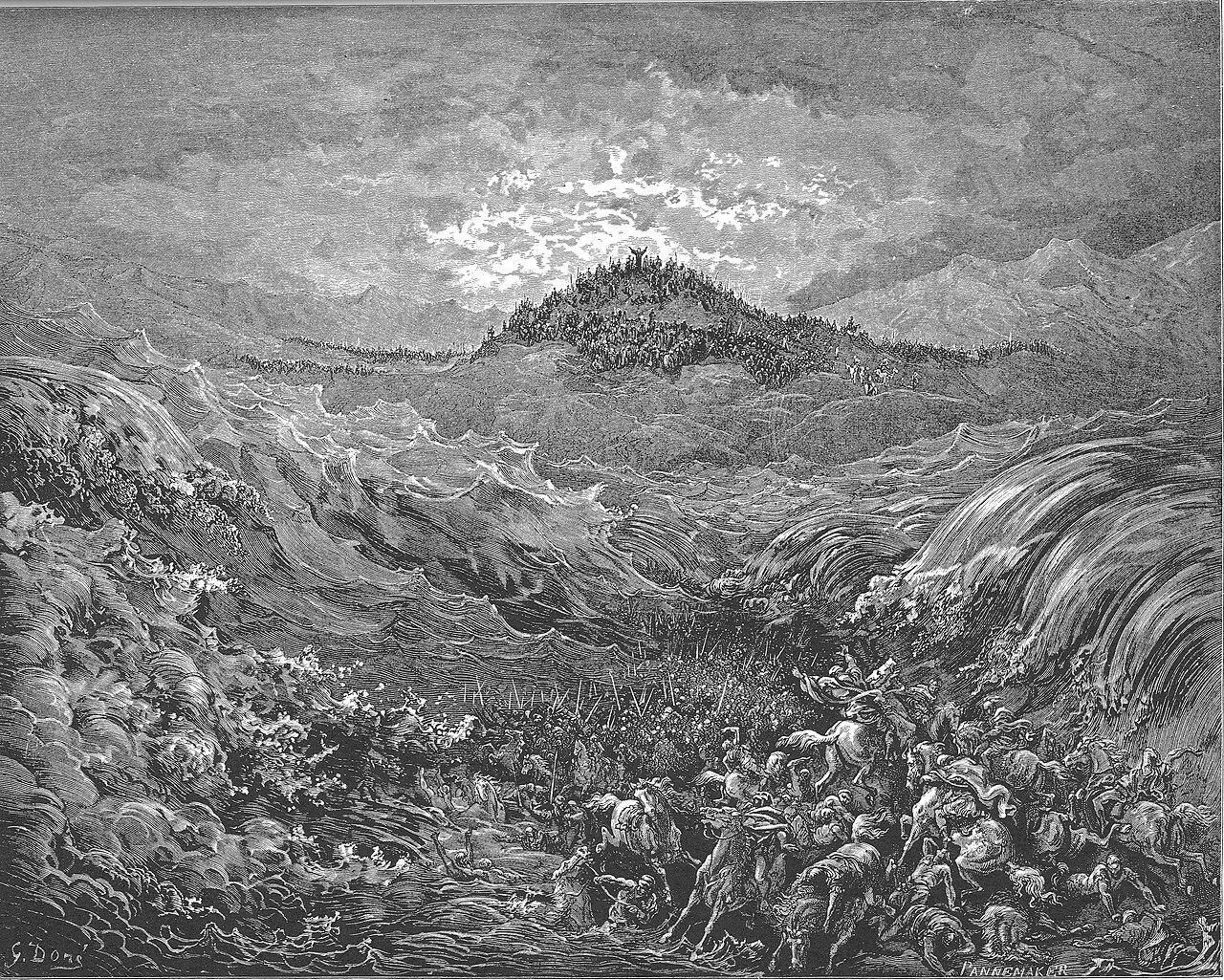
Exoduschapter 14
31 verses · Moses, by tradition · 15th or 13th century BC · The Law
Then the LORD said to Moses,
Introduction
Moses, by tradition, The Law, Exodus Overview.
Exodus is given as the work of Moses, who was raised in Pharaoh's household and knew Egypt's power at first hand. The first hearers were the people who came out of Egypt and the children they taught at every Passover. They knew what a chariot force meant to a column of families on foot. This chapter is the hinge of the book, where the story of Egypt ends and the story of the wilderness begins. Listen for who gives each order and who carries it out. Listen also for the one thing the people are asked to do.
Context
- Who
- Israel in the wilderness, whose national story begins at this shoreline
- What
- Exodus 14 is the account of Israel's crossing of the sea on dry ground and the drowning of the Egyptian army that pursued them.
- Where
- The camp by the sea at Pi-hahiroth, between Migdol and the sea and opposite Baal-zephon; none of the three sites is located with certainty, and the crossing has been placed near Suez, at the Bitter Lakes and at other points along the isthmus.
- When
- A few days after the first Passover, in the first month of Israel's year, and the exodus itself is dated to the fifteenth century BC or to the thirteenth century BC by the two main datings, both held, with Exodus 12:40 to 41 and 1 Kings 6:1 bearing on the question.
- Why
- It shows the LORD rescuing a people who fight no battle, so that Egypt would know He is the LORD and Israel would fear Him and believe.
Historical context
The chapter is told of Israel and of Moses, and the orders in it come to Moses from the LORD directly.
Show the rest of the historical context, 4 more paragraphs
It falls within days of the going out. The early dating puts it about 1446 BC from the four hundred and eighty years of 1 Kings 6:1 read literally, while Kenneth Kitchen and James Hoffmeier date the exodus to the thirteenth century from the store cities of Exodus 1:11, and the chapter names no Pharaoh and no year.
The place is named in three words, Pi-hahiroth, Migdol and Baal-zephon, and where each stood is disputed, as is the water itself, since the Hebrew yam suph, the sea of reeds, has been placed along the chain of lakes and gulfs east of the Delta while the Septuagint and the Vulgate carry the Red Sea, and the site stamps no verdict.
The occasion is Israel turned back to camp with water in front and an army behind, and the crossing that follows.
A first hearer knew what six hundred chosen chariots meant, since the Egyptian chariot was a light two-horse platform carrying a driver and an archer, decisive on flat firm ground and helpless in mud, which is what the chapter describes happening to it. He knew that a pillar standing between two armies all night, dark on one side and lit on the other, was a thing no army could march through. He also knew what the morning watch was, the last watch before dawn, when the LORD is said to have looked down on the Egyptian camp and thrown it into confusion.
Significance
This is the event the rest of the Old Testament points back to. The prophets, the psalms and the songs reach for this shoreline whenever they want to say what God is like.
Show the rest of the significance, 1 more paragraph
Moses' order to the people was the founding posture of the nation. They were to stand firm and watch the LORD fight, and at the end of the day they feared the LORD and believed in him and in his servant Moses.
This chapter in Jewish lifeWhat this chapter is in Jewish life and reading.
What is done
Rashi sets this chapter on the calendar of the feast. He counts the days from the going out, and puts Israel in the sea on the night of the seventh day, with the Song sung the following morning. That, he says, is the seventh day of Passover, "and that is why we read The Song as the Scriptural lesson on the seventh day of the Festival" (Rashi on Exodus 14:5:1). He cites the tractate Megillah for it. A Christian reader meets the crossing as a story. A Jewish congregation meets it as a day in the week of the feast, with this chapter and the next read aloud on it.
How it is read
Rashi reads the turning back of verse 2 as a trap laid for Pharaoh, so that he would think Israel lost (Rashi on Exodus 14:2:1). At verse 8 he treats the hardening as the settling of a doubt. Pharaoh was in two minds whether to pursue, "and He hardened his heart to pursue" (Rashi on Exodus 14:8:1). At verse 15 he carries two readings of the answer given to Moses. In the first, Moses was standing in prayer, and was told that this was no time to pray at length while Israel stood in trouble. In the second, the words mean that the matter rests on God rather than on Moses (Rashi on Exodus 14:15:1). At verse 19 he reads the divine name used there as the name of judgment, and holds that Israel itself stood under judgment at that hour (Rashi on Exodus 14:19:1). At verse 20 he gives the parable of a father who moves his son in front of him or behind him as the danger shifts. At last the father carries the boy on his arm (Rashi on Exodus 14:20:1). The text is the Rosenbaum and Silbermann Rashi of 1929 to 1934, in the public domain.
What the rabbis say
The rabbis take up the chariots of verse 7 at Arakhin 15a:17 and Eikhah Rabbah 3:1. On Israel crying out at the sea they taught in Bamidbar Rabbah 8:3, and on the complaint of verses 11 and 12 at Arakhin 15a:15. On the east wind they taught in Bereshit Rabbah 55:8. The Mekhilta of Rabbi Shimon ben Yochai carries this chapter at eleven places, from 14:1 to 14:24.
Sources: Rashi, Rashi on Exodus 14:2:1, 14:5:1, 14:8:1, 14:15:1, 14:19:1 and 14:20:1, Pentateuch with Rashi's commentary by M. Rosenbaum and A. M. Silbermann, 1929 to 1934 (public domain); Ibn Ezra, Ibn Ezra on Exodus 14:16:1 and 14:22:1, cited by ref alone under the corpus licence rule; The Babylonian Talmud, Arakhin 15a:17 and 15a:15, cited by ref; The Midrash, Eikhah Rabbah 3:1, Bamidbar Rabbah 8:3, Bereshit Rabbah 55:8, and Mekhilta DeRabbi Shimon Ben Yochai 14:1 to 14:24, cited by ref.
The heads below are this chapter's scenes. The numbered points under each are its verses.
Pharaoh Pursues to the Sea
Exodus 14:1-3
The route is dictated rather than chosen, and it puts the sea in front of the camp with Migdol behind it. God says in advance what Pharaoh will conclude from the map, that they are entangled in the land and the wilderness hath shut them in. Israel is placed in a trap on purpose, and the trap is set for Egypt.
Exodus 14:1
“Note, God sometimes raises difficulties in the way of the salvation of his people, that he may have the glory of subduing them, and helping his people over them.”
Matthew Henry · Commentary on the Whole Bible (1707-1721)puritan
turn back and encamp before Pi-hahiroth: The order to turn back reverses the march that had reached Etham on the edge of the wilderness at 13:20. Adam Clarke reads Migdol as the Hebrew for a tower, a fort guarding the bay, and Baal-zephon as lord of the watch, a shrine or beacon kept over the haven. None of the three sites has a certain location today.
Exodus 14:2
“Encamp before Pi-hahiroth - פי ההירת pi hachiroth, the mouth, strait, or bay of Chiroth. Between Migdol, מגדל migdol, the tower, probably a fortress that served to defend the bay. Over against Baal-zephon, בעל צפן baal tsephon, the lord or master of the watch, probably an idol temple, where a continual guard, watch, or light was kept up for the defense of one part of the haven, or as a guide to ships.”
Adam Clarke · Commentary on the Bible (1810-1826)evangelical
Albert Barnes holds that the Red Sea then reached north as far as the Bitter Lakes, so a camp turned south had water across its road east. Desert closed the other side, which is the ground the words boxed in describe. Pharaoh read the ground correctly and misjudged who had chosen it.
Exodus 14:3
“They are entangled ... - The original intention of Moses was to go toward Palestine by the wilderness: when that purpose was changed by God’s direction and they moved southwards, Pharaoh, on receiving information, was of course aware that they were completely shut in, since the waters of the Red Sea then extended to the Bitter Lakes. It is known that the Red Sea at some remote period extended considerably further toward the north than it does at present.”
This is one of the last three hardening statements in the book, with 14:8 and 14:17 still to come, and since 9:12 the subject has been the LORD every time. Through the first five plagues the text put the act on Pharaoh or left it stative, at 7:13, 7:22, 8:15, 8:19, 8:32 and 9:7. Sproul holds compatibilism and reads the whole sequence as one act carrying two true descriptions, while the free-will reading takes the order seriously and holds that God confirmed a man in the direction he had already taken. Romans 9:17 quotes Exodus 9:16 and draws from it the words whom he will he hardeneth.
Exodus 14:4
“I will harden Pharaoh’s heart - After relenting and giving them permission to depart, he now changes his mind and determines to prevent them; and without any farther restraining grace, God permits him to rush on to his final ruin, for the cup of his iniquity was now full.”
Adam Clarke · Commentary on the Bible (1810-1826)evangelical
1 more voice on this verse
Exodus 14:4
“And thus (says God) I will be honoured upon Pharaoh. Note, [1.] All men being made for the honour of their Maker, those whom he is not honoured by he will be honoured upon. [2.] What seems to tend to the church's ruin is often overruled to the ruin of the church's enemies, whose pride and malice are fed by Providence, that they may be ripened for destruction.”
Matthew Henry · Commentary on the Whole Bible (1707-1721)puritan
Exodus 14:5-7
Pharaoh's own words name what he counts as lost, that we have let Israel go from serving us, and the Hebrew root behind serving is the one Exodus 1:13 and 1:14 used five times over for the bondage. He had said go, serve the LORD at 12:31, and within days he reckons the cost in labour. Six hundred chosen chariots and all the chariots of Egypt go out after people who left with kneading troughs on their shoulders.
Exodus 14:5
“The people fled - This was a natural inference from the change of direction, which indicated a determination to escape from Egypt. Up to the time when that information reached Pharaoh both he and his people understood that the Israelites would return after keeping a festival in the district adjoining Etham. From Etham the intelligence would be forwarded by the commander of the garrison to Rameses in less than a day, and the cavalry, a highly-disciplined force, would be ready for immediate departure.”
1 more voice on this verse
Exodus 14:5
“He had been convinced, but not converted--overawed, but not sanctified by the appalling judgments of heaven. He bitterly repented of what he now thought a hasty concession. Pride and revenge, the honor of his kingdom, and the interests of his subjects, all prompted him to recall his permission to reclaim those runaway slaves and force them to their wonted labor.”
Jamieson, Fausset & Brown · Commentary Critical and Explanatory on the Whole Bible (1871)reformed
So Pharaoh prepared his chariot: Pharaoh goes out in person, in the chariot a king of Egypt rode to war. John Gill takes the army as his soldiers, the cavalry above all, and notes that the Greek version reads all his people. At 12:32 the same king had asked for a blessing.
Exodus 14:6
“And he made ready his chariot,.... Which he usually rode in when he went forth to war; for this seems to be a military chariot, and not for show or grandeur; and this was got ready not by himself, as Jarchi, but rather by his orders, as Aben Ezra: and took his people with him; the Greek version reads, "all his people"; not all his subjects, but his soldiers; at least a great number, and especially his cavalry.”
600 of the best chariots: Each of Pharaoh's chariots carried two men behind two horses, as Albert Barnes describes the Egyptian army, a driver with the shield and an armed fighter. The Hebrew for officers is shalish, a third, which Barnes takes for an Egyptian title of rank. He places the other chariots at Rameses and the frontier forts.
Exodus 14:7
“Six hundred chosen chariots - The Egyptian army comprised large numbers of chariots, each drawn by two horses, with two men, one bearing the shield and driving, the other fully armed. The horses were thoroughbred, renowned for strength and spirit. Chariots are first represented on the monuments of the 18th dynasty. By “all the chariots of Egypt” we are to understand all that were stationed in Lower Egypt, most of them probably at Rameses and other frontier garrisons near the headquarters of Pharaoh. Captains - The word שׁלישׁ shâlı̂ysh, literally “third or thirtieth,” may represent an Egyptian title.”
Exodus 14:8-9
hardened the heart of Pharaoh king of Egypt: One verse says both that the LORD hardened Pharaoh and that Israel went out with an high hand, so the pursuit and the boldness are reported together. Numbers 33:3 looks back on the same march and keeps the same phrase for it. What overtakes them is the whole force counted item by item, the horses, the chariots, the horsemen and the army, drawn up against a camp the text gives no weapons to.
The verse ends on the names of verse 2, Pi-hahiroth and Baal-zephon, so Egypt catches Israel at the very camp God assigned. John Gill, following Aben Ezra, reads the troops as foot soldiers set apart from the horses and horsemen. The trap closes where it was set.
Exodus 14:9
“But the Egyptians pursued after them,.... When they thought nothing of it, and had no fears about it: all the horses and chariots of Pharaoh, and his horsemen, and his army; by the latter Aben Ezra understands the foot, as distinguished from the cavalry, the horses and horsemen; and perhaps these, as before observed, might be carried in the chariots for quicker dispatch: and overtook them encamping by the sea, beside Pihahiroth, before Baalzephon; where they had pitched their camp by divine appointment, Exo 14:2.”
Stand Still and See the Salvation
Two things happen in the one verse, they were sore afraid and they cried out unto the LORD. Their crying out is the same act recorded at Exodus 2:23, where the cry came up unto God from the bondage and he remembered his covenant with Abraham, with Isaac, and with Jacob. Fear and prayer stand side by side here and the text prefers neither.
Exodus 14:10
“The children of Israel cried out unto the Lord - Had their prayer been accompanied with faith, we should not have found them in the next verses murmuring against Moses, or rather against the Lord, through whose goodness they were now brought from under that bondage from which they had often cried for deliverance. Calmet thinks that the most pious and judicious cried unto God, while the unthinking and irreligious murmured against Moses.”
Adam Clarke · Commentary on the Bible (1810-1826)evangelical
1 more voice on this verse
Exodus 14:10
“On the one hand was Pi-hahiroth, a range of craggy rocks impassable; on the other hand were Migdol and Baalzephon, which, some think were forts and garrisons upon the frontiers of Egypt; before them was the sea; behind them were the Egyptians: so that there was no way open for them but upwards, and thence their deliverance came.”
Matthew Henry · Commentary on the Whole Bible (1707-1721)puritan
Exodus 14:11-12
because there were no graves in Egypt: This is the first murmuring of the wilderness and it comes before the sea opens, with nothing yet suffered in the desert. Three more follow within four chapters, at Marah in 15:24, in the wilderness of Sin at 16:2, and at Rephidim in 17:2, and Exodus answers every one of them with water, bread, meat or a dry road. Their appeal to what they had said in Egypt has one recorded parallel, the officers of Israel to Moses at 5:21, and the request to be left alone to serve the Egyptians reverses the demand the whole book has been making.
Exodus 14:11
“No graves in Egypt - This bitter taunt was probably suggested by the vast extent of cemeteries in Egypt, which might not improperly be called the land of tombs.”
Albert Barnes calls the claim a gross exaggeration that still holds some truth. Israel welcomed Moses at first and lost heart at the first hard trial, when Pharaoh withdrew the straw for the bricks in chapter 5. Barnes reads the complaint as a forecast of the wilderness years.
Exodus 14:12
“Let us alone - This is a gross exaggeration, yet not without a semblance of truth: for although the Israelites welcomed the message of Moses at first, they gave way completely at the first serious trial. See the reference in the margin. The whole passage foreshadows the conduct of the people in the wilderness.”
Moses answers the complaint with three orders, fear ye not, stand still, and see the salvation of the LORD, and every one of them asks for stillness. The promise attached is specific enough to check, that the Egyptians they see that day they will see no more for ever, and verse 30 reports it kept on the shore. Standing still is the hardest instruction in the chapter because the army is already in sight.
Exodus 14:13
“For the Egyptians whom ... - The true sense is, ye shall never see the Egyptians in the same way, under the same circumstances.”
Egypt confirms this sentence inside the chapter, since at verse 25 the Egyptians themselves say the LORD fighteth for them against the Egyptians. One chapter later the song calls him a man of war at 15:3, which is the first place in Scripture that title is given him. Holding their peace is the whole of Israel's part in the deliverance, and the next chapter has them singing about it.
Exodus 14:14
“The Lord shall fight for you - Ye shall have no part in the honor of the day; God alone shall bring you off, and defeat your foes. Ye shall hold your peace - Your unbelieving fears and clamours shall be confounded, and ye shall see that by might none shall be able to prevail against the Lord, and that the feeblest shall take the prey when the power of Jehovah is exerted.”
Adam Clarke · Commentary on the Bible (1810-1826)evangelical
Exodus 14:15-16
The answer to the prayer is an order to move, and the only rebuke in the chapter falls on Moses rather than on the people who complained. The instrument is the shepherd's stick from Horeb, the rod that became a serpent at 4:3, swallowed the magicians' rods at 7:12, turned the river to blood at 7:20, and strikes the rock at 17:6. Israel is told to go forward while the water is still in front of them.
Exodus 14:15
“Or do you not hear how Moses, although he said nothing but met the Lord with his inexpressible groanings, was heard by the Lord, who said, "Why do you cry to me?" God knows how to hear even the blood of a just man, to which no tongue is attached and of which no voice pierces the air. The presence of good works is a loud voice before God.”
Basil of Caesarea · written before 379 · EXEGETIC HOMILIES 22patristic
2 more voices on this verse
Exodus 14:15
AT first sight we might suppose that crying unto God was so good a thing that it would never be necessary for the Lord to ask the question, "Why do you cry unto Me?" But the question we are now to consider shows that there may be a time when, even to a man like Moses, it is necessary for God to ask, "Why do you cry unto Me?"
Charles Spurgeon · written before 1892 · The Metropolitan Tabernacle Pulpit, Sermon No. 2851: “Unseasonable Prayer” (lightly modernized text, CCEL edition)Particular Baptist
Exodus 14:15
“Wherefore criest thou unto me? - Moses does not speak of his intercession, and we only know of it from this answer to his prayer.”
lift up your staff and stretch out your hand: The order joins the staff to the outstretched hand, and verse 21 records only the hand. Adam Clarke holds that the power was God's alone, and that Moses had to be seen using it so Israel would know God had chosen him. Verse 31 records the result, faith in His servant Moses.
Exodus 14:16
“But lift thou up thy rod, and stretch out thine hand over the sea, and divide it,.... Even the same rod with which so many wonders had been done in Egypt; and Artapanus, the Heathen, says (x), that Moses being bid by a divine voice to smite the sea with his rod, he hearkened to it, and touched the water with it, and so it divided, as it is said it did, Exo 14:21. and the children of Israel shall go on dry ground through the midst of the sea; and so they did, Exo 14:22. (x) Apud Euseb. Praepar.”
1 more voice on this verse
Exodus 14:16
“Lift thou up thy rod - Neither Moses nor his rod could be any effective instrument in a work which could be accomplished only by the omnipotence of God; but it was necessary that he should appear in it, in order that he might have credit in the sight of the Israelites, and that they might see that God had chosen him to be the instrument of their deliverance.”
Adam Clarke · Commentary on the Bible (1810-1826)evangelical
Exodus 14:17-18
I will harden the hearts of the Egyptians: This is the last of the nineteen hardening statements in Exodus and it widens from one man to a whole army. The purpose is given twice in two verses, that the Egyptians shall know that I am the LORD, which is the reason attached to the first sign back at 7:5. Egypt learns the name at the close of a contest it opened by asking at 5:2 who is the LORD, that I should obey his voice.
Exodus 14:17
“The manner of expression is observable: I, behold I, will do it. "I, that may do it;" so it is the language of his sovereignty. We may not contribute to the hardening of any man's heart, nor withhold any thing that we can do towards the softening of it; but God's grace is his own, he hath mercy on whom he will have mercy, and whom he will be hardeneth.”
Matthew Henry · Commentary on the Whole Bible (1707-1721)puritan
The Egyptians will know that I am the LORD: Adam Clarke reads know as acknowledge, a confession drawn from Egyptians who had shaken off the terror of the plagues and taken the field again. The honour is named in Egypt's own arms, the chariots and the horsemen. The song at 15:4 names those chariots cast into the sea.
Exodus 14:18
“Shall know that I am the Lord - Pharaoh had just recovered from the consternation and confusion with which the late plagues had overwhelmed him, and now he is emboldened to pursue after Israel; and God is determined to make his overthrow so signal by such an exertion of omnipotence, that he shall get himself honor by this miraculous act, and that the Egyptians shall know, i.e., acknowledge, that he is Jehovah, the omnipotent, self-existing, eternal God.”
Adam Clarke · Commentary on the Bible (1810-1826)evangelical
The Sea Split; Israel Walks Through
Exodus 14:19-20
The pillar that has led since 13:21 moves to the rear and becomes a barrier, and the verse names the angel of God and the cloud in the same breath. One cloud does opposite work on its two sides, darkness to the Egyptians and light to Israel, and the two camps come no nearer each other all night. Gill and other older writers read the angel of God here as the same figure who spoke from the bush at 3:2, and Exodus itself gives him no further name.
Exodus 14:19
“The angel of God - It has been thought by some that the angel, i.e., messenger, of the Lord, and the pillar of cloud, mean here the same thing. An angel might assume the appearance of a cloud; and even a material cloud thus particularly appointed might be called an angel or messenger of the Lord, for such is the literal import of the word מלאך malach, an angel.”
Adam Clarke · Commentary on the Bible (1810-1826)evangelical
it lit up the night: The cloud gave Israel light for a night march. John Wesley counts that night seven days after the full moon, leaving the pillar as the only light, while Albert Barnes sets the crossing at the full moon. Gregory of Nazianzus took the cloud between the camps as a picture of the bodily darkness that stands between a man and God.
Exodus 14:20
“Therefore this darkness of the body has been placed between us and God, like the cloud of old between the Egyptians and the Hebrews. This is perhaps what is meant by "He made darkness his separate place," namely, our dullness, through which few can see even a little.”
Gregory of Nazianzus · written before 390 · THEOLOGICAL ORATION 2:12patristic
1 more voice on this verse
Exodus 14:20
“The word and providence of God have a black and dark side towards sin and sinners, but a bright and pleasant side towards those that are Israelites indeed. That which is a savour of life unto life to some is a savour of death unto death to others.”
Matthew Henry · Commentary on the Whole Bible (1707-1721)puritan
Exodus 14:21-22
The sea goes back before a strong east wind blowing all that night, so a means and a miracle stand in the same sentence. Israel walks on dry ground with the waters a wall on the right hand and on the left, and both details are repeated word for word at verse 29 once the army is gone. Paul calls the crossing a baptism at 1 Corinthians 10:1 and 10:2, saying the fathers were all under the cloud and all passed through the sea and were all baptized unto Moses in the cloud and in the sea.
Exodus 14:21
“The instituted sign made use of was Moses's stretching out his hand over it, to signify that it was done in answer to his prayer, for the confirmation of his mission, and in favour to the people whom he led. The natural sign was a strong east wind, signifying that it was done by the power of God, whom the winds and the seas obey.”
Matthew Henry · Commentary on the Whole Bible (1707-1721)puritan
3 more voices on this verse
Exodus 14:21
“A strong east wind - The agency by which the object effected was natural (compare Exo 15:8 note): and the conditions of the narrative are satisfied by the hypothesis, that the passage took place near Suez. The waters were divided - i. e. there was a complete separation between the water of the gulf and the water to the north of Kolsum.”
Exodus 14:21
“The idea of divine interposition, therefore, is imperative; and, assuming the passage to have been made at Mount Attakah, or at the mouth of Wady Tawarik, an east wind would cut the sea in that line.”
Jamieson, Fausset & Brown · Commentary Critical and Explanatory on the Whole Bible (1871)reformed
Exodus 14:21
“This march through the sea was in the night, and not a moon-shine night, for it was seven days after the full moon, so that they had no light but what they had from the pillar of fire.”
John Wesley · Explanatory Notes upon the Old Testament (1765)evangelical
went through the sea on dry ground: Adam Clarke takes the walls of water on the right and on the left as the detail that rules out a strong wind and an ebb tide working alone. John Gill records a Jewish tradition that Judah went into the sea first, and the account of Josephus that Moses went ahead of the Israelites. Gill calls that first step through the sea strong faith.
Exodus 14:22
“How hard a temptation it is to pass through the midst of the sea, to see the waves rise piled up, to hear the noise and rumbling of the raging waters! But if you follow Moses, that is, the law of God, the waters will become for you walls on the right and left, and you will find a path on dry ground in the midst of the sea. Moreover, it can happen that the heavenly journey that we say the soul takes may hold peril of waters. Great waves may be found there.”
Origen of Alexandria · written before 253 · HOMILIES ON NUMBERS 27.10patristic
1 more voice on this verse
Exodus 14:22
“And the waters were a wall unto them on their right and on their left - This verse demonstrates that the passage was miraculous. Some have supposed that the Israelites had passed through, favored by an extraordinary ebb, which happened at that time to be produced by a strong wind, which happened just then to blow!”
Adam Clarke · Commentary on the Bible (1810-1826)evangelical
Egypt follows into the corridor the wind opened, so the whole army is standing inside a road God made for somebody else. Water has run through the book in both directions, drowning the boys of 1:22, turned to blood at 7:20, and here carrying one nation across and holding another for the morning. The chapter reports the two uses of one element and treats them as one act.
Exodus 14:23
“Surely in vain is the net spread in the sight of any bird ( Prov. i. 17 ); yet so blind where the Egyptians that they hastened to the snare, Prov. vii. Note, The ruin of sinners is brought on by their own presumption, which hurries them headlong into the pit.”
Matthew Henry · Commentary on the Whole Bible (1707-1721)puritan
Exodus 14:24-25
The LORD looks at the host of the Egyptians through the pillar of fire and of the cloud and the host is troubled, so the blow lands through a look rather than through a weapon. Their chariot wheels come off and they drive heavily, and the men whose king asked at 5:2 who the LORD was now say that he fighteth for them against the Egyptians. Egypt states the truth of verse 14 in its own mouth, and states it while fleeing.
Exodus 14:24
“Something or other they saw or heard from the pillar of cloud and fire which put them into great consternation, and gave them an apprehension of their ruin before it was brought upon them. Now it appeared that the triumphing of the wicked is short, and that God has ways to frighten sinners into despair, before he plunges them into destruction.”
Matthew Henry · Commentary on the Whole Bible (1707-1721)puritan
1 more voice on this verse
Exodus 14:24
“The morning watch - A watch was the fourth part of the time from sun-setting to sun-rising; so called from soldiers keeping guard by night, who being changed four times during the night, the periods came to be called watches. - Dodd.”
Adam Clarke · Commentary on the Bible (1810-1826)evangelical
He caused their chariot wheels to wobble: The Berean has the wheels wobble, and older English versions say the LORD took them off. John Gill reports that the Targum of Jonathan renders the verb as cut or sawn off, and he suggests hailstones broke them. The army that overtook Israel at verse 9 now barely moves.
Exodus 14:25
“And took off their chariot wheels,.... The Targum of Jonathan renders it "cut" or "sawed them off"; perhaps they might be broken off by the hailstones.”
The Waters Return on Egypt
Exodus 14:26-28
The gesture that opened the sea closes it, and the water returns to his strength when the morning appeared. There remained not so much as one of them, which is the same absolute the text used of Egypt's houses at 12:30, where there was not a house where there was not one dead. Nehemiah 9:11 and Psalm 136:15 sing the event back as Israel's history, and Hebrews 11:29 says the Egyptians assaying to do the same were drowned.
Exodus 14:26
“That the waters may come - A sudden cessation of the wind, possibly coinciding with a spring tide (it was full moon) would immediately convert the low flat sand-banks first into a quicksand, and then into a mass of waters, in a time far less than would suffice for the escape of a single chariot, or horseman loaded with heavy corslet.”
the LORD swept them into the sea: Albert Barnes renders the verb behind swept as shook off, the LORD hurling the riders from their chariots into the water. Matthew Henry reads the drowning of grown Egyptians as repayment for the newborn sons Egypt threw into the Nile at 1:22. He calls it the debt repaid double.
Exodus 14:27
“Moses stretched forth his hand over the sea, &c.--What circumstances could more clearly demonstrate the miraculous character of this transaction than that at the waving of Moses' rod, the dividing waters left the channel dry, and on his making the same motion on the opposite side, they returned, commingling with instantaneous fury? Is such the character of any ebb tide?”
Jamieson, Fausset & Brown · Commentary Critical and Explanatory on the Whole Bible (1871)reformed
1 more voice on this verse
Exodus 14:27
“Overthrew the Egyptians - Better as in the margin, The Lord shook them off, hurled them from their chariots into the sea.”
Not one of them survived: Adam Clarke records the figure Josephus gives for Pharaoh's army, fifty thousand horsemen and two hundred thousand troops on foot, with not one of them left to carry the news to Egypt. The chapter itself numbers only the 600 best chariots of verse 7. Ambrose of Milan set these waters beside the sea that Jesus calmed with a word.
Exodus 14:28
“The waters of the sea were held back yet at the same time surrounding the Hebrews. They then poured back and brought death upon the Egyptians, so that they destroyed one people and saved the other. What too do we find in the Gospel itself? Did not our Lord show there that the sea grew calm at his word, that the storm clouds of heaven were scattered, that the blasts of the winds subsided and that the dumb elements obeyed him and the shores were quieted?”
Ambrose of Milan · written before 397 · ON HIS BROTHER, SATYRUS 2.74patristic
1 more voice on this verse
Exodus 14:28
“There remained not so much as one of them - Josephus says that the army of Pharaoh consisted of fifty thousand horse, and two hundred thousand foot, of whom not one remained to carry tidings of this most extraordinary catastrophe.”
Adam Clarke · Commentary on the Bible (1810-1826)evangelical
Exodus 14:29-31
The crossing is stated a second time in the words of verse 22 and then summed up, thus the LORD saved Israel that day out of the hand of the Egyptians. The people feared the LORD and believed him and his servant Moses, which they had done once before at 4:31 when the signs were shown, and had stopped doing at 6:9 for anguish of spirit and cruel bondage. The song begins in the next verse, and 15:1 is the first place in Scripture where anyone sings.
Exodus 14:29
“And the pillar of cloud, that glory of the Lord, being their rearward ( Isa. lviii. 8 ), that the Egyptians might not charge them in the flank, the waters were a wall to them (it is twice mentioned) on their right hand and on their left.”
Matthew Henry · Commentary on the Whole Bible (1707-1721)puritan
Israel saw the Egyptians dead on the shore: Egypt preserved the bodies of its great men with care, and here the Egyptians lie dead on the shore where Israel saw them. John Wesley calls it contempt poured on Egypt's great men. Adam Clarke supposes Israel took clothing and weapons from the dead, the arms it later needed against Amalek at 17:8.
Exodus 14:30
“Israel saw the Egyptians dead upon the seashore - By the extraordinary agitation of the waters, no doubt multitudes of the dead Egyptians were cast on the shore, and by their spoils the Israelites were probably furnished with considerable riches, and especially clothing and arms; which latter were essentially necessary to them in their wars with the Amalekites, Basanites, and Amorites, etc., on their way to the promised land.”
Adam Clarke · Commentary on the Bible (1810-1826)evangelical
1 more voice on this verse
Exodus 14:30
“And Israel saw the Egyptians dead upon the shore - The Egyptians were very curious in preserving the bodies of their great men, but here the utmost contempt is poured upon all the grandees of Egypt; see how they lie heaps upon heaps, as dung upon the face of the earth.”
John Wesley · Explanatory Notes upon the Old Testament (1765)evangelical
the people feared the LORD: The verb for the terror of verse 10 returns here, and its object has moved from the Egyptians to the LORD. The narrator first calls Moses His servant here. Basil of Caesarea took Moses in this verse as a type of Christ, the one mediator between God and men of 1 Timothy 2:5.
Exodus 14:31
But belief in Moses not only does not show our belief in the Spirit to be worthless, but, if we adopt our opponents' line of argument, it rather weakens our confession in the God of the universe. "The people," it is written, "believed the Lord and his servant Moses." Moses then is joined with God, not with the Spirit; and he was a type not of the Spirit, but of Christ. For at that time in the ministry of the law, he by means of himself typified "the Mediator between God and men."
Basil of Caesarea · written before 379 · ON THE SPIRIT 14.33patristic
How this psalm is built
The form: A deliverance narrative told in the shape of a battle, with the people ordered to take no part in it, as Clarke classes it.
The patterns in this chapter
| Device | What it does | Where to see it |
|---|---|---|
| I will gain honour, said three times before the water moves | The LORD states his purpose at verses 4, 17 and 18, each time in the same terms, that he will gain honour through Pharaoh and his army and that the Egyptians will know he is the LORD. The refrain is stated before the crossing and repeated in the middle of it, so the reader is told what the event is for while it is still happening. | Exodus 14:4, Exodus 14:17, Exodus 14:18 |
| Walls of water on the right and on the left, said at the start of the crossing and again after it | Verse 22 says the Israelites went through on dry ground with walls of water on their right and on their left, and verse 29 says the same thing again in the same words. Between the two stands the destruction of the Egyptian force. The repetition puts Israel's safe passage on both sides of the judgment and leaves the judgment inside it. | Exodus 14:22, Exodus 14:29 |
| The Egyptian force counted piece by piece, and counted again as it drowns | Verses 6, 7 and 9 count the chariot, the six hundred best chariots, all the other chariots of Egypt, the officers over them, the horses, the horsemen and the troops. Verses 23 and 28 count the same list a second time going into the water and under it. Adam Clarke records that Josephus put the force at fifty thousand horsemen and two hundred thousand foot, which is a figure from outside the text.Adam Clarke, Commentary on the Bible, 1832, on Exodus 14:28. | Exodus 14:7, Exodus 14:9, Exodus 14:28 |
| The one cloud, dark on one side and light on the other | Verse 20 says the cloud was there in the darkness and that it lit up the night, and that neither camp went near the other all night long. Matthew Henry and John Wesley both read the line as one providence with two faces, and Gregory of Nazianzus takes up the same image of the cloud standing between the Egyptians and the Hebrews.Matthew Henry, Commentary on the Whole Bible, 1710, on Exodus 14:20. | Exodus 14:19, Exodus 14:20 |
| Stand still and be quiet, in the middle of a rout | Verses 13 and 14 are Moses speaking to the people in the second person, and the four commands in them are to stop being afraid, to stand firm, to watch, and to be still. Adam Clarke reads verse 14 as a statement that Israel will have no part in the honour of the day.Adam Clarke, Commentary on the Bible, 1832, on Exodus 14:14. | Exodus 14:13, Exodus 14:14 |
The chapter is the seam of the book. Everything before it is Egypt and everything after it is the wilderness, and the water is the line between them. The rest of the Old Testament treats this night as the founding event, and the prophets and the psalms return to it whenever they want to say what God is like.
8 more paragraphs on the patterns
The pattern inside the chapter is reversal held at every level. Israel is told to turn back so that the enemy will advance. The army that pursues is the same army that drowns. The wall of water that protects Israel at verse 22 is the wall of water that closes at verse 28. The people who demand to be left alone at verse 12 are the people who believe at verse 31. Even the pillar reverses, moving from the front of the column to the rear.
The chapter is also careful about agency. The wind is an east wind and it blows all night, which Albert Barnes reads as a natural agency producing a result that is manifestly supernatural. Jamieson, Fausset and Brown hold that the scale and the timing make divine interposition imperative however the wind is understood. Both readings are in the store's own pool of voices for this chapter.
The New Testament's use
Paul reads this chapter at 1 Corinthians 10:1 and 2, where the fathers are all under the cloud and all pass through the sea and are baptised into Moses in the cloud and in the sea. Hebrews 11:29 credits the crossing to faith and contrasts the Egyptians who tried it and were drowned. Stephen names the same event at Acts 7:36. The chapter is one of the most used passages of Exodus in the New Testament after chapter 12.
The debated point
Where the crossing happened is contested and the site stamps no verdict. The traditional reading takes the water as the Red Sea and is carried by the ancient versions, the Septuagint and the Vulgate. A second reading takes the Hebrew yam suph as a sea of reeds and places it at a shallower point along the chain of lakes and gulfs east of the Delta, such as Lake Timsah or the Bitter Lakes, and is held by a number of modern geographers and by a strand of critical scholarship. The dossier carries both with their holders (src/components/book/dossier-content/exodus.ts). Adam Clarke works the place names of verse 2 in Hebrew and Jamieson, Fausset and Brown record that some place the crossing near Suez, so the disagreement is old and it is about geography rather than about whether the event occurred.
Where to go deeper
The crossing itself is set out at the Red Sea crossing. The going out is set out at the exodus, the country left behind at Egypt, and the country entered at the wilderness. The reading Paul and Augustine both take is set out at water baptism.
Keep studying
Studies5
People1
Places1
Words12
Sources for this chapter
The summary
Jamieson, Fausset & Brown, Commentary Critical and Explanatory; John Calvin, Commentaries; John Wesley, Notes on the Old Testament and Matthew Henry, Complete Commentary.
The form and classifications
Adam Clarke, Commentary on the Bible, 1832, on Exodus 14:14; Augustine of Hippo, Explanation of the Psalms 107.3, 430 and Matthew Henry, Commentary on the Whole Bible, 1710, on Exodus 14:1.
The exposition
Adam Clarke, Commentary on the Bible; Albert Barnes, Notes, Explanatory and Practical, on the Old and New Testaments; Ambrose of Milan, On His Brother, Satyrus 2.74; Basil of Caesarea, On the Spirit 14.33; Chuck Missler, Learn the Bible in 24 Hours; Gregory of Nazianzus, Theological Oration 2.12; John Gill, Exposition of the Old Testament; John Wesley, Explanatory Notes upon the Old Testament; Keil and Delitzsch, Biblical Commentary on the Old Testament: The Pentateuch; Matthew Henry, Commentary on the Whole Bible and R.C. Sproul, Chosen by God.