
2 Kingschapter 19
37 verses · Jeremiah, by tradition · 6th century BC · History
Key verse
And Hezekiah received the letter of the hand of the messengers, and read it: and Hezekiah went up into the house of the Lord, and spread it before the Lord.
It stands in Hezekiah spreads the letter out before Jehovah, verses 14 to 19.
The chapter
Chapter summary
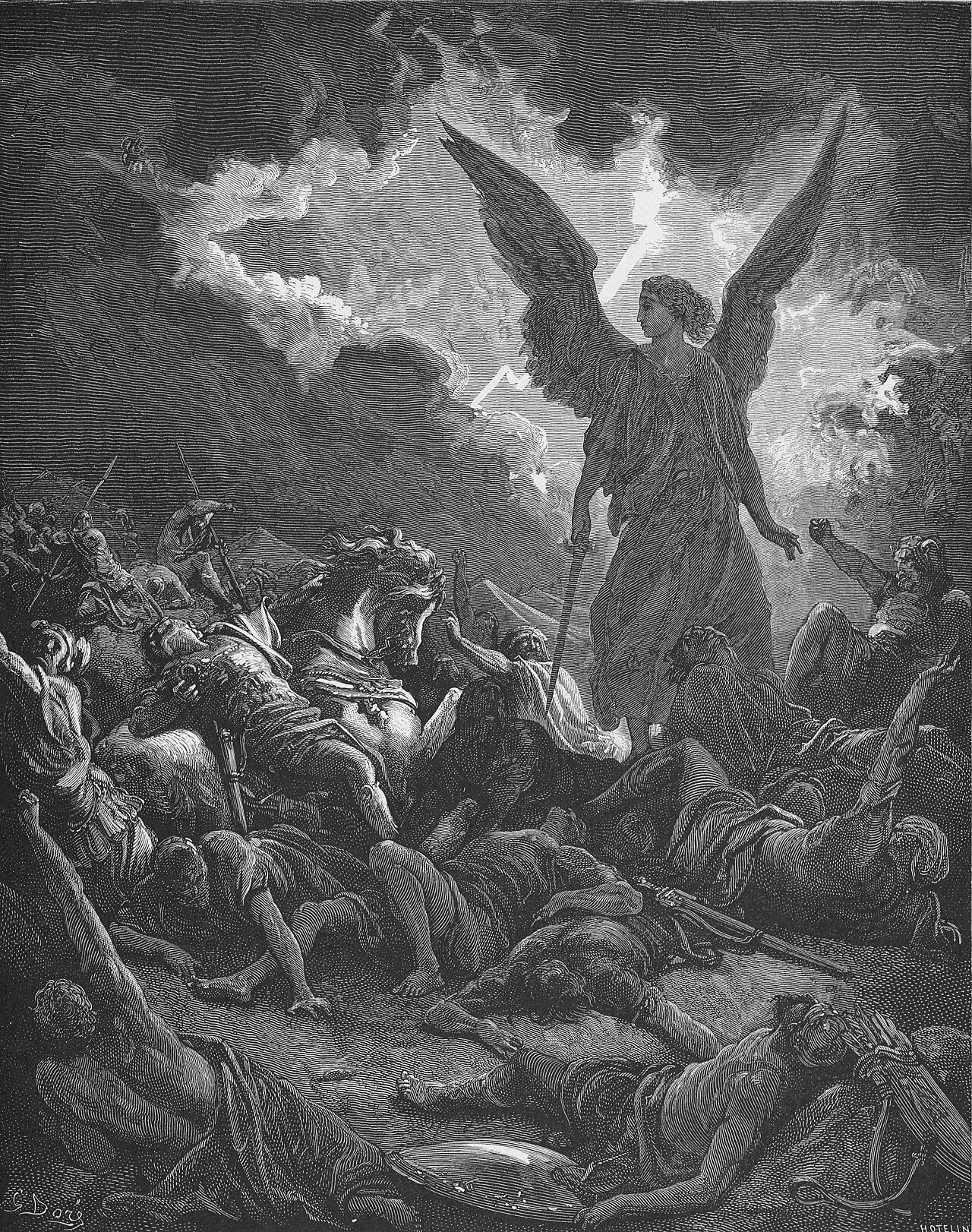
Hezekiah rends his clothes, covers himself with sackcloth, goes into the house of Jehovah, and sends to Isaiah: the day, he says, when the children are come to the birth and there is not strength to bring forth. Isaiah answers, be not afraid of the words wherewith Assyria's servants have blasphemed. When the threatening letter comes, Hezekiah spreads it before Jehovah and prays plainly: thou art the God, even thou alone, of all the kingdoms of the earth, and the gods Assyria burned were wood and stone. Isaiah's oracle mocks the boaster: 'I will put my hook in thy nose.' That night the angel of Jehovah smites a hundred and eighty-five thousand.
Context
History · Jeremiah · 2 Kings overview
The world behind this chapter
2 Kings 19The history
Hezekiah's response is formal and public. Torn clothes, sackcloth, and a walk up to the house of the LORD, with a delegation sent to Isaiah. When the threatening letter arrives he spreads it open before the LORD, physically laying the document out in the temple. Presenting a written grievance before a god was a recognised act in the ancient world, and the picture has held ever since.
The rest of the history, and what it meant to them
The Assyrian letter uses the standard royal boasting of the period, including cutting down the tallest cedars of Lebanon and drying up the streams of Egypt with the soles of his feet. Assyrian kings really did record these phrases, so the taunt is quoted accurately.
Tirhakah of Cush, who marched out against Sennacherib, was a Nubian prince of Egypt's twenty-fifth dynasty who later became pharaoh. The text calls him by the title he held when the account was written, which is ordinary ancient practice.
The sign given is agricultural and precise. This year and next they will eat what grows of itself, and in the third year they will sow and reap. That describes two lost planting seasons in a country whose fields had been trampled by an invading army, and it assumes the land will still be theirs to sow.
Then a hundred and eighty-five thousand die in the camp in one night. Herodotus preserves an Egyptian tradition that field mice ruined the Assyrians' bowstrings and shield straps before a battle at Pelusium, which many read as a garbled memory of a plague, since rodents carry it. The text itself names the angel of the LORD and gives no natural mechanism, so the plague reading stands as a proposed mediating cause. Sennacherib went home to Nineveh and was murdered twenty years later by his own sons at worship, an event Babylonian sources also record.
What it meant to them
The prayer is the heart of it. Hezekiah asks for deliverance so that all the kingdoms of the earth may know that the LORD alone is God, and he puts that reason ahead of his own safety.
For the first hearers, and especially for those reading in exile a century later, this chapter answered the question their own ruins raised. Their God had emptied a larger army in a single night when he chose to, so the fall of the city in 586 BC had some other cause than his weakness.
Sources cited
- The Taylor Prism of Sennacherib (Assyrian annals, c. 691 BC)
- Herodotus, The Histories , Book II, 141
- K. A. Kitchen, On the Reliability of the Old Testament
Where the chapter sits
2 Kings 19 falls in Hezekiah and the Assyrian crisis (chapters 18–20). Hezekiah's reforms; Nehushtan destroyed; Sennacherib's threat and the 185,000 dead; Isaiah's intervention; the backward shadow; the Babylonian envoys.
The 185,000. Hezekiah spreads the letter before the LORD; Isaiah's oracle; the angel of the LORD in the Assyrian camp.
Before it: Northern kingdom's fall, chapters 14–17. After it: Manasseh, Josiah, and the fall of Jerusalem, chapters 21–25.
The whole shape of 2 Kings→The structure of this chapter
Threads running through this chapter
- The lamp for David's sakePattern, v. 34
The heads below are this chapter's scenes. The numbered points under each are its verses.
A. Sackcloth in the house of Jehovah; Isaiah's answer
1. (vv. 1-3)
2 Kings 19:1
“Hezekiah, like his officers, probably rent his clothes on account of Rab-shakeh’s blasphemies: and he put on sackcloth in self-humiliation and in grief. The only hope left was in Yahweh, for Egypt could not be trusted to effect anything of importance. Rab-shakeh’s boldness had told upon Hezekiah. He was dispirited and dejected. He perhaps began to doubt whether he had done right in yielding to the bolder counsels of Eliakim and Isaiah. He had not lost his faith in God; but his faith was being severely tried. He wisely went and strove by prayer to strengthen it.”
2 Kings 19:2
“To Isaiah the prophet - His fame and influence were at this time great in Israel; and it was well known that the word of the Lord was with him. Here both the Church and the state unite in fervent application to, and strong dependence upon, God; and behold how they succeed!”
Adam Clarke· Commentary on the Bible (1810-1826)evangelical
2 Kings 19:3
The “trouble” consisted in rebuke” (rather, “chastisement,”) for sins at the hand of God, and “blasphemy” (rather, “reproach,”) at the hands of man. The children ... - i. e., “we are in a fearful extremity - at the last gasp - and lack the strength that might carry us through the danger.”
rent his clothes, and covered himself: Hezekiah's answer to Rabshakeh's blasphemy is torn clothes, sackcloth, and the house of the Lord rather than a council of war. He sends Eliakim, Shebna and the elders of the priests, themselves covered in sackcloth, to Isaiah instead of answering Sennacherib himself. His message names the crisis in the image of a birth with no strength left to finish it, a king admitting that the nation cannot deliver itself.
2. (vv. 4-7)
2 Kings 19:4
“The remnant that are left - That is, the Jews; the ten tribes having been already carried away captive by the kings of Assyria.”
Adam Clarke· Commentary on the Bible (1810-1826)evangelical
1 more voice on this verse
2 Kings 19:4
“We have begun an happy reformation, and are hindered by this insolent Assyrian, from bringing it to perfection. For the remnant - For Judah, which is but a remnant, now the ten tribes are gone: for Jerusalem, which is but a remnant, now the defensed cities of Judah are taken.”
John Wesley· Explanatory Notes upon the Old Testament (1765)evangelical
2 Kings 19:6
“God interested himself in the cause: They have blasphemed me. He encouraged Hezekiah, who was much dismayed: Be not afraid of the words which thou hast heard; they are but words (though swelling and fiery words), and words are but wind.”
Matthew Henry· Commentary on the Whole Bible (1707-1721)puritan
1 more voice on this verse
2 Kings 19:6
“The blast, the rumor, the fall by the sword, contained a brief prediction that was soon fulfilled in all the three particulars--namely, the alarm that hastened his retreat, the destruction that overtook his army, and the violent death that suddenly ended his career.”
Jamieson, Fausset & Brown· Commentary Critical and Explanatory on the Whole Bible (1871)reformed
2 Kings 19:7
“Will send a blast upon him - Rather, “I will put a spirit in him “ - i. e., “I will take from him his present pride and will put in him a new spirit, a spirit of craven fear.” Men shall tell him of the destruction that has come upon his host 2Ki 19:35, and he shall straightway return, etc.”
reproach the living God: Hezekiah's plea leans on one title, the living God, set against gods of wood and stone, and asks Isaiah to lift up prayer for the remnant that are left, the same remnant word that returns at verse 30. Isaiah's answer through the servants is short: be not afraid, God has already heard the blasphemy for himself. The oracle promises a rumour that sends Sennacherib home and a sword that finds him there, the first half fulfilled by verse 8 and the second not until verse 37.
B. A second letter: let not thy God deceive thee
1. (vv. 8-9)
2 Kings 19:8
“Libnah - Lachish - These two places were not very distant from each other; they were in the mountains of Judah, southward of Jerusalem.”
Adam Clarke· Commentary on the Bible (1810-1826)evangelical
2 Kings 19:9
“Tirhakah king of Ethiopia - The Tehrak or Teharka of the hieroglyphics. He was the last king of the 25th or Ethiopian dynasty, which commenced with Shebek or Sabaco, and he reigned upward of 26 years. The Assyrian inscriptions show that he still ruled in Egypt as late as 667 B.C., when Esarhaddon 2Ki 19:37 died, and his son Asshur-bani-pal succeeded him. He probably ascended the Egyptian throne about 692 B.C., having previously ruled over Ethiopia before he became king of Egypt (compare Isa 37:9).”
2 more voices on this verse
2 Kings 19:9
“Sennacherib sent a letter to Hezekiah, a railing letter, a blaspheming letter, to persuade him to surrender Jerusalem, because it would be to no purpose for him to think of standing it out. His letter is to the same purport with Rabshakeh's speech; there is nothing new offered in it.”
Matthew Henry· Commentary on the Whole Bible (1707-1721)puritan
2 Kings 19:9
“He was a powerful monarch, another Sesostris, and both he and Sabaco have left many monuments of their greatness. The name and figure of Tirhakah receiving war captives, are still seen in the Egyptian temple of Medinet Abou. This was the expected succor which was sneered at by Rab-shakeh as "a bruised reed" (2Ki 18:21).”
Jamieson, Fausset & Brown· Commentary Critical and Explanatory on the Whole Bible (1871)reformed
warring against Libnah: Rabshakeh's return finds the king already pulled off Lachish and warring at Libnah, the first half of Isaiah's rumour already moving before the oracle is even given in full. Tirhakah king of Ethiopia is the second half, a Cushite-backed Egyptian force Sennacherib must now answer, and Assyrian records name a campaign against Egypt at Eltekeh in this same period. Sennacherib sends messengers a second time rather than an army, and the letter that follows repeats his speech in writing.
2. (vv. 10-13)
2 Kings 19:10
“Let not thy God in whom thou trustest - This letter is nearly the same with the speech delivered by Rab-shakeh. See 2Ki 18:29.”
Adam Clarke· Commentary on the Bible (1810-1826)evangelical
2 Kings 19:11
“All lands - This boast is in strict accordance with the general tenor of the Assyrian inscriptions. Hyperbole is the general language of the East; but in this instance it was not so extreme as in some others. The Assyrians under Sargon and Sennacherib had enjoyed an uninterrupted series of military successes: they had succeeded in establishing their pre-eminence from the Median desert to the banks of the Nile, and from the shores of Lake Van to those of the Persian Gulf.”
2 Kings 19:12
“Haran - Harran, the Carrhae of the Greeks and Romans Gen 11:31, was among the earliest conquests of the Assyrians; being subject to them from the 12th century. Its conquest would have naturally followed that of Gozan (Gauzanitis, 2Ki 17:6), which lay between it and Assyria proper. Rezeph - Probably the Rozappa of the Assyrian inscriptions, a city in the neighborhood of Haran. The children of Eden - Or, “the Beni-Eden,” who appear from the Assyrian inscriptions to have inhabited the country on the east bank of the Euphrates, about the modern Balis.”
2 Kings 19:13
“Compare the marginal reference 2Ki 17:24. 2Ki 19:12 refers to former Assyrian successes, 2Ki 19:13 to comparatively recent ones.”
Let not thy God in whom thou trustest deceive thee: The second message repeats Rabshakeh's argument in the king's own name, naming city after conquered city, Gozan, Haran, Rezeph, Hamath, Arpad, Sepharvaim, so that Judah's God is filed among the local deities none of them saved. The list is the whole of Sennacherib's theology: every nation's god has failed against Assyria, so this one will fail too. The letter never allows that Israel's God might not be one more national god among the gods of Gozan and Haran, and that is precisely the ground Hezekiah's prayer stands on at verse 15.
C. Hezekiah spreads the letter out before Jehovah
1. (v. 14)
2 Kings 19:14
“Spread it before the Lord - The temple was considered to be God’s dwelling-place; and that whatever was there was peculiarly under his eye. Hezekiah spread the letter before the Lord, as he wished him to read the blasphemies spoken against himself.”
Adam Clarke· Commentary on the Bible (1810-1826)evangelical
spread it before the Lord: Hezekiah carries the letter itself into the temple and lays it open before the Lord, a king answering a written threat with a physical hand-off rather than a speech of his own. No army is summoned at this point, only a document carried up the temple stairs. The scene has stood for centuries as the plain instruction to bring a trouble into God's presence rather than only speak of it there.
2. (vv. 15-19)
2 Kings 19:15
“Which dwellest between the cherubims - The reference is to the shechinah, or miraculous glory, which from time to time appeared above the mercy-seat from between the two cherubims, whose wings overshadowed the ark of the covenant (1Ki 6:23-27; compare Exo 25:22; Lev 16:2, etc.). Thou art the God, even thou alone - This is the protest of the pure theist against the intense polytheism of Sennacherib’s letter, which assumes that gods are only gods of particular nations, and that Hezekiah’s God is but one out of an indefinite number, no stronger or more formidable than the rest.”
2 Kings 19:16
“Here it is under his own hand; here it is in black and white." Had Hezekiah only been abused, he would have passed it by; but it is God, the living God, that is reproached, the jealous God.”
Matthew Henry· Commentary on the Whole Bible (1707-1721)puritan
2 Kings 19:17
“But those are deceived who think they can therefore be too hard for him. He is none of the gods whom men's hands have made, but he has himself made all things, Ps. cxv.”
Matthew Henry· Commentary on the Whole Bible (1707-1721)puritan
2 Kings 19:18
“Have cast their gods into the fire - In general the Assyrians carried off the images of the gods from the temples of the conquered nations, and deposited them in their own shrines, as at once trophies of victory and proof of the superiority of the Assyrian deities over those of their enemies. But sometimes the gods are said to have been “destroyed” or “burnt with fire;” which was probably done when the idols were of rude workmanship or coarse material; and when it was inconvenient to encumber an army with spoils so weighty and difficult, of transport.”
2 Kings 19:19
“If the mighty army of the great Assyrian king were successfully defied by a petty monarch like Hezekiah, it would force the surrounding nations to confess that the escape was owing to the protecting hand of Yahweh. They would thus be taught, in spite of themselves, that He, and He alone, was the true God.”
which dwellest between the cherubims: The prayer opens where the ark sits, between the cherubims, and moves at once to a universal claim, thou art the God, even thou alone, of all the kingdoms of the earth, the exact claim Sennacherib's letter had just denied. Hezekiah quotes the letter's own language back to God, the reproach, the gods of wood and stone cast into the fire, and asks deliverance for a reason beyond his own safety, that all the kingdoms of the earth may know that thou art the Lord God, even thou only. The prayer answers Assyria's argument with theology rather than force: the nations' gods failed because they never existed, not because Assyria is stronger than every god there is.
D. Isaiah's taunt-song: I will put my hook in thy nose
1. (v. 20)
That which thou hast prayed to me: Isaiah's answer confirms the prayer was heard before a word of the oracle that follows is spoken, so the long poem of verses 21 through 34 arrives as the Lord's own reply read back to the king who prayed it. The prophet is named in full, the son of Amoz, and the formula thus saith the Lord God of Israel answers Sennacherib's letter claim for claim.
2. (v. 21)
The virgin the daughter of Zion: Jerusalem is pictured as a virgin daughter, untouched, mocking the king who boasted of taking every fenced city he approached, and daughter of Zion becomes Isaiah's standing poetic name for the city across his later chapters. The mockery runs directly against Sennacherib's own claim to be irresistible: this city alone has shaken her head at him and gone unharmed.
3. (vv. 22-24)
2 Kings 19:22
“The Holy One of Israel - This is a favorite phrase with Isaiah, in whose prophecies it is found 27 times, while it occurs five times only in the rest of Scripture Psa 71:22; Psa 78:41; Psa 89:18; Jer 50:29; Jer 51:5. Its occurrence here is a strong proof - one among many - of the genuineness of the present passage, which is not the composition of the writer of Kings, but an actual prophecy delivered at this time by Isaiah.”
2 Kings 19:23
“Lebanon - An high hill, famous for cedars and fir-trees. Cut down - I will cut down the trees that hinder my march, and plane the way for my numerous army and chariots. Lodgings - Those cities (which he calls lodgings in way of contempt) which are in his utmost borders.”
John Wesley· Explanatory Notes upon the Old Testament (1765)evangelical
1 more voice on this verse
2 Kings 19:23
“And hast said - Isaiah clothes in words the thoughts of Sennacherib’s heart - thoughts of the most extreme self-confidence. Compare Isa 10:7-14, where, probably at an earlier date, the same overweening pride is ascribed to this king. With the multitude of my chariots - There are two readings here, which give, however, nearly the same sense. The more difficult and more poetical of the two is to be preferred.”
2 Kings 19:24
“I have dipped and drunk strange waters - I have conquered strange countries, in which I have digged wells for my army; or, I have gained the wealth of strange countries. With the sole of my feet - My infantry have been so numerous that they alone have been sufficient to drink up the rivers of the places I have besieged.”
Adam Clarke· Commentary on the Bible (1810-1826)evangelical
even against the Holy One of Israel: The Holy One of Israel is Isaiah's own signature title for God, used across his book far more than any other prophet uses it, and it turns Sennacherib's boasting into blasphemy aimed at a named person rather than at an abstraction. The king's own words are quoted back at him, felling the cedars of Lebanon, entering the forest of his Carmel, the same mountain where a different contest had already been settled by fire in 1 Ki 18. Assyrian royal inscriptions do record kings boasting of cutting Lebanon's cedar for building projects, so the oracle answers Sennacherib in language his own scribes actually used.
4. (vv. 25-26)
2 Kings 19:25
“Hast thou not heard long ago ... - Rather, “Hast thou not heard, that from long ago I did this, from ancient times I fashioned it? etc.” The former part of the verse refers to the secret divine decrees, whereby the affairs of this world are determined and ordered from the very beginning of things. Sennacherib’s boasting, however, proved that he did not know this, that he did not recognize himself simply as God’s instrument - “the rod of His anger” Isa 10:5 - but regarded his victories as gained by his own “strength and wisdom” Isa 10:13.”
2 Kings 19:26
“The weakness of the nations exposed to the Assyrian attacks was as much owing to the divine decrees as was the strength of the Assyrians themselves. The grass on the house tops - Compare the marginal reference. The vegetation on the flat roofs of Oriental houses is the first to spring up and the first to fade away.”
of ancient times that I have formed it?: The oracle turns Sennacherib's own career into evidence against him: his conquests were not his own genius but a plan formed long ago and only now brought to pass, the same doctrine Isaiah states elsewhere of Assyria as a rod in another hand. The nations he flattened are pictured as grass on the housetops, green for a morning and scorched before it can grow, an image that answers the king's claim to unstoppable strength with a plant that never had a root.
5. (vv. 27-28)
2 Kings 19:27
“I know - Though thou dost not know me, yet I throughly know thee, and all thy designs and actions, all thy secret contrivances in the place of thy abode, in thy own kingdom and court; and the execution of thy designs abroad, what thou intendest in thy going out, and with what farther thoughts thou comest in, or returnest to thy own land.”
John Wesley· Explanatory Notes upon the Old Testament (1765)evangelical
2 Kings 19:28
“I will put my hook in thy nose - This seems to be an allusion to the method of guiding a buffalo; he has a sort of ring put into his nose, to which a cord or bridle is attached, by which he can be turned to the right, or to the left, or round about, according to the pleasure of his driver.”
Adam Clarke· Commentary on the Bible (1810-1826)evangelical
thy going out, and thy coming in: God's claim to know Sennacherib's abode, going out and rage answers the king's own boast of knowing every road in the region: everything Sennacherib claims to survey, he is himself already known by. The hook in the nose and the bridle in the lips are an animal's furniture, the same imagery Scripture uses of Leviathan at Job 41 and of Egypt's own king at Ezek 29:4, and here it turns Assyria's proud advance into a beast being led back the way it came.
6. (vv. 29-31)
2 Kings 19:29
“The prophet now once more addresses Hezekiah, and gives him a “sign,” or token, whereby he and his may be assured that Sennacherib is indeed bridled, and will not trouble Judaea anymore. It was a sign of the continued freedom of the land from attack during the whole of the remainder of Sennacherib’s reign - a space of 17 years.”
2 Kings 19:30
“The remnant - shall yet again take root - As your corn shall take root in the soil, and bring forth and abundantly multiply itself, so shall the Jewish people; the population shall be greatly increased, and the desolations occasioned by the sword soon be forgotten.”
Adam Clarke· Commentary on the Bible (1810-1826)evangelical
2 Kings 19:31
“Out of Jerusalem shall go forth a remnant - The Jews shall be so multiplied as not only to fill Jerusalem, but all the adjacent country. And they that escape out of Mount Zion - Some think that this refers to the going forth of the apostles to the Gentile world, and converting the nations by the preaching of the Gospel.”
Adam Clarke· Commentary on the Bible (1810-1826)evangelical
1 more voice on this verse
2 Kings 19:31
“Great destruction had been made both in city and country, bit in both there was a remnant that escaped, which typified the saved remnant of Israelites indeed (as appears by comparing Isa. x. 22, 23 , which speaks of this very event, with Rom. ix. 27, 28 ), and they shall go forth into the glorious liberty of the children of God.”
Matthew Henry· Commentary on the Whole Bible (1707-1721)puritan
such things as grow of themselves: The sign given to Hezekiah personally covers two years of eating what the land produces on its own, most likely because the Assyrian withdrawal still leaves the fields untended through one more season, and a third year of ordinary sowing once the danger has fully passed. The remnant taking root downward and bearing fruit upward answers the grass-on-housetops picture already used against Assyria's own transience, and the sign closes with the zeal of the Lord of hosts, the same phrase Isaiah uses again at 9:7 for the child who sits on David's throne.
7. (vv. 32-33)
2 Kings 19:32
“He shall not, etc. - Here follow the fullest proofs that Jerusalem shall not be taken by the Assyrians. 1. He shall not come into this city; 2. He shall not be able to get so near as to shoot an arrow into it; 3. He shall not be able to bring an army before it, 4. Nor shall he be able to raise any redoubt or mound against it; 5. No; not even an Assyrian shield shall be seen in the country; not even a foraging party shall come near the city.”
Adam Clarke· Commentary on the Bible (1810-1826)evangelical
2 Kings 19:33
“By the way that he came - i. e., through the low country of the Shephelah, thus avoiding not only Jerusalem, but even Judaea.”
1 more voice on this verse
2 Kings 19:33
“So determined was this invader to conquer Judah and the neighboring countries (Isa 10:7), that nothing but a divine interposition could have saved Jerusalem.”
Jamieson, Fausset & Brown· Commentary Critical and Explanatory on the Whole Bible (1871)reformed
nor shoot an arrow there: The oracle promises a siege that never happens, no arrow, no shield wall, no earthen bank thrown against the wall, the standard Assyrian siege technique Kings elsewhere describes in detail. Sennacherib's own Taylor Prism inscription boasts of shutting Hezekiah up like a caged bird in Jerusalem but never claims the city fell, a silence that fits the oracle's promise as evidence rather than as proof, since an inscription is naturally silent about a failure. The king who came the way of every other city returns the same way he came, exactly as verse 33 states.
8. (v. 34)
2 Kings 19:34
“33 By the way that he came, by the same shall he return, and shall not come into this city, saith the L ORD . 34 For I will defend this city, to save it, for mine own sake, and for my servant David's sake. We have here the gracious copious answer which God gave to Hezekiah's prayer.”
Matthew Henry· Commentary on the Whole Bible (1707-1721)puritan
1 more voice on this verse
2 Kings 19:34
“For mine own sake - God’s honor was concerned to defend His own city against one who denied His power in direct terms, as did Sennacherib 2Ki 18:35; 2Ki 19:10-12. His faithfulness was also concerned to keep the promise made to David Psa 132:12-18.”
for my servant David’s sake: The chapter's engine surfaces by name here: the deliverance is granted not for Judah's own righteousness but for mine own sake, and for my servant David's sake, the same covenant clause running from 1 Ki 11:12-13 through 2 Ki 8:19 to this verse. Hezekiah, whom 18:5 already ranks above every king before or after him, is still saved on David's account and not his own, which is the argument the whole book keeps making about grace running under merit. The phrase reaches its stated height here and the deliverance that follows makes it concrete.
E. A hundred fourscore and five thousand, and a sword in Nisroch's temple
1. (v. 35)
2 Kings 19:35
“The camp of the Assyrians - Which was now moved to Pelusium, if we may trust Herodotus; or which, at any rate, was at some considerable distance from Jerusalem. When they arose early in the morning, behold ... - These words form the only trustworthy data that we possess for determining to any extent the manner of the destruction now worked. They imply that there was no disturbance during the night, no alarm, no knowledge on the part of the living that their comrades were dying all around them by thousands.”
1 more voice on this verse
2 Kings 19:35
“Since the evil spirits have no power, they play as on a stage, changing their shapes and frightening children by the apparition of crowds and by their changed forms. This is why they are to be despised the more for their powerlessness. The true angel sent by the Lord against the Assyrians had no need of crowds or apparitions from without, or loud noises or clappings, but he used his power quietly and destroyed 185,000 at one time. Powerless demons such as these, however, try to frighten, if only by empty phantoms.”
Athanasius of Alexandria· written before 373· LIFE OF ST. ANTHONY 28.9-10patristic
an hundred fourscore and five thousand: Isa 37:36 preserves this verse word for word, one deliverance recorded twice in Scripture in two different books, and the number stands with no natural explanation offered by the text itself. The angel of the Lord acting as a destroyer recalls the same figure who struck Egypt's firstborn and who later stands over Jerusalem with a drawn sword in 1 Chr 21, judgment and deliverance carried by the same office. No siege engine, no arrow, no bank of earth accomplishes what verses 32 and 33 said would not happen; a single night ends the campaign instead.
2. (v. 36)
2 Kings 19:36
“So Sennacherib king of Assyria . . . went and returned--the same way as he came (2Ki 19:33). The route is described (Isa 10:28-32). The early chariot track near Beyrout is on the rocky edge of Lebanon, which is skirted by the ancient Lycus (Nahr-el Kelb).”
Jamieson, Fausset & Brown· Commentary Critical and Explanatory on the Whole Bible (1871)reformed
1 more voice on this verse
2 Kings 19:36
“Dwelt at Nineveh - The meaning is not that Sennacherib made no more expeditions at all, which would he untrue, for his annals show us that he warred in Armenia, Babylonia, Susiana, and Cilicia, during his later years; but that he confined himself to his own part of Asia, and did not invade Palestine or threaten Jerusalem anymore. Nineveh, marked by some ruins opposite Mosul, appears here unmistakably as the Assyrian capital, which it became toward the close of the 9th century B.C. It has previously been mentioned only in Genesis (marginal reference).”
and dwelt at Nineveh: The blast promised at verse 7 and the return promised at verse 33 both land in one plain sentence: Sennacherib withdraws to his own capital and stays there. Nineveh remained his seat for the rest of his reign, which Assyrian records confirm on their own account, the same city Jonah had earlier preached to and the city Nahum's whole book announces the fall of.
3. (v. 37)
2 Kings 19:37
“The death of Sennacherib, which took place many years afterward (680 B.C.), is related here, as, from the divine point of view, the sequel to his Syrian expeditions. Nisroch his god - Nisroch has not been as yet identified with any known Assyrian deity. The word may not be the name of a god at all but the name of the temple, as Josephus understood it. Assyrian temples were almost all distinguished by special names.”
1 more voice on this verse
2 Kings 19:37
“Justly is his blood mingled with his sacrifices, since he will not be convinced by such a plain and dear-bought demonstration of his folly in worshipping idols. His sons that murdered him were suffered to escape, and no pursuit was made after them, his subjects perhaps being weary of the government of so proud a man and thinking themselves well rid of him.”
Matthew Henry· Commentary on the Whole Bible (1707-1721)puritan
smote him with the sword: The sword promised at verse 7, that he would fall by the sword in his own land, arrives some twenty years later while Sennacherib is at worship, killed by his own sons in his own god's house. Babylonian and Assyrian records name Esarhaddon's accession after a succession crisis and broadly support an assassination, though the court details differ between sources, evidence the page can state honestly without forcing full agreement. The man who mocked every god that failed to protect its worshippers dies unprotected by the one he was bowing to when the blow fell, and Esarhaddon his son reigns in his stead.
This page carries no textual note on 2 Kings 19. Where this site has examined a place the manuscripts differ, the examination is in the manuscripts room. Every place this site examines →
Keep studying
On this page
Sources for this chapter
The summary
Jamieson, Fausset & Brown, Commentary Critical and Explanatory; John Wesley, Notes on the Old Testament and Matthew Henry, Complete Commentary.
The context
Keil, The Books of the Kings and Matthew Henry, Commentary on the Whole Bible.
The exposition
Adam Clarke, Commentary on the Bible; Albert Barnes, Notes on the Old Testament; Alfred Edersheim, Bible History: Old Testament; F. W. Farrar, The Second Book of Kings (Expositor's Bible); Jamieson Fausset and Brown, Commentary Critical and Explanatory on the Whole Bible; John Gill, Exposition of the Old Testament; John Wesley, Explanatory Notes upon the Old Testament; Keil, The Books of the Kings and Matthew Henry, Commentary on the Whole Bible.