
2 Kings 19:35
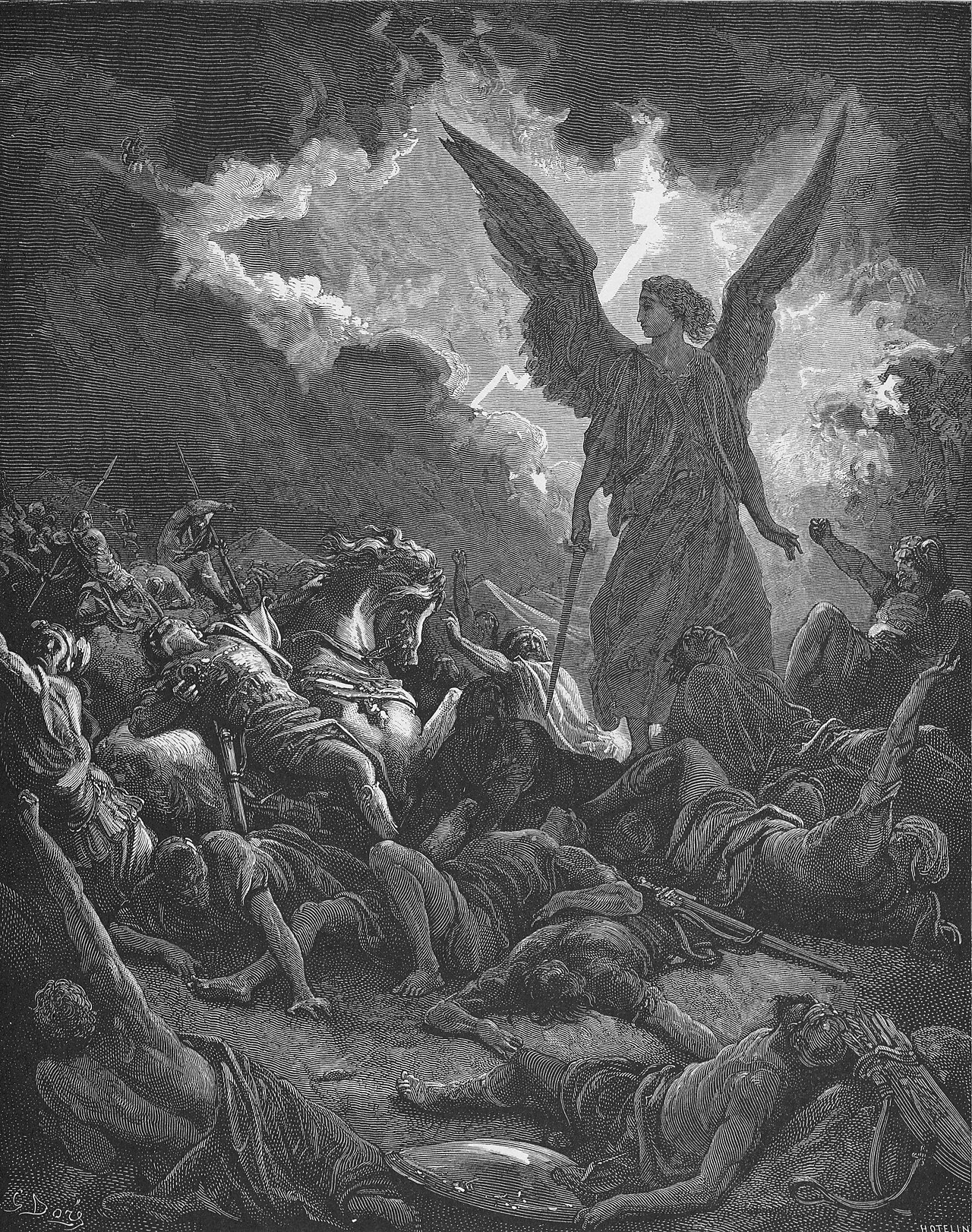
in 2 Kings 19And that very night the angel of the LORD went out and struck down 185,000 men in the camp of the Assyrians. When the people got up the next morning, there were all the dead bodies!
BSB
The same verse in ASV and KJV ▾
ASV
And it came to pass that night, that the angel of Jehovah went forth, and smote in the camp of the Assyrians a hundred fourscore and five thousand: and when men arose early in the morning, behold, these were all dead bodies.
KJV
And it came to pass that night, that the angel of the Lord went out, and smote in the camp of the Assyrians an hundred fourscore and five thousand: and when they arose early in the morning, behold, they were all dead corpses.
⋯
This verse in 2 Kings 19
Commentary
10 notes on this verseSince the evil spirits have no power, they play as on a stage, changing their shapes and frightening children by the apparition of crowds and by their changed forms. This is why they are to be despised the more for their powerlessness. The true angel sent by the Lord against the Assyrians had no need of crowds or apparitions from without, or loud noises or clappings, but he used his power quietly and destroyed 185,000 at one time. Powerless demons such as these, however, try to frighten, if only by empty phantoms.
This site's exposition
the angel of the LORD went out
Isaiah 37:36 preserves this verse word for word, and the text offers no natural explanation. The figure of "the angel of the LORD" as destroyer recalls the one who struck Egypt's firstborn and stands over Jerusalem in 1 Chronicles 21. Judgment and deliverance are carried by one office.
The record, by era
The Church Fathers2 voices
Faith unguarded is armed by God. Hezekiah, through the power of faith, proved stronger with his puny force than Sennacherib, king of Babylon and rich Nineveh, with his thousands. Sennacherib had enlisted the forces of Assyria and the realm of the Medes. Laying waste with …
A commentator
John ChrysostomDISCOURSES AGAINST JUDAIZING CHRISTIANS 6.3.6-7 · Written before 407.
proposed
But the Jews will say, "Where is the evidence that God has turned away from us?" Does this still need proof in words? Tell me this. Do not the facts themselves shout it out? Do they not send forth a sound clearer than the trumpet's call? Do you still ask for proof in words when you see the destruction of your city, the desolation of your temple and all the other misfortunes that have come on you? "But people brought these things on us, not God." Rather it was God above all others who did these things. If you attribute them to people, then you must consider that even if people were to have the boldness, they would not have had the power to bring these things to accomplishment, unless it were by God's decree. The barbarian came down on you and brought all Persia with him. He expected that he would catch you all by the suddenness of his attack, and he kept you all locked in the city as if you were caught in the net of a hunter or fisherman. Because God was gracious to you at the time—I repeat, at that time—without a battle, without a war, without a hostile encounter, the barbarian king left 185,000 of his slain soldiers among you and fled, contented that he alone was saved. And God often decided countless other battles in this way. So also now, if God had not deserted you once and for all, your enemies would not have had the power to destroy your city and leave your temple desolate. If God had not abandoned you, the ruin of desolation would not have lasted so long a time, nor would your frequent efforts to rebuild the temple have been in vain.
The Medieval Church1 voice
A commentator
BonaventureCollations on the Hexaemeron, Collation 16 · Written in the 13th century.
proposed
In the sixth time, three events came about: the height of victory, of teaching, and of prophecy. The height of victory occurred with Sennacherib who rose against Jerusalem, and "an angel of the Lord slew a hundred and eighty-five thousand." Yet Ezechias was healed in …
The Puritans and the Awakening2 voices
It was not by the sword of a mighty man or of a mean man, that is, not of any man at all, but of an angel, that the Assyrians army was to fall ( Isa. xxxi.
quarantine:debris (2026-07-29) — unbalanced-parens
2 And he sent Eliakim, which was over the household, and Shebna the scribe, and the elders of the priests, covered with sackcloth, to Isaiah the prophet the son of Amoz. 3 And they said unto him, Thus saith Hezekiah, This day is a day of trouble, and of rebuke, and blasphemy: for the children are come to the birth, and there is not strength to bring forth.
quarantine:scripture (2026-07-29) — verbatim-scripture
3 more voices on this verse
The Nineteenth Century3 voices
A commentator
Albert Barnes1798–1870
Notes, Explanatory and Practical, on the Old and New Testaments (1832-1869)
The camp of the Assyrians - Which was now moved to Pelusium, if we may trust Herodotus; or which, at any rate, was at some considerable distance from Jerusalem. When they arose early in the morning, behold ... - These words form the only trustworthy data that we possess for determining to any extent the manner of the destruction now worked. They imply that there was no disturbance during the night, no alarm, no knowledge on the part of the living that their comrades were dying all around them by thousands.
A commentator
Jamieson, Fausset & Brown1802–1910
Commentary Critical and Explanatory on the Whole Bible (1871)
proposed
in the morning . . . they were all dead corpses--It was the miraculous interposition of the Almighty that defended Jerusalem. As to the secondary agent employed in the destruction of the Assyrian army, it is most probable that it was effected by a hot south wind, the simoon, such as to this day often envelops and destroys whole caravans.
quarantine:debris (2026-07-29) — starts-lowercase
That night - The very night after the blasphemous message had been sent, and this comfortable prophecy delivered. The angel of the Lord went out - I believe this angel or messenger of the Lord was simply a suffocating or pestilential Wind; by which the Assyrian army was destroyed, as in a moment, without noise confusion or any warning. See the note 1Ki 20:30. Thus was the threatening, 2Ki 19:7, fulfilled, I will send a Blast upon him; for he had heard the rumor that his territories were invaded; and on his way to save his empire, in one night the whole of his army was destroyed, without any one even seeing who had hurt them. This is called an angel or messenger of the Lord: that is, something immediately sent by him to execute his judgments. When they arose early - That is, Sennacherib, and probably a few associates, who were preserved as witnesses and relaters of this most dire disaster. Rab-shakeh, no doubt, perished with the rest of the army.
The words behind it
19 Hebrew wordsEvery Hebrew word of this verse in the order it stands, with what it means and the door to its own study. The last column counts the times a word stands in the whole Bible: the rarer the word, the more the places it appears belong together.
| Hebrew | Sound | Meaning | Word study | In the Bible |
|---|---|---|---|---|
| וַיְהִי֮ | vayhi | and it was | H1961 → | 3559 times |
| בַּלַּ֣יְלָה | balaylah | in the night | H3915 → | 233 times |
| הַהוּא֒ | hahu' | <the> that | H1931 → | 1879 times |
| וַיֵּצֵ֣א׀ | vaiyetze' | and he went out | H3318 → | 1067 times |
| מַלְאַ֣ךְ | malakh | [the] angel of | H4397 → | 213 times |
| יְהוָ֗ה | yahweh | Yahweh | H3068 → | 6520 times |
| וַיַּךְ֙ | vaiyakh | and he struck down | H5221 → | 499 times |
| בְּמַחֲנֵ֣ה | bemachaneh | in [the] camp of | H4264 → | 215 times |
| אַשּׁ֔וּר | ʾashur | Assyria | H804 → | 151 times |
| מֵאָ֛ה | meah | one hundred | H3967 → | 581 times |
| שְׁמוֹנִ֥ים | shemonim | eighty | H8084 → | 38 times |
| וַחֲמִשָּׁ֖ה | vachamishah | and five | H2568 → | 343 times |
| אָ֑לֶף | ʾalef | thousand | H505 → | 505 times |
| וַיַּשְׁכִּ֣ימוּ | vaiyashkimu | and they rose early | H7925 → | 65 times |
| בַבֹּ֔קֶר | vaboker | in the morning | H1242 → | 214 times |
| וְהִנֵּ֥ה | vehineh | and there! | H2009 → | 843 times |
| כֻלָּ֖ם | khulam | all of them | H3605 → | 5413 times |
| פְּגָרִ֥ים | pegarim | [were] corpses | H6297 → | |
| מֵתִֽים׃ | metim | dead | H4191 → | 839 times |
וַיְהִי֮and it was
vayhiH1961 →3559 times
בַּלַּ֣יְלָהin the night
balaylahH3915 →233 times
הַהוּא֒<the> that
hahu'H1931 →1879 times
וַיֵּצֵ֣א׀and he went out
vaiyetze'H3318 →1067 times
מַלְאַ֣ךְ[the] angel of
malakhH4397 →213 times
יְהוָ֗הYahweh
yahwehH3068 →6520 times
וַיַּךְ֙and he struck down
vaiyakhH5221 →499 times
בְּמַחֲנֵ֣הin [the] camp of
bemachanehH4264 →215 times
אַשּׁ֔וּרAssyria
ʾashurH804 →151 times
מֵאָ֛הone hundred
meahH3967 →581 times
שְׁמוֹנִ֥יםeighty
shemonimH8084 →38 times
וַחֲמִשָּׁ֖הand five
vachamishahH2568 →343 times
אָ֑לֶףthousand
ʾalefH505 →505 times
וַיַּשְׁכִּ֣ימוּand they rose early
vaiyashkimuH7925 →65 times
בַבֹּ֔קֶרin the morning
vabokerH1242 →214 times
וְהִנֵּ֥הand there!
vehinehH2009 →843 times
כֻלָּ֖םall of them
khulamH3605 →5413 times
פְּגָרִ֥ים[were] corpses
pegarimH6297 →
מֵתִֽים׃dead
metimH4191 →839 times
A shaded row is a word that stands 400 times or fewer in the Bible.
The walk
8 stopsEach card is a verse this one points to, and under it the verses that one points to in turn. Where several paths arrive at the same place, that place is listed first: the text keeps returning to it.
Through
Isaiah 37:36Then the angel of the LORD went out and struck down 185,000 men in the camp of the Assyrians. When the people got up the next morning, there were all the dead bodies!
it leads to
- Isaiah 10:12
So when the Lord has completed all His work against Mount Zion and Jerusalem, He will say, “I will punish the king of Assyria for the fruit of his arrogant heart and the proud…
- 2 Samuel 24:16
But when the angel stretched out his hand to destroy Jerusalem, the LORD relented from the calamity and said to the angel who was destroying the people, “Enough! Withdraw your hand now!” At that…
- Isaiah 31:8
“Then Assyria will fall, but not by the sword of man; a sword will devour them, but not one made by mortals. They will flee before the sword, and their young men will be…
- 1 Thessalonians 5:2–3
For you are fully aware that the Day of the Lord will come like a thief in the night.
- Isaiah 10:33–34
Behold, the Lord GOD of Hosts will lop off the branches with terrifying power. The tall trees will be cut down, the lofty ones will be felled.
- Isaiah 10:12
Through
2 Samuel 24:16But when the angel stretched out his hand to destroy Jerusalem, the LORD relented from the calamity and said to the angel who was destroying the people, “Enough! Withdraw your hand now!” At that…
it leads to
- Exodus 12:23
When the LORD passes through to strike down the Egyptians, He will see the blood on the top and sides of the doorframe and will pass over that doorway; so He will not allow…
- Joel 2:13–14
So rend your hearts and not your garments, and return to the LORD your God. For He is gracious and compassionate, slow to anger, abounding in loving devotion. And He relents from sending disaster.
- Genesis 6:6
And the LORD regretted that He had made man on the earth, and He was grieved in His heart.
- Exodus 12:23
Where this verse is studied
On this page
Studies5
On this verse
About 2 Kings
This page draws on 9 works. Open the list of works
This page draws on Adam Clarke, Commentary on the Bible; Albert Barnes, Notes on the Old Testament; Albert Barnes, Notes, Explanatory and Practical, on the Old and New Testaments (1832-1869); Athanasius of Alexandria, LIFE OF ST. ANTHONY 28.9-10; Bonaventure, Collations on the Hexaemeron, Collation 16; Jamieson, Fausset & Brown, Commentary Critical and Explanatory on the Whole Bible; John Chrysostom, DISCOURSES AGAINST JUDAIZING CHRISTIANS 6.3.6-7; Matthew Henry, Commentary on the Whole Bible and Paulinus of Nola, POEMS 26.166-95.