
2 Kings 19:7
in 2 Kings 19Behold, I will put a spirit in him so that he will hear a rumor and return to his own land, where I will cause him to fall by the sword.’”
BSB
The same verse in ASV and KJV ▾
ASV
Behold, I will put a spirit in him, and he shall hear tidings, and shall return to his own land; and I will cause him to fall by the sword in his own land.
KJV
Behold, I will send a blast upon him, and he shall hear a rumour, and shall return to his own land; and I will cause him to fall by the sword in his own land.
⋯
This verse in 2 Kings 19
Commentary
5 notes on this verseA commentator
Albert Barnes1798–1870
Notes, Explanatory and Practical, on the Old and New Testaments (1832-1869)
Will send a blast upon him - Rather, “I will put a spirit in him “ - i. e., “I will take from him his present pride and will put in him a new spirit, a spirit of craven fear.” Men shall tell him of the destruction that has come upon his host 2Ki 19:35, and he shall straightway return, etc.
This site's exposition
reproach the living God
on 2 Kings 19:4-7
Hezekiah's plea leans on one title, the living God, set against gods of wood and stone, and asks Isaiah to lift up prayer for the remnant that are left, the same remnant word that returns at verse 30. Isaiah's answer through the servants is short: be not afraid, God has already heard the blasphemy for himself. The oracle promises a rumour that sends Sennacherib home and a sword that finds him there, the first half fulfilled by verse 8 and the second not until verse 37.
The record, by era
The Puritans and the Awakening2 voices
God interested himself in the cause: They have blasphemed me. He encouraged Hezekiah, who was much dismayed: Be not afraid of the words which thou hast heard; they are but words (though swelling and fiery words), and words are but wind.
), one would think, was an answer sufficient to his prayer; but, that he might have strong consolation, he was encouraged by two immutable things, in which it was impossible for God to lie, Heb. vi. In general, God assured him that his prayer was heard, his prayer against Sennacherib,
quarantine:debris (2026-07-29) — leading-punctuation+unbalanced-parens
The Nineteenth Century1 voice
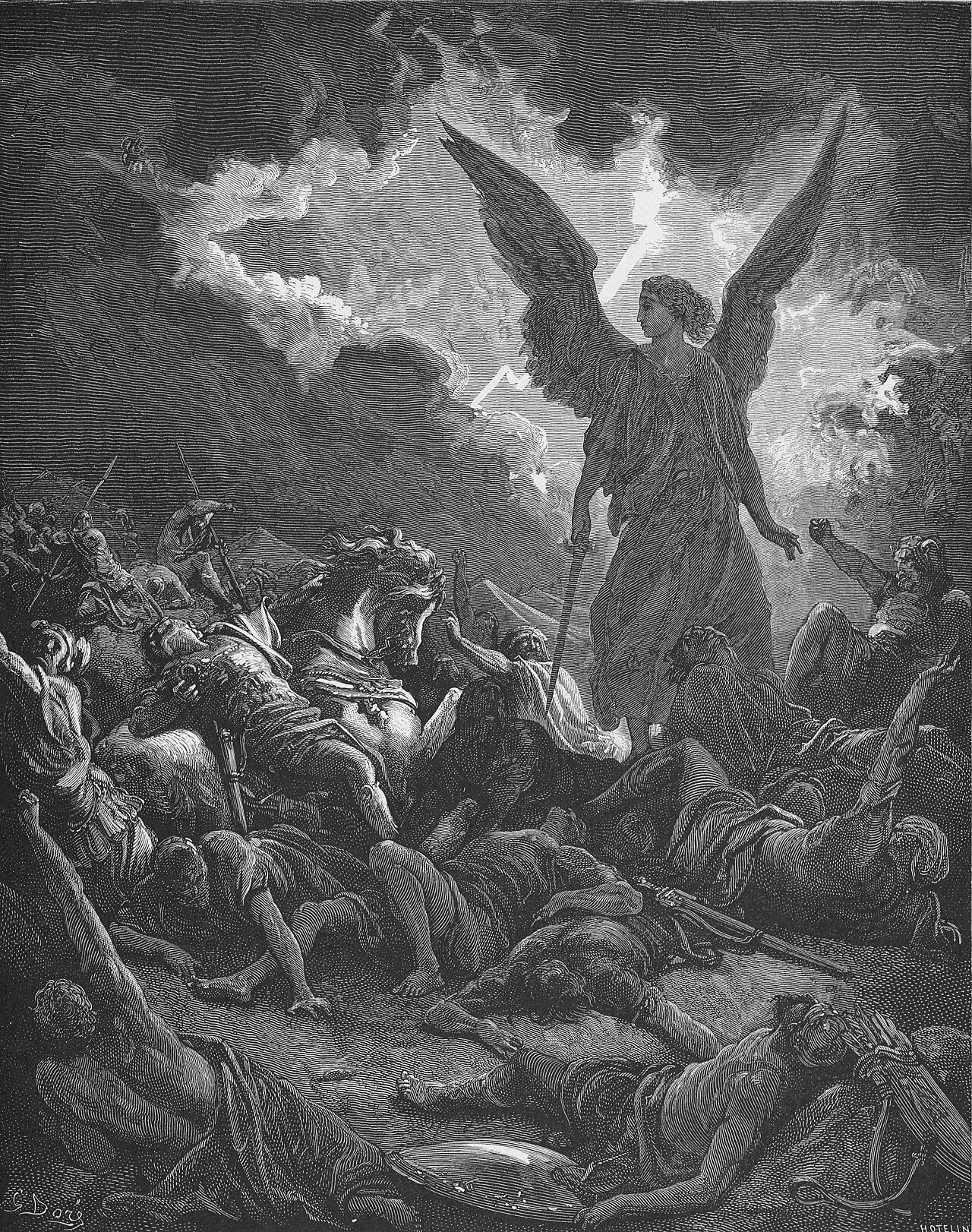
Behold, I will send a blast - and he shall hear a rumor - The rumor was, that Tirhakah had invaded Assyria. The blast was that which slew one hundred and eighty-five thousand of them in one night, see 2Ki 19:35. Cause him to fall by the sword - Alluding to his death by the hands of his two sons, at Nineveh. See 2Ki 19:35-37.
The words behind it
11 Hebrew wordsEvery Hebrew word of this verse in the order it stands, with what it means and the door to its own study. The last column counts the times a word stands in the whole Bible: the rarer the word, the more the places it appears belong together.
| Hebrew | Sound | Meaning | Word study | In the Bible |
|---|---|---|---|---|
| הִנְנִ֨י | hini | here I | H2005 → | 316 times |
| נֹתֵ֥ן | noten | [am] about to put | H5414 → | 2011 times |
| בּוֹ֙ | bo | in him | ||
| ר֔וּחַ | ruach | a spirit | H7307 → | 378 times |
| וְשָׁמַ֥ע | veshama' | and he will hear | H8085 → | 1159 times |
| שְׁמוּעָ֖ה | shemuah | a report | H8052 → | |
| וְשָׁ֣ב | veshav | and he will return | H7725 → | 1056 times |
| לְאַרְצ֑וֹ | leartzo | to own land his | H776 → | 2504 times |
| וְהִפַּלְתִּ֥יו | vehipaltiv | and I will make fall him | H5307 → | 435 times |
| בַּחֶ֖רֶב | bacherev | by the sword | H2719 → | 413 times |
| בְּאַרְצֽוֹ׃ | beartzo | in own land his | H776 → | 2504 times |
הִנְנִ֨יhere I
hiniH2005 →316 times
נֹתֵ֥ן[am] about to put
notenH5414 →2011 times
בּוֹ֙in him
bo
ר֔וּחַa spirit
ruachH7307 →378 times
וְשָׁמַ֥עand he will hear
veshama'H8085 →1159 times
שְׁמוּעָ֖הa report
shemuahH8052 →
וְשָׁ֣בand he will return
veshavH7725 →1056 times
לְאַרְצ֑וֹto own land his
leartzoH776 →2504 times
וְהִפַּלְתִּ֥יוand I will make fall him
vehipaltivH5307 →435 times
בַּחֶ֖רֶבby the sword
bacherevH2719 →413 times
בְּאַרְצֽוֹ׃in own land his
beartzoH776 →2504 times
A shaded row is a word that stands 400 times or fewer in the Bible.
The walk
8 stopsEach card is a verse this one points to, and under it the verses that one points to in turn. Where several paths arrive at the same place, that place is listed first: the text keeps returning to it.
Through
Isaiah 11:4but with righteousness He will judge the poor, and with equity He will decide for the lowly of the earth. He will strike the earth with the rod of His mouth and slay the…
it leads to
- 2 Thessalonians 2:8
And then the lawless one will be revealed, whom the Lord Jesus will slay with the breath of His mouth and annihilate by the majesty of His arrival.
- Revelation 19:15
And from His mouth proceeds a sharp sword with which to strike down the nations, and He will rule them with an iron scepter. He treads the winepress of the fury of the wrath…
- Proverbs 31:8–9
Open your mouth for those with no voice, for the cause of all the dispossessed.
- Job 4:9
By the breath of God they perish, and by the blast of His anger they are consumed.
- Malachi 4:6
And he will turn the hearts of the fathers to their children, and the hearts of the children to their fathers. Otherwise, I will come and strike the land with a curse.”
- 2 Thessalonians 2:8
Through
2 Kings 7:6For the Lord had caused the Arameans to hear the sound of chariots, horses, and a great army, so that they said to one another, “Look, the king of Israel must have hired the…
it leads to
- 2 Samuel 5:24
As soon as you hear the sound of marching in the tops of the balsam trees, move quickly, because this will mean that the LORD has marched out before you to strike the camp…
- Isaiah 31:1
Woe to those who go down to Egypt for help, who rely on horses, who trust in their abundance of chariots and in their multitude of horsemen. They do not look to the Holy…
- 1 Kings 10:29
A chariot could be imported from Egypt for six hundred shekels of silver, and a horse for a hundred and fifty. Likewise, they exported them to all the kings of the Hittites and to…
- 2 Samuel 5:24
Where this verse is studied
On this page
Studies1
About 2 Kings
This page draws on Adam Clarke, Commentary on the Bible; Albert Barnes, Notes, Explanatory and Practical, on the Old and New Testaments (1832-1869); John Gill, Exposition of the Old Testament; Keil, The Books of the Kings and Matthew Henry, Commentary on the Whole Bible.