
1 Kingschapter 22
53 verses · Jeremiah, by tradition · 6th century BC · History
Key verse
And he said, Hear thou therefore the word of the Lord: I saw the Lord sitting on his throne, and all the host of heaven standing by him on his right hand and on his left.
It stands in Micaiah, whom the king hates, sees a lying spirit in heaven, verses 13 to 28.
The chapter
Chapter summary
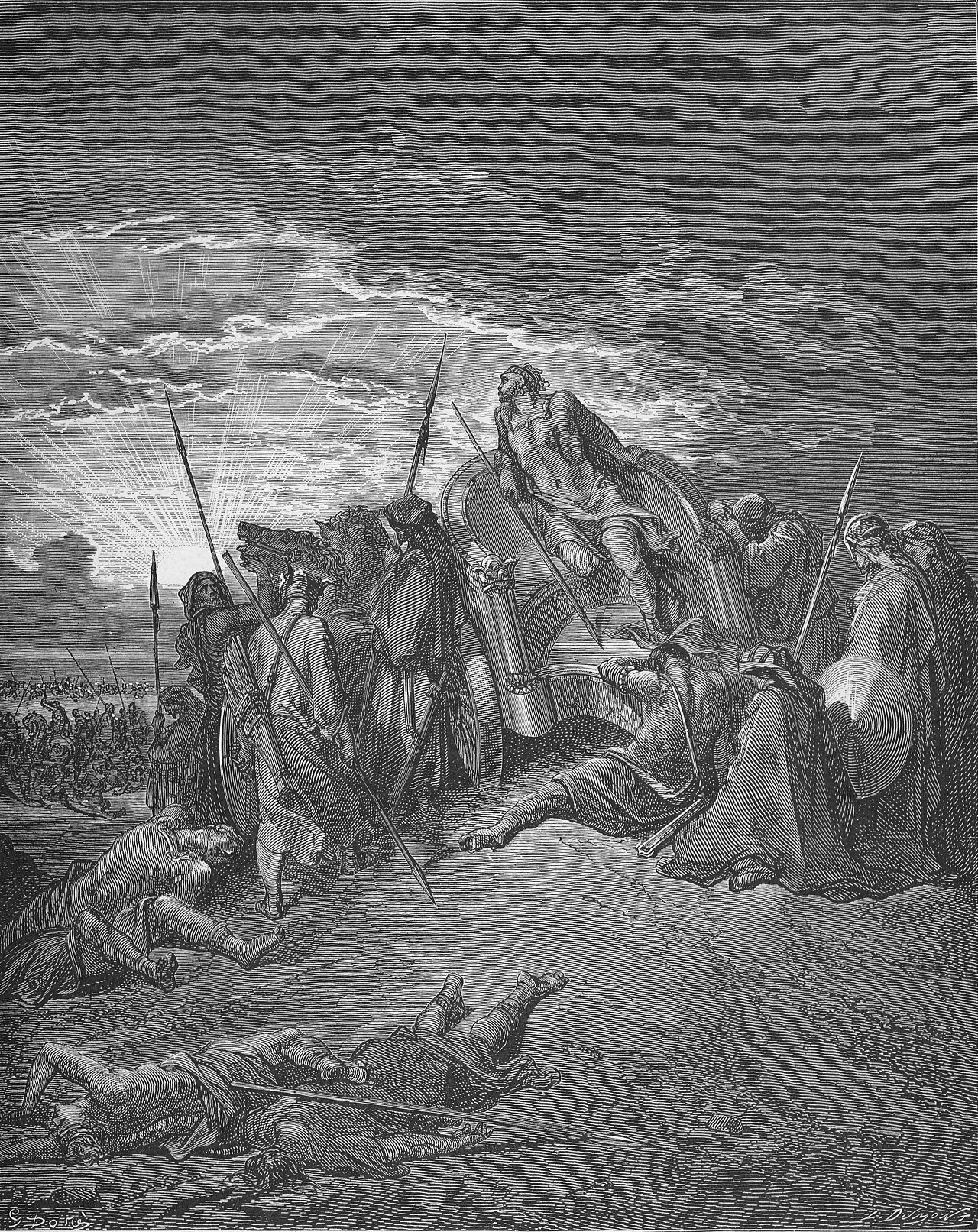
After three years of peace Jehoshaphat joins Ahab against Ramoth-gilead, asking first for a word from Jehovah. Four hundred prophets say go up; Jehoshaphat asks for one more, and Ahab names Micaiah: 'I hate him; for he doth not prophesy good concerning me, but evil.' Micaiah first mimics the chorus, then tells the truth: 'I saw all Israel scattered upon the mountains, as sheep that have no shepherd,' and behind it a heavenly council and a lying spirit in the mouth of the prophets. Struck by Zedekiah and jailed, he is vindicated: Ahab disguises himself, but an arrow drawn 'at a venture' finds the joint of the armor. Dogs lick his blood at the pool of Samaria.
Context
History · Jeremiah · 1 Kings overview
The world of this chapter
- Who
- Israelites who had heard four hundred prophets agree and one man disagree
- Where
- The threshing floor by the gate of Samaria, and the battlefield at Ramoth-gilead east of the Jordan
- When
- The death of Ahab, and the close of the scroll's first half. 853 BC, the one date in this range fixed from outside the biblical text
Historical context
The chapter belongs to Micaiah son of Imlah, a prophet the king kept and hated, and to Ahab and Jehoshaphat of Judah, who go to war as allies.
The time is fixed by Assyrian records rather than by the text. In 853 BC Shalmaneser III fought a western coalition at Qarqar on the Orontes, and the Kurkh Monolith names Ahab of Israel among its members. The three years of peace between Israel and Aram were the years both faced a larger threat.
The places are Samaria and Ramoth-gilead, a city east of the Jordan that Ben-Hadad's terms at 20:34 should have restored and never did.
The occasion is a consultation before a campaign, since Jehoshaphat asks first for the word of the LORD.
A first hearer knew the setting was staged, with the two kings in their robes on thrones at the threshing floor by the city gate, the flat open ground where crowds gathered. Zedekiah's iron horns are a standard prophetic sign act, borrowing the bull's horns of Deuteronomy 33:17.
He also knew how armour failed, since scale armour was made of overlapping metal plates sewn to a coat and the joints were its weak point.
The last thirteen verses file two reigns in the book's fixed order, from the accession dated by the rival king's year to the acts filed to the chronicles.
Significance
The first hearers learned to count differently. Four hundred voices said go up and prosper, one said he saw Israel scattered like sheep without a shepherd, and the one was right.
They also learned that a disguise does not outrun a word. The arrow was shot by a man who was aiming at no one, into the one gap in the armour of the one man in the field who was dressed as nobody.
Where the chapter sits
1 Kings 22 falls in Divided kingdom and Elijah (chapters 13–22). The man of God from Judah; Ahijah's oracle to Jeroboam's wife; the parade of kings evaluated in formulaic regnal summaries. Elijah arrives in ch. 17 and dominates through Carmel (18), Horeb (19), Naboth's vineyard (21), and the LORD's word that stands against four hundred false prophets (22).
Micaiah and the false prophets. ‘Smote Micaiah upon the cheek’; Ahab dies at Ramoth-gilead.
Before it: Division at Shechem, chapters 12.
The whole shape of 1 Kings→The structure of this chapter
The heads below are this chapter's scenes. The numbered points under each are its verses.
Four hundred prophets and a pair of iron horns
continued three years without war: The truce with Syria runs the three years Ahab's covenant with Ben-hadad bought him after chapter 20, and into it Jehoshaphat of Judah comes down to Samaria, the visit that opens the chapter's alliance. The two kingdoms that split at Jeroboam sit at peace with each other while both remain at odds with the Lord in different ways.
1 Kings 22:1
“And they continued three years without war between Syria and Israel. From the time that Benhadad made a covenant with Ahab; not three full years, but part of them: it was threatened by Elijah from the Lord, that Ahab's life should go for Benhadad's, because he had let him, go, 1Ki 22:42, but because of his humiliation, as is thought by Ben Gersom and others, it was respited for those three years; and now an opportunity and occasion would be given for the fulfilment of what was threatened.”
1 Kings 22:2
“This visit indicates an entire change in the relations which we have hitherto found subsisting between the kingdoms of Israel and Judah. The common danger to which the two kingdoms were exposed from the growing power of Syria had probably induced them to forget their differences. Jehoshaphat’s eldest son, Jehoram, was married to Athaliah, the daughter of Ahab: but apparently the bond between the two families had not hitherto led to any very close intimacy, much less to any joint military expeditions.”
Ramoth in Gilead is ours: Ahab presses a claim on Ramoth-gilead, a city Ben-hadad's terms should have restored and never did, and Jehoshaphat answers with the formula of full alliance, I am as thou art, my people as thy people, my horses as thy horses. The same sentence returns almost word for word at 2 Ki 3:7 when Jehoshaphat joins Jehoram against Moab, a partnership the house of David keeps making with the house of Omri.
1 Kings 22:3
By the terms of Ahab’s covenant with Ben-hadad, Ramoth in Gilead ought, long ere this, to have been restored 1Ki 20:34. Hence, the claim “is ours,” i. e., “it belongs to us of right though the Syrians still hold possession of it.”
1 Kings 22:4
“This affair being lately canvassed at the council board, and very much on Ahab's mind, he puts this question to Jehoshaphat, his visitor, relation, and ally; wisely considering that his own forces were small, and that to have such an auxiliary might be of great advantage to him: and Jehoshaphat said to the king of Israel, I am as thou art, my people as thy people, my horses as thy horses; meaning, that he and his soldiers, foot and horse, were at his service.”
3 more voices on this verse
1 Kings 22:4
“Wilt thou go with me - We find that there was a good understanding between Jehoshaphat and Ahab, which no doubt was the consequence of a matrimonial alliance between the son of the former, Jehoram, and the daughter of the latter, Athaliah; see 2Ch 18:1; 2Ki 8:18. This coalition did not please God, and Jehoshaphat is severely reproved for it by Jehu the seer, 2Ch 19:1-3.”
Adam Clarke· Commentary on the Bible (1810-1826)evangelical
1 Kings 22:4
“It is desirable to have an interest in those that have an interest in heaven, and to have those with us that have God with them. But it is strange that Jehoshaphat will go so entirely into Ahab's interests as to say, I am as thou art, and my people as thy people. Jehoshaphat and his people are not so wicked and corrupt as Ahab and his people.”
Matthew Henry· Commentary on the Whole Bible (1707-1721)puritan
1 Kings 22:4
“Ahab, well aware of the military strength of Syria, and feeling that he cannot now expect divine aid 1Ki 20:42; 1Ki 21:21, asks the aid of Jehoshaphat, whose military resources were very great 2Ch 17:12-19. Jehoshaphat’s answer is one of complete acquiescence, without reserve of any kind (compare 2Ch 18:3). Jehoshaphat was afterward rebuked for thus consenting to “help the ungodly” 2Ch 19:2. He probably acted not merely from complaisance, but from a belief that the interests of his own kingdom would be advanced by the step which he agreed to take.”
Enquire, I pray thee, at: Jehoshaphat asks first for the word of the Lord, and Ahab produces four hundred men who answer as one voice, Go up, for the Lord shall deliver it into the hand of the king. Their unanimity is the tell rather than the proof: court prophets salaried by a king tend to say what the king wants said, the same pattern Elijah's contest at Carmel had already exposed.
1 Kings 22:5
“And Jehoshaphat said unto the king of Israel, inquire, I pray thee, at the word of the Lord today. Being a pious and religious prince, he did not choose to go into a war at once, without consulting the Lord by his prophets, whether it was his will and pleasure they should engage in it, and should prosper; and he was desirous of having this done immediately, before they proceeded any further.”
2 more voices on this verse
1 Kings 22:5
Jehoshaphat, with characteristic piety 1Ki 22:43 takes advantage of his position as Ahab’s friend and ally, to suggest inquiry of the Lord (Yahweh) before the expedition is undertaken. Lest Ahab should consent in word and put off the inquiry in act, he asks to have the prophets called in at once: “today.”
1 Kings 22:5
“Whithersoever a good man goes he desires to take God along with him, and will acknowledge him in all his ways, ask leave of him, and look up to him for success. Whithersoever a good man goes he ought to take his religion along with him, and not be ashamed to own it, no, not when he is with those who have no kindness for it.”
Matthew Henry· Commentary on the Whole Bible (1707-1721)puritan
1 Kings 22:6
“About four hundred men - These were probably the prophets of Asherah or Venus, maintained by Jezebel, who were not present at the contention on Mount Carmel. See 1Ki 18:19, etc.”
Adam Clarke· Commentary on the Bible (1810-1826)evangelical
a prophet of the Lord besides: Jehoshaphat's question implies he does not count the four hundred as prophets of the Lord in the sense he means, and Ahab's answer confirms it: one man remains, Micaiah the son of Imlah, whom I hate, for he doth not prophesy good concerning me, but evil. The king states his objection to truth-telling as plainly as Scripture ever records a man stating it.
1 Kings 22:8
“Micaiah the son of Imlah - The Jews suppose that it was this prophet who reproved Ahab for dismissing Ben-hadad, 1Ki 20:35, etc. And that it was because of the judgments with which he had threatened him, that Ahab hated him: I hate him, for he doth not prophesy good concerning me, but evil.”
Adam Clarke· Commentary on the Bible (1810-1826)evangelical
1 more voice on this verse
1 Kings 22:8
“One man - In this place, for whom I can speedily send: for there were also other prophets elsewhere in the kingdom, but these were not at hand. Micaiah - Not one of the twelve prophets, who lived about a hundred and fifty years after this time, but another of that name.”
John Wesley· Explanatory Notes upon the Old Testament (1765)evangelical
Hasten hither Micaiah the son: An officer is sent for Micaiah while the two kings take their seats in full royal robes at the gate of Samaria, a threshingfloor turned into a staged court with all the prophets performing before them. The scene is built for spectacle before Micaiah ever arrives.
1 Kings 22:9
“Then the king of Israel called an officer,.... An eunuch, as the word is sometimes used, one of pages: and said, hasten hither Micaiah the son of Imlah; who, as it seems from 1Ki 22:26 was in prison, where perhaps Ahab had cast him for his last prophecy to him, and where he had lain ever since; and this gives a reason why he could so readily send for him, knowing where he was.”
1 more voice on this verse
1 Kings 22:9
“An officer - More properly, as in the margin, “a eunuch.” Eunuchs seem to have been first introduced among the Israelites by David (1Ch 28:1 note). They were a natural accompaniment of the seraglio of Solomon. The present passage is the first which shows that, after the separation of the kingdom, the kings of Israel employed them (compare 2Ki 8:6; 2Ki 9:32).”
1 Kings 22:10
“Sat each on his throne - Or, “were sitting.” They had removed from the banquet 2Ch 18:2 to the void place, or empty space at the entrance of the gate Rth 4:1; 2Sa 15:2, where Ahab daily sat to hear complaints and decide causes. Each was seated upon his throne, the Oriental kings having portable thrones, which they took with them upon their journeys.”
made him horns of iron: Zedekiah's sign-act, horns of iron with which thou shalt push the Syrians, borrows Deut 33:17's picture of a bull's horns pushing the peoples, the same kind of enacted prophecy that Jeremiah's yoke and Ezekiel's brick later use. All four hundred prophesy the identical verdict, Go up to Ramoth-gilead, and prosper, a chorus that has already answered the king's question before Micaiah opens his mouth.
1 Kings 22:11
“Horns of iron - The horn in Scripture is the favorite symbol of power; and pushing with the horn is a common metaphor for attacking and conquering enemies (see Deu 33:17; Compare Psa 44:5; Dan 8:4). Zedekiah, in employing a symbolic action, was following the example of a former Israelite prophet 1Ki 11:30. Thus saith the Lord - Or, יהוה yehovâh. Zedekiah lays aside the unmeaningful “Lord” אדני 'ǎdonāy of the general company of Israelite prophets 1Ki 22:6, and professes to have a direct message from Yahweh to Ahab.”
1 Kings 22:12
“Unity is not always the mark of a true church and a true ministry. Here were 400 men that prophesied with one mind and one mouth, and yet all in an error. Jehoshaphat cannot relish this sort of preaching; it is not like what he was used to.”
Matthew Henry· Commentary on the Whole Bible (1707-1721)puritan
Micaiah, whom the king hates, sees a lying spirit in heaven
let thy word, I pray: The messenger sent to fetch Micaiah presses him to match the other four hundred before he has even spoken. Micaiah's answer sets the office in one sentence, As the Lord liveth, what the Lord saith unto me, that will I speak, the same oath by which Balaam once bound himself in Num 22:18 and 24:13 against a king's pressure to bless what should not be blessed.
1 Kings 22:13
“And the messenger spake unto him ... - There seems to have been a widespread notion among the irreligious and the half-religious of the ancient world, that their prophets were not the mere mouth-pieces of the god, but that they were persons who had power with the god, and could compel, or at least induce, Him to work their will (compare Num 24:10; Isa 30:10). They saw that the prophet’s word was accomplished; they did not understand that if he falsified his message the accomplishment would no longer follow.”
1 Kings 22:14
“Micaiah, as a true prophet of Yahweh, of course rejected the counsel offered him, which he felt to be at once wicked and foolish. Compare also the resolution of Balaam, marginal reference.”
shall we forbear? And he: Micaiah's first answer, Go, and prosper: for the Lord shall deliver it into the hand of the king, repeats the four hundred word for word. Ahab, who wanted this answer from anyone else, recognizes mimicry rather than agreement and presses him again in the next verse.
1 Kings 22:15
“And he answered him ... - Micaiah speaks the exact words of the 400 in so mocking and ironical a tone, that the king cannot mistake his meaning, or regard his answer as serious. The king’s rejoinder implies that this mocking manner was familiar to Micaiah, who had used it in some former dealings with the Israelite monarch. Hence, in part, the king’s strong feeling of dislike (compare 1Ki 22:8).”
adjure thee that thou tell: Once Ahab demands the truth in the name of the Lord, Micaiah gives it: I saw all Israel scattered upon the hills, as sheep that have not a shepherd, an image whose earlier occurrence at Num 27:17 is Moses pleading for a successor so the congregation will not be left without one. Here the shepherdless flock is the army Ahab is about to lead to Ramoth-gilead without him.
1 Kings 22:17
“I saw all Israel scattered upon the hills, as sheep that have not a shepherd--The purport of this was that the army of Israel would be defeated and dispersed; that Ahab would fall in the battle, and the people return without either being pursued or destroyed by the enemy.”
Jamieson, Fausset & Brown· Commentary Critical and Explanatory on the Whole Bible (1871)reformed
1 more voice on this verse
1 Kings 22:17
“Thus adjured, Micaiah wholly changes his tone. Ahab cannot possibly mistake the meaning of his vision, especially as the metaphor of “sheep and shepherd” for king and people was familiar to the Israelites from the prayer of Moses Num 27:17.”
Did I not tell thee: Ahab's aside to Jehoshaphat, Did I not tell thee that he would prophesy no good concerning me, but evil, judges the man's reputation rather than weighing what he has just said. It is the verdict of a king who wanted a favorable word more than a true one, and who had already decided against Micaiah before the vision came.
1 Kings 22:18
“Did I not tell thee that he would prophesy no good concerning me, but evil?--Since Ahab was disposed to trace this unwelcome truth to personal enmity, Micaiah proceeded fearlessly to tell the incensed monarch in full detail what had been revealed to him. The Hebrew prophets, borrowing their symbolic pictures from earthly scenes, described God in heaven as a king in His kingdom.”
Jamieson, Fausset & Brown· Commentary Critical and Explanatory on the Whole Bible (1871)reformed
I saw the Lord sitting: Micaiah answers Ahab's contempt with a second vision, the Lord sitting on his throne with the host of heaven standing on his right hand and on his left, weighing who shall persuade Ahab to go up and fall at Ramoth-gilead. The scene is court imagery, and readers differ on how far to press its literalness: some take it as a true throne-room disclosure shown to the prophet, others as a dramatic form clothing a judgment already settled, and both readings are held without the page choosing between them.
1 Kings 22:19
“I saw - By the eyes of my mind: for he could not see the Lord with bodily eyes. The Host - The angels, both good and bad, the one possibly on his right, the other on his left hand. Nor is it strange that the devils are called the host of heaven; if you consider, first, that their original seat was in heaven.”
John Wesley· Explanatory Notes upon the Old Testament (1765)evangelical
1 more voice on this verse
1 Kings 22:19
“David’s Psalms had familiarised the Israelites with Yahweh sitting upon a throne in the heavens (Psa 9:7; Psa 11:4; Psa 45:6; Psa 103:19, etc.); but to be allowed to see in vision the ineffable glory of the Almighty thus seated, was a rare favor. It was granted to Isaiah, to Daniel (marginal references), to Ezekiel Eze 1:26, and in Christian times to Stephen Act 7:56, and John Rev 4:2.”
1 Kings 22:20
“Who shall - This is not to be grossly understood, as if God were at a loss to find out an expedient to accomplish his own will; but only to bring down divine things to our shallow capacities, and to express the various means which God hath to execute his own designs.”
John Wesley· Explanatory Notes upon the Old Testament (1765)evangelical
there came forth a spirit: A spirit volunteers to be a lying spirit in the mouth of all Ahab's prophets, and the Lord answers, Thou shalt persuade him, and prevail also: go forth, and do so. Commentators hold the scene two ways: some read the spirit as a real agent sent under divine judicial permission against a king who had already chosen to believe a flattering word (Keil), while others stress that the deceiving belongs to the spirit's own nature and God's part is to hand a self-deceived king over to the counsel he wanted (Henry). Both readings leave the Lord's justice intact, and Micaiah's own summary states the plain fact without settling how it works: the Lord hath put a lying spirit in the mouth of all these thy prophets.
1 Kings 22:21
A spirit - “The spirit “ - which some explain as “the evil spirit” - i. e. Satan; others as simply “the spirit” who should “persuade.”
1 more voice on this verse
1 Kings 22:21
“I think every evil and deceitful spirit is a lie, and whenever anyone of these speaks, it speaks from its own resources and by no means from the resources of God. And the father of these [spirits] is the liar, the devil. We will now present what moved us to say that every inferior spirit is false.”
Origen of Alexandria· written before 253· COMMENTARY ON THE GOSPEL OF JOHN 20.257-62patristic
1 Kings 22:22
“Go forth, and do so - This is no more than, “God has permitted the spirit of lying to influence the whole of thy prophets; and he now, by my mouth, apprises thee of this, that thou mayest not go and fall at Ramoth-gilead.” Never was a man more circumstantially and fairly warned; he had counsels from the God of truth, and counsels from the spirit of falsity; he obstinately forsook the former and followed the latter.”
Adam Clarke· Commentary on the Bible (1810-1826)evangelical
3 more voices on this verse
1 Kings 22:22
“He said - I will inspire a lie into the minds and mouths of his prophets. Thou shalt - I will give them up into thy hands, and leave them to their own ignorance and wickedness. Go - This is not a command, but only a permission.”
John Wesley· Explanatory Notes upon the Old Testament (1765)evangelical
1 Kings 22:22
“The difficulties which attach to this passage are considerable. On the one hand, it is hard to suppose one of the holy Angels a “lying spirit;” on the other, hard to find Satan, or an evil spirit, included among “the host of heaven” 1Ki 22:19 and acting as the minister of God. Still, Job 1:6; Job 2:1, lend countenance to the latter point, and 2Th 2:11 to the former. But it may be doubted whether we ought to take literally, and seek to interpret exactly, each statement of the present narrative.”
1 Kings 22:22
“And the Lord said unto him, wherewith?....”
1 Kings 22:23
“The Lord hath put a lying spirit - He hath permitted or suffered a lying spirit to influence thy prophets. Is it requisite again to remind the reader that the Scriptures repeatedly represent God as doing what, in the course of his providence, he only permits or suffers to be done? Nothing can be done in heaven, in earth, or hell, but either by his immediate energy or permission. This is the reason why the Scripture speaks as above.”
Adam Clarke· Commentary on the Bible (1810-1826)evangelical
smote Micaiah on the cheek: Zedekiah's blow and his taunt, Which way went the Spirit of the Lord from me to speak unto thee, assumes his own prophesying carried the Spirit and Micaiah's could not. Micaiah does not argue the point; he points forward instead, Behold, thou shalt see in that day, when thou shalt go into an inner chamber to hide thyself, a private reckoning promised for a public lie.
1 Kings 22:24
“Which way went the Spirit of the Lord from me - This is an expression of as great insolence as the act was of brutal aggression. “Did the Spirit of the Lord, who rests solely upon me, condescend to inspire thee? Was it at this ear [where he smote him] that it entered, in order to hold communion with thee?” Josephus tells an idle rabbinical tale about this business, which is as unworthy of repetition as it is of credit. See his Antiq. of the Jews, book viii., c. 10.”
Adam Clarke· Commentary on the Bible (1810-1826)evangelical
1 Kings 22:25
“And Micaiah said, behold, thou shalt see in the day when thou shalt go into an inner chamber to hide thyself. Who would either accompany Ahab to the battle, and, upon his being wounded, flee to the first place of secrecy for safety; or, upon the news of his defeat brought to Samaria, would betake himself to a private chamber for security, fearing the enemy would pursue to the very place; or else through fear of the populace, who would attribute the death of the king to the advice of him and the other prophets.”
carry him back unto Amon: Ahab orders Micaiah imprisoned on bread and water until I come in peace, and Micaiah stakes his whole office on the outcome: If thou return at all in peace, the Lord hath not spoken by me. It is the test Deut 18:22 sets for a true prophet, fulfillment or failure, and Micaiah calls the crowd itself to witness it before the battle rather than after: Hearken, O people, every one of you.
1 Kings 22:27
“Feed him with bread of affliction ... - Micaiah is to be once more put in prison, but, in order to punish him for his uncomplying spirit, upon a poorer and scantier diet than he had been previously allowed. This is to continue until Ahab returns in peace. Ahab introduces this expression purposely, in order to show his entire disbelief of Micaiah’s prophecy.”
1 more voice on this verse
1 Kings 22:27
“But by this it appeared that God had determined to destroy him, as 2 Chron. xxv. How confident is Ahab of success. He doubts not but he shall return in peace, forgetting what he himself had reminded Ben-hadad of, Let not him that girdeth on the harness boast; but there was little likelihood of his coming home in peace when he left one of God's prophets behind him in prison.”
Matthew Henry· Commentary on the Whole Bible (1707-1721)puritan
1 Kings 22:28
“And Micaiah said, if thou return at all in peace, the Lord hath not spoken by me,.... I am content to be reckoned a false prophet, and to be punished as such: and, he said, hearken, O people, everyone of you; he called aloud unto them to observe what he had predicted, and mark the issue of it, and to bear testimony for him, or against him, as things should be.”
1 more voice on this verse
1 Kings 22:28
“40 So Ahab slept with his fathers; and Ahaziah his son reigned in his stead. The matter in contest between God's prophet and Ahab's prophets is here soon determined, and it is made to appear which was in the right.”
Matthew Henry· Commentary on the Whole Bible (1707-1721)puritan
A disguise, an arrow drawn at a venture, dogs at the pool
went up to Ramoth–gilead: The two kings go up together, but Ahab disguises himself for the battle while asking Jehoshaphat to wear the royal robes, a plan that places the ally in the danger the word had named for the king. It reads as a man trying to outmaneuver a prophecy he has just heard and still refuses to believe.
1 Kings 22:29
“So the king of Israel, and Jehoshaphat the king of Judah, went up to Ramothgilead. Which, according to Bunting (r), was twenty four miles from Samaria.”
2 more voices on this verse
1 Kings 22:29
“It might have been expected that Jehoshaphat would have withdrawn from the expedition when he heard Micaiah denounce it. He had, however, rashly committed himself to take part in the war by a solemn promise, before he bethought himself of inquiring what was the will of God in the matter. Now he was ashamed to draw back, especially as Ahab, whom the prophecy chiefly threatened, was resolved to brave it. He may also have had a personal affection for Ahab, and so have been loth to desert him in his need. Compare 2Ch 19:2.”
1 Kings 22:29
“He was ready to give his opinion with the majority, and to conclude that it was 400 to one but they should succeed. Micaiah had not forbidden them to go; nay, at first, he said, Go, and prosper. If it came to the worst, it was only Ahab's fall that was foretold, and therefore Jehoshaphat hoped he might safely venture.”
Matthew Henry· Commentary on the Whole Bible (1707-1721)puritan
1 Kings 22:30
“I will disguise myself - Probably he had heard of the orders given by Ben-hadad to his thirty-two captains, to fight with the king of Israel only; that is, to make their most powerful attack where he commanded, in order to take him prisoner, that he might lead him captive whose captive he formerly was; and therefore he disguised himself that he might not be known. But put thou on thy robes - What is meant by this?”
Adam Clarke· Commentary on the Bible (1810-1826)evangelical
Fight neither with small nor: Syria's thirty and two captains are ordered to single out one man, the king of Israel, and the order nearly kills Jehoshaphat instead when his robes draw their chariots toward him and he cries out. Only when the captains see he is not Ahab do they turn back, and the disguise that was meant to shield the king has spent its danger on his ally first.
1 Kings 22:31
“Commanded - “Had commanded.” Ben-hadad delivers his order in the hyperbolical style common in the East. His meaning is, “Make it your chief object to kill or take the king of Israel.” Apparently, his own defeat and captivity were still rankling in his mind, and he wished to retaliate on Ahab, the humiliation which he considered himself to have suffered. He shows small appreciation of the generosity which had spared his life and restored him to his kingdom.”
1 Kings 22:32
“Surely it is the king of Israel - This was a natural supposition, as Jehoshaphat alone wore royal robes. And Jehoshaphat cried out - Jehoshaphat called to his men for help, using perhaps his own special battle-cry, which would be distinct from that of Ahab, and would probably be known to the Syrians.”
1 Kings 22:33
“And it came to pass, when the captains of the chariots perceived that it was not the king of Israel,.... Against whom only their orders were to fight: that they turned back from pursuing him; for upon so great a force coming upon him he could not withstand, he fled.”
drew a bow at a: An arrow shot without aim finds the one joint a disguise could not cover, and Ahab is held upright in his chariot through the day's fighting so the army will not scatter, dying only at even with the blood running into the chariot. The chance shot lands exactly where 21:19 and 22:20-22 had already said this reign would end.
1 Kings 22:34
“Drew a bow at a venture - It is supposed that he shot, as the archers in general did, not aiming at any person in particular. The word לתמו lethummo, which we translate in his simplicity, has been variously understood; in his integrity, his uprightness; in his perfection; i.e., to the utmost of his skill and strength. This is most probably the meaning; and may imply both aim and power, having his butt full in view.”
Adam Clarke· Commentary on the Bible (1810-1826)evangelical
1 more voice on this verse
1 Kings 22:34
“No armour is of proof against the darts of divine vengeance. Case the criminal in steel, and it is all one, he that made him can make his sword to approach him. That which to us seems altogether casual is done by the determinate counsel and fore-knowledge of God.”
Matthew Henry· Commentary on the Whole Bible (1707-1721)puritan
1 Kings 22:35
“The battle increased - See the margin; i. e. the tide of battle rose higher. Compare Isa 8:7-8. The king was stayed up in his chariot - The king’s wound made it impossible for him to remain standing without help; he therefore had himself supported in his chariot by attendants, in order that his soldiers might not lose heart, as they would be sure to do, if they knew of his peril. Ahab must not be denied the credit of right princely fortitude on this occasion. The midst of the chariot - literally, as in the margin.”
Every man to his city: The army disperses at sunset and Ahab is carried to Samaria for burial, and when his chariot is washed in the pool the dogs lick up his blood, the text closing the sentence with its own footnote, according unto the word of the Lord which he spake. The word is Elijah's, spoken over Ahab in the vineyard at 21:19, and the dogs-lick formula it fulfills runs back through Jeroboam's house at 14:11 and Baasha's at 16:4 before it reaches this king.
1 Kings 22:38
“And one washed the chariot in the pool of Samaria,.... After the body was taken out, very likely the chariot driver, who drove it into the pool, and plunged it into it, as the word signifies, to cleanse it from the blood of his master: and the dogs licked up his blood; mixed with the water of the pool; the Septuagint adds, "the swine", which is not probable, such creatures not being bred in the land of Israel: and they washed his armour; his coat of mail, through the joints of which the blood issued, and ran upon it.”
2 more voices on this verse
1 Kings 22:38
“The dogs licked up his blood - Some of the rabbins think that this was in the very place where Naboth was stoned; see on 1Ki 21:19 (note).”
Adam Clarke· Commentary on the Bible (1810-1826)evangelical
1 Kings 22:38
“Now Naboth's blood was avenged ( ch. xxi. 19 ), and that word of David, as well as Elijah's word, was fulfilled ( Ps. lxviii. 23 ), That thy foot may be dipped in the blood of thy enemies, and the tongue of thy dogs in the same.”
Matthew Henry· Commentary on the Whole Bible (1707-1721)puritan
the ivory house which he: The closing formula names Ahab's ivory house among his works, the same kind of luxury Amos 6:4 later condemns in Israel's houses of ivory, before the reign passes without further comment to his son Ahaziah. Twenty-two years end in one summary sentence and a burial.
1 Kings 22:39
“The ivory house - So called from the character of its ornamentation. Ivory was largely used in the ancient world as a covering of wood-work, and seems to have been applied, not only to furniture, but to the doors and walls of houses. Nothing is known of the cities built by Ahab; but the fact is important as indicating the general prosperity of the country in his time, and his own activity as a ruler.”
1 Kings 22:40
“So Ahab slept with his fathers, and Ahaziah his son reigned in his stead, Of whom more is said in the latter part of this chapter, and in the following book.”
Jehoshaphat's long reign; ships broken at Ezion-geber
began to reign over Judah: Jehoshaphat's record opens with the formula this book gives every king of Judah, judged against doing right in the eyes of the Lord, and his mother Azubah is named as every queen mother in this book is named. The same qualifier attached to nearly every good king before him is attached here too: the high places were not taken away, so the people still offered and burnt incense there.
1 Kings 22:41
“And Jehoshaphat the son of Asa began to reign over Judah in the fourth year of Ahab king of Israel. And as Ahab reigned twenty two years, 1Ki 16:29, Jehoshaphat must reign about eighteen years with him, and seven years after him.”
1 Kings 22:42
“Jehoshaphat was thirty five years old when he began to reign, and he reigned twenty and five years in Jerusalem,.... So that he must be sixty years of age when he died: and his mother's name was Azubah, the daughter of Shilhi; but of what family they were is not said.”
1 Kings 22:43
“On the general piety of Asa, see above, 1Ki 15:11-15 and references. Jehoshaphat seems to have been a still better king, for he did not, like Asa, fall away in his old age 2Ch 16:2-12. The high places were not taken away - This seems to contradict 2Ch 17:6. Probably the writer of Chronicles refers to the desire and intention of the monarch, while the author of Kings records the practical failure of his efforts.”
made peace with the king: Jehoshaphat's peace with Israel closes the war thread the chapter opened with, and the record is filed to the chronicles of Judah as every reign in this book is filed. One reform is credited to him plainly: the remnant of the sodomites his father Asa had begun removing at 15:12 he finishes taking out of the land.
1 Kings 22:44
“This refers probably to an early period in Jehoshaphat’s reign - about his eighth or his ninth year - when he closed the long series of wars between the two kingdoms by a formal peace, perhaps at once cemented by a marriage between Jehoram and Athaliah (1Ki 22:2 note).”
1 more voice on this verse
1 Kings 22:44
“Made peace - With Ahab first, and then with his son. This is noted as a blemish in his government, 2 Chron. xix, 2, and proved of most mischievous consequence to his posterity.”
John Wesley· Explanatory Notes upon the Old Testament (1765)evangelical
1 Kings 22:45
“The book of the chronicles ... - Compare 1Ki 22:39 note. The biographer of Jehoshaphat appears to have been Jehu, the son of Hanani 2Ch 20:34.”
1 Kings 22:46
“The remnant of the sodomites - הקדש of the consecrated persons; or it may rather apply here to the system of pollution, effeminacy, and debauch. He destroyed the thing itself; the abominations of Priapus, and the rites of Venus, Baal, and Ashtaroth. No more of that impure worship was to be found in Judea.”
Adam Clarke· Commentary on the Bible (1810-1826)evangelical
no king in Edom: Edom sits under a deputy rather than a king of its own, the arrangement David set in place at 2 Sam 8:14 still holding under Jehoshaphat. His ships built for Ophir's gold never sail, broken at Ezion-geber, the same port Solomon's fleet had used at 9:26 a generation earlier.
1 Kings 22:47
“In the time of Solomon, Hadad 1Ki 11:14, according to the Septuagint, “reigned over Edom.” It appears by the present passage that the country had been again reduced either by Jehoshaphat, or by an earlier king, and was dependent on the kingdom of Judah, being governed by a “deputy” or viceroy, who, however, was allowed the royal title (compare 2Ki 3:9, 2Ki 3:12, 2Ki 3:26). This government of dependencies by means of subject-kings was the all but universal practice in the East down to the time of Cyrus (the 1Ki 4:21 note).”
1 Kings 22:48
“Ships of Tharshish to go to Ophir for gold - In the parallel place (2Ch 20:36) it is said that Jehoshaphat joined himself to Ahaziah, to make ships to go to Tharshish; and they made the ships in Ezion-geber. Concerning these places, and the voyage thither, see the notes on 1Ki 9:26-28 (note); 1Ki 10:11 (note), 1Ki 10:22 (note). Some translate, instead of ships of Tharshish, ships of burden. See Houbigant, who expresses himself doubtful as to the meaning of the word.”
Adam Clarke· Commentary on the Bible (1810-1826)evangelical
Let my servants go with: Ahaziah's offer to join the shipping venture is refused, a rare instance of Jehoshaphat drawing back from partnership with Ahab's house. 2 Chr 20:35-37 names the reason this account only implies, that Jehoshaphat had joined himself with Ahaziah to do very wickedly and the ships were broken for it, and here the chapter simply records the refusal before Jehoshaphat is buried with his fathers and Jehoram succeeds him.
1 Kings 22:49
“Would not - He did join with Ahaziah before this time, and before the ships were broken: for the breaking of the ships mentioned here, is noted to be the effect of his sin, in joining with Ahaziah, 2 Chron. xx, 37. And Jehoshaphat being warned and chastised by God for this sin, would not be persuaded to repeat it.”
John Wesley· Explanatory Notes upon the Old Testament (1765)evangelical
1 more voice on this verse
1 Kings 22:49
“2Ch 20:35-36, explains that the two kings conjointly built the fleet with which the Ophir trade (1Ki 9:28 note) was to be re-opened. Ahaziah had thus an interest in the ships; and when they were wrecked, attributing, as it would seem, the calamity to the unskillfulness of his ally’s mariners, he proposed that the fleet should be manned in part by Israelite sailors - men probably accustomed to the sea, perhaps trained at Tyre.”
1 Kings 22:50
“And Jehoshaphat slept with his fathers, and was buried with his fathers in the city of David his father,.... In the city of Sion, where David, Rehoboam, Abijam, and Asa, were buried: and Jehoram his son reigned in his stead; who was now thirty two years of age, and he reigned ten years.”
Ahaziah serves Baal as his father didvv. 51-53
began to reign over Israel: Ahaziah's formula closes the scroll's first half on the same note it has used for every northern king, walking in the way of his father and his mother and of Jeroboam the son of Nebat, who made Israel to sin, and serving Baal outright. Ahab and Jezebel's household produces the same pattern in the next generation without variation, and Elijah's ministry still has this king to reckon with in 2 Kings 1.
1 Kings 22:51
“Ahaziah the son of Ahab began to reign over Israel in Samaria the seventeenth year of Jehoshaphat king of Judah,.... It is observed, that Jehoshaphat began to reign in the fourth year of Ahab, and Ahab reigned twenty two years, see 1Ki 22:41, and therefore Ahab's son must begin to reign in the eighteenth year of Jehoshaphat; but perhaps he was made king in his father's lifetime, before he went on his expedition to Ramothgilead, or Ahab's reign was not twenty two years complete: and reigned two years over Israel; not complete, as appears from 2Ki 3:1.”
1 Kings 22:52
“Which evil was idolatry: and walked in the way of his father; his father Ahab, who worshipped Baal: and in the way of his mother; his mother Jezebel, who was still living, and served Baal and Astarte, the deities of her country: and in the way of Jeroboam the son of Nebat; who set up and worshipped the golden calves: who made Israel to sin; by the worship of the same, into which he drew them by his example and authority.”
1 Kings 22:53
“For he served Baal, and worshipped him,.... That is, Ahaziah served him, as his father had done, and his mother still did: and provoked to anger the Lord God of Israel, according to all that his father had done; of which there is an instance in the first chapter of the following book; for falling through a lattice, and becoming sick upon it, he quickly died, having sent messengers to inquire of the god of Ekron whether he should die or not.”
Keep studying
On this page
Studies4
On this book
Sources for this chapter
The summary
Jamieson, Fausset & Brown, Commentary Critical and Explanatory; John Wesley, Notes on the Old Testament and Matthew Henry, Complete Commentary.
The exposition
Adam Clarke, Commentary on the Bible; Albert Barnes, Notes on the Old Testament; F. W. Farrar, The First Book of Kings (Expositor's Bible); Jamieson, Fausset & Brown, Commentary Critical and Explanatory on the Whole Bible; John Gill, Exposition of the Old Testament; Keil, The Books of the Kings and Matthew Henry, Commentary on the Whole Bible.