
1 Kings 22:35
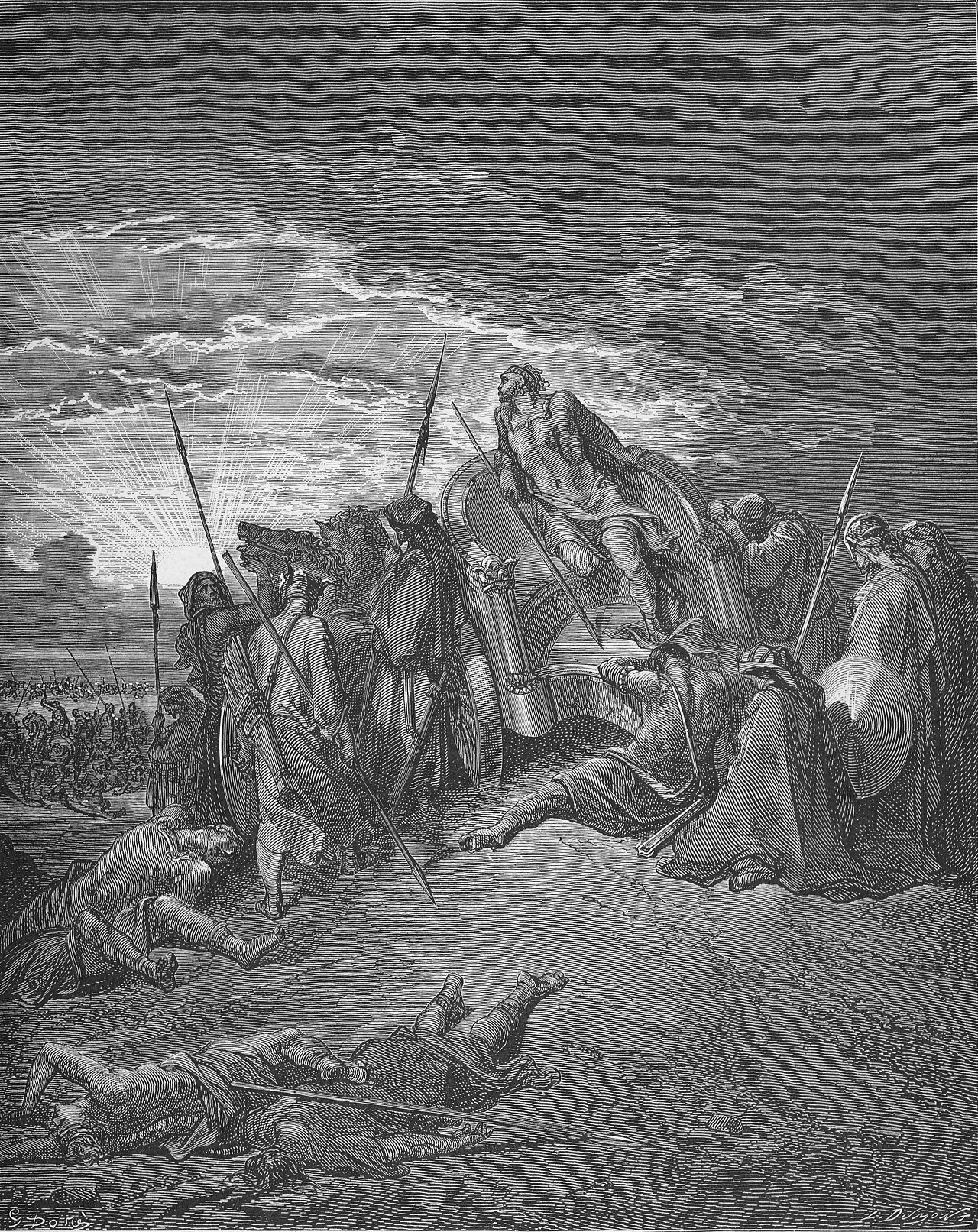
in 1 Kings 22The battle raged throughout that day, and the king was propped up in his chariot facing the Arameans. And the blood from his wound ran out onto the floor of the chariot, and that evening he died.
BSB
The same verse in ASV and KJV ▾
ASV
And the battle increased that day: and the king was stayed up in his chariot against the Syrians, and died at even; and the blood ran out of the wound into the bottom of the chariot.
KJV
And the battle increased that day: and the king was stayed up in his chariot against the Syrians, and died at even: and the blood ran out of the wound into the midst of the chariot.
⋯
This verse in 1 Kings 22
Commentary
5 notes on this verseA commentator
Albert Barnes1798–1870
Notes, Explanatory and Practical, on the Old and New Testaments (1832-1869)
The battle increased - See the margin; i. e. the tide of battle rose higher. Compare Isa 8:7-8. The king was stayed up in his chariot - The king’s wound made it impossible for him to remain standing without help; he therefore had himself supported in his chariot by attendants, in order that his soldiers might not lose heart, as they would be sure to do, if they knew of his peril. Ahab must not be denied the credit of right princely fortitude on this occasion. The midst of the chariot - literally, as in the margin.
This site's exposition
drew a bow at a
on 1 Kings 22:34-35
An arrow shot without aim finds the one joint a disguise could not cover, and Ahab is held upright in his chariot through the day's fighting so the army will not scatter, dying only at even with the blood running into the chariot. The chance shot lands exactly where 21:19 and 22:20-22 had already said this reign would end.
The record, by era
The Puritans and the Awakening1 voice
And the battle increased that day,....
The Nineteenth Century2 voices
A commentator
Jamieson, Fausset & Brown1802–1910
Commentary Critical and Explanatory on the Whole Bible (1871)
proposed
The corpse was conveyed to Samaria; and, as the chariot which brought it was being washed, in a pool near the city, from the blood that had profusely oozed from the wound, the dogs, in conformity with Elijah's prophecy, came and licked it [1Ki 21:19]. Ahab was succeeded by his son Ahaziah [1Ki 22:40].
The king was stayed up - He did not wish his misfortune should be known, lest his troops should be discouraged.
The words behind it
18 Hebrew wordsEvery Hebrew word of this verse in the order it stands, with what it means and the door to its own study. The last column counts the times a word stands in the whole Bible: the rarer the word, the more the places it appears belong together.
| Hebrew | Sound | Meaning | Word study | In the Bible |
|---|---|---|---|---|
| וַתַּעֲלֶ֤ה | vataaleh | and it went up | H5927 → | 890 times |
| הַמִּלְחָמָה֙ | hamilchamah | the battle | H4421 → | 320 times |
| בַּיּ֣וֹם | baiyom | on the day | H3117 → | 2304 times |
| הַה֔וּא | hahu' | <the> that | H1931 → | 1879 times |
| וְהַמֶּ֗לֶךְ | vehamelekh | and the king | H4428 → | 2525 times |
| הָיָ֧ה | hayah | he was | H1961 → | 3559 times |
| מָעֳמָ֛ד | moomad | placed | H5975 → | 521 times |
| בַּמֶּרְכָּבָ֖ה | bamerkavah | in the chariot | H4818 → | 44 times |
| נֹ֣כַח | nokhach | opposite to | H5227 → | |
| אֲרָ֑ם | ʾaram | Aram | H758 → | 143 times |
| וַיָּ֣מָת | vaiyamot | and he died | H4191 → | 839 times |
| בָּעֶ֔רֶב | baerev | in the evening | H6153 → | |
| וַיִּ֥צֶק | vaiyitzek | and it flowed | H3332 → | 50 times |
| דַּֽם־ | dam- | [the] blood of | H1818 → | 360 times |
| הַמַּכָּ֖ה | hamakah | the wound | H4347 → | |
| אֶל־ | ʾel- | into | H413 → | 5510 times |
| חֵ֥יק | cheik | [the] bottom of | H2436 → | 38 times |
| הָרָֽכֶב׃ | harakhev | the chariot | H7393 → | 119 times |
וַתַּעֲלֶ֤הand it went up
vataalehH5927 →890 times
הַמִּלְחָמָה֙the battle
hamilchamahH4421 →320 times
בַּיּ֣וֹםon the day
baiyomH3117 →2304 times
הַה֔וּא<the> that
hahu'H1931 →1879 times
וְהַמֶּ֗לֶךְand the king
vehamelekhH4428 →2525 times
הָיָ֧הhe was
hayahH1961 →3559 times
מָעֳמָ֛דplaced
moomadH5975 →521 times
בַּמֶּרְכָּבָ֖הin the chariot
bamerkavahH4818 →44 times
נֹ֣כַחopposite to
nokhachH5227 →
אֲרָ֑םAram
ʾaramH758 →143 times
וַיָּ֣מָתand he died
vaiyamotH4191 →839 times
בָּעֶ֔רֶבin the evening
baerevH6153 →
וַיִּ֥צֶקand it flowed
vaiyitzekH3332 →50 times
דַּֽם־[the] blood of
dam-H1818 →360 times
הַמַּכָּ֖הthe wound
hamakahH4347 →
אֶל־into
ʾel-H413 →5510 times
חֵ֥יק[the] bottom of
cheikH2436 →38 times
הָרָֽכֶב׃the chariot
harakhevH7393 →119 times
A shaded row is a word that stands 400 times or fewer in the Bible.
The walk
8 stopsEach card is a verse this one points to, and under it the verses that one points to in turn. Where several paths arrive at the same place, that place is listed first: the text keeps returning to it.
Through
1 Kings 20:42And the prophet said to the king, “This is what the LORD says: ‘Because you have let slip from your hand the man I had devoted to destruction, your life will be exchanged for…
it leads to
- 1 Kings 22:31–37
Now the king of Aram had ordered his thirty-two chariot commanders, “Do not fight with anyone, small or great, except the king of Israel.”
- 2 Chronicles 18:33–34
However, a certain man drew his bow without taking special aim, and he struck the king of Israel between the joints of his armor. So the king said to his charioteer, “Turn around and…
- 1 Kings 20:39
As the king passed by, he cried out to the king: “Your servant had marched out into the middle of the battle, when suddenly a man came over with a captive and told me,…
- 2 Kings 6:24
Some time later, Ben-hadad king of Aram assembled his entire army and marched up to besiege Samaria.
- 1 Kings 22:31–37
Through
1 Kings 22:28But Micaiah replied, “If you ever return safely, the LORD has not spoken through me.” Then he added, “Take heed, all you people!”
it leads to
- Micah 1:2
Hear, O peoples, all of you; listen, O earth, and everyone in it! May the Lord GOD bear witness against you, the Lord from His holy temple.
- Numbers 16:29
If these men die a natural death, or if they suffer the fate of all men, then the LORD has not sent me.
- Acts 13:10–11
and said, “O child of the devil and enemy of all righteousness, you are full of all kinds of deceit and trickery! Will you never stop perverting the straight ways of the Lord?
- Mark 12:37
David himself calls Him ‘Lord.’ So how can He be David’s son?” And the large crowd listened to Him with delight.
- Micah 1:2
Where this verse is studied
On this page
About 1 Kings
This page draws on Adam Clarke, Commentary on the Bible; Albert Barnes, Notes, Explanatory and Practical, on the Old and New Testaments (1832-1869); Jamieson, Fausset & Brown, Commentary Critical and Explanatory on the Whole Bible; John Gill, Exposition of the Old Testament (1748-1763); Keil, The Books of the Kings and Matthew Henry, Commentary on the Whole Bible.