
1 Kings 22:34
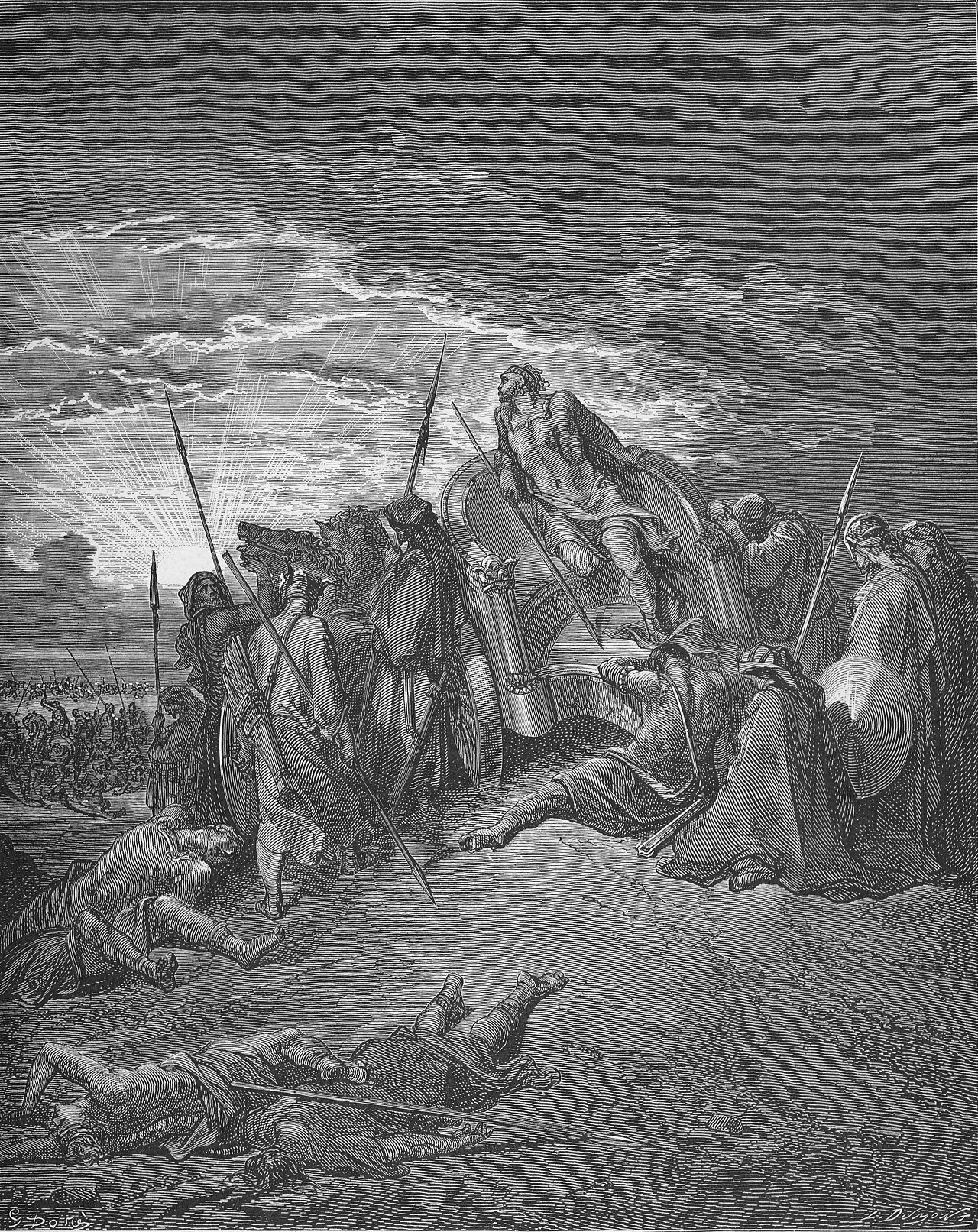
in 1 Kings 22However, a certain man drew his bow without taking special aim, and he struck the king of Israel between the joints of his armor. So the king said to his charioteer, “Turn around and take me out of the battle, for I am badly wounded!”
BSB
The same verse in ASV and KJV ▾
ASV
And a certain man drew his bow at a venture, and smote the king of Israel between the joints of the armor: wherefore he said unto the driver of his chariot, Turn thy hand, and carry me out of the host; for I am sore wounded.
KJV
And a certain man drew a bow at a venture, and smote the king of Israel between the joints of the harness: wherefore he said unto the driver of his chariot, Turn thine hand, and carry me out of the host; for I am wounded.
⋯
This verse in 1 Kings 22
Commentary
7 notes on this verseDrew a bow at a venture - It is supposed that he shot, as the archers in general did, not aiming at any person in particular. The word לתמו lethummo, which we translate in his simplicity, has been variously understood; in his integrity, his uprightness; in his perfection; i.e., to the utmost of his skill and strength. This is most probably the meaning; and may imply both aim and power, having his butt full in view.
This site's exposition
drew a bow at a
on 1 Kings 22:34-35
An arrow shot without aim finds the one joint a disguise could not cover, and Ahab is held upright in his chariot through the day's fighting so the army will not scatter, dying only at even with the blood running into the chariot. The chance shot lands exactly where 21:19 and 22:20-22 had already said this reign would end.
The record, by era
The Puritans and the Awakening3 voices
No armour is of proof against the darts of divine vengeance. Case the criminal in steel, and it is all one, he that made him can make his sword to approach him. That which to us seems altogether casual is done by the determinate counsel and fore-knowledge of God.
Now he sees himself flattered into his own ruin, and Zedekiah's horns of iron pushing, not the Syrians, but himself, into destruction. Thus is he brought to the king of terrors without hope in his death. The royal corpse is brought to Samaria and buried there (
quarantine:debris (2026-07-29) — unbalanced-parens
And a certain man drew a bow at a venture,.... Not aiming at the king of Israel, or knowing whereabout he was.
The Nineteenth Century2 voices
A commentator
Jamieson, Fausset & Brown1802–1910
Commentary Critical and Explanatory on the Whole Bible (1871)
proposed
The corpse was conveyed to Samaria; and, as the chariot which brought it was being washed, in a pool near the city, from the blood that had profusely oozed from the wound, the dogs, in conformity with Elijah's prophecy, came and licked it [1Ki 21:19]. Ahab was succeeded by his son Ahaziah [1Ki 22:40].
A commentator
Albert Barnes1798–1870
Notes, Explanatory and Practical, on the Old and New Testaments (1832-1869)
proposed
At a venture - literally, as in the margin, i. e. without intent to kill the king. Between the joints of the harness - literally, as in the margin. The “joints” were probably pieces of armor which attached the breast-plate to the helmet or to the greaves. The arrow entered between the breastplate and one of these “joints.” breastplates made of metal scales were common both in Egypt and Assyria. Turn thine hand - literally, “turn thy hands.” The driver of a chariot, both in Egypt and Assyria, held the reins with his two hands.
The words behind it
21 Hebrew wordsEvery Hebrew word of this verse in the order it stands, with what it means and the door to its own study. The last column counts the times a word stands in the whole Bible: the rarer the word, the more the places it appears belong together.
| Hebrew | Sound | Meaning | Word study | In the Bible |
|---|---|---|---|---|
| וְאִ֗ישׁ | veish | and someone | H376 → | 1663 times |
| מָשַׁ֤ךְ | mashakh | he drew | H4900 → | |
| בַּקֶּ֙שֶׁת֙ | bakeshet | on the bow | H7198 → | |
| לְתֻמּ֔וֹ | letumo | to innocence his | H8537 → | |
| וַיַּכֶּה֙ | vaiyakeh | and he struck | H5221 → | 499 times |
| אֶת־ | ʾet- | <obj.> | H853 → | 10935 times |
| מֶ֣לֶךְ | melekh | [the] king of | H4428 → | 2525 times |
| יִשְׂרָאֵ֔ל | yisrael | Israel | H3478 → | 2507 times |
| בֵּ֥ין | bein | between | H996 → | 407 times |
| הַדְּבָקִ֖ים | hadevakim | the joints | H1694 → | |
| וּבֵ֣ין | uvein | and between | H996 → | 407 times |
| הַשִּׁרְיָ֑ן | hashiryan | the body armor | H8302 → | |
| וַיֹּ֣אמֶר | vaiyomer | and he said | H559 → | 5305 times |
| לְרַכָּב֗וֹ | lerakavo | to charioteer his | H7395 → | |
| הֲפֹ֥ךְ | hafokh | turn around | H2015 → | |
| יָדְךָ֛ | yadekha | hand your | H3027 → | 1618 times |
| וְהוֹצִיאֵ֥נִי | vehotzieni | and take out me | H3318 → | 1067 times |
| מִן־ | min- | from | H4480 → | 1188 times |
| הַֽמַּחֲנֶ֖ה | hamachaneh | the camp | H4264 → | 215 times |
| כִּ֥י | ki | for | H3588 → | 4482 times |
| הָחֳלֵֽיתִי׃ | hocholeiti | I have been wounded | H2470 → | 76 times |
וְאִ֗ישׁand someone
veishH376 →1663 times
מָשַׁ֤ךְhe drew
mashakhH4900 →
בַּקֶּ֙שֶׁת֙on the bow
bakeshetH7198 →
לְתֻמּ֔וֹto innocence his
letumoH8537 →
וַיַּכֶּה֙and he struck
vaiyakehH5221 →499 times
אֶת־<obj.>
ʾet-H853 →10935 times
מֶ֣לֶךְ[the] king of
melekhH4428 →2525 times
יִשְׂרָאֵ֔לIsrael
yisraelH3478 →2507 times
בֵּ֥יןbetween
beinH996 →407 times
הַדְּבָקִ֖יםthe joints
hadevakimH1694 →
וּבֵ֣יןand between
uveinH996 →407 times
הַשִּׁרְיָ֑ןthe body armor
hashiryanH8302 →
וַיֹּ֣אמֶרand he said
vaiyomerH559 →5305 times
לְרַכָּב֗וֹto charioteer his
lerakavoH7395 →
הֲפֹ֥ךְturn around
hafokhH2015 →
יָדְךָ֛hand your
yadekhaH3027 →1618 times
וְהוֹצִיאֵ֥נִיand take out me
vehotzieniH3318 →1067 times
מִן־from
min-H4480 →1188 times
הַֽמַּחֲנֶ֖הthe camp
hamachanehH4264 →215 times
כִּ֥יfor
kiH3588 →4482 times
הָחֳלֵֽיתִי׃I have been wounded
hocholeitiH2470 →76 times
A shaded row is a word that stands 400 times or fewer in the Bible.
The walk
8 stopsEach card is a verse this one points to, and under it the verses that one points to in turn. Where several paths arrive at the same place, that place is listed first: the text keeps returning to it.
Through
1 Samuel 17:49Then David reached into his bag, took out a stone, and slung it, striking the Philistine on the forehead. The stone sank into his forehead, and he fell facedown on the ground.
it leads to
- 1 Corinthians 1:27–28
But God chose the foolish things of the world to shame the wise; God chose the weak things of the world to shame the strong.
- 1 Corinthians 1:27–28
Through
2 Chronicles 35:23There the archers shot King Josiah, who said to his servants, “Take me away, for I am badly wounded!”
it leads to
- 2 Kings 9:24
Then Jehu drew his bow and shot Joram between the shoulders. The arrow pierced his heart, and he slumped down in his chariot.
Reached by 2 separate paths from here.
- 2 Kings 9:24
Through
Micah 6:13Therefore I am striking you severely, to ruin you because of your sins.
it leads to
- Psalms 107:17–18
Fools, in their rebellious ways, and through their iniquities, suffered affliction.
- Acts 12:23
Immediately, because Herod did not give glory to God, an angel of the Lord struck him down, and he was eaten by worms and died.
- Leviticus 26:16
then this is what I will do to you: I will bring upon you sudden terror, wasting disease, and fever that will destroy your sight and drain your life. You will sow your seed…
- Hosea 13:16
Samaria will bear her guilt because she has rebelled against her God. They will fall by the sword; their little ones will be dashed to pieces, and their pregnant women ripped open.
- Deuteronomy 28:21–22
The LORD will make the plague cling to you until He has exterminated you from the land that you are entering to possess.
- Psalms 107:17–18
Through
Revelation 9:9They also had thoraxes like breastplates of iron, and the sound of their wings was like the roar of many horses and chariots rushing into battle.
it leads to
- Joel 2:5–8
With a sound like that of chariots they bound over the mountaintops, like the crackling of fire consuming stubble, like a mighty army deployed for battle.
- Joel 2:5–8
Where this verse is studied
On this page
About 1 Kings
This page draws on Adam Clarke, Commentary on the Bible; Albert Barnes, Notes, Explanatory and Practical, on the Old and New Testaments (1832-1869); Jamieson, Fausset & Brown, Commentary Critical and Explanatory on the Whole Bible; John Gill, Exposition of the Old Testament (1748-1763); Keil, The Books of the Kings and Matthew Henry, Commentary on the Whole Bible.