
1 Kings 22:31
in 1 Kings 22Now the king of Aram had ordered his thirty-two chariot commanders, “Do not fight with anyone, small or great, except the king of Israel.”
BSB
The same verse in ASV and KJV ▾
ASV
Now the king of Syria had commanded the thirty and two captains of his chariots, saying, Fight neither with small nor great, save only with the king of Israel.
KJV
But the king of Syria commanded his thirty and two captains that had rule over his chariots, saying, Fight neither with small nor great, save only with the king of Israel.
⋯
This verse in 1 Kings 22
Commentary
5 notes on this verseA commentator
Albert Barnes1798–1870
Notes, Explanatory and Practical, on the Old and New Testaments (1832-1869)
Commanded - “Had commanded.” Ben-hadad delivers his order in the hyperbolical style common in the East. His meaning is, “Make it your chief object to kill or take the king of Israel.” Apparently, his own defeat and captivity were still rankling in his mind, and he wished to retaliate on Ahab, the humiliation which he considered himself to have suffered. He shows small appreciation of the generosity which had spared his life and restored him to his kingdom.
This site's exposition
Fight neither with small nor
on 1 Kings 22:31-33
Syria's thirty and two captains are ordered to single out one man, the king of Israel, and the order nearly kills Jehoshaphat instead when his robes draw their chariots toward him and he cries out. Only when the captains see he is not Ahab do they turn back, and the disguise that was meant to shield the king has spent its danger on his ally first.
The record, by era
The Puritans and the Awakening2 voices
), to aim at his person, as if against him he had a particular enmity. Now Ahab was justly repaid for sparing Ben-hadad, who, as the seed of the serpent commonly do, stung the bosom in which he was fostered and saved from perishing.
quarantine:debris (2026-07-29) — leading-punctuation+unbalanced-parens
But the king of Syria commanded his thirty and two captains that had the rule over his chariots,....
The Nineteenth Century1 voice
A commentator
Jamieson, Fausset & Brown1802–1910
Commentary Critical and Explanatory on the Whole Bible (1871)
proposed
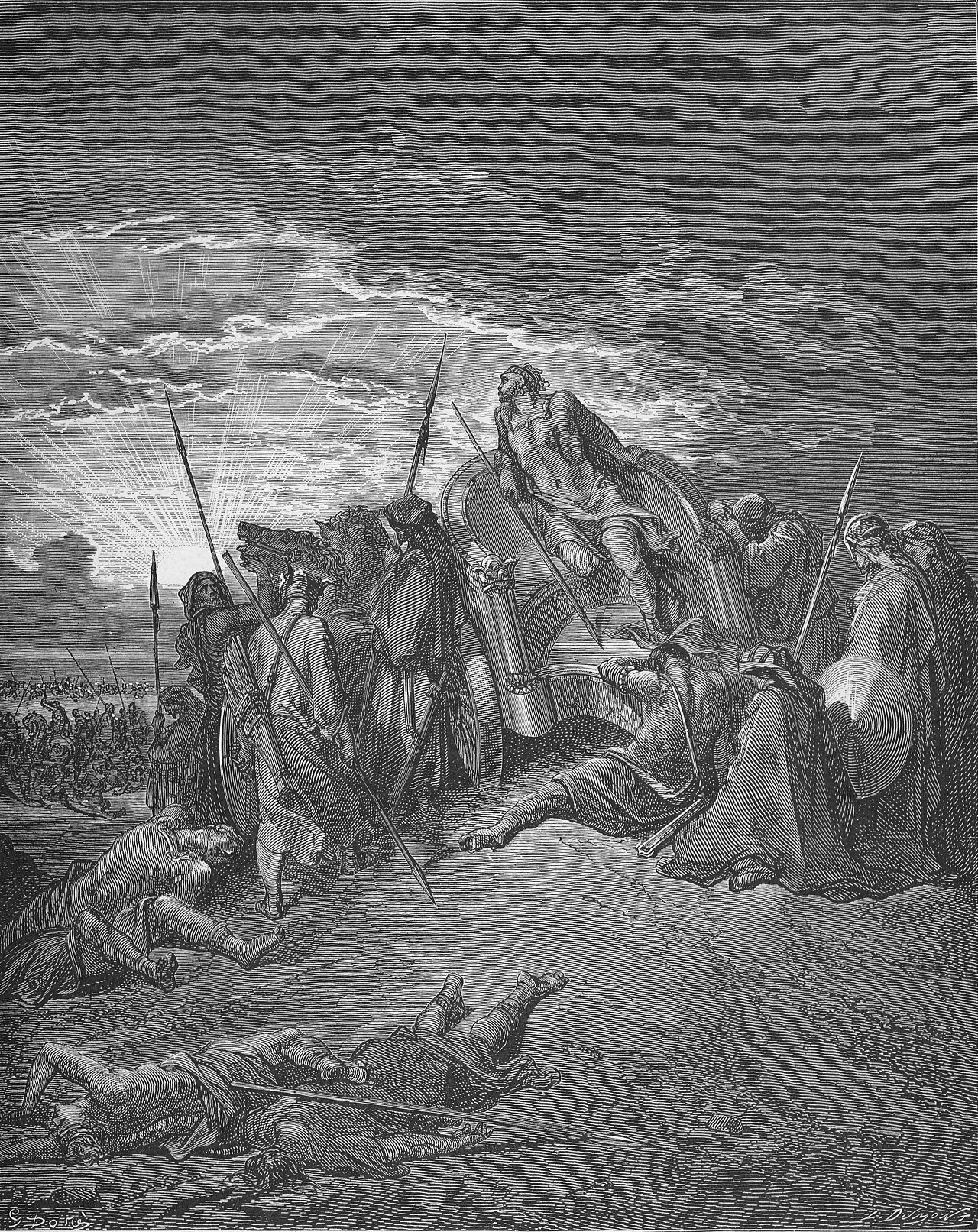
The corpse was conveyed to Samaria; and, as the chariot which brought it was being washed, in a pool near the city, from the blood that had profusely oozed from the wound, the dogs, in conformity with Elijah's prophecy, came and licked it [1Ki 21:19]. Ahab was succeeded by his son Ahaziah [1Ki 22:40].
The words behind it
23 Hebrew wordsEvery Hebrew word of this verse in the order it stands, with what it means and the door to its own study. The last column counts the times a word stands in the whole Bible: the rarer the word, the more the places it appears belong together.
| Hebrew | Sound | Meaning | Word study | In the Bible |
|---|---|---|---|---|
| וּמֶ֣לֶךְ | umelekh | and king of | H4428 → | 2525 times |
| אֲרָ֡ם | ʾaram | Aram | H758 → | 143 times |
| צִוָּ֣ה | tzivah | he had commanded | H6680 → | 494 times |
| אֶת־ | ʾet- | <obj.> | H853 → | 10935 times |
| שָׂרֵי֩ | sarei | [the] commanders of | H8269 → | 421 times |
| הָרֶ֨כֶב | harekhev | the chariotry | H7393 → | 119 times |
| אֲשֶׁר־ | ʾasher- | which | H834 → | 5497 times |
| ל֜וֹ | lo | [belonged] to him | ||
| שְׁלֹשִׁ֤ים | sheloshim | thirty | H7970 → | 172 times |
| וּשְׁנַ֙יִם֙ | ushenayim | and two | H8147 → | 768 times |
| לֵאמֹ֔ר | lemor | <to> saying | H559 → | 5305 times |
| לֹ֚א | lo' | not | H3808 → | 5168 times |
| תִּלָּ֣חֲמ֔וּ | tilachamu | you must do battle | H3898 → | 177 times |
| אֶת־ | ʾet- | with | H854 → | 929 times |
| קָטֹ֖ן | katon | [the] small | H6996 → | 101 times |
| וְאֶת־ | veet | and with | H854 → | 929 times |
| גָּד֑וֹל | gadol | [the] great | H1419 → | 526 times |
| כִּ֛י | ki | that | H3588 → | 4482 times |
| אִֽם־ | ʾim- | except | H518 → | 1069 times |
| אֶת־ | ʾet- | with | H854 → | 929 times |
| מֶ֥לֶךְ | melekh | [the] king of | H4428 → | 2525 times |
| יִשְׂרָאֵ֖ל | yisrael | Israel | H3478 → | 2507 times |
| לְבַדּֽוֹ׃ | levado | to only him | H905 → | 200 times |
וּמֶ֣לֶךְand king of
umelekhH4428 →2525 times
אֲרָ֡םAram
ʾaramH758 →143 times
צִוָּ֣הhe had commanded
tzivahH6680 →494 times
אֶת־<obj.>
ʾet-H853 →10935 times
שָׂרֵי֩[the] commanders of
sareiH8269 →421 times
הָרֶ֨כֶבthe chariotry
harekhevH7393 →119 times
אֲשֶׁר־which
ʾasher-H834 →5497 times
ל֜וֹ[belonged] to him
lo
שְׁלֹשִׁ֤יםthirty
sheloshimH7970 →172 times
וּשְׁנַ֙יִם֙and two
ushenayimH8147 →768 times
לֵאמֹ֔ר<to> saying
lemorH559 →5305 times
לֹ֚אnot
lo'H3808 →5168 times
תִּלָּ֣חֲמ֔וּyou must do battle
tilachamuH3898 →177 times
אֶת־with
ʾet-H854 →929 times
קָטֹ֖ן[the] small
katonH6996 →101 times
וְאֶת־and with
veetH854 →929 times
גָּד֑וֹל[the] great
gadolH1419 →526 times
כִּ֛יthat
kiH3588 →4482 times
אִֽם־except
ʾim-H518 →1069 times
אֶת־with
ʾet-H854 →929 times
מֶ֥לֶךְ[the] king of
melekhH4428 →2525 times
יִשְׂרָאֵ֖לIsrael
yisraelH3478 →2507 times
לְבַדּֽוֹ׃to only him
levadoH905 →200 times
A shaded row is a word that stands 400 times or fewer in the Bible.
The walk
8 stopsEach card is a verse this one points to, and under it the verses that one points to in turn. Where several paths arrive at the same place, that place is listed first: the text keeps returning to it.
Through
Jeremiah 16:6“Both great and small will die in this land. They will not be buried or mourned, nor will anyone cut himself or shave his head for them.
it leads to
- Deuteronomy 14:1
You are sons of the LORD your God; do not cut yourselves or shave your foreheads on behalf of the dead,
- Jeremiah 41:5
eighty men who had shaved off their beards, torn their garments, and cut themselves came from Shechem, Shiloh, and Samaria, carrying grain offerings and frankincense for the house of the LORD.
- Jeremiah 47:5
The people of Gaza will shave their heads in mourning; Ashkelon will be silenced. O remnant of their valley, how long will you gash yourself?
- Leviticus 19:28
You must not make any cuts in your bodies for the dead or put tattoo marks on yourselves. I am the LORD.
- Jeremiah 48:37
For every head is shaved and every beard is clipped; on every hand is a gash, and around every waist is sackcloth.
- Deuteronomy 14:1
Through
1 Kings 20:24So do this: Dismiss all the kings from their positions and replace them with other officers.
it leads to
- Proverbs 21:30
There is no wisdom, no understanding, no counsel that can prevail against the LORD.
- Proverbs 21:30
Through
1 Samuel 30:2They had taken captive the women and all who were there, both young and old. They had not killed anyone, but had carried them off as they went on their way.
it leads to
- 1 Samuel 27:11
David did not leave a man or woman alive to be brought to Gath, for he said, “Otherwise they will report us, saying, ‘This is what David did.’” And this was David’s custom the…
- Job 38:11
and I declared: ‘You may come this far, but no farther; here your proud waves must stop’?
- 1 Samuel 27:11
Where this verse is studied
On this page
About 1 Kings
This page draws on Albert Barnes, Notes, Explanatory and Practical, on the Old and New Testaments (1832-1869); Jamieson, Fausset & Brown, Commentary Critical and Explanatory on the Whole Bible; John Gill, Exposition of the Old Testament; John Gill, Exposition of the Old Testament (1748-1763); Keil, The Books of the Kings and Matthew Henry, Commentary on the Whole Bible.