
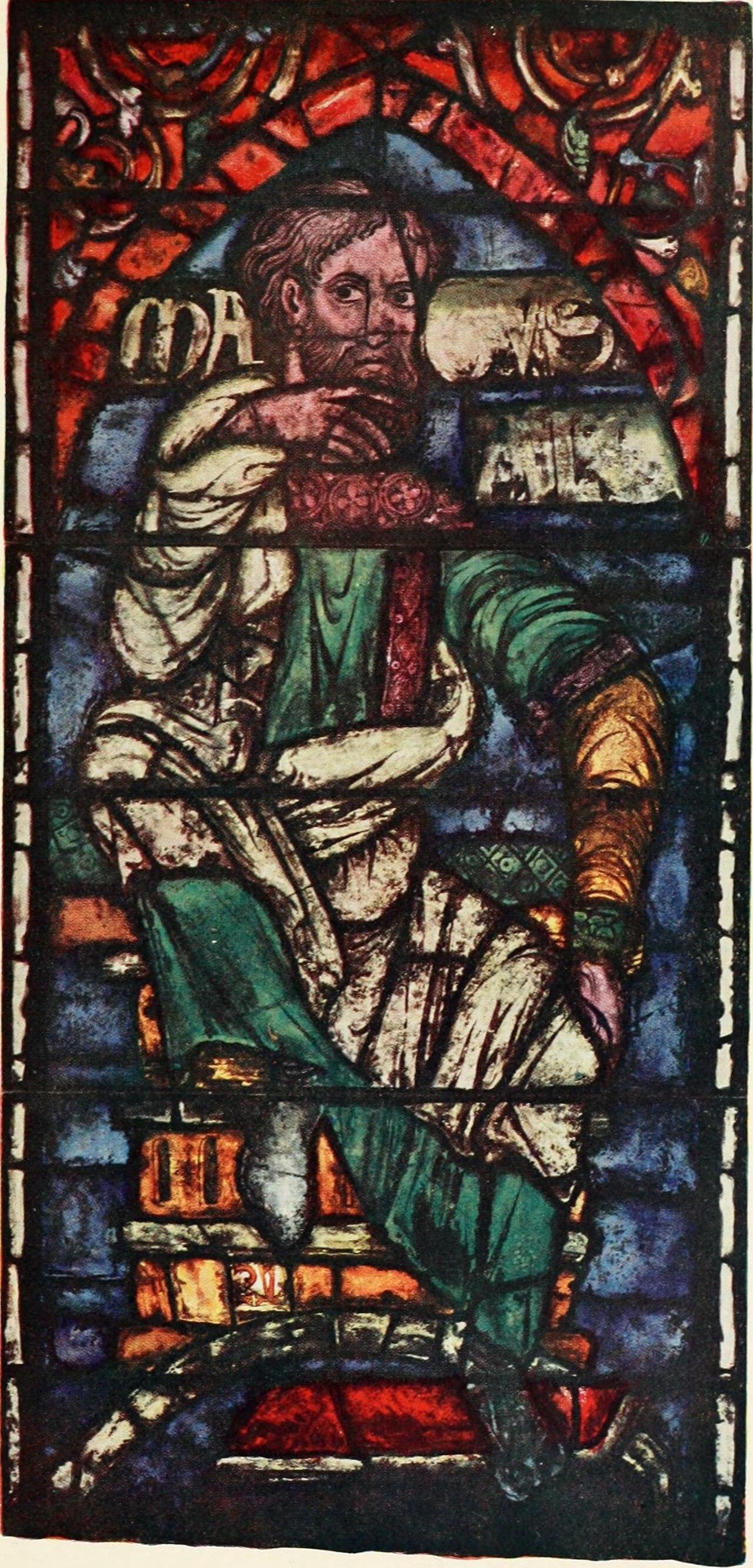
Lawrence B. Saint, Methuselah, Canterbury, 1913. Public domain.
Genesis 5:21 to 27 · Person · Featured Study
Methuselah
Methuselah is the longest-lived man Scripture names.
Genesis gives nearly ten centuries of his life in three verses.
And after he had become the father of Methuselah, Enoch walked with God 300 years and had other sons and daughters.
And after he had become the father of Methuselah, Enoch walked with God 300 years and had other sons and daughters.
- The name means
- disputed between two readings
- Born
- when Enoch was 65
- Died
- in the year of the flood, by the Hebrew numbers (probable)
- Family
- father: Enoch; son: Lamech
- First named
- Genesis 5:21 “…he became the father of Methuselah.”
- Last named
- Luke 3:37 “the son of Methuselah, the son…”
Summary
Methuselah stands in the line of Seth that Genesis 5 traces from Adam to the flood. On either reckoning of its numbers, his death falls near the flood.
- His whole record is seven verses, and each gives his place in a line of descent.
- Commentators and lexicons divide over what his name means.
- Luke counts him among the ancestors of Jesus.
His Record
Genesis names him at his birth and gives his years, and two later lists repeat his place.
When Enoch was 65 years old, he became the father of Methuselah.His name first stands in the record of his father.
When Methuselah was 187 years old, he became the father of Lamech. And after he had become the father of Lamech, Methuselah lived 782 years and had other sons and daughters. So Methuselah lived a total of 969 years, and then he died.The chapter's pattern of age, son, years and death holds for him.
Enoch, Methuselah, Lamech.The Chronicler sets him between Enoch and Lamech and adds nothing.
the son of Methuselah, the son of Enoch, the son of Jared, the son of Mahalalel, the son of Cainan,Luke's list runs back through him to Adam and to God.
1 Chronicles 1:3, Luke 3:37
The Year He Died
The Hebrew text and the Greek copies differ at two births, which decides whether he outlived the flood.
By the Hebrew numbers he died in the year of the flood, and by the Greek copies he outlived it by fourteen years.
| The count | Hebrew text | Greek copies |
|---|---|---|
| Methuselah's age at Lamech's birth | 187 | 167 |
| Lamech's age at Noah's birth | 182 | 188 |
| Noah's age when the flood came | 600 | 600 |
| Methuselah's age when the flood came | 969 | 955 |
Augustine, in City of God 15.11 to 13, held the Hebrew numbers true, since only eight souls escaped in the ark. He put the Greek figure down to a copyist's error. He reports that some in his day held that Methuselah spent those years with his father Enoch, who had been taken.
Jerome, writing on Genesis 5:25, said the question was famous and argued over in every church. He answered it from the Hebrew copies, and from Samaritan copies that he reports agree with them.
His Family
The table runs from his grandfather Jared to the sons of Noah.
He stands in the middle of the line from Jared to Noah.
| Person | Tie to Methuselah | What Genesis adds |
|---|---|---|
| Jared | His grandfather | Became the father of Enoch at 162 |
| Enoch | His father | Was taken by God |
| Lamech | His son | Named his own son Noah |
| Noah | His grandson | Became the father of Shem, Ham and Japheth |
His Death, His Years and 1 Enoch
Readers have asked how he died, how such long lives are read, and what 1 Enoch adds.
Did he die in the flood?Genesis 5:27; Genesis 6 to 9
Genesis says only that he died, and gives no cause or month of his death. The account of the flood in Genesis 6 to 9 does not name him.
Why did no one reach a thousand years?John Gill; Psalm 90:4
John Gill reports a Jewish answer: a thousand years is God's day, by Psalm 90:4, and no man was allowed to reach it.
For in Your sight a thousand years are but a day that passes, or a watch of the night.The answer rests on this verse.
How are the long lives read?Josephus; Augustine; Adam to Noah
Josephus gave three reasons in his Antiquities. The first men were beloved of God and lately made by Him, and their food was fitter to prolong life. God also gave them long years for their virtue and for their study of the stars. Augustine rejected the view that ten of their years made one of ours. By that count some fathers would have had sons at seven years old.
The chronology built on these numbers is a widely held reading. Its closed and open readings stand on the page Adam to Noah, with the purpose for which Genesis was written.
What does 1 Enoch say of him?1 Enoch 106 to 107, a study resource outside the canon
What Does His Name Mean?
Commentators read a prophecy in the name, and the lexicons read a weapon.
A prophecy of the floodJamieson, Fausset and Brown; the Glossa Ordinaria
Jamieson, Fausset and Brown read the name as he dieth, and the sending forth. They hold that Enoch gave it as a prophecy of the flood. The Glossa Ordinaria, as Aquinas gathered it in the Catena Aurea, gives the sending forth of death, or he died.
The objection: Strong's and Brown-Driver-Briggs read no word for death in the name.
Man of the dartStrong's; Brown-Driver-Briggs; Keil and Delitzsch
Strong's derives the name from math and shelach and glosses it man of a dart. Brown-Driver-Briggs gives man of the dart with a question mark. Keil and Delitzsch, on Genesis 4:18, give man of the sword or of increase.
The objection: Brown-Driver-Briggs itself marks the reading uncertain and thinks a Babylonian origin more probable.
The Years Before the Flood
Two letters of the New Testament look back on the generation of the flood, his grandson's generation.
who disobeyed long ago when God waited patiently in the days of Noah while the ark was being built. In the ark a few people, only eight souls, were saved through water.Peter speaks of God's patience with that generation.
By faith Noah, when warned about things not yet seen, in godly fear built an ark to save his family. By faith he condemned the world and became heir of the righteousness that comes by faith.Hebrews names his grandson among the heroes of faith.
Sources
Scripture is the Berean Standard Bible.
- Augustine of Hippo, The City of God, book 15, chapters 11 to 13, translated by Marcus Dods.
- Jerome, Hebrew Questions on Genesis, on 5:25, the Latin of Paul de Lagarde's edition (1868)
- Flavius Josephus, Antiquities of the Jews 1.3.9, translated by William Whiston.
- Strong's Hebrew dictionary and Brown-Driver-Briggs on H4968; Keil and Delitzsch on Genesis 4:18; the Pulpit Commentary on Genesis 5:21.
- Jamieson, Fausset and Brown, Commentary Critical and Explanatory (1871), on Genesis 5:21; John Gill, Exposition of the Old Testament, on Genesis 5:27; Adam Clarke, Commentary on the Bible, on Genesis 5:27 (the subtitle's longest life); the Glossa Ordinaria in the Catena Aurea on Luke 3:36 to 37.
- 1 Enoch 106 to 107, translated by R. H. Charles (1917)
- Lawrence B. Saint, Methuselah, Canterbury, plate III of Hugh Arnold, Stained Glass of the Middle Ages in England and France (London: A. and C. Black, 1913); the drawings held by the Victoria and Albert Museum, by the book's preface; public domain.
Keep Studying
Read it4
People and groups5
Doctrines1
Go further7