
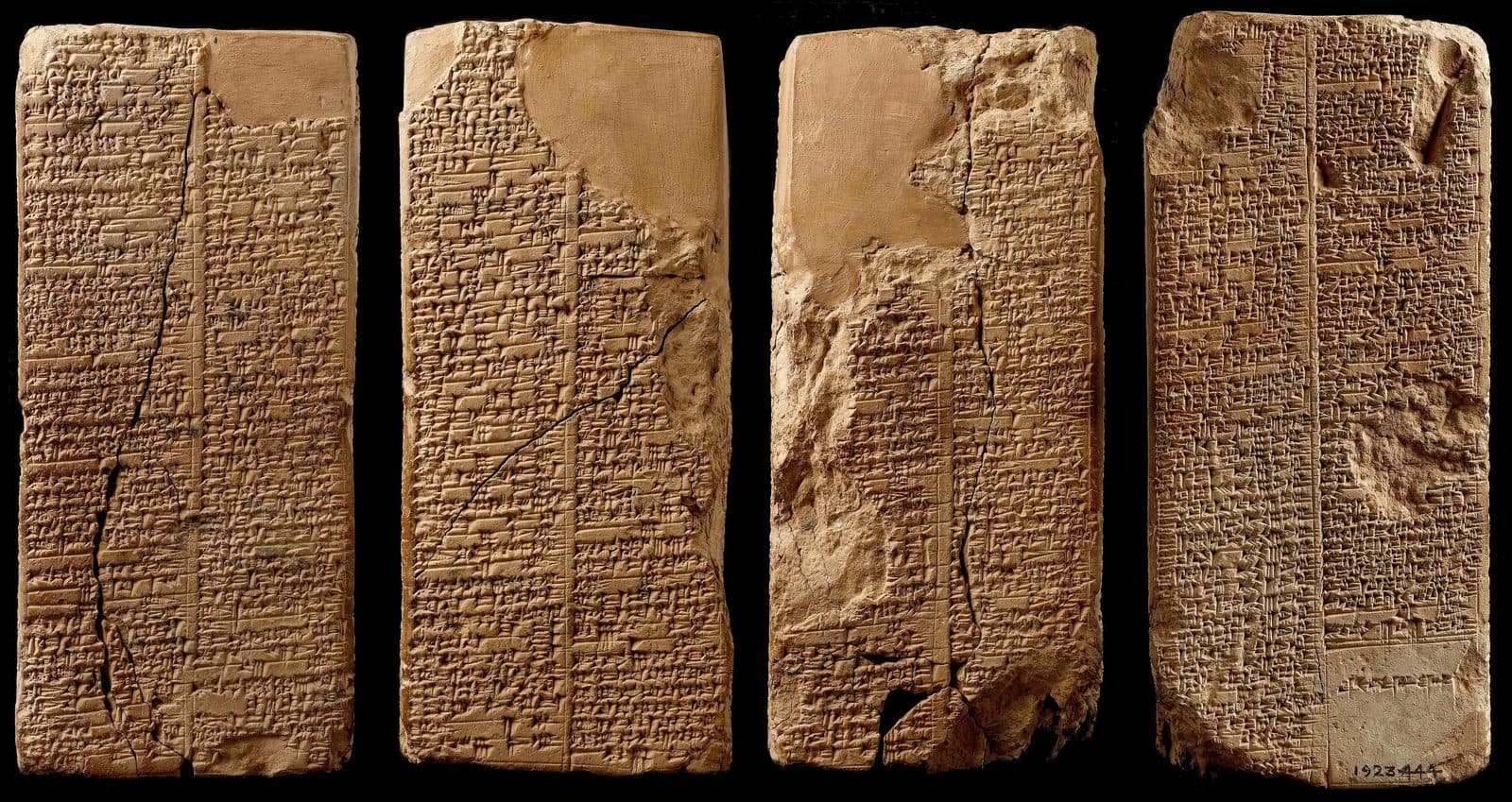
The Weld-Blundell Prism of the Sumerian King List. Public domain; File:Lista_Reale_Sumerica.jpg.
Genesis 5:18 to 24 · Debate · Featured Study
Was Enoch a King?
Three answers to one question about the seventh man from Adam, each with its holders and its oldest witness.
A sixteenth-century Hebrew book gives Enoch a throne over the kings of the earth.
Enoch walked with God, and then he was no more, because God had taken him away.
- The question
- Did Enoch, the seventh in the line from Adam, reign as a king over men?
- The texts
- Genesis 5:22, Genesis 5:24, Hebrews 11:5, Jude 1:14
A sixteenth-century Hebrew book gives Enoch a throne over the kings of the earth.
Summary
Enoch was the son of Jared and the father of Methuselah, the seventh in the line from Adam.
- Genesis, Hebrews and Jude say he walked with God, spoke as a prophet and was taken up.
- A later Hebrew book, Sefer ha-Yashar, says he ruled as king for 243 years.
- Jubilees calls him the first man to learn to write.
- Scholars today compare him with Enmeduranki, a king of the old city of Sippar.
The Verses Every Answer Reads
Genesis 5, Hebrews 11 and Jude hold what Scripture says of him.
And after he had become the father of Methuselah, Enoch walked with God 300 years and had other sons and daughters.Genesis gives Enoch three hundred years of walking with God, the phrase every reading has to explain.
By faith Enoch was taken up so that he did not see death: “He could not be found, because God had taken him away.” For before he was taken, he was commended as one who pleased God.Hebrews counts his taking-up as an act of faith and says he pleased God.
Enoch, the seventh from Adam, also prophesied about them: “Behold, the Lord is coming with myriads of His holy onesJude numbers him the seventh from Adam, the count that the comparison with the seventh king of Sippar rests on.
Three Answers, Row by Row
A king, a scribe and a figure modelled on a king
The three answers part ways on what Enoch was, how long he lived or reigned, and how his days ended.
| The question | Enoch the king | Enoch the scribe who walked with God | Enoch beside the seventh king of Sippar |
|---|---|---|---|
| What he was | King over the kings and princes of men | A man who walked with God, the first to learn writing | A figure modelled on Enmeduranki, king of Sippar |
| His years | A reign of 243 years | A life of 365 years | A reign of 21,000 years for Enmeduranki |
| His end | An angel takes him up to reign over the sons of God | God took him away (Genesis); he did not see death (Hebrews) | The gods Shamash and Adad bring Enmeduranki into their assembly |
| The oldest witness | The retelling of 1625 | Genesis 5, then Jubilees 4 | The King List of Sumer |
| Its holders | The writer of Sefer ha-Yashar | The writer of Jubilees; Rashi | John Collins; Amar Annus; James VanderKam and Helge Kvanvig, as Annus reports them |
The Case for a King
One Hebrew book gives Enoch a reign, and a twentieth-century collection of legends retells it.
The reign in Sefer ha-YasharSefer ha-Yashar, chapter 3, English of 1840
Sefer ha-Yashar, chapter 3, tells that Enoch left his place of seclusion at the word of the Lord and gathered the sons of men to teach them the ways of the Lord. All the kings of the sons of men came to him with their princes and judges, and 130 kings and princes made him king over them. In its telling he did justice and righteousness and made peace among them.
The reign retoldLouis Ginzberg, The Legends of the Jews, Volume 1, 1909
Louis Ginzberg, in the first volume of The Legends of the Jews, tells the same story under the heading Enoch, Ruler and Teacher. In his telling an angel calls Enoch to assume dominion over men, and the kings and princes submit to him.
Where the book comes fromVenice 1625; Joseph Dan's critical edition of 1986
The oldest printing of Sefer ha-Yashar was made in Venice in 1625, and its preface names an earlier printing at Naples in 1552 of which no copy is known. The printer claimed it was copied from an ancient manuscript. Joseph Dan, in his critical edition of 1986, concluded from its Hebrew that it was written in Naples in the early sixteenth century. Leon Modena of the Venetian rabbinate kept the printers from naming it the Book of Jasher that Joshua 10:13 cites. An English translation appeared in New York in 1840.
The Case for a Scribe Who Walked with God
Jubilees, Rashi and Jude give Enoch the offices of writer, righteous man and prophet.
Jubilees 4:17, in R. H. Charles's translation, calls Enoch the first among men born on earth who learnt writing, knowledge and wisdom, and says he wrote down the signs of heaven. Rashi's comment on Enoch's walk with God reads him as a righteous man whose mind was easily turned, and says God made him die before his full time.
to execute judgment on everyone, and to convict all the ungodly of every ungodly act of wickedness and every harsh word spoken against Him by ungodly sinners.”The prophecy Jude gives him is a word of judgment on the ungodly, the speech of a prophet to a world under God.
The Seventh King of Sippar
A list of Sumer's kings sets a king of Sippar among the rulers before the flood.
Sippar was the city of the sun god, Utu in Sumerian and Shamash in Akkadian. Amar Annus wrote on the question in the Journal for the Study of the Pseudepigrapha in 2010. He reports that biblical scholars generally agree the figure of Enoch, the seventh man from Adam, has its background in Enmeduranki, the seventh king before the flood in the list. He quotes John Collins for that view and names the longer studies of James VanderKam and Helge Kvanvig.
The eight kings before the floodETCSL 2.1.1, the composite list
In the composite list eight kings rule 241,200 years between them before the flood.
| Order | King | City | Years ruled |
|---|---|---|---|
| 1 | Alulim | Eridug | 28,800 |
| 2 | Alaljar | Eridug | 36,000 |
| 3 | En-men-lu-ana | Bad-tibira | 43,200 |
| 4 | En-men-gal-ana | Bad-tibira | 28,800 |
| 5 | Dumuzid, the shepherd | Bad-tibira | 36,000 |
| 6 | En-sipad-zid-ana | Larag | 28,800 |
| 7 | En-men-dur-ana | Zimbir, which is Sippar | 21,000 |
| 8 | Ubara-Tutu | Curuppag | 18,600 |
7, 8
What the gods taught Enmedurankian Akkadian text
An Akkadian text tells that the gods taught Enmeduranki the secrets of heaven and earth, among them the arts of reading oil on water and the livers of animals.
What Genesis Leaves Unsaid
Genesis 4 and 5 hold two men named Enoch
And Cain had relations with his wife, and she conceived and gave birth to Enoch. Then Cain built a city and named it after his son Enoch.A city named for an Enoch belongs to Cain's son, the third from Adam, so the one Enoch Genesis ties to a city is not the man of Genesis 5.
Voices on Enoch
Four teachers on the seventh from Adam, from Tertullian to John Wesley.
died 220 · Tertullian
ON THE DRESS OF WOMEN 3.3
The book of Enoch and the Lord's coming
The quotation1 quotation
“Since Enoch in the same book tells us of our Lord, we must not reject anything at all which genuinely pertains to us. Do we not read that every word of Scripture useful for edification is divinely inspired? As you very well know, Enoch was later rejected by the Jews for the same reason that prompted them to reject almost everything which prophesied about Christ. It is not at all surprising that they rejected certain Scriptures which spoke of him, considering that they were destined not to receive him when he spoke to them himself.”
Tertullian · On the Dress of Women 3.3 · on Jude 1:14Patristic
died 735 · Bede
Homilies on the Gospels 2.15
The seventh from Adam as a sign
The quotation1 quotation
“Enoch, in that he was engendered seventh in the line of descent from Adam, prefigured that the Lord would be conceived and born not in the usual way of mortal nature but by the power of the Holy Spirit.”
Bede · Homilies on the Gospels 2.15 · on Genesis 5:18Patristic
1662 to 1714 · Matthew Henry
Commentary on the Whole Bible
Walking with God as a priest's office
The quotation1 quotation
“Executing the priest's office is called walking before God, 1 Sam. ii. 30, 35 , and see Zech. iii. Enoch, it should seem, was a priest of the most high God, and like Noah, who is likewise said to walk with God, he was a preacher of righteousness, and prophesied of Christ's second coming.”
Matthew Henry · Commentary on the Whole Bible · on Genesis 5:24Puritan
1703 to 1791 · John Wesley
Explanatory Notes upon the Old Testament
Enoch changed without dying
The quotation1 quotation
“He was changed, as those saints shall be that will be found alive at Christ's second coming. Methuselah signifies, He dies, there is a sending forth, viz. of the deluge, which came the very year that Methuselah died. If his name was so intended, it was a fair warning to a careless world long before the judgment came.”
John Wesley · Explanatory Notes upon the Old Testament · on Genesis 5:24Evangelical
Matthew Henry, John Wesley
The Three Answers Weighed
Each answer meets one chief objection, raised by the holders of another.
The objection to the king1 paragraph
The one book that crowns Enoch is the latest of the books that speak of him, and Genesis, Jubilees and Rashi call him a man who walked with God, a writer and a righteous man.
The objection to the scribe1 paragraph
Genesis 5 gives each man of the line a few verses, and a man who walked with God for three hundred years may have held an office the short notice leaves out.
The objection to the seventh king1 paragraph
A parallel shows what a writer had before him and gives Enoch no throne, and Genesis 5 counts ten generations from Adam to Noah where the King List counts eight kings.
Books to Read Next
Three primary texts, each free to read online
The Book of Jasher (Sefer ha-Yashar), chapter 3
Anonymous, English translation · 1840
The story of Enoch's reign stands in the third chapter, translated into English in 1840.
Read at CCELThe Book of Jubilees, chapter 4
Translated by R. H. Charles · 1913
Charles translated the fourth chapter, which retells the generations from Cain and Abel to Noah with additions of its own.
Read at pseudepigrapha.comThe Sumerian King List
The Electronic Text Corpus of Sumerian Literature, text 2.1.1 · 1999
The editors printed each manuscript's variant numbers beside the composite list.
Read at ETCSLHe Pleased God
Scripture remembers Enoch for walking with God and for a faith that pleased Him, and Jude hears in his words the coming of the Lord in judgment.
And without faith it is impossible to please God, because anyone who approaches Him must believe that He exists and that He rewards those who earnestly seek Him.Hebrews draws from Enoch the one thing it asks of every reader who comes to God.
Sources
Scripture is the Berean Standard Bible.
- Sefer ha-Yashar, chapter 3, English translation, New York, 1840.
- Louis Ginzberg, The Legends of the Jews, Volume 1, 1909, Enoch, Ruler and Teacher.
- The Book of Jubilees 4:17, translated by R. H. Charles, 1913.
- The Sumerian King List, Electronic Text Corpus of Sumerian Literature 2.1.1, translation.
- Wikipedia, the article on Sefer haYashar, on the printings of 1625 and 1552, Joseph Dan's dating and Leon Modena.
- Wikipedia, En-men-dur-ana, on Sippar and the Akkadian text of Shamash and Adad.
- Rashi on Genesis 5:24, in the Pentateuch with Rashi's commentary by M. Rosenbaum and A. M. Silbermann, 1929 to 1934, public domain.
- Bede, Homilies on the Gospels 2.15, on Genesis 5:18.
- Matthew Henry, Commentary on the Whole Bible, 1710, on Genesis 5:24.
- John Wesley, Explanatory Notes upon the Old Testament, 1765, on Genesis 5:24.
- Tertullian, On the Dress of Women 3.3, on Jude 1:14.
- Amar Annus, On the Origin of Watchers: A Comparative Study of the Antediluvian Wisdom in Mesopotamian and Jewish Traditions, Journal for the Study of the Pseudepigrapha 19.4, 2010, pages 277 to 320.
Keep Studying
Read it4
Studies5
People and groups4
Places1