
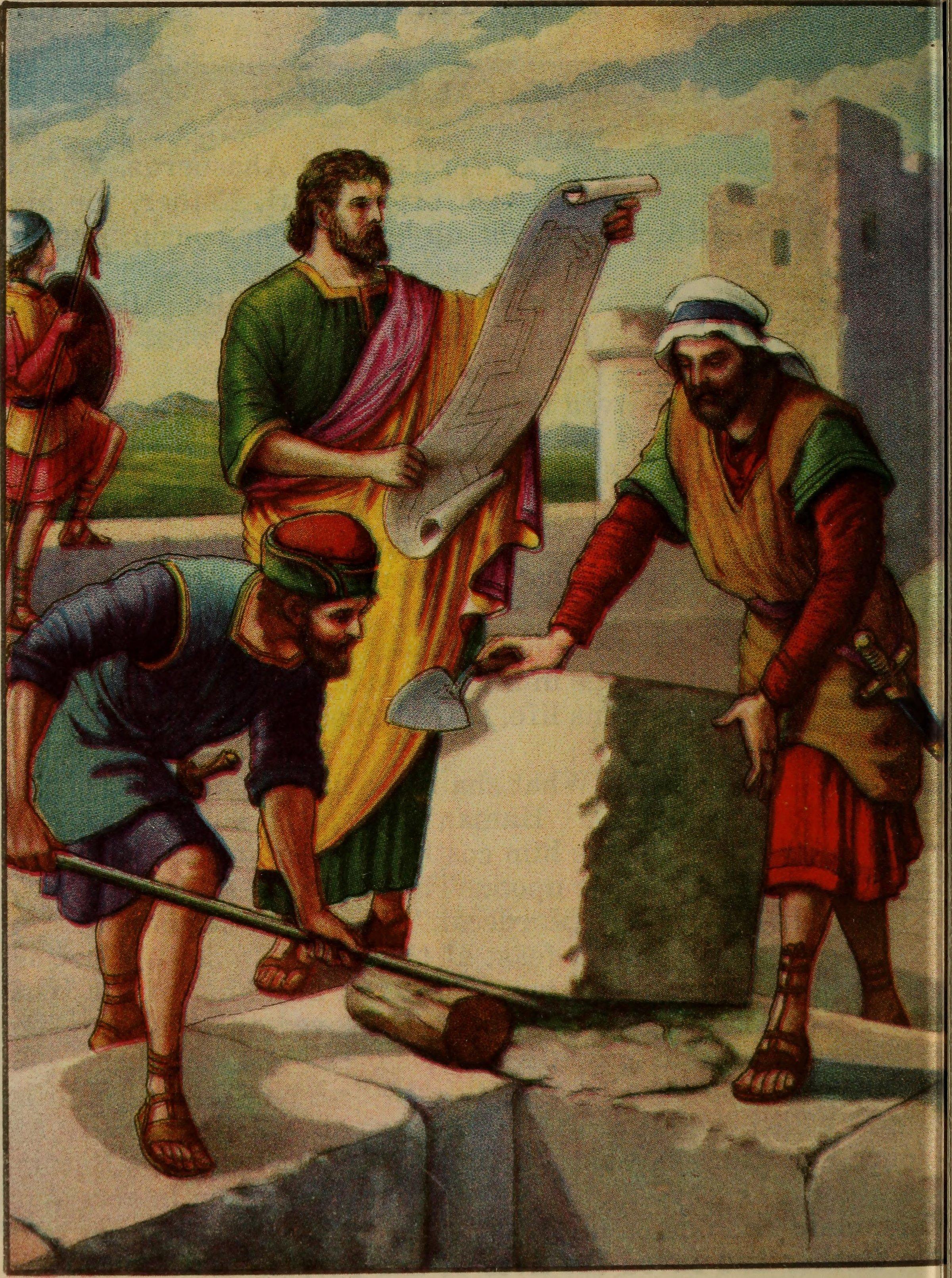
Bible Primer, Old Testament, 1919. Public domain.
Nehemiah 3 · Place · Featured Study
The Gates of Jerusalem in Nehemiah's Day
Nehemiah names twelve gates in the wall of Jerusalem, and five of the names stand in no other book.
At the feast of Booths the people built shelters in the squares by the Water Gate and the Gate of Ephraim.
At the Sheep Gate, Eliashib the high priest and his fellow priests began rebuilding. They dedicated it and installed its doors. After building as far as the Tower of the Hundred and the Tower of Hananel, they dedicated the wall.
At the Sheep Gate, Eliashib the high priest and his fellow priests began rebuilding. They dedicated it and installed its doors. After building as far as the Tower of the Hundred and the Tower of Hananel, they dedicated the wall.
- Today
- The Old City of Jerusalem and the City of David
- Region
- Jerusalem stands in the hill country of Judah.
- First named
- Nehemiah 1:3 “…is broken down, and its gates are burned…”
- Last named
- Nehemiah 13:22 “…purify themselves and guard the gates in order…”
Summary
Gates stand in nine of the thirteen chapters of Nehemiah, from the first report from Jerusalem to the last chapter.
- Charles F. Kent's plan draws the wall around both hills of the city.
- The ISBE of 1915 leaves three of the gates unplaced.
- Archaeologists differ on whether any wall of Nehemiah's time has been found.
The Gates in Nehemiah's Record
Chapter 3 records doors hung on six of the gates, and bolts and bars on five.
This study asks where the gates of Nehemiah's Jerusalem stood. It sets them on an old plan of the city, lists the other verses that name them and weighs how far the wall ran.
And they told me, “The remnant who survived the exile are there in the province, in great trouble and disgrace. The wall of Jerusalem is broken down, and its gates are burned with fire.”It shows the gates were part of the ruin that sent Nehemiah to the king.
And I told them, “Do not open the gates of Jerusalem until the sun is hot. While the guards are on duty, keep the doors shut and securely fastened. And appoint the residents of Jerusalem as guards, some at their posts and some at their own homes.”It shows the gates as the city's first defence once the doors were hung.
The book page of Nehemiah charts the gates in the order of chapter 3 with their builders, and the study of the wall tells the night ride and the building.
The Gates on Kent's Plan
Charles F. Kent drew Nehemiah's wall in red over the modern city and marked the gates the book names.
Kent's plan, with the gates Nehemiah names and the Broad Wall called out.
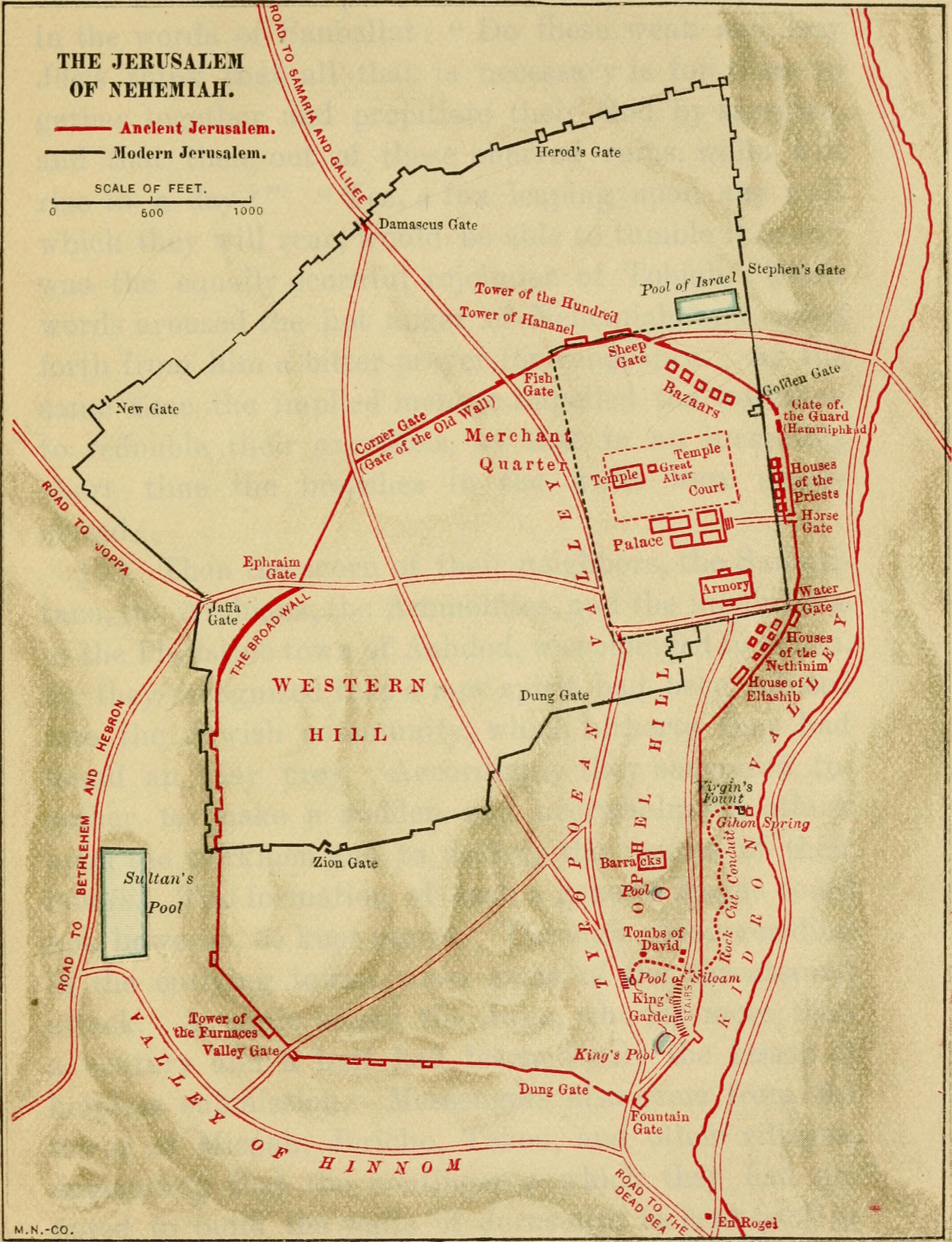
- The Sheep Gate stands north of the temple courtNehemiah 3:1
- The Fish Gate stands on the north wallNehemiah 3:3
- The Jeshanah Gate, which Kent marks as the Corner Gate or Gate of the Old WallNehemiah 3:6
- The Gate of Ephraim stands on the western wallNehemiah 8:16
- The Broad Wall runs along the western hillNehemiah 3:8
- The Valley Gate stands at the south-western cornerNehemiah 3:13
- The Dung Gate stands on the south wallNehemiah 3:14
- The Fountain Gate stands at the southern tipNehemiah 3:15
- The Water Gate stands on the eastern wallNehemiah 3:26
- The Horse Gate stands below the houses of the priestsNehemiah 3:28
- The Gate of the Guard, which Kent sets at the Inspection GateNehemiah 12:39
Charles Foster Kent, The Jerusalem of Nehemiah, a plan in A History of the Jewish People during the Babylonian, Persian, and Greek Periods, London, Smith, Elder, 1899, page 200. Public domain. Wikimedia Commons, File:Charles Foster Kent, The Jerusalem of Nehemah (1899) (14596514630).jpg.
Eleven parts of the plan, each with the verse that names it. Kent's red line is the ancient wall and his black line the wall of his own day.
Each Gate and Where It Stood
The ISBE places the gates by the excavations of its day, those of Bliss among them.
Where the ISBE of 1915 places each gate, and where else Scripture uses its name.
| Gate | Where the ISBE places it | The same name elsewhere |
|---|---|---|
| Sheep Gate | At the eastern end of the north wall | John 5:2, beside the pool of Bethesda |
| Fish Gate | Across the Tyropoeon Valley, as the Damascus Gate stands now but considerably farther south | Manasseh's outer wall ran to it, 2 Chronicles 33:14 |
| Jeshanah Gate | Near the present Jaffa Gate, if it is the Corner Gate of 2 Kings 14:13 | Named only in Nehemiah |
| Valley Gate | At or near a gate Bliss uncovered | Uzziah built a tower at it, 2 Chronicles 26:9 |
| Dung Gate | At gate foundations Bliss uncovered at the south-eastern corner | Named only in Nehemiah |
| Fountain Gate | Not placed: its site had not been recovered | Named only in Nehemiah |
| Water Gate | Where a road would lead from the temple area down to Gihon | Named only in Nehemiah |
| Horse Gate | Near the south-eastern angle of the present city | Athaliah was killed at its entrance, 2 Chronicles 23:15 |
| East Gate | Not placed | 1 Chronicles 26:14, a gate of the temple |
| Inspection Gate | Near the north-eastern corner of the temple area | Named only in Nehemiah |
| Gate of Ephraim | On the western wall | Jehoash broke down the wall from it, 2 Kings 14:13 |
| Gate of the Guard | Not placed | The palace gate of the guards, 2 Kings 11:19 |
Water Gate, Horse Gate, East Gate, Inspection Gate, Gate of Ephraim, Gate of the Guard
The study of Jerusalem teaches the city's ridge and valleys, and the study of Zion teaches the City of David.
The Valley Gate in the Ground
Excavators of the 1920s set this gate on a structure in the Tyropoeon Valley.
John W. Crowfoot and Gerald M. Fitzgerald dug a massive structure on the western side of the City of David in 1927, and Crowfoot identified it as a gatehouse. Albright took it for the Dung Gate, and Albrecht Alt proposed in 1928 that it was the Valley Gate of Nehemiah 3:13. Finkelstein writes that most authorities accepted Alt's proposal.
David Ussishkin has since doubted that the structure was a gate and dates it to the late Hellenistic or early Roman period.
What the Text Leaves Unsaid
The roll of chapter 3 leaves out two gates the book names later.
The Gate of Ephraim and the Gate of the Guard, both passed by the second choir in Nehemiah 12:39, stand nowhere in the roll of chapter 3.
Gates Shut for the Sabbath, Gates Never Shut
Nehemiah shut the gates to keep the Sabbath holy, and the prophets saw a city whose gates stand open.
When the evening shadows began to fall on the gates of Jerusalem, just before the Sabbath, I ordered that the gates be shut and not opened until after the Sabbath. I posted some of my servants at the gates so that no load could enter on the Sabbath day.It shows the gates used to guard the Sabbath as well as the city.
Its gates will never be shut at the end of the day, because there will be no night there.John's vision answers the closed doors of chapter 13 with the hope of the age to come.
Your gates will always stand open; they will never be shut, day or night, so that the wealth of the nations may be brought into you, with their kings being led in procession.Isaiah's promise is the hope behind John's open gates.
Nehemiah's gates kept out the Sabbath trade of a city still at risk.
Voices on the Walled City
Matthew Henry wrote on the ground the walls enclosed, and Albert Barnes on the hour the gates were shut.
Matthew Henry (1662 to 1714)
Matthew Henry, on Nehemiah 7:3 to 4, weighs the size of the city against its few houses.
“The city, in compass, was large and great. The walls enclosed the same ground as formerly; but much of it lay waste, for the houses were not built, few at least in comparison with what had been; so that Nehemiah walled the city in faith, and with an eye to that promise of the replenishing of it which God had lately made by the prophet, Zech. viii.”
Matthew Henry · Commentary on the Whole Bible · on Nehemiah 7:3 to 4Puritan
Albert Barnes (1798 to 1870)
Albert Barnes, on Nehemiah 13:19, ties the closing to the reckoning of the Sabbath from evening.
“The gates were closed at the sunset of the day before the Sabbath; since the Sabbath was regarded as commencing on the previous evening.”
Albert Barnes · Notes, Explanatory and Practical, on the Old and New Testaments (1832-1869) · on Nehemiah 13:19Evangelical
How Far Nehemiah's Wall Ran
Scholars hold three readings of the wall of Nehemiah 3, each with its holders and an objection.
The wall took in the western hillE. W. G. Masterman in the ISBE (1915); Charles F. Kent (1899)
Masterman holds that the line of the wall followed the south edge of the south-western hill, though it made an enclosure much larger than the people needed. Kent's plan draws the same circuit.
The objection is Finkelstein's: excavations show the south-western hill was not inhabited in the Persian and early Hellenistic periods.
A wall of Nehemiah's time stands on the eastern ridgeEilat Mazar (2007), with Ephraim Stern on the date of the finds
Mazar reported in 2007 that pottery and arrowheads under a tower in the City of David date the tower and the wall beside it to the 5th century BC. Ephraim Stern said he could vouch for the Persian date of the finds.
The objection is Finkelstein's: finds under a tower give only the earliest date it could have been built, and he dates the tower and the wall to the Hasmonean period.
Nehemiah's wall is unattested in the groundIsrael Finkelstein (2008, reprinted 2018)
Finkelstein holds that there is no archaeological evidence for the city wall of Nehemiah. He writes that without the account of Nehemiah 3 no scholar would have argued for a Persian-period city wall in Jerusalem.
The objection is the account itself: Nehemiah 3 names the builders of each section and the gates they hung.
Books to Read Next
Two works on Jerusalem in Nehemiah's day, each free to read.
A History of the Jewish People during the Babylonian, Persian, and Greek Periods
Charles F. Kent · 1899
The history that carries Kent's plan of the Jerusalem of Nehemiah.
Read it at the Internet ArchiveHasmonean Realities behind Ezra, Nehemiah, and Chronicles
Israel Finkelstein · 2018
Finkelstein weighs the archaeology of Persian-period Jerusalem against Nehemiah 3 in its first chapter.
Read it at the Society of Biblical LiteratureThe Levites at the Gates
The wall was built for safety, and the book ends with its gates kept for worship.
Then I instructed the Levites to purify themselves and guard the gates in order to keep the Sabbath day holy. Remember me for this as well, O my God, and show me mercy according to Your abundant loving devotion.The verse joins the guarding of the gates to Nehemiah's prayer to be remembered.
Sources
Scripture is the Berean Standard Bible.
- E. W. G. Masterman, Jerusalem, part 2, sections 12 to 24, International Standard Bible Encyclopedia, 1915.
- Hammiphkad, Gate of, International Standard Bible Encyclopedia, 1915.
- Israel Finkelstein, Hasmonean Realities behind Ezra, Nehemiah, and Chronicles, Atlanta, SBL Press, 2018, chapter 1, reprinting Journal for the Study of the Old Testament 32 (2008)
- Regan E. Doherty, Elusive biblical wall found at last, scholar says, Associated Press, 29 November 2007.
- Matthew Henry, Commentary on the Whole Bible (1710), on Nehemiah 7:3 to 4.
- Albert Barnes, Notes, Explanatory and Practical, on the Old and New Testaments (1832 to 1869), on Nehemiah 13:19.
Keep Studying
Studies1
Church history2
People and groups3
Subjects1