
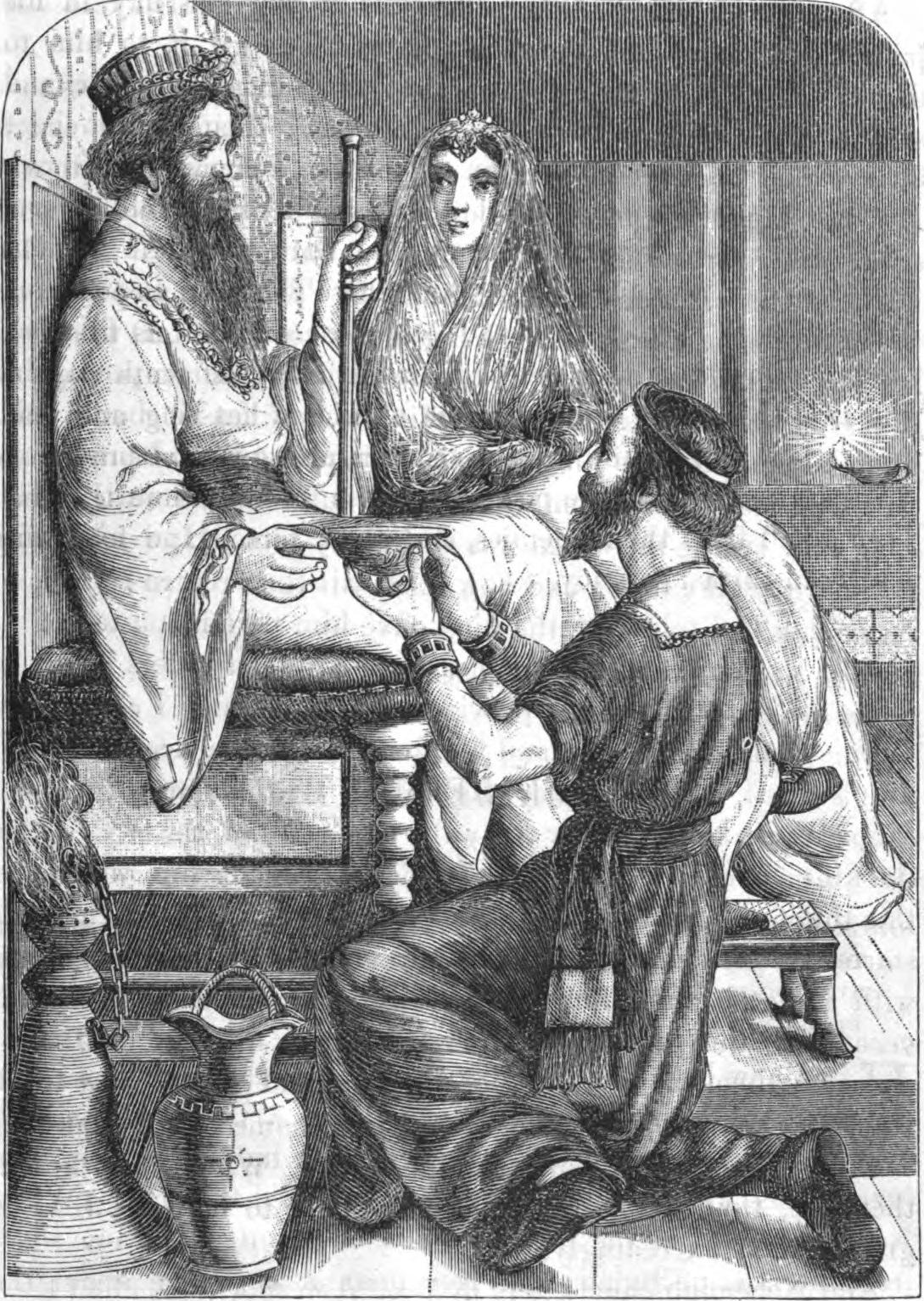
An engraving in The Story of the Bible, 1873. Public domain.
Nehemiah 1 to 13 · Person · Featured Study
Nehemiah
Nehemiah son of Hacaliah was cupbearer to King Artaxerxes and then governor of Judah for twelve years.
Nehemiah wept, fasted and prayed for days before he said a word to the king.
and answered the king, “If it pleases the king, and if your servant has found favor in your sight, I ask that you send me to Judah, to the city where my fathers are buried, so that I may rebuild it.”
and answered the king, “If it pleases the king, and if your servant has found favor in your sight, I ask that you send me to Judah, to the city where my fathers are buried, so that I may rebuild it.”
- Family
- father: Hacaliah; brother: Hanani
- Places
- Susa, Jerusalem
- First named
- Nehemiah 1:1 “These are the words of Nehemiah son of…”
- Last named
- Nehemiah 12:47 “…the days of Zerubbabel and Nehemiah, all Israel…”
Summary
News of Jerusalem's broken wall reached Nehemiah at the Persian court. He asked to be sent to rebuild it, and the king made him governor of Judah. After his term he went back to the king and later returned to Jerusalem.
- He refused the food allowed to a governor.
- Two other men of Scripture bear his name.
- Josephus sets his story in another reign.
Where Nehemiah Stands in Scripture
His life is known only from the book that bears his name.
Most of the book of Nehemiah is in his own voice. Three later chapters, Nehemiah 8, 10 and 12, also speak of him by name.
These are the words of Nehemiah son of Hacaliah: In the month of Chislev, in the twentieth year, while I was in the citadel of Susa,Albert Barnes takes this heading to mark where Nehemiah's own writing begins.
His Life, Turn by Turn
His story runs from the citadel of Susa to his second term in Jerusalem.
Nehemiah went from the king's table at Susa to the governor's seat in Jerusalem and back again.
- Hears that the wall of Jerusalem is broken downthe citadel of SusaNehemiah 1:3
- Asks the king to send him to Judahthe king's presenceNehemiah 2:5
- Travels with army officers and cavalrythe region west of the EuphratesNehemiah 2:9
- Inspects the broken walls by nightthe Valley GateNehemiah 2:13
- Calls the people to rebuildamong the officials and priestsNehemiah 2:17
- Stops the nobles' usurya large assemblyNehemiah 5:7
- Refuses to go down to meet his enemiesthe wallNehemiah 6:3
- Sees the wall completed in fifty-two daysthe whole wallNehemiah 6:15
- Puts Hanani and Hananiah in charge of the citythe gatesNehemiah 7:2
- Stands with Ezra at the reading of the Lawthe square before the Water GateNehemiah 8:9
- Seals the written covenantthe assemblyNehemiah 10:1
- Returns to the king in the thirty-second yearthe court of ArtaxerxesNehemiah 13:6
- Comes back and sets the temple rooms in orderthe house of GodNehemiah 13:7 to 9
Thirteen turns of his life, each with its verse.
Refuses to go down to meet his enemies, Sees the wall completed in fifty-two days, Puts Hanani and Hananiah in charge of the city, Stands with Ezra at the reading of the Law, Seals the written covenant, Returns to the king in the thirty-second year, Comes back and sets the temple rooms in order
The Cupbearer Who Became Governor
His work runs from the request at court to the reforms of his second term.
The request at courtNehemiah 1:1 to 2:10
In the month of Chislev his brother Hanani came from Judah. In Nisan the king saw Nehemiah's sad face and asked what he wanted.
Then the king, with the queen seated beside him, asked me, “How long will your journey take, and when will you return?” So it pleased the king to send me, and I set a time.The length of his stay is given later, in Nehemiah 5:14.
The wallNehemiah 2:11 to 7:3
He led the rebuilding of the wall, which is told scene by scene in its own study.
The Law and the covenantNehemiah 8 to 10
When Ezra read the Law, Nehemiah the governor told the weeping people that the day was holy.
The second termNehemiah 13:6 to 31
While all this was happening, I was not in Jerusalem, because I had returned to Artaxerxes king of Babylon in the thirty-second year of his reign. Some time later I obtained leave from the kingFrom here to its end, the book reports his second term.
The Persian Court and the Province
His two offices were a post at the Persian court and the rule of a small province.
The Hebrew word for his first office, mashqeh, is glossed cupbearer in the STEP Bible lexicon, a Hebrew dictionary from Tyndale House, which counts it nineteen times. Jamieson, Fausset and Brown, in their commentary of 1871, write that the office carried rank and influence because its holder came often into the king's presence.
Susa, where he served, is also the citadel of Esther 1:2 and of Daniel's vision in Daniel 8:2.
The governors before him had taken bread, wine and forty shekels of silver from the people.
Each day one ox, six choice sheep, and some fowl were prepared for me, and once every ten days an abundance of all kinds of wine was provided. But I did not demand the food allotted to the governor, because the burden on the people was so heavy.This verse gives his own reason for the refusal.
Albert Barnes notes that Nehemiah calls himself by the ordinary Hebrew word for governor in Nehemiah 5. Nehemiah 8:9 first gives him the Persian title Tirshatha, which the STEP Bible lexicon glosses as the title of a Persian deputy or governor.
The refusal drew this comment in 1710.
“So far was he from extorting more than his due that he never demanded that, but lived upon what he had got in the king of Persia's court and his own estate in Judea: the reason he gives for this piece of self-denial is, Because the bondage was heavy upon the people.”
Matthew Henry · Commentary on the Whole Bible · on Nehemiah 5:18Puritan
The Circle of Nehemiah
Eight people stand around him in his own account.
His circle ran from his father and brother to the king who sent him and the men who opposed him.
Generation 1
- HacaliahHis father
Generation 2
- HananiHis brother
- ArtaxerxesThe king he served as cupbearer
- AsaphKeeper of the king's forest, asked for timber
- EzraThe priest and scribe who read the Law beside him
- EliashibThe priest in charge of the temple storerooms
- SanballatThe Horonite who opposed the wall
- TobiahThe Ammonite official who opposed the wall
Two of the eight opposed his work.
The Places of His Life
Five places mark his life, from Susa to the plain of Ono.
Nehemiah's life ran between the Persian court and Jerusalem.
- 1Susa, The citadel where he heard the news from Judah. Nehemiah 1:1
- 2West of the Euphrates, The region whose governors received the king's letters. Nehemiah 2:9
- 3Jerusalem, The city whose wall he rebuilt and governed. Nehemiah 2:11
- 4The plain of Ono, The villages where his enemies asked him to meet them. Nehemiah 6:2
- 5Babylon, The book names Artaxerxes king of Babylon when Nehemiah goes back to him. Nehemiah 13:6
Not placed: West of the Euphrates (2), The plain of Ono (4).
The coasts and rivers are simplified; each place stands at its place page's coordinates.
Daniel 8:2 places the citadel of Susa in the province of Elam.
Questions His Life Raises
Two questions arise from the text and its commentators.
How many men named Nehemiah does Scripture name?Nehemiah 1:1, Nehemiah 3:16 and Nehemiah 7:7
The STEP Bible lexicon gives the name to three Israelites. Nehemiah son of Hacaliah wrote the book, and Nehemiah son of Azbuk, ruler of half the district of Beth-zur, repaired a section of the wall.
accompanied by Zerubbabel, Jeshua, Nehemiah, Azariah, Raamiah, Nahamani, Mordecai, Bilshan, Mispereth, Bigvai, Nehum, and Baanah. This is the count of the men of Israel:This third Nehemiah came up with Zerubbabel, in the list Ezra 2:2 also gives.
Why does he name his office so late?Nehemiah 1:11; Matthew Henry
Matthew Henry noticed where in Nehemiah 1 the office is first named.
“Observe, He is not forward to tell us what great preferment he had at court; it is not till the end of the chapter that he tells us he was the king's cup-bearer (a place of great trust, as well as of honour and profit), when he could not avoid the mentioning of it because of the following story; but at first he only said, I was in Shushan the palace.”
Matthew Henry · Commentary on the Whole Bible · on Nehemiah 1:11Puritan
What the Text Leaves Unsaid
The text leaves three things about him untold.
The book gives Nehemiah's father and brother and names no wife or child of his.
It gives no age for him at any point of his life. C. F. Keil supposed that he was thirty-five to forty years old when the king sent him.
It ends with his prayer and records nothing of his death. Josephus says that he came to a great age and then died.
How Scripture Reads Him
The book sets his days beside those of Ezra and of Zerubbabel.
The lists of Nehemiah 12 count time by its leaders, and twice they name Nehemiah among them.
They served in the days of Joiakim son of Jeshua, the son of Jozadak, and in the days of Nehemiah the governor and Ezra the priest and scribe.The verse dates the gatekeepers' service by his days and Ezra's.
So in the days of Zerubbabel and Nehemiah, all Israel contributed the daily portions for the singers and gatekeepers. They also set aside daily portions for the Levites, and the Levites set aside daily portions for the descendants of Aaron.This verse dates the daily portions by his days and those of the leader of the first return.
Voices on Nehemiah
John Wesley's notes on the Old Testament appeared in 1765.
John Wesley (1703 to 1791)
Explanatory Notes upon the Old Testament
John Wesley compared the two leaders of the return in his note on Nehemiah 5:7.
“Ezra was a man of a mild tender spirit, and when told of the sin of the rulers, rent his clothes and wept: Nehemiah forced them to reform, being of a warm and eager spirit. So God's work may be done, and yet different methods taken in doing it; which is a good reason why we should not arraign the management of others, nor make our own standard.”
on Nehemiah 5:7Evangelical
Which King Sent Nehemiah?
The book names Artaxerxes, and Josephus names Xerxes.
Now in the month of Nisan, in the twentieth year of King Artaxerxes, when wine was set before him, I took the wine and gave it to the king. I had never been sad in his presence,Artaxerxes Longimanus, in 445 or 444 BCC. F. Keil and Albert Barnes
C. F. Keil names the king Artaxerxes Longimanus and dates his twentieth year to 445 BC. Albert Barnes dates his accession to 465 BC, which sets the twentieth year in 445 to 444 BC.
Against this reading, Josephus names another king.
Xerxes, as Josephus tells itJosephus, Antiquities 11.5.6 to 8
Josephus dates the finished wall to the twenty-eighth year of Xerxes, in the ninth month. He ends his account with the words, "Now this was done in the days of Xerxes."
Against this reading, Keil reports that even Heinrich Ewald, who drew on Josephus, admitted that Josephus gives no trustworthy dates for Nehemiah.
Books to Read Next
Both works are in the public domain, and each has a free copy to read.
Antiquities of the Jews
Flavius Josephus, translated by William Whiston · 1737
Josephus retells Nehemiah's life in Book 11, chapter 5, with his own dates.
Read at Project GutenbergThe Books of Ezra, Nehemiah, and Esther
C. F. Keil, translated by Sophia Taylor · 1873
Keil's introduction weighs how long Nehemiah governed and how old he may have been.
Read at the Internet ArchiveShould a Man Like Me Run Away?
A prophet hired by his enemies urged Nehemiah to shut himself inside the temple, and Nehemiah refused.
But I replied, “Should a man like me run away? Should one like me go into the temple to save his own life? I will not go!”It is the last plot against his life that the book records.
Sources
Scripture is the Berean Standard Bible.
- The site's lexicon, STEP Bible TBESH glosses (Tyndale House, CC BY 4.0), entries H4945, H5166 and H8660.
- Flavius Josephus, Antiquities of the Jews 11.5.6 to 8, translated by William Whiston (1737)
- Albert Barnes, Notes, Explanatory and Practical, on the Old and New Testaments, 1832 to 1869, on Nehemiah 1:1, 2:1 and 8:9.
- C. F. Keil, The Books of Ezra, Nehemiah, and Esther, translated by Sophia Taylor, T. and T. Clark, 1873, pp. 140, 145, 149 to 150 and 221.
- Matthew Henry, Commentary on the Whole Bible, 1710, on Nehemiah 1:11 and 5:18.
- Jamieson, Fausset and Brown, Commentary Critical and Explanatory on the Whole Bible, 1871, on Nehemiah 1:11.
- John Wesley, Explanatory Notes upon the Old Testament, 1765, on Nehemiah 5:7.
Keep Studying
Read it4
People and groups4
Go further3