MANNAFEST

The Minor Prophets · Amos

The Trap That Springs Shut on Israel

Amos, a Judean shepherd with no prophetic pedigree, is sent north to Israel at the peak of Jeroboam II’s golden prosperity — and he opens with a trap: eight oracles against Israel’s neighbors that his hearers would cheer, until it springs shut on Israel itself, indicted at greater length than any of its neighbours, because covenant election intensifies accountabilityrather than excusing it. Three sermons build the case — exploitation, complacency, worship divorced from justice — until five visions, with intercession fading to nothing, announce the verdict is final. Yet the book’s last word is not the verdict: beyond judgment, the LORD will raise up the fallen tabernacle of David.

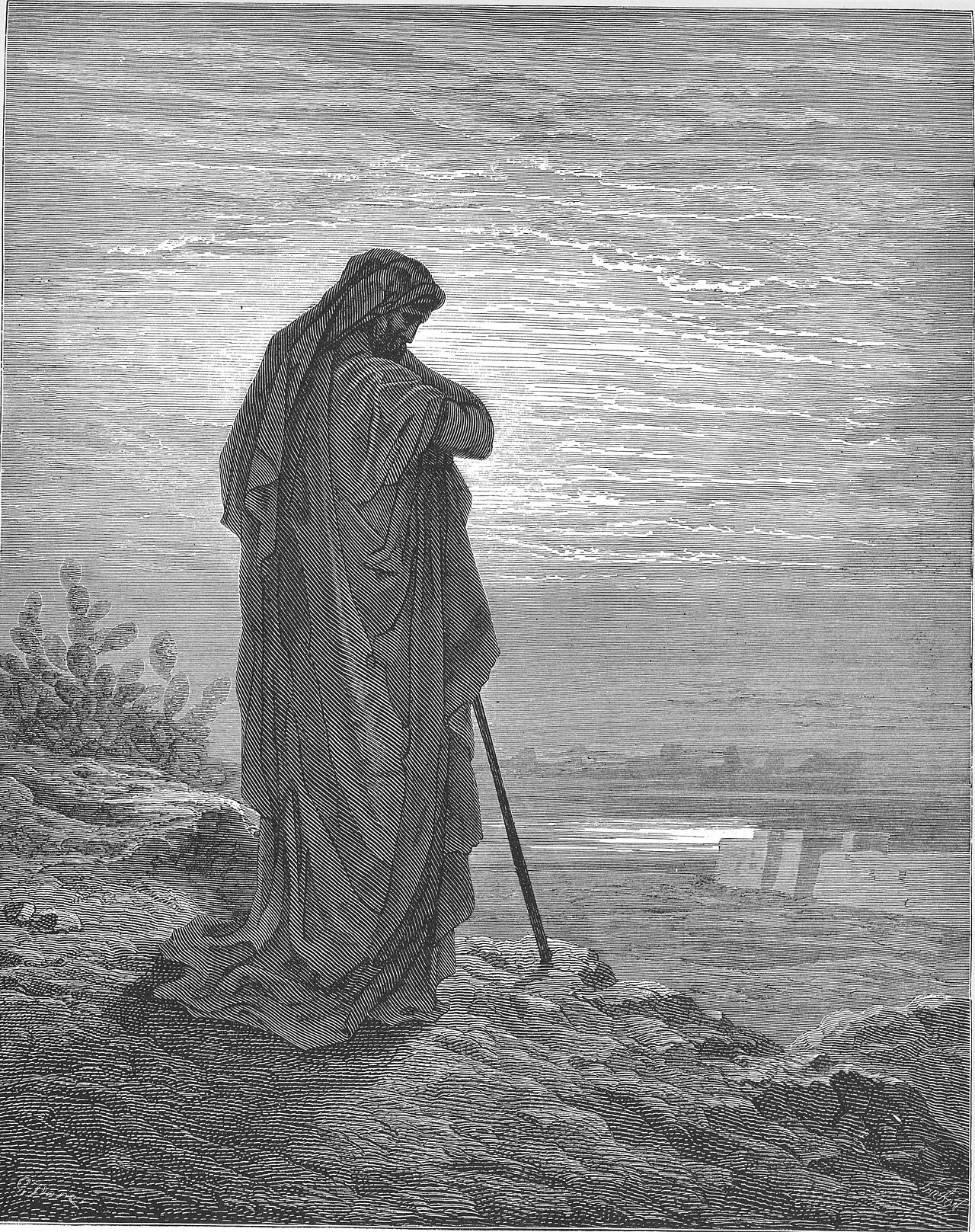
The Prophet Amos — Gustave Doré
The shepherd of Tekoa — the LORD roars from Zion — Gustave Doré, Doré’s English Bible (1866), public domain · Amos 1:1-2

The Trap

eight oracles, growing, until the audience is caught in its own applause (1:3–2:16)

Each oracle opens with the same formula — “for three transgressions... yea, for four” — a Semitic idiom for a full, overflowing measure. The nations move inward geographically, each condemnation the Israelite audience would applaud, until Judah takes a warm-up jab and then, without warning, Israel itself — indicted at eleven verses, longer than any other oracle by more than three times, and nearly two-thirds the length of all seven others put together.

The nations Israel would cheer againstJudah — the warm-up jabIsrael — the trap springs shut
  1. DamascusAmos 1:3–5Threshed Gilead under iron sledges — war waged without mercy.
  2. GazaAmos 1:6–8Sold a whole captive people into slavery.
  3. TyreAmos 1:9–10The same slave trade — and the breaking of a brotherly covenant.
  4. EdomAmos 1:11–12Pursued his brother nation with the sword, and cast off all pity.
  5. AmmonAmos 1:13–15Ripped open pregnant women in Gilead to enlarge a border.
  6. MoabAmos 2:1–3Burned a rival king's bones to lime — desecration past the grave.
  7. JudahAmos 2:4–5Despised the law of the LORD and let its statutes go — the audience's rival kingdom, jabbed before the trap springs.
  8. IsraelAmos 2:6–16Sold the righteous for silver, the needy for a pair of shoes, and trampled the poor into the dust — the longest oracle in the sequence by far.

The Argument

the whole book in three sentences
Author
Amos of Tekoa (1:1) — a Judean shepherd/herdsman, no prophetic guild pedigree
Date
c. 760–750 BC, under Uzziah of Judah and Jeroboam II of Israel — likely the earliest writing prophet
Audience
The Northern Kingdom (Israel), at the peak of Jeroboam II's prosperity
Genre
Covenant-lawsuit oracles + three sermons + five visions, closing in restoration
  1. 1

    Amos opens with a rhetorical trap — oracles against Israel's neighbors his hearers would cheer — before it springs shut on Israel itself, indicted more severely than the nations because “you only have I known... therefore I will visit upon you all your iniquities” (3:2).

  2. 2

    Three sermons build the indictment — exploitation of the poor, the complacent “kine of Bashan,” ritual divorced from justice — until five escalating visions, with intercession fading to nothing, announce the verdict is final.

  3. 3

    The book does not end there: beyond judgment, the LORD will raise up “the tabernacle of David that is fallen” (9:11).

The Five Visions

intercession fades to nothing as the verdict's finality rises (7:1–9:10)

Amos intercedes for Israel twice, and twice the LORD relents. From the third vision onward, no plea is recorded — the visions escalate toward a fifth that is not even a vision-and-dialogue anymore, only a decree.

The historical interlude — Amaziah vs. Amos (7:10–17)

Between the third and fourth visions, the book's one narrated scene: Amaziah, priest of Bethel, orders Amos back to Judah. Amos answers with his own credentials — not a guild prophet, but a herdsman and dresser of sycomore fruit, taken from following the flock by direct divine call (7:14–15). A lay call against a professional pedigree.

The Shape Beneath the Sermons

three hymns at the seams, a funeral song over a living nation, and five refrains that never land

Three doxologies at the structural breaks

Three times the indictment stops and the book breaks into praise of the LORD as Creator. Each falls where a major section ends, and their placement is part of the argument: the God being ignored at the sanctuaries is the God who formed the mountains. Many scholars read them as liturgical fragments, perhaps drawn from an older hymn to the Creator-Judge — a reasonable reading of their sudden hymnic register, but not a settled source-critical fact.

A funeral song for someone still alive — 5:1–2

Amos takes up a qinah, the limping lament-meter Israel used at burials, and sings it over the northern kingdom at the height of its prosperity: “The virgin of Israel is fallen; she shall no more rise.” Nothing has happened yet. The nation is rich, expanding, and confident — and its prophet is already at the graveside.

Five blows, one refrain — 4:6–11

Five escalating disasters, and after every one the same sentence: yet have ye not returned unto me, saith Jehovah. The repetition is the point — mercy kept sending warnings, and the warnings kept being survived rather than heeded, until 4:12 stops arguing: “prepare to meet thy God, O Israel.”

  1. 01Amos 4:6Cleanness of teeth and want of bread in every city — famine.
  2. 02Amos 4:7–8Rain withheld from one city and given to another; the thirsty wander and are not satisfied.
  3. 03Amos 4:9Blasting and mildew; the palmerworm devours gardens, vineyards, figs and olives.
  4. 04Amos 4:10Pestilence “after the manner of Egypt,” and young men taken by the sword.
  5. 05Amos 4:11Cities overthrown as Sodom and Gomorrah — survivors “as a brand plucked out of the burning.”

The Ground Under the Oracles

the dirt, the money, and the earthquake behind an 8th-century indictment
Samaria's ivories3:15; 6:4

Amos indicts “houses of ivory” and “beds of ivory” — and excavations at Samaria under J. W. Crowfoot, in the early-to-mid 20th century, recovered a substantial cache of carved ivory inlays consistent with exactly that kind of luxury. It corroborates the wealth Amos describes without needing to be tied to any particular palace or king.

The earthquake Amos dates his ministry by1:1; cf. Zech 14:5a proposed correlation

Amos dates himself “two years before the earthquake” — an event still remembered as a byword for sudden flight when Zechariah invokes it over two centuries later. Yigael Yadin's excavations at Hazor identified a destruction layer some scholars have correlated with it, dated to roughly the mid-8th century BC. That is a proposed correlation, not yet confirmed — the stratum designation and date range are still argued — so it is offered here as a plausible identification, not a settled one.

Jeroboam II's golden decades2 Ki 14:23–29

The prosperity Amos indicts is historical: under Jeroboam II, Israel's borders were restored “from the entrance of Hamath unto the sea of the Arabah” (2 Kings 14:25), a peak of northern-kingdom power and wealth. The Assyrian campaigns that would end it begin in the 740s BC — after Amos, not during him. He announces the collapse while the money is still coming in.

Amos names Kir as the Arameans’ own place of origin (9:7), and population transfer on that scale is well attested in Assyrian royal inscriptions of the period — but where Kir actually was is still debated, so no site is identified here.

Christ in Amos

three lines, one of them load-bearing for the whole New Testament
The tabernacle of David, raised again9:11–12 → Acts 15:16–18

The book's single most load-bearing New Testament usage. At the Jerusalem Council, James cites this oracle as the scriptural warrant for receiving Gentile believers without circumcision — an 8th-century BC promise of restored Davidic kingship read as fulfilled in the Messiah's reign gathering Jew and Gentile into one people. The Council's own scene, and the genuine MT/LXX textual question this citation sits on top of, has its own page.

Open the Council →
“Did ye bring unto me sacrifices?” — Stephen's speech5:25–27 → Acts 7:42–43

Stephen quotes Amos's rebuke of wilderness idolatry almost verbatim before the Sanhedrin, in the church's earliest recorded martyr sermon — a direct line from Amos's 8th-century covenant-lawsuit into first-century apostolic preaching.

“The sun to go down at noon”8:9 — homiletical, not a direct fulfillment claim

Preachers across church history have drawn a typological parallel between Amos's darkened noon and the darkness at the crucifixion (Matt 27:45). Presented here explicitly as later homiletical reflection, not as exegesis of Amos's own historical referent — the 8th-century judgment on Israel the oracle itself announces.

“In him God’s covenant with David had its accomplishment; and the glory of that house, which was not only sullied, but quite sunk, revived again; the breaches of it were closed and its ruins raised up, as in the days of old; nay, the spiritual glory of the family of Christ far exceeded the temporal glory of the family of David when it was at its height.”

Matthew Henry, Commentary on the Whole Bible(1710), on Amos 9:11 — public domain.

Themes

six load-bearing lines through the book
01

Mishpat and tsedaqah — justice and righteousness

Amos 5:24

The book's twin keynotes, paired at its climax: “But let justice roll down as waters, and righteousness as a mighty stream.” Covenant-court terms — the right verdict at the gate, right relationship lived toward the poor — not abstract virtues. Where the ASV reads “justice,” the KJV renders the same word, mishpat, as “judgment,” which is why the verse is quoted both ways.

02

Election intensifies accountability

Amos 3:2

“You only have I known of all the families of the earth: therefore I will visit upon you all your iniquities.” Covenant privilege is the ground of Israel's judgment, not its exemption.

03

Ritual without justice is rejected, not merely insufficient

Amos 5:21–24

“I hate, I despise your feasts... take thou away from me the noise of thy songs.” Among Scripture's starkest statements that worship divorced from obedience is offensive to God, not neutral.

04

The complacent wealthy — kine of Bashan

Amos 4:1

Samaria's ruling class addressed as fattened cattle who oppress the poor while demanding luxury — an indictment of a whole social system, not isolated individuals.

05

The reversed Day of the LORD

Amos 5:18–20

Israel expected the Day of the LORD as vindication; Amos overturns it — “Shall not the day of Jehovah be darkness, and not light?” On the conventional dating this is the earliest extant use of the formula among the writing prophets, and it lands as a warning, not a promise.

06

The famine of the word

Amos 8:11–12

“I will send a famine in the land, not a famine of bread, nor a thirst for water, but of hearing the words of Jehovah.” The ultimate covenant curse is not starvation but divine silence.

The Approved Voices on Amos

the roster applied — the specific work named, so you can go to it
R. C. Sproulcite-only ≤50w

The Holiness of God (1985)

Cite-only, ≤50 words. Applies directly to 4:12's “prepare to meet thy God” — the confrontation with a holy standard, the plumb line of 7:7–8, that does not bend to human self-assessment.

John Pipercite-only ≤50w

the Desiring God corpus (specific title pending verification)

Cite-only, ≤50 words. His justice-and-God's-glory framework fits Amos's fusion of worship and justice at 5:21–24 — right worship and right treatment of the poor as one demand, not competing priorities.

A. W. Tozercite-only ≤50w

The Knowledge of the Holy (1961)

Cite-only, ≤50 words. His holiness-of-God emphasis applies to 4:12–13's confrontation with the Creator-Judge of the embedded doxology.

Chuck Misslercite-only ≤50w

catalog Amos treatment pending verification via Koinonia House

Marcus Brown's formative teacher. No confirmed dedicated “Book of Amos” title is independently confirmed yet; his integrated-design, numerical-pattern hermeneutic is carried here as method — applied to the “three... and four” formula and the five-vision structure — pending catalog confirmation.

Charles Spurgeonpublic domain

Metropolitan Tabernacle Pulpit (63 vols., PD) — specific sermon titles pending verification

Plausibly touches “prepare to meet thy God” (4:12) and 5:24's justice imagery; sermon titles are being confirmed via SpurgeonGems.org before any text is drawn from them.

John Calvinpublic domain

Commentaries on the Twelve Minor Prophets

The standard Reformed full-text commentary on Amos — Calvin's own lectures on the minor prophets are a dedicated, book-length treatment worth foregrounding specifically here.

Matthew Henry · JFB · Wesley · Keil & Delitzschpublic domain

the PD whole-canon commentaries, verse by verse on Amos

The public-domain floor beneath every Amos verse page, pulled at build time rather than hand-quoted here.

Marcus Brown’s own commentary leads above all; within a tier, all voices are equal. Martin Luther King Jr.’s reception of 5:24 is handled below as cultural-reception fact, not a roster theological voice. No verbatim public-domain quotation appears on this page until the quote-pull pass confirms exact wording.

Contested Points

presented at full strength, then MannaFest's flag

The “tabernacle of David” — MT vs. LXX at 9:11–12, and its use in Acts 15

The MT-original position

The Hebrew reads “that they may possess the remnant of Edom, and all the nations that are called by my name” — conquest language, Israel absorbing its neighbors. On this reading, James and the LXX translators apply a Spirit-guided fuller sense, legitimately extending the oracle's referent beyond its 8th-century horizon.

The LXX-original position

The Greek reads “that the residue of men may seek after the Lord, and all the Gentiles” — inclusion language, which James quotes directly at the Council (Acts 15:17). On this reading, the LXX may preserve a genuinely earlier or variant Hebrew text, and James is quoting Scripture as it legitimately stood, not creatively reinterpreting the MT.

MannaFest flag — The MT/LXX divergence traces to near-identical unpointed consonant clusters — Edom vs. “mankind,” “possess” vs. “seek” — a documented textual-critical crux, not an error in either direction. MannaFest presents both positions at full strength; this is load-bearing for how Acts 15 uses the Old Testament and deserves the fuller scene, not a flattened answer.

The Jerusalem Council, in full →

Amos's “I was no prophet” (7:14) — denial or refusal of a label?

The past-tense / traditional reading

“I was no prophet, neither was I a prophet's son” — before this call Amos had no prior prophetic status, but has one now by direct divine commission (7:15). The contrast is institutional pedigree vs. direct call.

The present-tense reading

Hebrew has no explicit copula here, so the clause could equally read “I am no prophet... even now,” in a technical guild sense — Amos refusing the professional label even while actively ministering.

MannaFest flag — Both readings preserve the same basic point — a lay call, not a guild credential — and differ only on the exact status Amos claims at the moment of speaking. MannaFest does not need to adjudicate the grammatical nuance to preach the passage's main point: a shepherd with no pedigree, sent by direct word.

5:24 — covenant-lawsuit grammar, or a free-standing social-justice text?

The covenant-lawsuit (rib) reading

Amos's justice oracles function within the formal rib genre — YHWH as covenant suzerain indicting Israel for treaty violation. The “justice” in view is covenant fidelity toward the poor as stipulated in Torah, inseparable from 5:4–6's “Seek ye me, and ye shall live.” Right worship and social justice are two faces of one covenant loyalty.

The reception-history reading

5:24 has become one of Scripture's most quoted verses in modern social-justice discourse — most famously by Martin Luther King Jr., “I Have a Dream” (1963): “we will not be satisfied until justice rolls down like waters, and righteousness like a mighty stream.” A real and honorable application, not the verse's original genre.

MannaFest flag — MannaFest holds both: the covenant-lawsuit frame governs the exegesis, and the verse's modern reception is a real and honorable extension of its force, correctly located as application rather than substituted for the text's own 8th-century grammar.

The Cast and the Land

one narrated confrontation, and geography spanning eight nations
Amos of Tekoa1:1, 7:14–15 — a Judean shepherd and sycomore-dresser, sent north by direct call, no guild pedigree.
Amaziah of Bethel7:10–17 — priest of the royal sanctuary who confronts Amos and orders him home, the book's one narrated scene.

Jeroboam II and Uzziah, the superscription's two kings (1:1), and Jeroboam's territorial expansion (2 Ki 14:23–29), supply the prosperity Amos indicts — verified person pages for this book's named figures are pending.

Places

Keep studying

— more from The Prophets

Drafted from MannaFest's research brief on Amos — public-domain commentators (Calvin, Henry, JFB, Wesley, Keil & Delitzsch, Spurgeon) paraphrased, with ledger-confirmed verbatim excerpts, and the founder's approved-voices roster cite-only for moderns. Scripture ASV. Every cited work — the sources registry →