
Hebrews 10:33
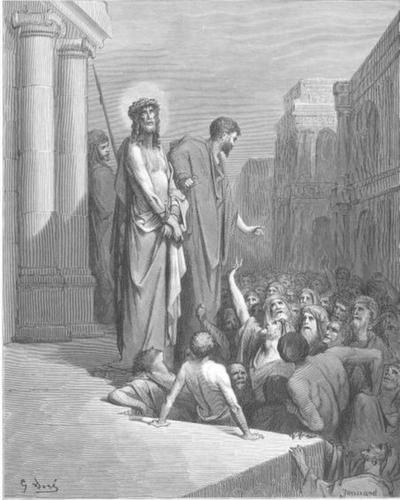
in Hebrews 10Sometimes you were publicly exposed to ridicule and persecution; at other times you were partners with those who were so treated.
BSB
The same verse in ASV and KJV ▾
ASV
partly, being made a gazingstock both by reproaches and afflictions; and partly, becoming partakers with them that were so used.
KJV
Partly, whilst ye were made a gazingstock both by reproaches and afflictions; and partly, whilst ye became companions of them that were so used.
⋯
This verse in Hebrews 10
Commentary
11 notes on this verseNow "exposures to abuse and persecutions" they had to endure, because the law imposed on them the requirement to reveal their sins over their offerings. However, these exposures to abuse discouraged people from revealing their sins. These difficulties, he says, that you had in revealing …
This site's exposition
call to remembrance the former days
on Hebrews 10:32-34
As before, the warning turns immediately to evidence of grace already shown: call to remembrance the former days, right after their illumination, when they endured a great fight of afflictions, some as public gazingstocks under reproach, others standing by their companions who suffered. Verse 34 names two specific griefs the readers already bore, compassion shown to the writer in his bonds and the joyful loss of their own goods, taken because they knew, present tense knowledge rather than a wish, that they possessed in heaven a better and an enduring substance. The better thread returns at its most personal, the readers' own history read back to them as proof that the warning is not a verdict already passed against them.
The record, by era
The Church Fathers2 voices
Then he also enumerates them particularly, amplifying his discourse, and multiplying his praise. How? "Partly" (he says) "whilst ye were made a gazing-stock by reproaches and afflictions"; for reproach is a great thing, and calculated to pervert the soul, and to darken the judgment. For hear what the prophet says: "While they daily say unto me, Where is thy God?" And again, "If the enemy had reproached me, I would have borne it." For since the human race is exceedingly vainglorious, therefore it is easily overcome by this. And he did not simply say "by reproaches," but that even with great intensity, being "made a gazing-stock." For when a person is reproached alone, it is indeed painful, but far more so when in presence of all. For tell me how great the evil was when men who had left the meanness of Judaism, and gone over, as it were, to the best course of life, and despised the customs of their fathers, were ill treated by their own people, and had no help. I cannot say (he says) that ye suffered these things indeed and were grieved, but ye even rejoiced exceedingly. And this he expressed by saying, "Whilst ye became companions of them that were so used," and he brings forward the Apostles themselves. Not only (he means) were ye not ashamed of your own sufferings, but ye even shared with others who were suffering the same things. This too is the language of one who is encouraging them. He said not, "Bear my afflictions, share with me," but respect your own.
"you endured a great struggle with sufferings, partly." A strong soul is needed to bear accusations and tribulations, even if they are done privately and secretly; however, since they were done openly and in front of everyone (for this means: you were made a spectacle), …
The Medieval Church2 voices
538. – Then when he says, and on the one hand by abuse and affliction you were made a gazing stock, he shows what these afflictions were. For a person suffers in two ways: in himself by enduring affliction, and in someone else by taking …
Pay attention to the praise. Namely, a person with a noble soul has need to endure reproaches, as the prophet testifies: "they said to me every day: where is your God?" (Ps. 42:3) and: "for it is not an enemy who reproaches me — that …
The Puritans and the Awakening1 voice
Partly whilst ye were made a gazing stock,.... Brought upon the stage or theatre, and made a spectacle to the world, angels, and men, 1Co 4:9 both by reproaches and afflictions; suffering both in their characters and reputations, and in their persons and substance: and partly whilst ye became companions of them that were so used; they maintained their communion with them, relieved them in distress, and sympathized with them.
4 more voices on this verse
The Puritans and the Awakening1 voice
Christians are one body, are animated by one spirit, have embarked in one common cause and interest, and are the children of that God who is afflicted in all the afflictions of his people.
The Nineteenth Century3 voices
A commentator
Albert Barnes1798–1870
Notes, Explanatory and Practical, on the Old and New Testaments (1832-1869)
Partly - That is, your affliction consisted partly in this. The Greek is, “this” - specifying one kind of affliction that they were called to endure. Whilst ye were made a gazing-stock - Greek θεατριζόμενοι theatrizomenoi - you were made a public spectacle, as if in a theater; you were held up to public view, or exposed to public scorn. When this was done, or in precisely what manner, we are not told.
A commentator
Jamieson, Fausset & Brown1802–1910
Commentary Critical and Explanatory on the Whole Bible (1871)
The persecutions here referred to seem to have been endured by the Hebrew Christians at their first conversion, not only in Palestine, but also in Rome and elsewhere, the Jews in every city inciting the populace and the Roman authorities against Christians. gazing-stock--as in a theater (so the Greek): often used as the place of punishment in the presence of the assembled multitudes.
Ye were made a gazing-stock - Θεατριζομενοι· Ye were exhibited as wild beasts and other shows at the theatres. See the note on 1Co 4:9, where all this is illustrated. Companions of them that were so used - It appears, from 1Th 2:14, 1Th 2:15, that the Churches of God in Judea were greatly persecuted, and that they believed with courage and constancy in their persecutions. When any victim of persecuting rage was marked out, the rest were prompt to take his part, and acknowledge themselves believers in the same doctrine for which he suffered. This was a noble spirit; many would have slunk into a corner, and put off the marks of Christ, that they might not be exposed to affliction on this account.
The words behind it
14 Greek wordsEvery Greek word of this verse in the order it stands, with what it means and the door to its own study. The last column counts the times a word stands in the whole Bible: the rarer the word, the more the places it appears belong together.
| Greek | Sound | Meaning | Word study | In the Bible |
|---|---|---|---|---|
| τοῦτο | touto | this | G3778 → | 1381 times |
| μὲν | men | indeed | G3303 → | 176 times |
| ὀνειδισμοῖς | oneidismois | by revilings | G3680 → | 5 times |
| τε | te | both | G5037 → | 213 times |
| καὶ | kai | and | G2532 → | 9120 times |
| θλίψεσιν | thlipsesin | by tribulations | G2347 → | |
| θεατριζόμενοι, | theatrizomenoi | being made a spectacle, | G2301 → | |
| τοῦτο | touto | this | G3778 → | 1381 times |
| δὲ | de | however | G1161 → | 2765 times |
| κοινωνοὶ | koinonoi | partners | G2844 → | |
| τῶν | ton | of those | G3588 → | 19766 times |
| οὕτως | houtos | thus | G3779 → | 208 times |
| ἀναστρεφομένων | anastrephomenon | passing through [them] | G390 → | |
| γενηθέντες· | genethentes | having become; | G1096 → | 667 times |
τοῦτοthis
toutoG3778 →1381 times
μὲνindeed
menG3303 →176 times
ὀνειδισμοῖςby revilings
oneidismoisG3680 →5 times
τεboth
teG5037 →213 times
καὶand
kaiG2532 →9120 times
θλίψεσινby tribulations
thlipsesinG2347 →
θεατριζόμενοι,being made a spectacle,
theatrizomenoiG2301 →
τοῦτοthis
toutoG3778 →1381 times
δὲhowever
deG1161 →2765 times
κοινωνοὶpartners
koinonoiG2844 →
τῶνof those
tonG3588 →19766 times
οὕτωςthus
houtosG3779 →208 times
ἀναστρεφομένωνpassing through [them]
anastrephomenonG390 →
γενηθέντες·having become;
genethentesG1096 →667 times
A shaded row is a word that stands 400 times or fewer in the Bible.
The walk
8 stopsEach card is a verse this one points to, and under it the verses that one points to in turn. Where several paths arrive at the same place, that place is listed first: the text keeps returning to it.
Through
2 Corinthians 12:10That is why, for the sake of Christ, I delight in weaknesses, in insults, in hardships, in persecutions, in difficulties. For when I am weak, then I am strong.
it leads to
- 2 Corinthians 12:9
But He said to me, “My grace is sufficient for you, for My power is perfected in weakness.” Therefore I will boast all the more gladly in my weaknesses, so that the power of…
- Ephesians 6:10
Finally, be strong in the Lord and in His mighty power.
- Romans 5:3
Not only that, but we also rejoice in our sufferings, because we know that suffering produces perseverance;
- 2 Corinthians 13:4
For He was indeed crucified in weakness, yet He lives by God’s power. And though we are weak in Him, yet by God’s power we will live with Him to serve you.
- James 1:2
Consider it pure joy, my brothers, when you encounter trials of many kinds,
- 2 Corinthians 12:9
Through
Philippians 1:7It is right for me to feel this way about all of you, since I have you in my heart. For in my chains and in my defense and confirmation of the gospel, you…
it leads to
- 2 Corinthians 7:3
I do not say this to condemn you. I have said before that you so occupy our hearts that we live and die together with you.
- 2 Corinthians 7:3
Through
Isaiah 51:7Listen to Me, you who know what is right, you people with My law in your hearts: Do not fear the scorn of men; do not be broken by their insults.
it leads to
- Matthew 5:11
Blessed are you when people insult you, persecute you, and falsely say all kinds of evil against you because of Me.
- Ezekiel 2:6
But you, son of man, do not be afraid of them or their words. Do not be afraid, though briers and thorns surround you, and you dwell among scorpions. Do not be afraid of…
- Matthew 5:11
Where this verse is studied
On this page
Studies16
On this verse
On this chapter
- The Binding of Isaac (Genesis 22)
- The General Epistles
- The Covenants
- Eternal Security, and the Five Warnings of Hebrews
- The Messianic Psalms
- The Tabernacle
- The Ascension: Acts 1:1-11 · Luke 24:50-53
- The Blood
- The Door & the Gate
- The Just Shall Live by His Faith: Habakkuk 2:4
- The Right Hand
- The Shadow
- Types of Christ
About Hebrews
This page draws on 11 works. Open the list of works
This page draws on Adam Clarke, Commentary on the Bible; Albert Barnes, Notes on the New Testament; Albert Barnes, Notes, Explanatory and Practical, on the Old and New Testaments (1832-1869); Ephrem the Syrian, COMMENTARY ON THE EPISTLE TO THE HEBREWS; Jamieson, Fausset & Brown, Commentary Critical and Explanatory on the Whole Bible; John Chrysostom, Homily on Hebrews 21; John Gill, Exposition of the New Testament (1746-1748); Matthew Henry, Commentary on the Whole Bible; Oecumenius, The Pseudo-Oecumenian Catena on Hebrews; Theophylact of Ohrid, Commentary on Hebrews and Thomas Aquinas, Commentary on Hebrews.