
Exoduschapter 2
25 verses · Moses, by tradition · 15th or 13th century BC · The Law
In Jewish life
The reading
Weekly portion 13 of 54
שְׁמוֹת Shemot, Exodus 1:1 to 6:1
Read with it: Isaiah 27:6 to 28:13 and 29:22 to 29:23 in Ashkenazi use, and Jeremiah 1:1 to 2:3 in Sephardi use.
The verse numbers here are the ones a Hebrew Bible carries, which differ from an English Bible by a verse or two in several places. The Sephardi reading is named only where this site records a difference; communities vary beyond what is listed. What these books are, and how a Christian reader meets them →
How it is read
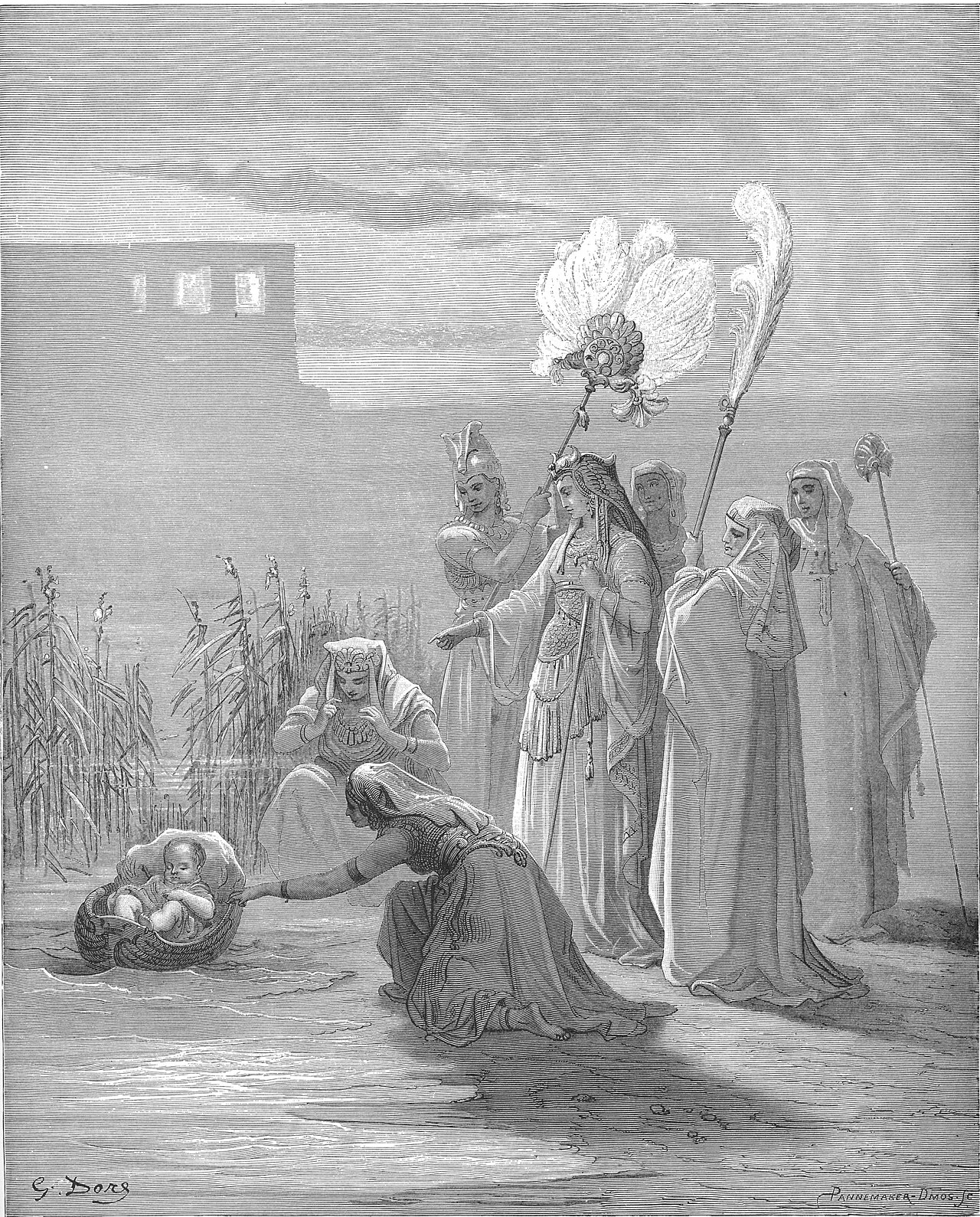
Rashi fills the gaps of the birth story from the tradition. At verse 1 he holds that Amram had separated from his wife under Pharaoh's decree and then took her back. At verse 2 he carries the saying that when Moses was born "the whole house became filled with light" (Rashi on Exodus 2:2:1). At verse 6 he gives the plain sense first, that Pharaoh's daughter saw the child. Then he gives the midrashic reading, that "she saw the Shechina with him" (Rashi on Exodus 2:6:1). He names the two quarrelling Hebrews of verse 13 as Dathan and Abiram (Rashi on Exodus 2:13:1). At verse 16 he reads the priest of Midian as a man who had left the idol worship of his people and been banished for it (Rashi on Exodus 2:16:1). The text is the Rosenbaum and Silbermann Rashi of 1929 to 1934, in the public domain. Ibn Ezra's notes on Miriam at the river and on Jethro's daughters stand by reference alone (Ibn Ezra on Exodus 2:4:1 and 2:18:1).
What the rabbis say
The rabbis take up the marriage of verse 1 at Bava Batra 119b:13, and the birth of verse 2 at Avot DeRabbi Natan 2:5. On the ark of bulrushes they taught in Bereshit Rabbah 31:9. On the daughter of Pharaoh at the river they taught in Bamidbar Rabbah 14:1. The Mekhilta reads the killing of the Egyptian at Tractate Amalek 3:26, and Midrash Lekach Tov, Exodus 2:22:1 carries the naming of Gershom.
The text, verse by verse
Each word shows the Hebrew, the English under it, how it sounds and its Strong’s number. A rule between verses marks where the Hebrew manuscripts end a paragraph.
Drawn Out of the Water
Ramban on Exodus 2:1
Our Rabbis have said. Sotah 12a. that he went after the advice of his daughter. 52 Amram and Jochebed, Moses’ parents, had been married previously. The children of that union were Miriam and Aaron.
Read it in full at Sefaria · Commentary on the Torah by Ramban (Nachmanides). Translated and annotated by Charles B. Chavel. New York, Shilo Pub. House, 1971-1976
Moses Kills and Flees
Ramban on Exodus 2:11
This is to be understood that he grew to manhood. It has already been said, And the child grew, 80 Verse. which means that it was no longer necessary to wean him, and then the mother.
Read it in full at Sefaria · Commentary on the Torah by Ramban (Nachmanides). Translated and annotated by Charles B. Chavel. New York, Shilo Pub. House, 1971-1976
Ibn Ezra on Exodus 2:13
Nitzim (striving) is a nifal adjective. 135 That is, a nifal participle. I.E. refers to nifal participles as adjectives.
Read it in full at Sefaria · Ibn Ezra's commentary on the Pentateuch, tran. and annot. by H. Norman Strickman and Arthur M. Silver. Menorah Pub., 1988-2004
Ramban on Exodus 2:14
WILT THOU SPEAK TO KILL ME? “From here we learn that Moses had killed the Egyptian by merely pronouncing the Tetragrammaton.” 84 The Tetragrammaton ( Shem Hamphorash or Shem Hamyuchad ) is the Proper Name of G-d.
Read it in full at Sefaria · Commentary on the Torah by Ramban (Nachmanides). Translated and annotated by Charles B. Chavel. New York, Shilo Pub. House, 1971-1976
A Stranger in the Land of Midian
God Hears Their Groaning
Hebrew words in this chapter
The 40 most used Hebrew words of the chapter, counted by lemma. The article, the object marker, the negatives and the common prepositions are left out.
| Word | Sense here | Uses | Strong’s |
|---|---|---|---|
| אָמַרʼâmar | to say | 13 | H559 |
| בַּתbath | daughter | 9 | H1323 |
| אִישׁʼîysh | man | 8 | H376 |
| יֶלֶדyeled | the child | 8 | H3206 |
| מֹשֶׁהMôsheh | Moses | 8 | H4872 |
| רָאָהrâʼâh | and she saw | 7 | H7200 |
| פַּרְעֹהParʻôh | Pharaoh | 7 | H6547 |
| הָלַךְhâlak | went | 6 | H1980 |
| בֵּןbên | son | 5 | H1121 |
| קָרָאqârâʼ | to call | 5 | H7121 |
| בּוֹאbôwʼ | to come | 5 | H935 |
| אֱלֹהִיםʼĕlôhîym | God | 5 | H430 |
| לָקַחlâqach | and he took | 4 | H3947 |
| עִבְרִיʻIbrîy | Hebrew | 4 | H5680 |
| יָנַקyânaq | to suckle | 4 | H3243 |
| יוֹםyôwm | day | 4 | H3117 |
| מִצְרִיMitsrîy | Egyptian | 4 | H4713 |
| אִשָּׁהʼishshâh | woman | 3 | H802 |
| שׂוּםsûwm | and she put | 3 | H7760 |
| יְאֹרyᵉʼôr | the river | 3 | H2975 |
| Word | Sense here | Uses | Strong’s |
|---|---|---|---|
| יָדַעyâdaʻ | to know | 3 | H3045 |
| נָכָהnâkâh | striking | 3 | H5221 |
| הָרַגhârag | to kill | 3 | H2026 |
| יָשַׁבyâshab | to dwell | 3 | H3427 |
| דָּלָהdâlâh | and they drew | 3 | H1802 |
| שָׁקָהshâqâh | to water | 3 | H8248 |
| צֹאןtsôʼn | flock | 3 | H6629 |
| לֵוִיLêvîy | Levi | 2 | H3878 |
| יָלַדyâlad | and she bore | 2 | H3205 |
| צָפַןtsâphan | and she hid him | 2 | H6845 |
| תֵּבָהtêbâh | a basket of | 2 | H8392 |
| סוּףçûwph | among the rush | 2 | H5488 |
| אָחוֹתʼâchôwth | sister | 2 | H269 |
| יָדyâd | hand | 2 | H3027 |
| הִנֵּהhinnêh | and there | 2 | H2009 |
| נָתַןnâthan | I will pay | 2 | H5414 |
| גָּדַלgâdal | and he grew up | 2 | H1431 |
| שֵׁםshêm | name | 2 | H8034 |
| יָצָאyâtsâʼ | to come out | 2 | H3318 |
| אָחʼâch | brother | 2 | H251 |
Keep studying
Studies5
Words12
Trails1
Sources for this chapter
The Hebrew text
STEP Bible, the tagged Hebrew text and its English glosses and James Strong, Strong's Exhaustive Concordance.
In Jewish life
Rashi, Rashi on Exodus 2:1:1, 2:2:1, 2:6:1, 2:13:1 and 2:16:1, Pentateuch with Rashi's commentary by M. Rosenbaum and A. M. Silbermann, 1929 to 1934 (public domain); Ibn Ezra, Ibn Ezra on Exodus 2:4:1 and 2:18:1, cited by ref alone under the corpus licence rule; The Babylonian Talmud, Bava Batra 119b:13, cited by ref and The Midrash, Avot DeRabbi Natan 2:5, Bereshit Rabbah 31:9, Bamidbar Rabbah 14:1, Mekhilta DeRabbi Yishmael, Tractate Amalek 3:26, and Midrash Lekach Tov, Exodus 2:22:1, cited by ref.
The rabbinic texts
Ramban, Commentary on the Torah by Ramban (Nachmanides). Translated and annotated by Charles B. Chavel. New York, Shilo Pub. House, 1971-1976; Ibn Ezra, Ibn Ezra's commentary on the Pentateuch, tran. and annot. by H. Norman Strickman and Arthur M. Silver. Menorah Pub., 1988-2004 and Sefaria, texts and citation data.