
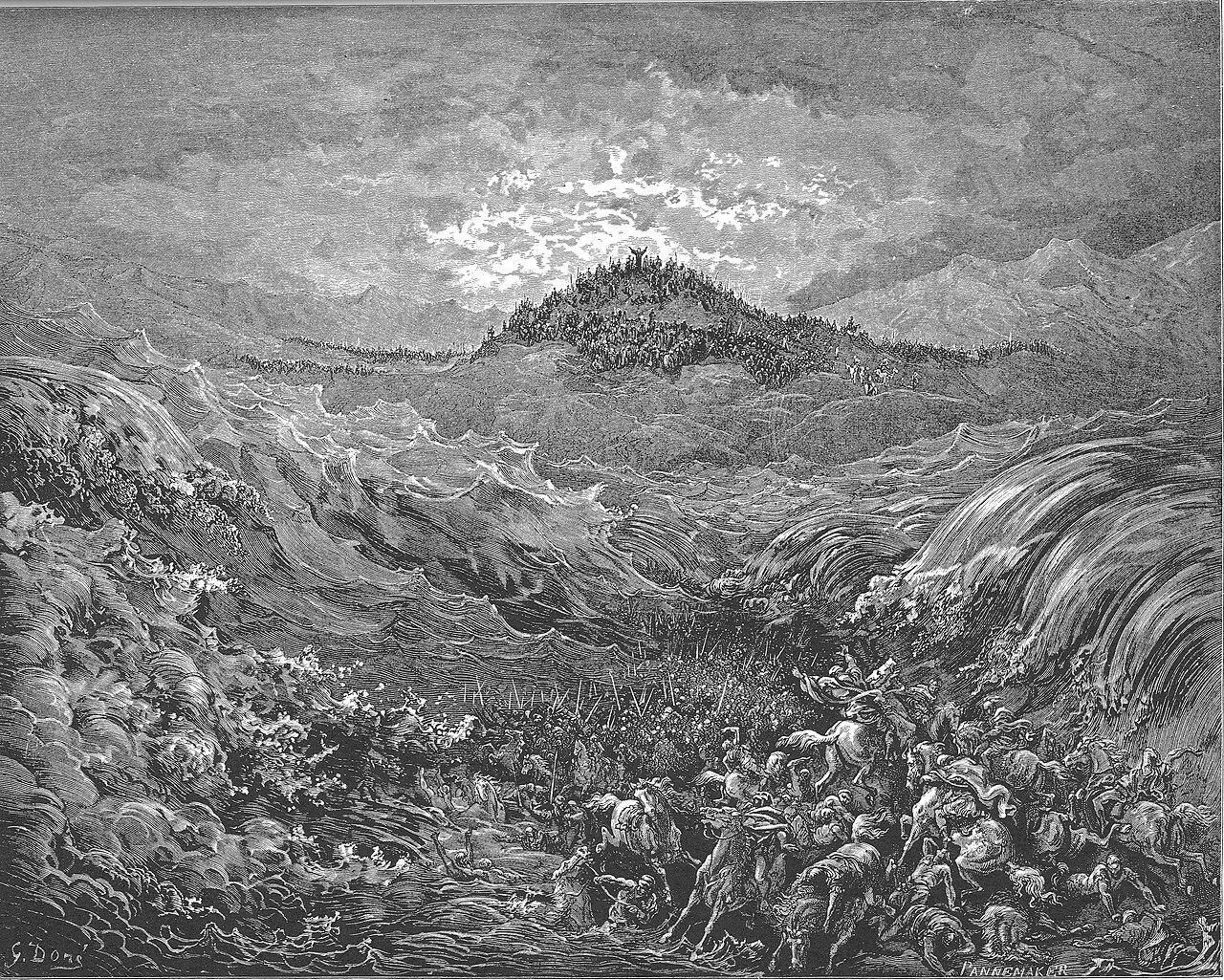
Exoduschapter 14
31 verses · Moses, by tradition · 15th or 13th century BC · The Law
In Jewish life
The reading
Weekly portion 16 of 54
בְּשַׁלַּח Beshalach, Exodus 13:17 to 17:16
Read with it: Judges 4:4 to 5:31 in Ashkenazi use, and Judges 5:1 to 5:31 in Sephardi use.
The verse numbers here are the ones a Hebrew Bible carries, which differ from an English Bible by a verse or two in several places. The Sephardi reading is named only where this site records a difference; communities vary beyond what is listed. What these books are, and how a Christian reader meets them →
What is done
Rashi sets this chapter on the calendar of the feast. He counts the days from the going out, and puts Israel in the sea on the night of the seventh day, with the Song sung the following morning. That, he says, is the seventh day of Passover, "and that is why we read The Song as the Scriptural lesson on the seventh day of the Festival" (Rashi on Exodus 14:5:1). He cites the tractate Megillah for it. A Christian reader meets the crossing as a story. A Jewish congregation meets it as a day in the week of the feast, with this chapter and the next read aloud on it.
How it is read
Rashi reads the turning back of verse 2 as a trap laid for Pharaoh, so that he would think Israel lost (Rashi on Exodus 14:2:1). At verse 8 he treats the hardening as the settling of a doubt. Pharaoh was in two minds whether to pursue, "and He hardened his heart to pursue" (Rashi on Exodus 14:8:1). At verse 15 he carries two readings of the answer given to Moses. In the first, Moses was standing in prayer, and was told that this was no time to pray at length while Israel stood in trouble. In the second, the words mean that the matter rests on God rather than on Moses (Rashi on Exodus 14:15:1). At verse 19 he reads the divine name used there as the name of judgment, and holds that Israel itself stood under judgment at that hour (Rashi on Exodus 14:19:1). At verse 20 he gives the parable of a father who moves his son in front of him or behind him as the danger shifts. At last the father carries the boy on his arm (Rashi on Exodus 14:20:1). The text is the Rosenbaum and Silbermann Rashi of 1929 to 1934, in the public domain.
What the rabbis say
The rabbis take up the chariots of verse 7 at Arakhin 15a:17 and Eikhah Rabbah 3:1. On Israel crying out at the sea they taught in Bamidbar Rabbah 8:3, and on the complaint of verses 11 and 12 at Arakhin 15a:15. On the east wind they taught in Bereshit Rabbah 55:8. The Mekhilta of Rabbi Shimon ben Yochai carries this chapter at eleven places, from 14:1 to 14:24.
The text, verse by verse
Each word shows the Hebrew, the English under it, how it sounds and its Strong’s number. A rule between verses marks where the Hebrew manuscripts end a paragraph.
Pharaoh Pursues to the Sea
Ibn Ezra on Exodus 14:1
It is truly not proper for an intelligent person to scrutinize God’s actions and ask, why did the Lord act thus?
Read it in full at Sefaria · Ibn Ezra's commentary on the Pentateuch, tran. and annot. by H. Norman Strickman and Arthur M. Silver. Menorah Pub., 1988-2004
Stand Still and See the Salvation
Onkelos Exodus 14:10
Pharaoh drew near, and the B’nei Yisrael looked up, and beheld the Egyptians coming after them.
Read it in full at Sefaria · Metsudah Chumash, Metsudah Publications, 2009 [with Onkelos translation]
Ibn Ezra on Exodus 14:11
We find that the holy tongue employs two words with one meaning back to back when one would suffice.
Read it in full at Sefaria · Ibn Ezra's commentary on the Pentateuch, tran. and annot. by H. Norman Strickman and Arthur M. Silver. Menorah Pub., 1988-2004
Ramban on Exodus 14:13
In the opinion of our Rabbis, 47 Yerushalmi Succah V,. See Maimonides’ “The Commandments,” Vol. II, pp. 44-46, in my translation. this is a negative commandment for all times.
Read it in full at Sefaria · Commentary on the Torah by Ramban (Nachmanides). Translated and annotated by Charles B. Chavel. New York, Shilo Pub. House, 1971-1976
Ibn Ezra on Exodus 14:14
Lakhem means for you. 54 Literally, to you, hence I.E.’s comment.
Read it in full at Sefaria · Ibn Ezra's commentary on the Pentateuch, tran. and annot. by H. Norman Strickman and Arthur M. Silver. Menorah Pub., 1988-2004
The Sea Split; Israel Walks Through
The Waters Return on Egypt
Hebrew words in this chapter
The 40 most used Hebrew words of the chapter, counted by lemma. The article, the object marker, the negatives and the common prepositions are left out.
| Word | Sense here | Uses | Strong’s |
|---|---|---|---|
| יְהֹוָהYᵉhôvâh | yahweh | 17 | H3068 |
| יִשְׂרָאֵלYisrâʼêl | Israel | 17 | H3478 |
| יָםyâm | sea | 17 | H3220 |
| מִצְרַיִםMitsrayim | Egypt | 15 | H4714 |
| פַּרְעֹהParʻôh | Pharaoh | 11 | H6547 |
| מִצְרִיMitsrîy | egypt | 11 | H4713 |
| בֵּןbên | people of | 10 | H1121 |
| אָמַרʼâmar | to say | 9 | H559 |
| רֶכֶבrekeb | chariot | 9 | H7393 |
| מֹשֶׁהMôsheh | Moses | 8 | H4872 |
| יָדyâd | hand | 7 | H3027 |
| פָּרָשׁpârâsh | and horsemen his | 6 | H6571 |
| בּוֹאbôwʼ | so they may go | 6 | H935 |
| עָשָׂהʻâsâh | and they did | 5 | H6213 |
| עַםʻam | people | 5 | H5971 |
| רָאָהrâʼâh | to see | 5 | H7200 |
| תָּוֶךְtâvek | in middle of | 5 | H8432 |
| מַחֲנֶהmachăneh | camp | 5 | H4264 |
| מַיִםmayim | water | 5 | H4325 |
| דָבַרdâbar | to speak | 4 | H1696 |
| Word | Sense here | Uses | Strong’s |
|---|---|---|---|
| שׁוּבshûwb | to return | 4 | H7725 |
| פִּי הַחִירֹתPîy ha-Chîyrôth | pi- | 4 | H6367 |
| בַּעַל צְפוֹןBaʻal Tsᵉphôwn | baal- | 4 | H1189 |
| רָדַףrâdaph | to pursue | 4 | H7291 |
| חַיִלchayil | army his | 4 | H2428 |
| נָסַעnâçaʻ | to set out | 4 | H5265 |
| נָטָהnâṭâh | to stretch | 4 | H5186 |
| הָלַךְhâlak | went | 4 | H1980 |
| חָנָהchânâh | and they may encamp | 3 | H2583 |
| מִדְבָּרmidbâr | the wilderness | 3 | H4057 |
| חָזַקchâzaq | and I will make strong | 3 | H2388 |
| לֵבlêb | heart | 3 | H3820 |
| כָּבַדkâbad | to honor | 3 | H3513 |
| עָבַדʻâbad | to serve | 3 | H5647 |
| לָקַחlâqach | he took | 3 | H3947 |
| יָרֵאyârêʼ | to fear | 3 | H3372 |
| מוּתmûwth | to die | 3 | H4191 |
| יוֹםyôwm | day | 3 | H3117 |
| יַבָּשָׁהyabbâshâh | dry land | 3 | H3004 |
| עָנָןʻânân | cloud | 3 | H6051 |
Keep studying
Studies5
Words12
Sources for this chapter
The Hebrew text
STEP Bible, the tagged Hebrew text and its English glosses and James Strong, Strong's Exhaustive Concordance.
In Jewish life
Rashi, Rashi on Exodus 14:2:1, 14:5:1, 14:8:1, 14:15:1, 14:19:1 and 14:20:1, Pentateuch with Rashi's commentary by M. Rosenbaum and A. M. Silbermann, 1929 to 1934 (public domain); Ibn Ezra, Ibn Ezra on Exodus 14:16:1 and 14:22:1, cited by ref alone under the corpus licence rule; The Babylonian Talmud, Arakhin 15a:17 and 15a:15, cited by ref and The Midrash, Eikhah Rabbah 3:1, Bamidbar Rabbah 8:3, Bereshit Rabbah 55:8, and Mekhilta DeRabbi Shimon Ben Yochai 14:1 to 14:24, cited by ref.
The rabbinic texts
Ramban, Commentary on the Torah by Ramban (Nachmanides). Translated and annotated by Charles B. Chavel. New York, Shilo Pub. House, 1971-1976; Ibn Ezra, Ibn Ezra's commentary on the Pentateuch, tran. and annot. by H. Norman Strickman and Arthur M. Silver. Menorah Pub., 1988-2004; Targum, Metsudah Chumash, Metsudah Publications, 2009 [with Onkelos translation] and Sefaria, texts and citation data.