
2 Samuelchapter 3
39 verses · Samuel, Nathan and Gad, by tradition · 10th century BC · History
Meanwhile, Saul had a concubine named Rizpah, the daughter of Aiah. So Ish-bosheth questioned Abner, “Why did you sleep with my father’s concubine?”
Introduction
Samuel, Nathan and Gad, by tradition, History, 2 Samuel Overview.
This chapter comes near the end of the long war between the house of Saul and the house of David. Its first hearers would have asked one question about it: did David arrange the deaths that cleared his way to the throne? The chapter is written to answer that question in public. It turns on the loyalty of one powerful man and the anger of another. Listen for the names of the women, since each one carries a claim to a throne. Watch where a killing takes place and what the king does in front of the whole people afterward.
Context
- Who
- Israelites weighing whether David was behind the killings that cleared his path
- What
- Abner's quarrel with Saul's son, his agreement to bring the north to David, and his murder by Joab at the gate of Hebron.
- Where
- Mahanaim east of the Jordan, where Abner held the northern court, and the gate of Hebron, where he died.
- When
- About 1005 BC, at the close of the seven and a half years at Hebron, a date that follows from the reign figures.
- Why
- To show that Abner's death was Joab's doing and none of David's, and to set David's public grief as the proof.
Historical context
2 Samuel names no author, and Samuel himself is dead before the book opens. The oldest internal lead is 1 Chronicles 29:29, which names the histories of Samuel the seer, Nathan the prophet and Gad the seer behind the acts of David. The chapter falls at the close of the Hebron years, about 1005 BC, a date that follows from the reign figures rather than from any external record. It moves between Mahanaim east of the Jordan, where Abner holds the northern court, and the gate of Hebron, where he dies. A first hearer knew a dead king's harem was political property, so taking a woman who had belonged to the king was a public claim on the throne. That is why the charge about Rizpah enrages Abner and frightens Saul's son, since it was a coup announced in the bedroom. He knew Michal had been David's wife by a bride price paid in Philistine trophies and then handed to another man, so her return gave David a legal tie to the old royal house. He knew Israelite law put the duty of avenging a killing on the nearest male relative, called the redeemer of blood, and separated battle manslaughter from murder. Cities were set aside where an accused man could stand trial rather than be run down, and Hebron was one of them. Joab kills Abner just inside the gate, in the one place a man was supposed to be safe, and the chief mourner's public conduct was the evidence of where a king stood.
Significance
Everyone in Israel would have asked who benefits. The chapter answers in the most public way available. The king fasts, mourns, and says out loud that he is weak this day though anointed, and that the sons of Zeruiah are too fierce for him. For the first hearers that was the difference between a kingdom built on murder and a kingdom that had inherited murderers it could not yet deal with.
This chapter in Jewish lifeWhat this chapter is in Jewish life and reading.
How it is read
The corpus for this chapter holds twenty-four commentary entries and forty rabbinic locators. Thirteen entries carry English text under a licence that permits quotation, and all thirteen are Rashi in the Metsudah translation, Lakewood, N.J., CC-BY, cited below by ref alone. Radak stands at five further places, Metzudat David at five and Malbim at one, with no English version, so those eleven are cited and never quoted.
Rashi handles two of the chapter's names as questions of paternity and marriage. On the second son born at Hebron he records that another book of Scripture calls the same child Daniel. He brings the answer of Rabbi Isaac. The cynics of the generation were saying that Abigail had conceived by Nabal, so the boy's face was made to resemble his father, and the name carries that. He adds a second reading from the Rabbis, that the name marks the boy's skill in halakhic argument (Rashi on II Samuel 3:3:1). On the sixth wife named in the list he writes that she is Michal, called by a name of endearment. He then takes up the verse that says Michal had no child. He dates her childlessness from the day she despised David rather than from the start (Rashi on II Samuel 3:5:1).
Abner's angry answer he reads twice over, once with the words for head and dog joined and once with the cantillation separating them. On the second reading Abner is saying that he would rather be an ordinary man in David's house than a chief in the house of Saul. Rashi notes that the Targum takes it that way too (Rashi on II Samuel 3:8:1). Of Paltiel following Michal and weeping, Rashi writes that he wept "over the good deed [about to be] leaving him". For all those years he had set a sword in the bed between them and never touched her (Rashi on II Samuel 3:16:1). At the killing of Abner he reads the gate as a court, saying that Joab brought him before a sanhedrin to be judged for the blood of his brother Asahel (Rashi on II Samuel 3:27:1).
What the rabbis say
One rabbinic saying on this chapter reaches the surface through Rashi with its own wording. On the name of the well from which Abner was called back, he reports that the Rabbis said "A well and a thorn caused Avner to be killed". Abner had explained away David's mercy at the cave and at the camp, treating the cut corner of the garment as the work of a thorn (Rashi on II Samuel 3:26:1). The saying is a play on the place name and a judgment on Abner at once.
Forty locators stand on this chapter in the corpus, twenty-four from the Midrash and sixteen from the Talmud, every one of them a locator without text. This chapter draws more Talmud than any other in the first half of the book. The chapter runs through Sanhedrin from end to end. The demand for Michal and her removal from Paltiel draw Sanhedrin 19b:10, Sanhedrin 19b:19, Sanhedrin 19b:20 and Tractate Soferim 7:4. The killing of Abner draws Sanhedrin 49a:12, David's lament over him draws Sanhedrin 20a:10 and Sanhedrin 20a:11, and his refusal of food draws Sanhedrin 20a:8. David's words against the house of Joab draw Aggadat Bereshit 40:1 and Arakhin 16a:7. The naming of David's sons at Hebron draws Berakhot 4a:11 and Berakhot 4a:12. The mourning at Abner's bier draws Ein Yaakov, Sanhedrin 2:5 and Ein Yaakov, Sanhedrin 2:7, and the chapter's last verse draws Bava Batra 4a:5.
Sources: Rashi, Rashi on II Samuel 3:3:1, 3:5:1, 3:8:1, 3:16:1, 3:26:1 and 3:27:1, The Metsudah Tanach series, Lakewood, N.J., CC-BY; Radak, Radak on II Samuel 3:7:1, 3:9:1, 3:14:1, 3:19:1 and 3:25:1, cited only, no English version in the corpus; Metzudat David, Metzudat David on II Samuel 3:1:1, 3:11:1, 3:21:1, 3:23:1 and 3:28:1, cited only; Malbim, Malbim on II Samuel 3:24:1, cited only; The Midrash and the Talmud on this chapter, Sanhedrin 19b:10, 19b:19, 19b:20, 20a:8, 20a:10, 20a:11 and 49a:12; Berakhot 4a:11 and 4a:12; Arakhin 16a:7; Bava Batra 4a:5; Tractate Soferim 7:4, as the corpus records them.
The heads below are this chapter's scenes. The numbered points under each are its verses.
The long war, and sons born at Hebron
David grew stronger and stronger: The chapter opens with the shape of the whole civil war stated as a single trend line: David rising, the house of Saul falling. Henry reads the verse as a picture of sanctification, grace waxing stronger against a weakening corruption, and gives it beside the plain history.
2 Samuel 3:1
“There was long war - Frequent battles and skirmishes took place between the followers of David and the followers of Ish-bosheth, after the two years mentioned above, to the end of the fifth year, in which Ish-bosheth was slain by Rechab and Baanah.”
Adam Clarke · Commentary on the Bible (1810-1826)evangelical
2 Samuel 3:2-5
sons were born to David in Hebron: Six sons are born to David in the seven and a half years at Hebron: Amnon, Chileab, Absalom, Adonijah, Shephatiah and Ithream. Absalom's mother is Maacah, “daughter of King Talmai of Geshur”. Three of the names carry the book's later grief, and Adonijah will claim the throne and die.
2 Samuel 3:2
“And unto David were sons born in Hebron,.... He was married before he came there, had wives in his state of exile, but had no children by them there, at least no sons; if any, only daughters: and his firstborn was Amnon, of Ahinoam the Jezreelitess; who being mentioned first, and her son his firstborn, seems to have been his wife before be took Abigail; he had not much comfort of this firstborn son of his; see 2Sa 13:1.”
his second was Chileab: Albert Barnes notes that the parallel list in Chronicles calls Chileab Daniel, a name meaning God judges, which recalls the death of Nabal. Barnes takes Chileab as a copyist’s slip. Talmai of Geshur bears the name of a son of Anak at Hebron.
2 Samuel 3:3
“Chileab - In the duplicate passage (see the margin.) David’s second son is called Daniel (God is my judge), a name given to him in commemoration of the death of Nabal 1Sa 25:39. Chileab seems to be made up of the three first letters of the following Hebrew word, through an error of the transcriber, and intended to be erased. Talmai king of Geshur - Talmai was the name of one of the sons of Anak at Hebron Num 13:22; this Talmai was perhaps of the same race.”
1 more voice on this verse
2 Samuel 3:3
“This marriage seems to have been a political match, made by David, with a view to strengthen himself against Ish-bosheth's party, by the aid of a powerful friend and ally in the north. Piety was made to yield to policy, and the bitter fruits of this alliance with a heathen prince he reaped in the life of the turbulent Absalom.”
Jamieson, Fausset & Brown · Commentary Critical and Explanatory on the Whole Bible (1871)reformed
his fourth was Adonijah: Shephatiah means God is judge, the name Jehoshaphat with its two parts reversed, as Albert Barnes notes. John Gill finds his name nowhere else in Scripture.
2 Samuel 3:4
“Adonijah - The same who, when David was dying, aspired to the crown, and was put to death by Solomon. Shephatiah - “God is judge.” This is the same name as Jehoshaphat, only with the two elements composing it placed in inverted order. Nothing more is known of him or of his brother Ithream.”
by David’s wife Eglah: Only Eglah is called David’s wife in the list. Jamieson, Fausset and Brown and Matthew Henry report the view that Eglah was another name for Michal, his first wife. Michal bore no child after 6:23, and the view holds she might have borne one before.
2 Samuel 3:5
“Eglah David's wife--This addition has led many to think that Eglah was another name for Michal, the first and proper wife, who, though she had no family after her insolent ridicule of David (2Sa 6:23), might have had a child before.”
Jamieson, Fausset & Brown · Commentary Critical and Explanatory on the Whole Bible (1871)reformed
Abner breaks with Ish-bosheth over a concubine
2 Samuel 3:6-8
Abner had continued to strengthen his position in the house of Saul: Abner has been strengthening “his position in the house of Saul”, and Ish-bosheth asks why he slept with Saul's concubine Rizpah. Taking a king's concubine was a claim on his throne. His answer, “Am I the head of a dog”, sets his loyal service against the charge.
2 Samuel 3:6
“Abner made himself strong - This strengthening of himself, and going in to the late king’s concubine, were most evident proofs that he wished to seize upon the government. See 1Ki 2:21, 1Ki 2:22; 1Ki 12:8; 1Ki 16:21.”
Adam Clarke · Commentary on the Bible (1810-1826)evangelical
a concubine named Rizpah: John Gill notes that Rizpah bore Saul two sons, and her story returns at chapter 21. Albert Barnes reads her father’s name, Aiah, as Edomite or Horite. Matthew Henry notes that the text never says whether the charge was true.
2 Samuel 3:7
“Rizpah, the daughter of Aiah - For the sequel of her history, see the marginal reference. Aiah, was an Edomite, or rather Horite name Gen 36:24.”
Albert Barnes finds the words that belongs to Judah obscure, and he reads them as Abner throwing back the charge that he sided with Judah. Matthew Henry notes that Abner never denies the act. He answers with his record of loyalty.
2 Samuel 3:8
“Am I a dog’s head - Dost thou treat a man with indignity who has been the only prop of thy tottering kingdom, and the only person who could make head against the house of David?”
Adam Clarke · Commentary on the Bible (1810-1826)evangelical
2 Samuel 3:9-11
what the LORD has sworn to him: Abner swears the self-cursing oath, “May God punish Abner, and ever so severely”. He vows to do for David “what the LORD has sworn to him”, to transfer the kingdom and set David's throne “from Dan to Beersheba”. Ish-bosheth holds a crown Abner has just declared forfeit.
2 Samuel 3:9
“Except, as the Lord hath sworn to David - And why did he not do this before, when he knew that God had given the kingdom to David? Was he not now, according to his own concession, fighting against God?”
Adam Clarke · Commentary on the Bible (1810-1826)evangelical
John Gill traces the oath to 1 Samuel 15:28, where the LORD tore the kingdom from Saul. Dan and Beersheba marked the north and south ends. Matthew Henry reads the zeal of Abner as ambition turned to revenge.
2 Samuel 3:10
“To translate the kingdom from the house of Saul,.... Which was what the Lord had sworn to do, 1Sa 15:28; and which Abner now threatens to do, insolently taking that to himself which belonged to the Lord, and as if he could not do it without him: and to set up the throne of David over Israel and over Judah; over the one as well as over the other; for it was set over Judah already: from Dan even unto Beersheba; which were the utmost borders of the land of Israel, from north to south, and so includes the whole.”
did not dare to say another word: Matthew Henry reads the silence as a weak king afraid of making his position worse. Adam Clarke calls it the lot of a king ruled by the commander of his own army. Ish-bosheth held the crown, and Abner held the power.
2 Samuel 3:11
“If Ish-bosheth had had the spirit of a man, especially of a prince, he might have answered him that his merits were the aggravation of his crimes, that he would not be served by so base a man, and doubted not but to do well enough without him. But he was conscious to himself of his own weakness, and therefore said not a word, lest he should make bad worse.”
Matthew Henry · Commentary on the Whole Bible (1707-1721)puritan
Abner's deal, and Michal brought home weeping
2 Samuel 3:12-14
Make your covenant with me: Abner opens the talks, “To whom does the land belong?”, and offers to bring all Israel over to David. David makes one condition, the return of Michal, “whom I betrothed to myself for a hundred Philistine foreskins”. The words name the bride price Saul set as a legal claim.
2 Samuel 3:12
“And Abner sent messengers to David on his behalf,.... On his own account, and not on the account of Ishbosheth, or the people of Israel; but to obtain terms for himself, or in his own name, as representing him and standing in his stead; or secretly, as Kimchi explains it, unknown to Ishbosheth, or the people of Israel.”
2 more voices on this verse
2 Samuel 3:12
“Abner sent messengers to David--Though his language implied a secret conviction, that in supporting Ish-bosheth he had been laboring to frustrate the divine purpose of conferring the sovereignty of the kingdom on David, this acknowledgment was no justification either of the measure he was now adopting, or of the motives that prompted it.”
Jamieson, Fausset & Brown · Commentary Critical and Explanatory on the Whole Bible (1871)reformed
2 Samuel 3:12
“He sent messengers to David, to tell him that he was at his service. " Whose is the land? For thou hast the best title to the government and the best interest in the people's affections." Note, God can find out ways to make those serviceable to the kingdom of Christ who yet have no sincere affection for it and who have vigorously set themselves against it.”
Matthew Henry · Commentary on the Whole Bible (1707-1721)puritan
one thing I require of you: Albert Barnes gives three motives: David’s love for Michal, the wrong in taking her, and the weight of a daughter of Saul as his queen. Adam Clarke notes the danger of leaving her with another man. Through her, that man could claim the throne.
2 Samuel 3:13
“David’s motive in requiring the restitution of Michal was partly his affection for her, and his memory of her love for him; partly the wish to wipe out the affront put upon him in taking away his wife, by obtaining her return; and partly, also, a politic consideration of the effect on Saul’s partisans of a daughter of Saul being David’s queen.”
Albert Barnes notes that David sent to Ish-bosheth while the covenant with Abner was still secret. The weak king had to act at Abner’s word. Augustine reads David taking Michal back as a picture of forgiveness under the new covenant.
2 Samuel 3:14
“Deliver me my wife - It is supposed that he meant to screen Abner; and to prevent that violence which he might have used in carrying off Michal.”
Adam Clarke · Commentary on the Bible (1810-1826)evangelical
2 Samuel 3:15-16
took Michal from her husband Paltiel: Ish-bosheth takes Michal from Paltiel, the man Saul gave her to at 1 Samuel 25:44 while David was in exile. Paltiel follows her, “weeping all the way to Bahurim”, until Abner sends him home with two words, “Go back”. An ordinary man's sorrow receives more space than the king's.
2 Samuel 3:15
“And Ishbosheth sent and took her from her husband,.... Her second husband, to whom Saul had given her, 1Sa 25:44, even from Phaltiel the son of Laish; he is called Phalti in 1Sa 25:44.”
weeping all the way to Bahurim: Albert Barnes places Bahurim on the southern edge of Benjamin, on the road from Jerusalem to the Jordan fords. The town returns as the home of Shimei at 16:5. Matthew Henry notes that Paltiel knew another man had a right to her when he took her.
2 Samuel 3:16
“And her husband went with her along weeping behind her,.... Because of his great affection to her, unwilling to part with her, but forced to it at the command of the king her brother: to Bahurim; a city in the tribe of Benjamin, 2Sa 19:16; perhaps the same with Almon, Jos 21:18; these two words being of the same signification; and the Targum has it hero Almuth; so Alemeth in 1Ch 6:60. It seems to be the same Josephus (c) calls Bachures, and says it was not far from Jerusalem.”
1 more voice on this verse
2 Samuel 3:16
“Weeping behind her - If genuine affection did not still subsist between David and Michal, it was a pity to have taken her from Phaltiel, who had her to wife from the conjoint authority of her father and her king. Nevertheless David had a legal right to her, as she had never been divorced, for she was taken from him by the hand of violence.”
Adam Clarke · Commentary on the Bible (1810-1826)evangelical
2 Samuel 3:17-19
Abner works on two audiences, the elders of Israel and the Benjamites. His argument is the word already spoken of David: “Through My servant David I will save My people Israel”. Verse 18 opens “Now take action”, and Charles Spurgeon preached the verse under the title Now Then Do It.
2 Samuel 3:17
“Ye sought for David ... - Compare 1Sa 18:5. It was only by Abner’s great influence that the elders of Israel had been restrained hitherto from declaring for David, and this accounts for Ish-bosheth’s helpless submission to his uncle’s dictation.”
1 more voice on this verse
2 Samuel 3:17
“Abner had communication with the elders of Israel--He spoke the truth in impressing their minds with the well-known fact of David's divine designation to the kingdom. But he acted a base and hypocritical part in pretending that his present movement was prompted by religious motives, when it sprang entirely from malice and revenge against Ish-bosheth.”
Jamieson, Fausset & Brown · Commentary Critical and Explanatory on the Whole Bible (1871)reformed
Now take action: Adam Clarke finds no recorded promise in these exact words. He takes Abner to be summing up what the LORD had plainly purposed for David. Abner now argues from the promise he had fought against.
2 Samuel 3:18
The Lord hath spoken of David - Where is this spoken? Such a promise is not extant. Perhaps it means no more than, “Thus, it may be presumed, God hath determined.”
Adam Clarke · Commentary on the Bible (1810-1826)evangelical
Abner also spoke to the Benjamites: Jamieson, Fausset and Brown note that Abner told the elders the truth about David’s calling from God. They read his religious appeal as cover for revenge against Ish-bosheth. He then carried the answer of Benjamin to Hebron himself.
2 Samuel 3:20-21
When Abner and twenty of his men came to David at Hebron: Abner comes to Hebron with twenty men and David holds a feast, marking a peace struck. Abner leaves with a promise to gather all Israel, and “he went in peace” closes the scene. Ambrose of Milan cites David's conduct toward a former enemy in On the Duties of the Clergy.
2 Samuel 3:20
“He had bound the people to himself freely in doing his duty; first, when during the division among the people he preferred to live like an exile at Hebron rather than to reign at Jerusalem; next, when he showed that he loved valor even in an enemy. He had also thought that justice should be shown to those who had borne arms against himself the same as to his own men. Again, he admired Abner, the bravest champion of the opposing side, while he was their leader and was yet waging war.”
Ambrose of Milan · written before 397 · On the Duties of the Clergy 2.7.33patristic
1 more voice on this verse
2 Samuel 3:20
“Twenty men - These were doubtless his official suite as Ish-bosheth’s envoy to conduct Michal to David, but privy and consenting to his intrigue with David. It is remarkable that not a word should be said about the meeting of David and Michal.”
Albert Barnes notes that Abner repeats the offer of verse 12, now that Michal has been returned. Adam Clarke holds that David sent him away in good faith. The covenant Abner promises would bind all Israel to David.
2 Samuel 3:21
“He went in peace - David dismissed him in good faith, having no sinister design in reference to him.”
Adam Clarke · Commentary on the Bible (1810-1826)evangelical
2 more voices on this verse
2 Samuel 3:21
“26 And when Joab was come out from David, he sent messengers after Abner, which brought him again from the well of Sirah: but David knew it not. 27 And when Abner was returned to Hebron, Joab took him aside in the gate to speak with him quietly, and smote him there under the fifth rib, that he died, for the blood of Asahel his brother.”
Matthew Henry · Commentary on the Whole Bible (1707-1721)puritan
2 Samuel 3:21
“Abner repeats the offer 2Sa 3:12; and the condition of Michal’s return 2Sa 3:13 being now fulfilled, David accepts it, and the league between them was solemnly ratified at David’s board, amidst the rites of hospitality.”
Joab's knife in the gate of Hebron
2 Samuel 3:22-25
returned from a raid, bringing with them a great plunder: Joab returns to find the man who killed his brother Asahel feasted and sent off in peace. His question, “What have you done?”, is an accusation, and he claims that Abner “came to deceive you”. The narrator gives Joab's ground at verse 27, the blood of Asahel shed at 2:23.
2 Samuel 3:22
“My wife - Who, though she was taken from me by force, and constrained to marry another, yet is my rightful wife. David demands her, both for the affection he still retained to her, and upon a political consideration that she might strengthen his title to the kingdom.”
John Wesley · Explanatory Notes upon the Old Testament (1765)evangelical
When Joab and all his troops arrived: The report to Joab says a third time that Abner left in peace. Jamieson, Fausset and Brown note the blood feud Joab had carried since Abner killed his brother Asahel at 2:23. Joab hears the name of that man first.
Joab comes to the king in person and puts two questions to him without waiting for an answer. Albert Barnes reads a man ready to act without scruple. Within three verses that readiness takes Abner’s life at the gate.
2 Samuel 3:24
“Joab saw that if Abner was reconciled to David, his own post as second in the state would be forfeited; and then with characteristic unscrupulosity he proceeded to take Abner’s life.”
1 more voice on this verse
2 Samuel 3:24
“To these considerations was added the remembrance of the blood feud that existed between them since the death of his brother Asahel (2Sa 2:23).”
Jamieson, Fausset & Brown · Commentary Critical and Explanatory on the Whole Bible (1871)reformed
came to deceive you: Joab names Abner son of Ner in full, the commander who had led the army of Saul against David. He charges Abner with spying out the movements of David and all his plans. John Gill hears an appeal to what David knew.
2 Samuel 3:26-27
sent messengers after Abner: Joab acts without David's knowledge, calling Abner from the well of Sirah and stabbing him in the gateway. The text names his motive, “the blood of Joab’s brother Asahel”. Blood vengeance had its place with the cities of refuge, and a private killing by deceit answers to no such provision.
2 Samuel 3:26
“The well Sirah - Nowhere else mentioned; according to Josephus, about two and a half miles from Hebron.”
into the gateway: Adam Clarke notes that Joab later killed Amasa in the same way, at chapter 20. Clarke adds that the power of Joab left the king afraid to bring him to justice. He calls the murder unprovoked and wicked.
2 Samuel 3:28-30
David declares himself and his kingdom guiltless and lays the killing on Joab's house by name. The narrator names Abishai beside Joab. Their reason, that Abner had killed Asahel “in the battle at Gibeon”, ties the crime to a death in war and to nothing else.
2 Samuel 3:28
“It is a comfort to be able to say, when any bad thing is done, that we had no hand in it. We have not shed this blood, Deut. xxi. However we may be censured or suspected, our hearts shall not reproach us.”
Matthew Henry · Commentary on the Whole Bible (1707-1721)puritan
May it whirl over the heads of Joab: Adam Clarke notes that the verbs can be read as future, a prophecy that the guilt will rest on Joab. Albert Barnes reads the one who leans on a staff as a man lame or infirm. Matthew Henry reads it as blood guilt on a family.
2 Samuel 3:29
“The curse of David proves that Joab was not justified as blood-revenger or Goel 2Sa 3:27 in taking away Abner’s life. That leaneth on a staff - Rather, a crutch. The phrase denotes one lame or infirm. For similar instances of hereditary disease and poverty as a punishment of great sin, see 1Sa 2:31-33, 1Sa 2:36; 2Ki 5:27; Joh 9:2.”
(Joab and his brother Abishai murdered Abner: John Wesley reads the words in the battle as the answer to the claim of Joab. Abner killed Asahel in war and in his own defense, and that gave no ground for murder. Matthew Henry adds that David only delayed the sentence.
2 Samuel 3:30
“Abishai - For though Joab only committed the murder, yet Abishai was guilty of it, because it was done with his consent, and counsel, and approbation. In battle - Which he did for his own necessary defense; and therefore it was no justification of this treacherous murder.”
John Wesley · Explanatory Notes upon the Old Testament (1765)evangelical
1 more voice on this verse
2 Samuel 3:30
“Righteousness supports the throne and will never shake it. Yet it was only a reprieve that David gave to Joab; on his death-bed he left it to Solomon (who could the better wield the sword of justice because he had no occasion to draw the sword of war) to avenge the blood of Abner. Evil pursues sinners, and will overtake them at last.”
Matthew Henry · Commentary on the Whole Bible (1707-1721)puritan
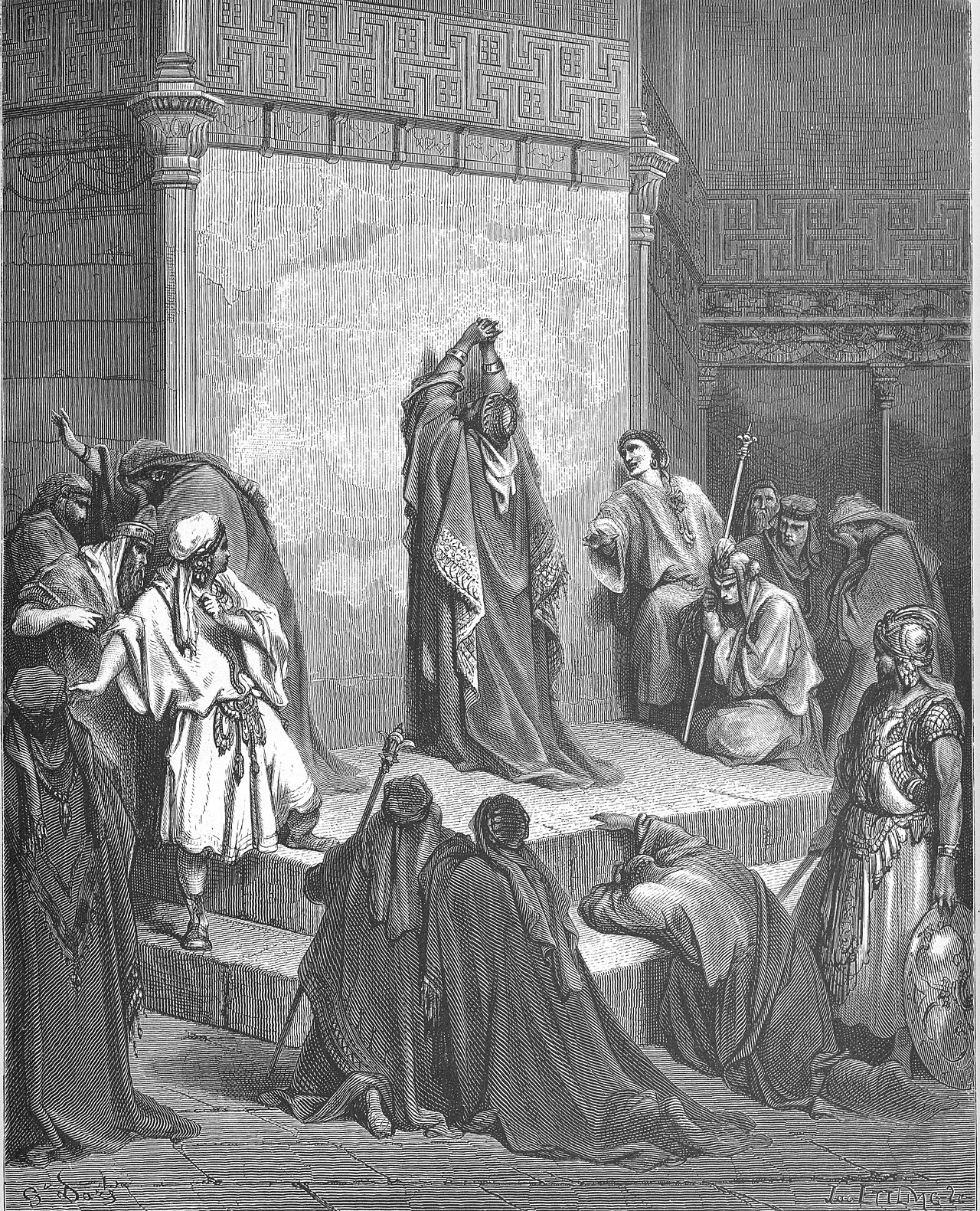
The king walks behind the bier
2 Samuel 3:31-32
David orders the whole camp into mourning, Joab included, and walks behind Abner's bier himself. He weeps aloud at the tomb, and all the people weep with him. The honor paid to a man who had led the army against him shows the people that David bore Abner no malice.
2 Samuel 3:31
“Joab - Him he especially obliged to it, to bring him to repentance for his sin, and to expose him to public shame. Followed - That is, attending upon his corps, and paying him that respect which was due to his quality.”
John Wesley · Explanatory Notes upon the Old Testament (1765)evangelical
the king wept aloud at Abner’s tomb: Matthew Henry notes that Abner was brave in the field and could have served the kingdom well at this turn. Abner was buried at Hebron, the city where David reigned. All the people wept with the king.
2 Samuel 3:32
“Though Abner had been his enemy, and might possibly have proved no very firm friend, yet because he had been a man of bravery in the field, and might have done great service in the public counsels at this critical juncture, all former quarrels are forgotten and David is a true mourner for his fall.”
Matthew Henry · Commentary on the Whole Bible (1707-1721)puritan
2 Samuel 3:33-34
David sings a lament over Abner, the second after the one for Saul and Jonathan. Its opening question, whether Abner should “die the death of a fool”, is answered: “Your hands were not bound, your feet were not fettered”. Abner fell to treachery, as a man falls before the wicked.
2 Samuel 3:33
“Was he cut off by the hand of justice for his crimes? Nothing less; but by Joab's malice and treachery. It is a sad thing to die as a fool dieth, as they do that any way shorten their own days: and indeed all they that make no provision for another world.”
John Wesley · Explanatory Notes upon the Old Testament (1765)evangelical
Your hands were not bound: John Gill reads bound hands and fettered feet as the marks of a condemned criminal led out to die. Abner went free and still fell. Adam Clarke calls the dirge a heavy rebuke to Joab, sung by all the people.
2 Samuel 3:34
“Thy hands were not bound ... - This thought prepares the way for the solution; Abner had been treacherously murdered by wicked men.”
2 Samuel 3:35-37
David fasts until sundown and swears the self-cursing oath, “May God punish me, and ever so severely”. All Israel “were convinced that the king had no part in the murder of Abner son of Ner”. Charles Spurgeon preached the episode in his sermon The King Can Do No Wrong.
2 Samuel 3:35
“To eat meat ... - Fasting was a sign of the deepest mourning 2Sa 1:12. The fast lasted until the sun was set.”
All the people took note and were pleased: Matthew Henry compares the fear of David to that of Jacob, whose sons Simeon and Levi made him odious by their slaughter at Genesis 34. The crime of Joab could have made David odious the same way. Everything the king did pleased the people.
2 Samuel 3:36
“The people took notice - They saw that the king’s grief was sincere, and that he had no part nor device in the murder of Abner: see 2Sa 3:37.”
Adam Clarke · Commentary on the Bible (1810-1826)evangelical
the king had no part in the murder: John Gill notes that all Israel understood it that same day. The northern tribes had lost the commander who was bringing them to David, and they cleared David of his death. Charles Spurgeon holds that David neither ordered the crime nor could have prevented it.
a great prince has fallen today in Israel?: David's word to his own servants names what the murder cost Israel: “a great prince”. Abner's defection had been about to hand him every remaining tribe. Henry reads the line as David's own grief speaking honestly, weighing what Abner's life was worth to the kingdom now that it is gone.
2 Samuel 3:38
“If he could be brought to do it sincerely, it would be an expression of repentance for his sin in slaying him. If he did it in show only, as it is likely he did, yet it was a sort of penance imposed upon him, and a present commutation of the punishment. If he do not as yet expiate the murder with his blood, let him do something towards it with tears.”
Matthew Henry · Commentary on the Whole Bible (1707-1721)puritan
though anointed as king: David calls himself weak: “I am weak this day, though anointed as king”. The sons of Zeruiah, Joab and Abishai, are “too fierce for me”, and David leaves the evildoer to the LORD. The debt stays open until David charges Solomon with it at 1 Kings 2:5-6.
2 Samuel 3:39
“I am this day weak - Had Abner lived, all the tribes of Israel would have been brought under my government. Though anointed king - I have little else than the title: first, having only one tribe under my government; and secondly, the sons of Zeruiah, Joab and his brethren, having usurped all the power, and reduced me to the shadow of royalty. The Lord shall reward the doer of evil - That is, Joab, whom he appears afraid to name.”
Adam Clarke · Commentary on the Bible (1810-1826)evangelical
1 more voice on this verse
2 Samuel 3:39
“It was therefore carnal wicked policy, yea cruel pity that spared him. If the law had had its course against Joab, it is probable the murder of Ishbosheth, Ammon, and others, had been prevented. So truly was he in these, and some other respects, a bloody man, which may be observed to the glory of the Divine grace, in his forgiveness and conversion.”
John Wesley · Explanatory Notes upon the Old Testament (1765)evangelical
How this psalm is built
The form: Narrative with a short dirge inside it, the second of the two laments this book preserves in David's own words, as Barnes classes it.
The patterns in this chapter
| Device | What it does | Where to see it |
|---|---|---|
| Stronger and stronger against weaker and weaker | Verse 1 states the whole civil war as one trend rather than a count of battles. Matthew Henry reads the same line a second way, as a picture of grace waxing stronger against a weakening corruption, and gives that reading beside the plain history rather than instead of it.Matthew Henry, Commentary on the Whole Bible, 1710, on 2 Samuel 3:1. | 2 Samuel 3:1 |
| The six sons born at Hebron | Verses 2 to 5 list six sons by six mothers in birth order. Three of the six names carry the book's later grief, Amnon at chapter 13, Absalom from chapter 13 to chapter 18, and Adonijah past the book's end at 1 Kings 2. Jamieson, Fausset and Brown read the Geshur marriage that gives Absalom his mother as a political alliance against Ish-bosheth's party.Jamieson, Fausset and Brown, Commentary Critical and Explanatory on the Whole Bible, 1871, on 2 Samuel 3:3. | 2 Samuel 3:2, 2 Samuel 3:3, 2 Samuel 3:4, 2 Samuel 3:5 |
| So may God do to me and more also, sworn twice | Abner swears the self-cursing oath at verse 9 to hand the kingdom to David, and David swears the same form at verse 35 to refuse food until sundown. The site's published exposition names the two as the same construction and does not tie them to a numbered thread, since the chapter's own brief carries none. | 2 Samuel 3:9, 2 Samuel 3:35 |
| Should Abner die the death of a fool | David's dirge opens on a question in the Berean text at verse 33, should Abner die the death of a fool. The next line answers it, since his hands were not bound and his feet were not fettered. Albert Barnes reads the whole lament as the deliberate opposite of a fool's death, since Abner was neither guilty nor helpless but simply unwarned.Albert Barnes, Notes on the Old Testament, on 2 Samuel 3:33. | 2 Samuel 3:33, 2 Samuel 3:34 |
The word of the LORD Abner quotes
11 more paragraphs on the patterns
At verse 18 Abner presses the elders with a word already spoken of David, that by the hand of his servant David the LORD will save Israel from the Philistines and from all their enemies. The site's judgment file for this chapter records the honest textual note that the quoted word is not found verbatim elsewhere in Scripture. The row keeps that as a gap rather than resolving it, and no reading here supplies a verse the text does not carry.
The curse on Joab's house
David's curse at verse 29 names issue, leprosy, the crutch of the lame, death by the sword and want of bread, across generations. The kept commentary on this chapter works the material and legal detail behind those terms, including the hereditary-disease law that stands behind the crutch. The narrator names Abishai beside Joab as guilty of the same killing, though Joab alone struck the blow.
The debt the chapter leaves open is paid outside the book. David charges Solomon with it on his deathbed at 1 Kings 2:5 to 6. The kept commentary ties Joab's murder of Abner forward to his murder of Amasa at 20:10, and to Solomon's judgment after David's death.
The names, and what they carry
The kept commentary on the sons list carries four points of identification. One is the question whether Eglah at verse 5 is Michal. A second is the transcription note behind Chileab at verse 3 and Daniel at 1 Chronicles 3:1. A third ties Talmai king of Geshur to the Anak line remembered at Hebron. The fourth is the Horite name Aiah at verse 7. John Gill cites Kimchi by name on Abner's messengers. Each stands with its holder, and the row states none of them as settled where the holders differ.
The geography
Bahurim at verse 16 is placed with the help of the Targum and Josephus in the kept commentary. It is the same road David takes in flight at 16:5, where Shimei comes out to curse him, so the place carries two of the book's hardest scenes.
How it has been taught
Ambrose of Milan reads David's reception of Abner at verse 20 in On the Duties of the Clergy. He takes the whole conduct as the mark of the man. David preferred to live like an exile at Hebron rather than to reign at Jerusalem, and he loved valour even in an enemy. Ambrose returns to the chapter in Letter 51, where the point is that a king who kills the innocent has sinned, king or not.
Charles Spurgeon preached two texts from this chapter. On verse 18 he took the phrase now then do it as a call to present obedience, that light once given leaves no room for delay. On verses 35 to 37 he read the episode as the moment Joab's treachery first compromised a reign otherwise marked by justice.
Keep studying
Sources for this chapter
The summary
Jamieson, Fausset & Brown, Commentary Critical and Explanatory; John Wesley, Notes on the Old Testament and Matthew Henry, Complete Commentary.
The form and classifications
Albert Barnes, Notes on the Old Testament, on 2 Samuel 3:33, where the lament over Abner is read as the deliberate opposite of a fool's death and This site's published book sections table, src/lib/bible/book-sections.ts, the entry "2 Samuel": "history".
The exposition
Adam Clarke, Commentary on the Bible; Albert Barnes; Ambrose of Milan, On the Duties of the Clergy; Augustine of Hippo, Adulterous Marriages 5; Charles Spurgeon; Jamieson, Fausset & Brown, Commentary Critical and Explanatory on the Whole Bible; Jamieson, Fausset and Brown, Commentary Critical and Explanatory on the Whole Bible; John Gill; John Wesley, Explanatory Notes upon the Old Testament; Keil and Delitzsch, Biblical Commentary on the Books of Samuel and Matthew Henry, Commentary on the Whole Bible.