
2 Samuel 3:36
in 2 Samuel 3All the people took note and were pleased. In fact, everything the king did pleased them.
BSB
The same verse in ASV and KJV ▾
ASV
And all the people took notice of it, and it pleased them; as whatsoever the king did pleased all the people.
KJV
And all the people took notice of it, and it pleased them: as whatsoever the king did pleased all the people.
⋯
This verse in 2 Samuel 3
Commentary
8 notes on this verseThe people took notice - They saw that the king’s grief was sincere, and that he had no part nor device in the murder of Abner: see 2Sa 3:37.
This site's exposition
if I taste bread, or ought else
on 2 Samuel 3:35-37
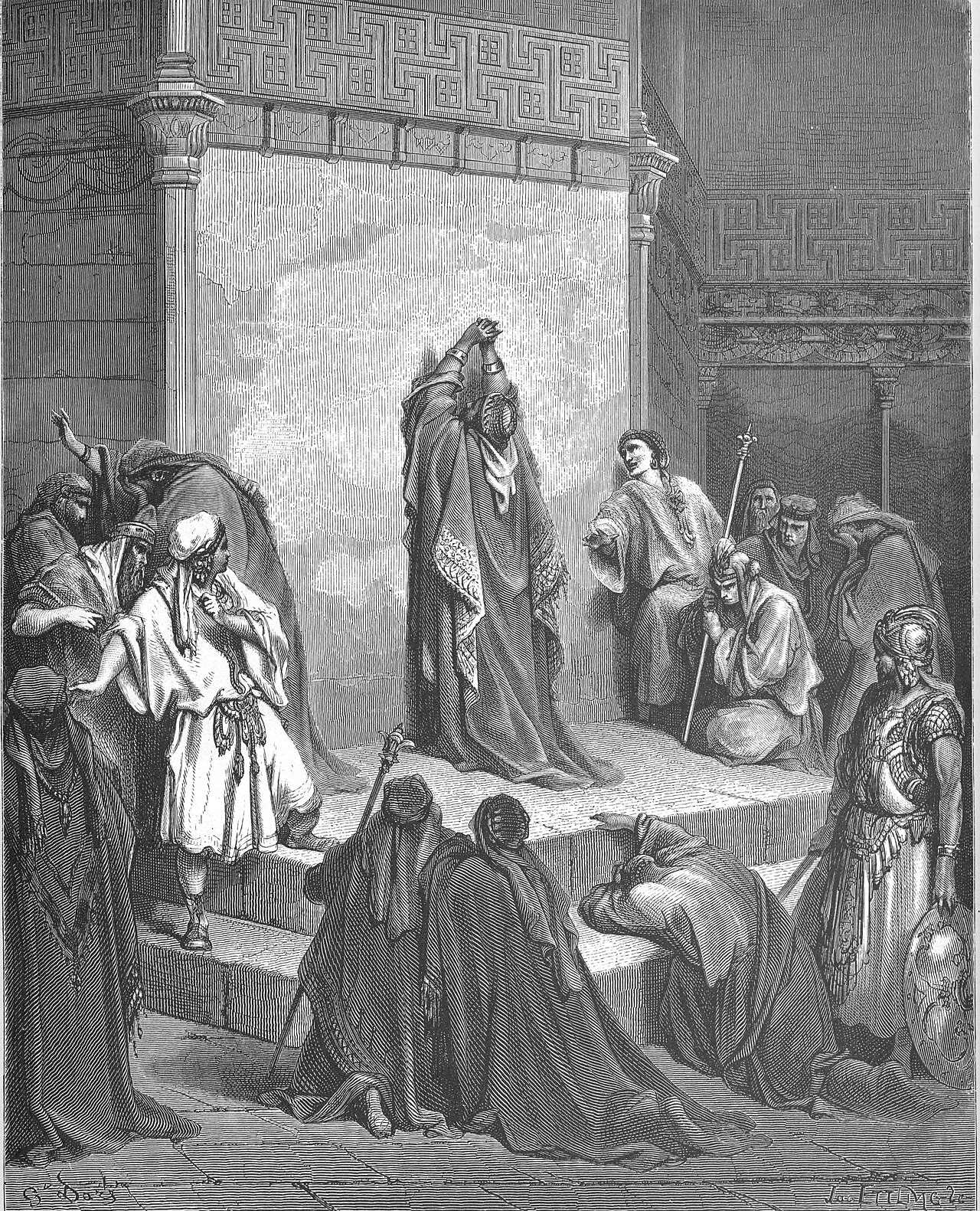
David fasts publicly until sundown and swears the same self-cursing oath Abner used at verse 9, so do God to me and more also, and the people read his refusal to eat as proof of a grief they could not have staged for him. Spurgeon preached the episode as the moment Joab's treachery first compromised a reign otherwise marked by justice, and the chapter records the verdict the fast was meant to earn: all Israel understood that day that it was not of the king to slay Abner.
This site's exposition
All the people took note and were pleased
Matthew Henry compares the fear of David to that of Jacob, whose sons Simeon and Levi made him odious by their slaughter at Genesis 34. The crime of Joab could have made David odious the same way. Everything the king did pleased the people.
The record, by era
The Puritans and the Awakening3 voices
David's Wives and Children. 1 Now there was long war between the house of Saul and the house of David: but David waxed stronger and stronger, and the house of Saul waxed weaker and weaker. 2 And unto David were sons born in Hebron: and his firstborn was Amnon, of Ahinoam the Jezreelitess;
quarantine:scripture (2026-07-29) — scripture-overlap:92%@v1-3
), of which he was solicitous to avoid the suspicion, lest Joab's villany should make him odious, as that of Simeon and Levi did Jacob, Gen. xxxiv. On this occasion it is said, Whatever the king did pleased all the people.
quarantine:debris (2026-07-29) — leading-punctuation+unbalanced-parens
And all the people took notice of it,....
The Nineteenth Century2 voices
A commentator
Charles Spurgeon1834–1892
The Metropolitan Tabernacle Pulpit, Sermon No. 2420: “"The King Can Do No Wrong"” (lightly modernized text, CCEL edition) · Written before 1892.
proposed
DAVID was a great king and a good king, but his character was compromised by the conduct of Joab, who had been one of his chief friends and supporters. Abner came to David, in Hebron, and proposed terms of peace which David accepted. But Joab could not bear that Abner should be his rival and, therefore, he most treacherously murdered him.
A commentator
Charles Spurgeon1834–1892
The Metropolitan Tabernacle Pulpit, Sermon No. 2420: “"The King Can Do No Wrong"” (lightly modernized text, CCEL edition) · Written before 1892.
proposed
DAVID was a great king and a good king, but his character was compromised by the conduct of Joab, who had been one of his chief friends and supporters. Abner came to David, in Hebron, and proposed terms of peace which David accepted. But Joab could not bear that Abner should be his rival and, therefore, he most treacherously murdered him. This abominable act was greatly to the detriment of David's character—he could not prevent the crime, certainly he had not instigated it—and yet it was only natural that all the people would suppose that David had a hand in it because Joab was not merely one of his subjects, but his prime minister! Dear Friends, in a similar way, the character of our great Lord and King among the sons of men is very much in the hands of His people, especially in the hands of those who are more prominent than others, and whom He uses in His service more than others. We may go and do, on our own account, things that shall bring dishonor to the name of Jesus Christ our Lord and King! He will have no part nor lot in them, nothing that He has taught will suggest them, and nothing that He desires will urge us, thus, to act. We may, however, of our own free will, even those of us whom the Lord uses most, bring grievous dishonor on His holy name. Jesus has often to lift up His pierced hands and when we ask Him, "What are these wounds in Your hands?" He has to answer, "Those with which I was wounded in the house of My friends." It is evident to each one of you that all the vile insults of infidels could never dishonor Christ as the inconsistencies of His own disciples! No slur ever comparatively attaches to the glorious name of the Well-Beloved from His avowed enemies, let them slander Him as they may.
The words behind it
13 Hebrew wordsEvery Hebrew word of this verse in the order it stands, with what it means and the door to its own study. The last column counts the times a word stands in the whole Bible: the rarer the word, the more the places it appears belong together.
| Hebrew | Sound | Meaning | Word study | In the Bible |
|---|---|---|---|---|
| וְכָל־ | vekhol | and all | H3605 → | 5413 times |
| הָעָ֣ם | haam | the people | H5971 → | 1873 times |
| הִכִּ֔ירוּ | hikiru | they paid regard | H5234 → | |
| וַיִּיטַ֖ב | vaiyitav | and it was good | H3190 → | |
| בְּעֵֽינֵיהֶ֑ם | beeineihem | in view their | H5869 → | 887 times |
| כְּכֹל֙ | kekhol | like all | H3605 → | 5413 times |
| אֲשֶׁ֣ר | ʾasher | that | H834 → | 5497 times |
| עָשָׂ֣ה | ʾasah | he did | H6213 → | 2628 times |
| הַמֶּ֔לֶךְ | hamelekh | the king | H4428 → | 2525 times |
| בְּעֵינֵ֥י | beeinei | in [the] eyes of | H5869 → | 887 times |
| כָל־ | khol- | all | H3605 → | 5413 times |
| הָעָ֖ם | haam | the people | H5971 → | 1873 times |
| טֽוֹב׃ | tov | it was good | H2895 → | 45 times |
וְכָל־and all
vekholH3605 →5413 times
הָעָ֣םthe people
haamH5971 →1873 times
הִכִּ֔ירוּthey paid regard
hikiruH5234 →
וַיִּיטַ֖בand it was good
vaiyitavH3190 →
בְּעֵֽינֵיהֶ֑םin view their
beeineihemH5869 →887 times
כְּכֹל֙like all
kekholH3605 →5413 times
אֲשֶׁ֣רthat
ʾasherH834 →5497 times
עָשָׂ֣הhe did
ʾasahH6213 →2628 times
הַמֶּ֔לֶךְthe king
hamelekhH4428 →2525 times
בְּעֵינֵ֥יin [the] eyes of
beeineiH5869 →887 times
כָל־all
khol-H3605 →5413 times
הָעָ֖םthe people
haamH5971 →1873 times
טֽוֹב׃it was good
tovH2895 →45 times
A shaded row is a word that stands 400 times or fewer in the Bible.
The walk
8 stopsEach card is a verse this one points to, and under it the verses that one points to in turn. Where several paths arrive at the same place, that place is listed first: the text keeps returning to it.
Through
Psalms 62:9Lowborn men are but a vapor, the exalted but a lie. Weighed on the scale, they go up; together they are but a vapor.
it leads to
- Psalms 39:5
You, indeed, have made my days as handbreadths, and my lifetime as nothing before You. Truly each man at his best exists as but a breath. Selah
- Isaiah 40:15
Surely the nations are like a drop in a bucket; they are considered a speck of dust on the scales; He lifts up the islands like fine dust.
- Isaiah 40:17
All the nations are as nothing before Him; He regards them as nothingness and emptiness.
- Psalms 39:5
Through
Mark 7:37The people were utterly astonished and said, “He has done all things well! He makes even the deaf hear and the mute speak!”
it leads to
- Mark 6:51
Then He climbed into the boat with them, and the wind died down. And the disciples were utterly astounded,
- Exodus 4:10–11
“Please, Lord,” Moses replied, “I have never been eloquent, neither in the past nor since You have spoken to Your servant, for I am slow of speech and tongue.”
- Mark 4:41
Overwhelmed with fear, they asked one another, “Who is this, that even the wind and the sea obey Him?”
- Mark 5:42
Immediately the girl got up and began to walk around. She was twelve years old, and at once they were utterly astounded.
- Genesis 1:31
And God looked upon all that He had made, and indeed, it was very good. And there was evening, and there was morning—the sixth day.
- Mark 6:51
Where this verse is studied
On this page
Studies1
About 2 Samuel
This page draws on Adam Clarke, Commentary on the Bible; Charles Spurgeon, The Metropolitan Tabernacle Pulpit, Sermon No. 2420, The King Can Do No Wrong; Charles Spurgeon, The Metropolitan Tabernacle Pulpit, Sermon No. 2420: “"The King Can Do No Wrong"” (lightly modernized text, CCEL edition); John Gill, Exposition of the Old Testament (1748-1763) and Matthew Henry, Commentary on the Whole Bible.