
1 Kings 13:1
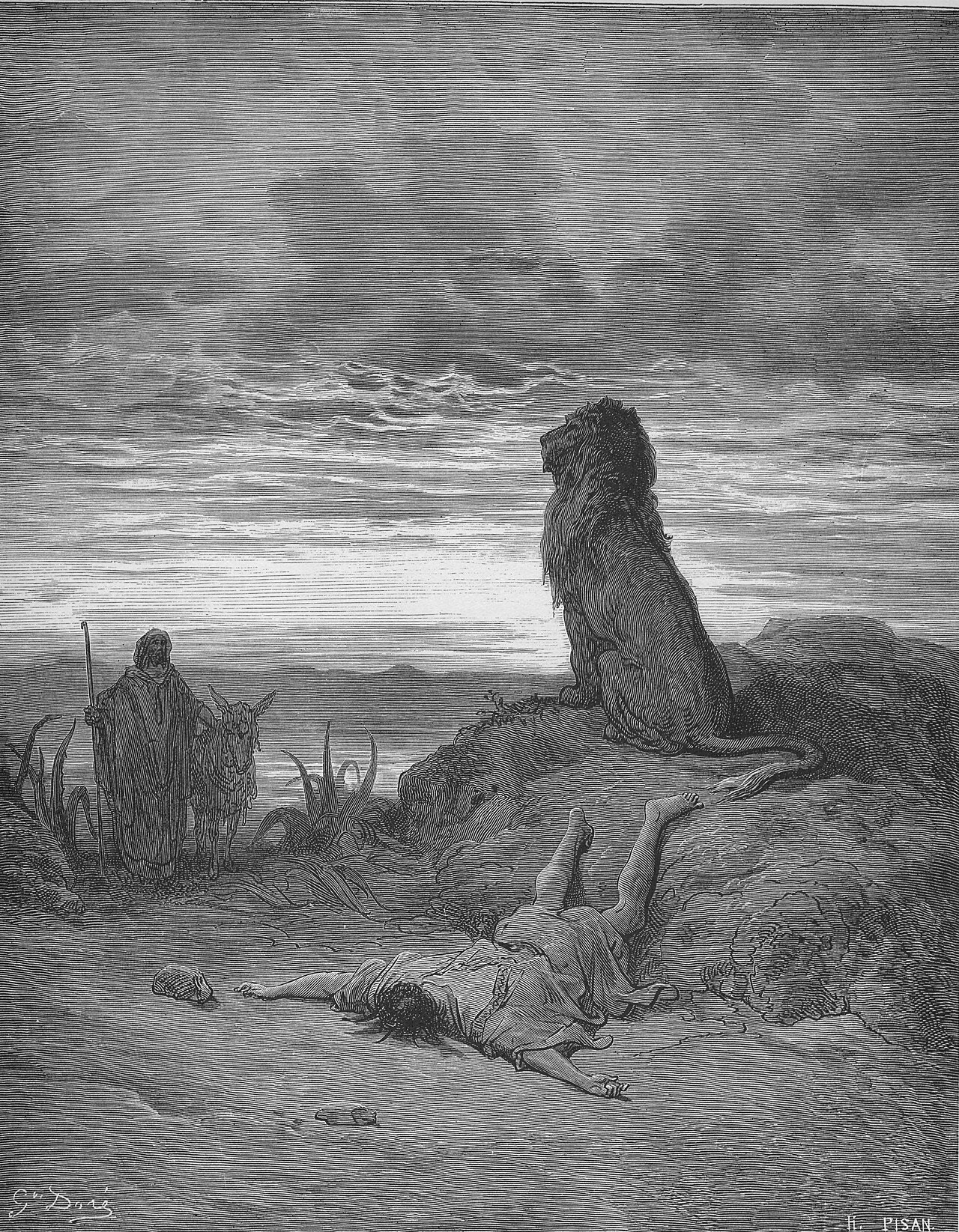
in 1 Kings 13Suddenly, as Jeroboam was standing beside the altar to burn incense, there came a man of God from Judah to Bethel by the word of the LORD.
BSB
The same verse in ASV and KJV ▾
ASV
And, behold, there came a man of God out of Judah by the word of Jehovah unto Beth-el: and Jeroboam was standing by the altar to burn incense.
KJV
And, behold, there came a man of God out of Judah by the word of the Lord unto Beth–el: and Jeroboam stood by the altar to burn incense.
⋯
This verse in 1 Kings 13
Commentary
6 notes on this verseA commentator
Albert Barnes1798–1870
Notes, Explanatory and Practical, on the Old and New Testaments (1832-1869)
Rather, “in the word of the Lord.” The meaning seems to be, not merely that the prophet was bid to come, but that he came in the strength and power of God’s word, a divinely inspired messenger. (Compare 1Ki 13:2, 1Ki 13:5,1Ki 13:32.) By the altar - “On the altar;” i, e. on the ledge, or platform, halfway up the altar, whereupon the officiating priest always stood to sacrifice. Compare 1Ki 12:32 note.
This site's exposition
there came a man of God out of Judah
on 1 Kings 13:1-2
The man of God comes from Judah under no name the text gives him, and he speaks against Jeroboam's new altar three centuries before the reform it describes. He names the king who will do it, Josiah, one of only two figures in the Old Testament named in prophecy before birth, the other being Cyrus at Isa 44:28. The altar built to rival Jerusalem hears its own end pronounced at its dedication.
The record, by era
The Puritans and the Awakening2 voices
24 ); but a prophet of Judah is, instead thereof, sent to reclaim him from his evil way, and is sent in time, while he is but dedicating his altar, before his heart is hardened by the deceitfulness of his sin; for God delights not in the death of sinners, but would rather they would burn and live.
quarantine:debris (2026-07-29) — leading-citation-number+unbalanced-parens
And, behold, there came a man of God out of Judah,....
The Nineteenth Century2 voices
A commentator
Jamieson, Fausset & Brown1802–1910
Commentary Critical and Explanatory on the Whole Bible (1871)
proposed
there came a man of God out of Judah--Who this prophet was cannot be ascertained, He came by divine authority. It could not be either Iddo or Ahijah, for both were alive after the events here related. Jeroboam stood by the altar to burn incense--It was at one of the annual festivals.
quarantine:debris (2026-07-29) — starts-lowercase
There came a man of God - Who this was we know not. The Chaldee, Syriac, and Arabic call him a prophet. The Vulgate and Septuagint follow the Hebrew, איש אלהים ish elohim means a Divine person, one wholly devoted to God’s service. Some have thought it was Shemaiah, others Joel, and others Iddo. It could not have been the latter, for he wrote the acts of Jeroboam, 2Ch 9:29, and the prophet was killed before he returned home; but conjecture is idle on such a subject. Jeroboam stood by the altar - Like gods, like priest; he made himself high priest, and he took of the lowest of the people, and made them priests of the high places; they proved themselves to be fools by worshipping calves.
How the passage was read
What the Jewish commentators add
On the verses either side of this one
Altar, altar. [The one] in Beis Eil and [the one] in Dan. 2 Alternatively, it is common to use repetition when summoning, i.e., “Avrohom, Avrohom [Bereishis:1],” etc.—Radak
This section is reception history: how the passage was read and kept in the Jewish tradition. Where a reading parts from an essential of the Christian faith, the section says so at that point.
Texts and citation data: Sefaria; each excerpt follows its version’s licence. 6 further sources are cited on this chapter that carry no English text this site may quote or only restate the verse.
The words behind it
15 Hebrew wordsEvery Hebrew word of this verse in the order it stands, with what it means and the door to its own study. The last column counts the times a word stands in the whole Bible: the rarer the word, the more the places it appears belong together.
| Hebrew | Sound | Meaning | Word study | In the Bible |
|---|---|---|---|---|
| וְהִנֵּ֣ה׀ | vehineh | and there! | H2009 → | 843 times |
| אִ֣ישׁ | ʾish | a man of | H376 → | 1663 times |
| אֱלֹהִ֗ים | ʾelohim | God | H430 → | 2601 times |
| בָּ֧א | ba' | he came | H935 → | 2568 times |
| מִיהוּדָ֛ה | mihudah | from Judah | H3063 → | 819 times |
| בִּדְבַ֥ר | bidvar | by [the] word of | H1697 → | 1440 times |
| יְהוָ֖ה | yahweh | Yahweh | H3068 → | 6520 times |
| אֶל־ | ʾel- | to | H413 → | 5510 times |
| בֵּֽית־ | beit- | Beth- | H1008 → | 142 times |
| אֵ֑ל | ʾel | -el | H1008 → | 142 times |
| וְיָרָבְעָ֛ם | veyaraveam | and Jeroboam | H3379 → | 104 times |
| עֹמֵ֥ד | ʾomed | [was] standing | H5975 → | 521 times |
| עַל־ | ʾal- | at | H5921 → | 5755 times |
| הַמִּזְבֵּ֖חַ | hamizbeach | the altar | H4196 → | 401 times |
| לְהַקְטִֽיר׃ | lehaktir | to make smoke | H6999 → | 116 times |
וְהִנֵּ֣ה׀and there!
vehinehH2009 →843 times
אִ֣ישׁa man of
ʾishH376 →1663 times
אֱלֹהִ֗יםGod
ʾelohimH430 →2601 times
בָּ֧אhe came
ba'H935 →2568 times
מִיהוּדָ֛הfrom Judah
mihudahH3063 →819 times
בִּדְבַ֥רby [the] word of
bidvarH1697 →1440 times
יְהוָ֖הYahweh
yahwehH3068 →6520 times
אֶל־to
ʾel-H413 →5510 times
בֵּֽית־Beth-
beit-H1008 →142 times
אֵ֑ל-el
ʾelH1008 →142 times
וְיָרָבְעָ֛םand Jeroboam
veyaraveamH3379 →104 times
עֹמֵ֥ד[was] standing
ʾomedH5975 →521 times
עַל־at
ʾal-H5921 →5755 times
הַמִּזְבֵּ֖חַthe altar
hamizbeachH4196 →401 times
לְהַקְטִֽיר׃to make smoke
lehaktirH6999 →116 times
A shaded row is a word that stands 400 times or fewer in the Bible.
The walk
8 stopsEach card is a verse this one points to, and under it the verses that one points to in turn. Where several paths arrive at the same place, that place is listed first: the text keeps returning to it.
Through
1 Thessalonians 4:15By the word of the Lord, we declare to you that we who are alive and remain until the coming of the Lord will by no means precede those who have fallen asleep.
it leads to
- 1 Corinthians 15:51–53
Listen, I tell you a mystery: We will not all sleep, but we will all be changed—
- 2 Corinthians 4:14
knowing that the One who raised the Lord Jesus will also raise us with Jesus and present us with you in His presence.
- 1 Corinthians 15:51–53
Through
Jeremiah 25:3“From the thirteenth year of Josiah son of Amon king of Judah until this very day—twenty-three years—the word of the LORD has come to me, and I have spoken to you again and again,…
it leads to
- Jeremiah 26:5
and if you do not listen to the words of My servants the prophets, whom I have sent you again and again even though you did not listen,
- Jeremiah 11:7
For from the time I brought your fathers out of the land of Egypt until today, I strongly warned them again and again, saying, ‘Obey My voice.’
- Jeremiah 1:2
The word of the LORD came to Jeremiah in the thirteenth year of the reign of Josiah son of Amon king of Judah,
- Jeremiah 7:13
And now, because you have done all these things, declares the LORD, and because I have spoken to you again and again but you would not listen, and I have called to you but…
- Jeremiah 29:19
I will do this because they have not listened to My words, declares the LORD, which I sent to them again and again through My servants the prophets. And neither have you exiles listened,…
- Jeremiah 26:5
Through
2 Kings 23:17Then the king asked, “What is this monument I see?” And the men of the city replied, “It is the tomb of the man of God who came from Judah and pronounced these things…
it leads to
- 1 Kings 13:30–31
Then he laid the body in his own tomb, and they lamented over him, “Oh, my brother!”
- 1 Kings 13:30–31
Where this verse is studied
On this page
About 1 Kings
Who and where
2 names in this verse with a page on the site.
- PersonPatriarchsJudahJacob's fourth son who pledges himself for Benjamin; the tribe that carries the scepter to Shiloh (49:10) and the line to Christ (…
- PlaceCentral hill countryBethelThe house of God, where Jacob saw the ladder and heard the promise, where he returned to raise an altar, and where Jeroboam’s gold…
This page draws on Adam Clarke, Commentary on the Bible; Albert Barnes, Notes, Explanatory and Practical, on the Old and New Testaments (1832-1869); Jamieson, Fausset & Brown, Commentary Critical and Explanatory on the Whole Bible; John Gill, Exposition of the Old Testament (1748-1763); Keil, The Books of the Kings and Matthew Henry, Commentary on the Whole Bible.