
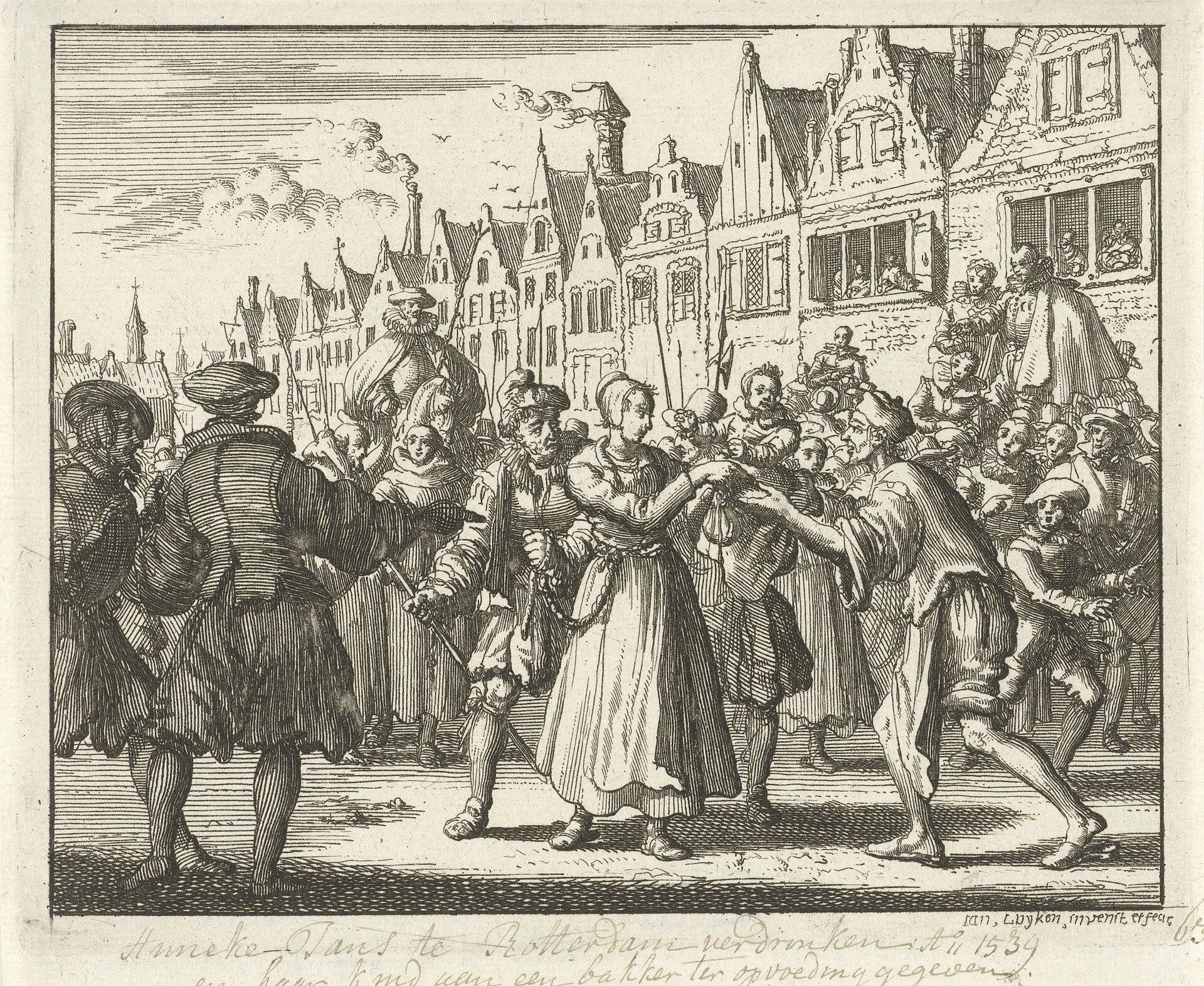
Jan Luyken, Anneken Jans gives her son to a baker, 1539, 1685. Public domain.
1563 to 1883 · Subject · Featured Study
The Art of Martyrdom
Printers and painters showed the martyrs to their readers from the Reformation to the 1880s.
- Books
- Hebrews, Revelation
- Hold in memory
- Revelation 7:14
An etcher of 1685 pictured Anneken Jans giving her son to a baker on the way to her death, a scene he never saw.
Still others endured mocking and flogging, and even chains and imprisonment.
Summary
For three centuries after the Reformation, artists drew and painted the martyrs. Every picture shows how its maker imagined a death he did not see. None of them settles a fact, which rests on the written record of courts and witnesses.
- The Acts and Monuments opened the series with its English cuts.
- Jan Luyken etched the Anabaptist martyrs for the Dutch Martyrs Mirror of 1685.
- Paul Delaroche painted The Young Martyr in 1855.
- The pictures span more than three hundred years of making.
The Verses the Pictures Answer
Two chapters of Scripture name what the pictures later drew.
The makers of these pictures drew sufferings that Scripture had already named. Hebrews 11 lists the mocking, the chains and the deaths of the faithful, and Revelation 7 shows the end of their story.
The sufferings and the end
They were stoned, they were sawed in two, they were put to death by the sword. They went around in sheepskins and goatskins, destitute, oppressed, and mistreated.
It names the deaths by stoning and by the sword that later pictures set in Rome and in the Low Countries.
“Sir,” I answered, “you know.” So he replied, “These are the ones who have come out of the great tribulation; they have washed their robes and made them white in the blood of the Lamb.
John is told that those in white robes came out of the great tribulation, the end the painters set above their scenes.
The Pictures in Order
Three centuries of pictures run from the printing house to the salon, and each row doors to the page that shows the work.
The pictures run from Foxe's first woodcuts to a painting finished in 1883, and each came long after the deaths it shows.
- The title page and woodcuts of the Actes and Monuments1563Woodcut, printed by John Day in London
- The plates of the Dutch Mirror, among them Anneken Jans1685Etched by their designer
- The burning of Ridley and Latimer, re-cut for Cattley's Foxe1838A new cut after the old woodcut
- The Young Martyr1855Paul Delaroche, painting, the Louvre
- Nero's Torches1882, as its Commons record dates itHenryk Siemiradzki, painting
- The Christian Martyrs' Last Prayer1863 to 1883Jean-Léon Gérôme, painting, the Walters Art Museum
A timeline of the pictures, each row naming its maker, its medium and the record that dates it.
What Each Age Pictured
The printers of the Reformation drew the fires of their own century, and the nineteenth century turned back to Rome.
Foxe's book is illustrated throughout by woodcuts, most of them of the martyrs' sufferings and some of the Reformation's triumph. On the title page of 1563, martyrs burning at the stake blow trumpets beside the faithful, under Christ seated above them on a globe.
Foxe's cut of the burning of Ridley and Latimer lettered their last words on banners. Cattley's edition of 1838 printed a new cut of it, captioned with Doctor Smith preaching, so the picture travelled with the text for nearly three centuries.
Jan Luyken etched the plates for the second Dutch printing of the Martyrs Mirror, each a scene from the book's accounts. The Rijksmuseum catalogues his Anneken Jans of 1539 and his Anneken Hendriks of 1571 among them.
The nineteenth century painted the martyrs of Rome. Delaroche's Young Martyr of 1855 is now in the Louvre. It shows a young woman with her hands bound, floating dead on dark water with a halo above her.
Gérôme took the commission for The Christian Martyrs' Last Prayer in 1863 and delivered it twenty years later. In it a crowd of Christians kneels in prayer in a vast arena while a lion climbs out of a pit. Men hang burning on crosses along the far wall.
What a Picture Can Prove
Pictures show belief and feeling, and courts and witnesses supply the facts.
Every picture in the timeline above was made long after the death it shows. The etching of Anneken Jans came one hundred and forty-six years after her death. The painters of the nineteenth century set their scenes in the Rome of the first centuries.
A picture can show what a reader of its day believed and felt. The facts of a martyr's death rest on the written record, such as a court's sentence or a witness's report. Each caption here names the maker and the date for that reason.
In Their Own Words
Hugh Latimer (1487 to 1555)
His prayer at the stake, lettered on the plate of the burning of Ridley and Latimer, in John Foxe, The Acts and Monuments, The plate after page 550
Cattley's plate lettered Latimer's prayer on a banner.
“Father of heaven receive my soule”
English Reformation
About this saying1 paragraph
The plate of 1838 sets Latimer's last prayer on a banner above his head.
John Foxe (died 1587)
Actes and Monuments, the title page, The title page
Foxe's title page named its sources.
“Gathered and collected according to the true copies & wrytinges certificatorie as wel of the parties them selues that suffered, as also out of the Bishops Registers, which wer the doers therof”
English Reformation Protestant
About this saying1 paragraph
The woodcut border of 1563 frames these words, set under the title of the book.
Francis Urquhart
Foxe's Book of Martyrs, The Catholic Encyclopedia, volume 2, Foxe's Book of Martyrs, paragraph 3
A Catholic historian described Foxe's woodcuts in 1907.
“The book is illustrated throughout by woodcuts, some of them symbolizing the triumph of the Reformation, most of them depicting the sufferings of the martyrs.”
Roman Catholic
About this saying1 paragraph
Francis Urquhart wrote this of the pictures in 1907, in his article on Foxe for the Catholic Encyclopedia.
Books to Read Next
The Bloody Theatre, or Martyrs Mirror
Thieleman J. van Braght, translated by Joseph F. Sohm · 1886
Its title page calls it illustrated, and it is the English of the book Luyken etched for.
Free scan of the 1886 EnglishThe Acts and Monuments of John Foxe, volume 7
John Foxe, edited by S. R. Cattley · 1838
Its plate stands beside the account it pictures, so a reader can compare the two.
Free scan of volume 7What the Pictures Keep
The pictures set the martyrs before the eyes of everyone who opened the books. They show what each age believed of its martyrs, and the books beside them hold the record.
Sources
Scripture is the Berean Standard Bible.
- The Holy Bible, Berean Standard Bible (read 2026)
- Francis Urquhart, Foxe's Book of Martyrs, The Catholic Encyclopedia, volume 2 (New York: Robert Appleton, 1907)
- John Foxe, The Acts and Monuments, edited by S. R. Cattley, volume 7 (London: R. B. Seeley and W. Burnside, 1838), the plate after page 550.
Keep Studying
Studies1
Church history2
People and groups1
Trials of life1