
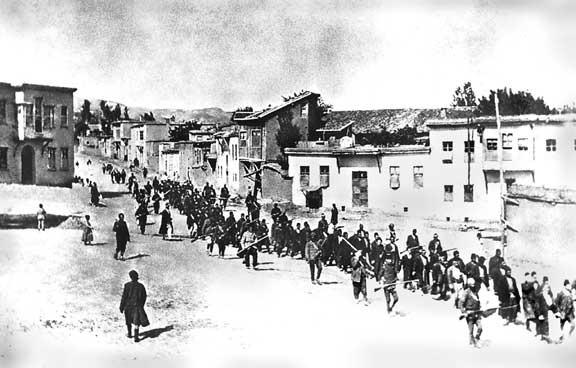
Armenians marched by Ottoman soldiers, 1915. Public domain.
1915 to 1916 · The churches · Featured Study
The Armenian Martyrs
The witnesses of the time recorded the deportations and killings, and every count of the dead stands here with its maker.
In the spring of 1915 the Ottoman government began to send the Armenians of Anatolia on forced marches. The marches led toward the deserts of Mosul, Der-el-Zor and Aleppo.
Do not fear what you are about to suffer. Look, the devil is about to throw some of you into prison to test you, and you will suffer tribulation for ten days. Be faithful even unto death, and I will give you the crown of life.
Summary
The Armenians of the Ottoman Empire were Christians. In the Great War most were driven from their homes, and many were killed.
- Toynbee counted over 600,000 dead, and Morgenthau up to a million.
- The marches left from every province, and only three large cities were spared.
- Letters from the witnesses were laid before the British Parliament.
- Some were told they could live if they became Moslems, and some refused.
Faithful to Death
The texts come from Revelation 2, Romans 8 and Matthew 24.
The risen Christ told the church at Smyrna that some of its members would be thrown into prison and suffer.
Who shall separate us from the love of Christ? Shall trouble or distress or persecution or famine or nakedness or danger or sword? As it is written: “For Your sake we face death all day long; we are considered as sheep to be slaughtered.” No, in all these things we are more than conquerors through Him who loved us.Paul wrote these words to the believers at Rome.
Then they will deliver you over to be persecuted and killed, and you will be hated by all nations because of My name.Jesus gave this warning on the Mount of Olives about the days before the end.
The Record of the Deportations
Seven dated events from the arrests at Constantinople to the publication of the Blue Book
The deportations ran from spring through summer, and the witnesses' accounts were in print within two years.
- The first arrests in the capitalApril 1915
- The Russians enter VanMay 1915
- The deportations run through the provincesSpring and summer 1915
- The ambassador's talks with the Minister of the Interior1915
- The narrative printed as document 68 is dated2 November 1915
- The Blue Book is laid before Parliament and published1916
- Morgenthau publishes his storyOctober 1918
A timeline of seven events, each dated by the document that records it. The Blue Book gathered accounts written while the deportations were still going on.
What Was Done
Toynbee summed up the deportations, and Morgenthau saw them.
In April the authorities arrested about two hundred Armenians in Constantinople and sent them into the interior. Many of them were leaders in education, industry and finance. Through the spring and summer the deportations reached the provinces.
Arnold Toynbee, who edited the documents for Viscount Bryce, summed up the year in his historical summary.
“There is no dispute as to what happened in 1915. The Armenian inhabitants of the Ottoman Empire were everywhere uprooted from their homes, and deported to the most remote and unhealthy districts that the Government could select for them. Some were murdered at the outset, some perished on the way, and some died after reaching their destination.”
Arnold Toynbee · James Bryce and Arnold Toynbee, editors, The Treatment of Armenians in the Ottoman Empire, 1915-16, the historical summary, part 5, The Deportations of 1915: Antecedents, page 627not recorded
Henry Morgenthau, the American ambassador at Constantinople, wrote that the deportations were a new method of massacre.
“When the Turkish authorities gave the orders for these deportations, they were merely giving the death warrant to a whole race; they understood this well, and, in their conversations with me, they made no particular attempt to conceal the fact.”
Henry Morgenthau · Henry Morgenthau, Ambassador Morgenthau's Story, chapter 24, The Murder of a Nation, chapter 24, from page 301not recorded
The Witnesses
The deported and those who saw them wrote down what happened.
Many Armenians were pressed to accept Islam. A memorandum from Bucharest that October reported that at Kaisaria more than 500 Armenian families had been forced to embrace it.
An Armenian woman deported from the province of Mamouret-ul-Aziz to Ras-ul-Ain wrote her account at Alexandria after her escape. She tells how the Circassians of Ras-ul-Ain tried to make her company Moslems.
“The Circassians (or Tchetchens) endeavoured to force us to become Moslems, but we answered them: ‘We will throw ourselves into the water and die, but we will not become Moslems.’”
The Treatment of Armenians in the Ottoman Empire, 1915-16 · Her narrative dated Alexandria, 2 November 1915, published in Gotchnag of New York, 8 January 1916, in James Bryce and Arnold Toynbee, editors, The Treatment of Armenians in the Ottoman Empire, 1915-16, document 68, document 68, from page 271Other
An Armenian from Aleppo, named in the account only by letters, bribed the chief of the Circassians. He then led her company of forty-one to the railway one by one.
The Counts and Their Makers
Every count of the dead with the person or body that made it
The counts of the dead made during and just after the war run from about 300,000 to 1,000,000.
| Who counted | Year | Deported | Dead |
|---|---|---|---|
| The Ottoman Minister of the Interior, as a foreign resident at Constantinople reported him | 1916 | About 800,000 | About 300,000 |
| Other estimates in the same report | 1916 | 1,200,000 | 500,000 |
| Arnold Toynbee | 1916 | Not given | Upwards of 600,000 |
| Henry Morgenthau | 1918 | Not given | At least 600,000, perhaps 1,000,000 |
The Armenian Genocide Museum-Institute gives 1.5 million for 1915 to 1923. It stands at the high end of the counts and is the one most often heard today.
What the Record Leaves Open
Two things the documents cannot settle
Toynbee wrote that errors of detail were most likely in the native witnesses' estimates of numbers, though he held their accounts accurate in substance.
The Blue Book withholds the names of witnesses within reach of Turkish revenge. It marks them with capital letters assigned in no order, so many who suffered are known only by a letter.
The Crown of Life
What the Armenian martyrs show of faith under the sword
The Armenians were killed as a people. Among them were those who refused to give up their faith when they were pressed to do so. The fifth seal of John's vision shows where the slain are kept.
And when the Lamb opened the fifth seal, I saw under the altar the souls of those who had been slain for the word of God and for the testimony they had upheld. And they cried out in a loud voice, “How long, O Lord, holy and true, until You avenge our blood and judge those who dwell upon the earth?” Then each of them was given a white robe and told to rest a little while longer, until the full number of their fellow servants, their brothers, were killed, just as they had been killed.John's vision gives the martyrs of every age their place before God.
How the Key Verse Was Taught
Cyprian and Matthew Henry read Christ's word to Smyrna.
Cyprian (died 258)
Treatise XII Three Books of Testimonies Against the Jews
Cyprian, bishop of Carthage, gathered the texts on the benefits of martyrdom in the third century, before his own death for Christ.
“Of the benefits of martyrdom. In the Proverbs of Solomon: ‘The faithful martyr delivers his soul from evils.’ Also in the same place: ‘Then shall the righteous stand in great boldness against them who have afflicted them, and who took away their labours.”
on Revelation 2:10Patristic
Matthew Henry (1662 to 1714)
Commentary on the Whole Bible
Matthew Henry in 1710 read the verse as Christ's notice of every trouble His faithful people suffer.
“Those who will be faithful to Christ must expect to go through many tribulations; but Jesus Christ takes particular notice of all their troubles. In all their afflictions, he is afflicted, and he will recompense tribulation to those who trouble them, but to those that are troubled rest with himself.”
on Revelation 2:10Puritan
In Their Own Words
A refugee from Van, a priest and a survivor of the marches speak through the Blue Book of 1916 and a book of 1918.
Father Rhoupen (died 1915)
Aurora Mardiganian, Ravished Armenia: The Story of Aurora Mardiganian, the Christian Girl Who Lived Through the Great Massacres, interpreted by H. L. Gates (New York: Kingfield Press, 1918), chapter 1, page 36
Father Rhoupen's counsel
“The way is clear, my child. The answer has come. Trust in Jesus Christ and He will save you as He deems best. It were better that you should die, if need be, or suffer even worse than death, than by your example lead others to forswear their faith in the Saviour.”
Christian
About this saying1 paragraph
Aurora Mardiganian's book of 1918, written down by H. L. Gates, gives the counsel of her priest at Easter 1915. She had asked him whether she might give herself to a pasha to save her family.
Sylvia Gazarian
Van: interview with a refugee, Mrs. Gazarian, published in the Pioneer Press of St. Paul, Minnesota, document 20 of Arnold Toynbee, editor, The Treatment of Armenians in the Ottoman Empire: Documents Presented to Viscount Grey of Fallodon, Secretary of State for Foreign Affairs, with a preface by Viscount Bryce (London: Hodder and Stoughton, 1916)
The school at Van
“When the Armenians resisted, Djevdet Bey ordered them to be shot. He demanded that we and the American and German missionaries should leave Van and seek protection from the Turkish Government. We all refused. Our valley had been a garden. The Turks did their worst to make it a morgue.”
Christian
About this saying1 paragraph
Sylvia Gazarian founded the Christian school at Van and fled the city in 1915. She told her story through an interpreter to the Pioneer Press of St. Paul, and the Blue Book of 1916 reprinted it.
Aurora Mardiganian
Aurora Mardiganian, Ravished Armenia: The Story of Aurora Mardiganian, the Christian Girl Who Lived Through the Great Massacres, interpreted by H. L. Gates (New York: Kingfield Press, 1918), chapter 10, page 179
A sunrise on the march
“More than ever before I loved Jesus Christ and trusted Him that morning while the Mohammedan bandits were praying to him they call Allah.”
Christian
About this saying1 paragraph
In the same book of 1918 she told of a sunrise on the march, when the bandits knelt toward Mecca at their morning prayer.
Why the Armenians Were Deported
Two accounts of why the Armenians were deported, each with its holders
The Ottoman government and the witnesses gave two accounts of the deportations. Morgenthau reports what Talaat, the Minister of the Interior, told him.
“We base our objections to the Armenians on three distinct grounds. In the first place, they have enriched themselves at the expense of the Turks. In the second place, they are determined to domineer over us and to establish a separate state. In the third place, they have openly encouraged our enemies.”
Mehmed Talaat · His words to Henry Morgenthau in 1915, as Morgenthau reports them in Henry Morgenthau, Ambassador Morgenthau's Story, chapter 25, Talaat Tells Why He Deports the Armenians, chapter 25, from page 326Muslim
A war measure against disloyaltyMehmed Talaat, as Morgenthau reports him; the Ottoman government
Talaat told Morgenthau that the government was acting in self-defence, that the Armenians of Van had shown themselves revolutionaries, and that they had helped the Russians in the Caucasus.
The objection, from Toynbee: no wrong by single Armenians could justify such a crime against the whole race, and the deported were women, children and old men as well as men of fighting age.
The destruction of a peopleHenry Morgenthau; Arnold Toynbee and Viscount Bryce
Morgenthau and Toynbee held that the deportations were meant to destroy the Armenians as a people. Morgenthau reports that Talaat himself said the government had already disposed of three quarters of them and had got to finish with them.
The objection, from the Ottoman side: the war was real, the Russians were on the frontier, and the government pointed to the rising at Van that spring.
Books to Read Next
Two works by witnesses of the time.
The Treatment of Armenians in the Ottoman Empire, 1915-16
James Bryce and Arnold Toynbee, editors · 1916
It prints the witnesses' letters and statements, province by province.
Ambassador Morgenthau's Story
Henry Morgenthau · 1918
Morgenthau tells of his years at Constantinople and his talks with Talaat and Enver.
What the Armenian Martyrs Hand On
The Armenian martyrs ask the reader to remember those who suffer for the name of Christ.
The letter to the Hebrews tells believers to remember those in prison as if bound with them. It asks the same for the mistreated, as if they themselves were suffering.
Sources
Scripture is the Berean Standard Bible.
- James Bryce and Arnold Toynbee, editors, The Treatment of Armenians in the Ottoman Empire, 1915-16, London: Hodder and Stoughton, 1916.
- Henry Morgenthau, Ambassador Morgenthau's Story, Garden City, New York: Doubleday, Page and Company, 1918.
- Aurora Mardiganian, Ravished Armenia: The Story of Aurora Mardiganian, the Christian Girl Who Lived Through the Great Massacres, interpreted by H. L. Gates, New York: Kingfield Press, 1918.
- The Armenian Genocide Museum-Institute, The Armenian Genocide.
- Matthew Henry, Commentary on the Whole Bible, on Revelation 2:10.
- Cyprian, Treatise 12, Three Books of Testimonies.
Keep Studying
Read it1
Symbols1
Subjects1
Trials of life1