
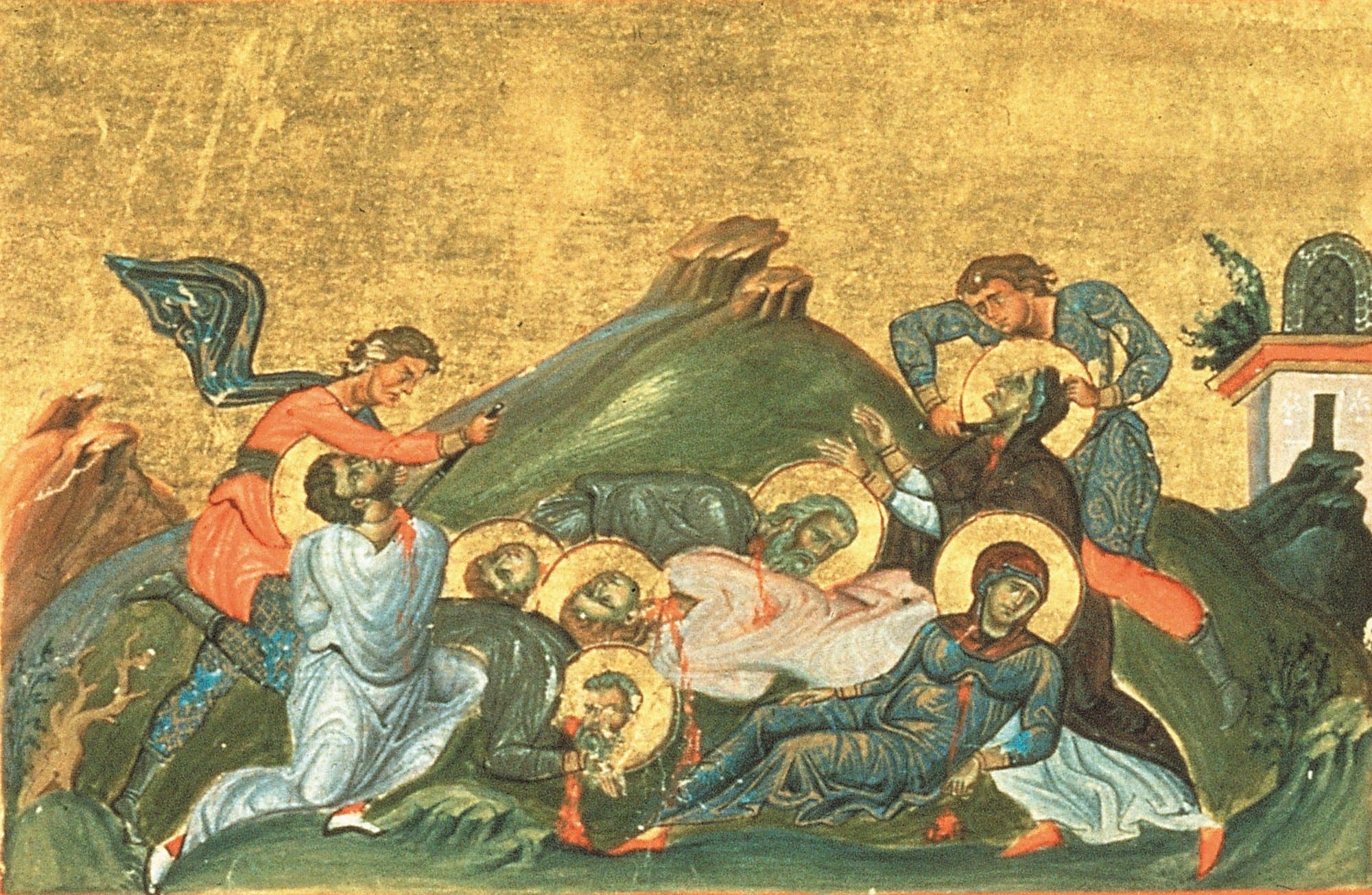
The martyrdom of Perpetua, Felicity, Revocatus, Saturninus and Secundulus, about 985. Public domain.
Carthage, AD 202 or 203 · Person · Featured Study
Perpetua and Felicity
Her prison diary is one of the earliest pieces of Christian writing from a woman's own hand.
- Born
- about AD 182, if she was about twenty-two at her death in 203 (proposed)
- Died
- 7 March 203, as Kirsch dates it; Wallis gives about 202 (probable)
- Family
- father: not named; mother: not named; brother: not named, a catechumen; brother: not named; brother: Dinocrates, who died at seven; son: not named, an infant
- Places
- Carthage
With her father begging her to pity her infant son, a young mother told the procurator that she was a Christian.
Therefore everyone who confesses Me before men, I will also confess him before My Father in heaven.
Summary
Vibia Perpetua and Felicity died in the arena early in the third century, most likely at Carthage. Perpetua was about twenty-two and nursing an infant son. She wrote her own account of her arrest and her days in prison. Felicity, a fellow-servant of Revocatus, gave birth in prison. An editor finished the record after their deaths.
- Perpetua's father begged her to give up her confession, and her account keeps his words.
- Saturus, a third hand, wrote down a vision of his own.
- Augustine argued over her prayers for her dead brother.
The Name She Would Not Deny
Jesus spoke of confessing Him and of loving Him more than family, and 1 Peter 4 speaks to those who suffer under His name.
Perpetua and Felicity lived after the New Testament was written, and the verses that stand over their lives speak of what a confession of Christ may cost.
The question of this life is what one record can tell when its subject wrote part of it herself. The Passion leaves open where they died, under what law, and who framed the account.
Anyone who loves his father or mother more than Me is not worthy of Me; anyone who loves his son or daughter more than Me is not worthy of Me;Her father stood before her with her son at the hearing, and here Jesus speaks of love for father and for son.
But if you suffer as a Christian, do not be ashamed, but glorify God that you bear that name.The verse speaks of suffering under the name Christian, which Perpetua gave as her own.
The Life in Order
Her own part and the editor's give the order, and Kirsch and Wallis give the year.
The Passion counts by days and occasions and names no year.
- About AD 182, if she was about twenty-two at her death in 203She was bornAn inference from Passion 1.1 with Kirsch (1909)
- Before the arrestShe was educated and married, nursing an infant son and under instruction as a catechumenPassion 1.1
- No date givenShe was arrested with Revocatus, Felicity, Saturninus and SecundulusPassion 1.1
- Within a few daysShe entered the dungeon after her baptismPassion 1.2
- After many daysHer son stayed with her in the dungeonPassion 1.2
- Another day, at dinnerShe was heard at the town-hall and condemned to the beastsPassion 2.2
- After the sentenceHer father refused to give up the childPassion 2.2
- Near the birthday of Geta CaesarShe prayed for her dead brother and was moved to the prison of the campPassion 2.3
- Several days before the gamesShe finished writing her partPassion 3.2
- Three days before the gamesThe prisoners prayed for Felicity, and her labour beganPassion 5.2
- The day of the gamesPerpetua and Felicity went into the arena and died by the swordPassion 6.1 to 6.4
- AfterwardsA basilica rose over their tomb, and Rome kept their day in its calendarKirsch (1909)
Each step of the life stands with its witness, by the divisions of Wallis's English of 1885.
After the sentence, Near the birthday of Geta Caesar, Several days before the games, Three days before the games, The day of the games, Afterwards
From a Family of Carthage to the Arena
Her own part tells of her father, her son and her visions, and the editor tells the rest.
Vibia Perpetua was a young noblewoman of Carthage, newly a mother and newly a believer, when she was arrested. Kirsch wrote in 1909 that a rescript of Septimius Severus forbade anyone to become a Christian "under severe penalties", and the Passion itself names no edict.
The Passion opens by calling her "respectably born, liberally educated, a married matron", with a father and mother, two brothers and "a son an infant at the breast". It gives her age as "about twenty-two years", and it says no more of her husband.
Her father came to her again and again to beg her to recant; she answered that she could be called nothing else than a Christian. In her own account he kisses her hands and throws himself at her feet, and he calls her "not Daughter, but Lady".
She was baptized within days of the arrest and then taken into the dungeon, where she feared for her child. The deacons Tertius and Pomponius paid for the prisoners to be moved for some hours to a better part of the prison. There she nursed him and gave him into the care of her mother and brother. After many days she obtained leave to keep him with her.
When she was condemned she sent Pomponius to ask for the child, and her father would not give him up. She wrote that the child no longer wanted the breast, and her account does not speak of him again.
In prison she asked for a vision and saw a ladder, and she prayed for her dead brother Dinocrates and saw him relieved. On the eve of the games she saw herself defeat an Egyptian in the arena. After her death an eyewitness finished the diary she kept in prison.
Felicity was a catechumen too, and she was eight months with child as the games drew near. She feared she would be held back, "because pregnant women are not allowed to be publicly punished". The prisoners prayed for her, her pains came at once, and she bore a girl whom "a certain sister" brought up as her own daughter.
On the day of the games Perpetua and Felicity went into the arena together and died together. "Perpetua sang psalms", the editor writes, and when a wild cow had thrown them both she lifted Felicity up. They kissed one another before the sword, and Perpetua set the young gladiator's wavering hand to her own throat.
The editor closes by saying that those who honour Christ "ought to read these examples for the edification of the Church", and Robinson wrote in 1891 that Augustine "frequently refers to our Martyrs".
Read Perpetua and Felicity, the story of their days in prison and in the arena
The Hands Behind the Record
Three hands wrote the Passion.
An unnamed editor wrote the preface and the opening, and says that Perpetua will narrate the rest "as she left it described by her own hand and with her own mind". Her part ends, "what passed at the exhibition itself let who will write".
Saturus, who gave himself up and joined the prisoners, adds a vision "which he himself committed to writing". The editor then finishes the account as "the command of the most blessed Perpetua".
Wallis's English of 1885 divides the text into chapters and sections, and Kirsch's chapters iii to x are another scheme for the same words.
Rendel Harris found a Greek form of the narrative in 1890, as Kirsch records, and Robinson printed the Latin in 1891. The visions are what Perpetua and Saturus say they saw.
In Their Own Words
Six sayings, four in Perpetua's own part and the rest in the editor's, in Wallis's English of 1885.
Perpetua of Carthage (182 to 203)
The Passion of Perpetua and Felicity, her own narrative, chapter 2, section 2
Before Hilarianus
“I am a Christian.”
Early church martyr
About this saying1 paragraph
Hilarianus asked, "Are you a Christian?", about 203, and she records her reply from the platform in chapter 2, section 2.
What I am1 quotation, 1 paragraph
Perpetua records this answer to her father over a pitcher, before the dungeon, in chapter 1, section 2 of the Passion, and the Passion gives no year.
As it were a palace1 quotation, 1 paragraph
She wrote this of the dungeon after she was allowed to keep her son there, and her account gives no year.
Whatever God wills1 quotation, 1 paragraph
She records this reply to her father before the hearing, about 203, in chapter 2, section 1.
Another in me1 quotation, 1 paragraph
Felicity said this in labour, about 203, to a servant of the gaolers who mocked her, as the editor reports it in chapter 5, section 2.
Her charge at the gate1 quotation, 1 paragraph
The editor reports this as what she said to her brother and the catechumen Rusticus in the arena, about 203, in chapter 6, section 3.
The People Around Them
The Passion names her family, her companions, the deacons and the judge.
Her father alone of her family, she wrote, would not rejoice over her passion.
| Person | Tie to Perpetua | The witness |
|---|---|---|
| Her father | He pleaded with her at each stage. | Passion 1.2, 2.1, 2.2 and 3.1 |
| Her mother and her aunt | Her mother took the child into her care in the first days, and her father names the aunt. | Passion 1.2 and 2.1 |
| Her brothers | One was a catechumen who urged her to ask for a vision, and Dinocrates had died at seven. | Passion 1.1, 1.3 and 2.3 |
| Her son | An infant at the breast, he stayed with her father after the sentence. | Passion 1.1 and 2.2 |
| Felicity | A catechumen arrested with her, she was lifted up by Perpetua in the arena. | Passion 1.1, 5.2 and 6.3 |
| Revocatus, Saturninus and Secundulus | They were arrested with her, and Secundulus died in prison. | Passion 1.1 and 5.1 |
| Saturus | He gave himself up later, and his vision sets Perpetua at his side. | Passion 1.3 and 4.1 |
| Tertius and Pomponius | These deacons ministered to the prisoners, and Pomponius carried her request to her father. | Passion 1.2 and 2.2 |
| Hilarianus | The procurator told her to sacrifice and condemned them to the beasts. | Passion 2.2 |
| Pudens | A soldier of the prison, he let many brethren in to see them. | Passion 3.1 and 6.4 |
| Rusticus | A catechumen, he kept close to her at the gate after the wild cow. | Passion 6.3 |
Saturus, Tertius and Pomponius, Hilarianus, Pudens, Rusticus
The Places of the Record
Her own words place her in a town-hall, a dungeon and a camp.
Later writers place the deaths at Carthage or Tuburbium.
| Place | What the witnesses say | The witness |
|---|---|---|
| Carthage | Wallis calls it the more general opinion for the scene of their deaths, and Kirsch states it. | Wallis's notice (1885); Kirsch (1909) |
| Tuburbium in Mauritania | Some, Wallis writes, think they suffered there. | Wallis's notice (1885) |
| The town-hall | She was heard on a platform there before a great crowd. | Passion 2.2 |
| Dungeon and camp prison | She was held in the dungeon and moved to the camp's prison before the camp-show. | Passion 1.2 and 2.3 |
| The amphitheatre | The prisoners went there from the prison and died by the sword. | Passion 6.1 to 6.4 |
| The Basilica Majorum | It was raised over their tomb, and Delattre found an inscription there. | Kirsch (1909) |
What Her Confession Cost
She left a son with her father and a father at her feet.
Perpetua gives the cost in her own words. She wrote that she was "very unusually distressed by my anxiety for my infant", and that her father's beating grieved her "as if I myself had been beaten".
Her father's plea stands in full, "have regard to your son, who will not be able to live after you". The Passion sets his plea and her answer side by side.
The editor's preface gives the reason for writing it down, "that so no weakness or despondency of faith may suppose that the divine grace abode only among the ancients". That is the editor's claim for the grace of the prisoners' own day.
How the Key Verse Was Taught
Tertullian and Hilary of Poitiers read the words on confessing Christ before men.
Tertullian (died 220)
Against Praxeas
Tertullian, who named Perpetua in his Treatise on the Soul, read the verse as the Son's own promise before His Father.
“He, moreover, affirms also that to no man is the Father known, but to His Son; and promises that, as the Son of the Father, He will confess those who confess Him, and deny those who deny Him, before His Father.”
on Matthew 10:32Patristic
Hilary of Poitiers (died 367)
Catena Aurea by Aquinas
Hilary of Poitiers, as the Catena Aurea keeps him, measured the witness in heaven by the witness on earth.
“This He says in conclusion, because it behoves them after being confirmed by such teaching, to have a confident freedom in confessing God.”
on Matthew 10:32 to 33Patristic
The rest1 more paragraph
This teaches us, that in what measure we have borne witness to Him upon earth, in the same shall we have Him to bear witness to us in heaven before the face of God the Father.
What the Witnesses Leave Open
Readers differ on the year, the law, Felicity's station, the editor, the Montanist charge, the prayers for Dinocrates and Tertullian's memory.
The year of their deathsR. E. Wallis; J. P. Kirsch
The Passion gives the birthday of Geta Caesar and no year. Wallis wrote "about the year 202", and Kirsch wrote 7 March 203.
The law behind the arrestJ. P. Kirsch; J. B. Rives
Against Kirsch's rescript, J. B. Rives wrote in 1999 of the time before Decius, "Previously, persecutions of Christians had always been local affairs determined by local conditions."
The Passion shows a procurator, newly given the power of life and death, ordering a sacrifice for the emperors.
Felicity's stationR. E. Wallis; J. Armitage Robinson; J. P. Kirsch
Wallis's English calls her the "fellow-servant" of Revocatus, and Robinson's Latin reads "Felicitas conserua eius". Kirsch wrote "the slave Felicitas, and her fellow-slave Revocatus". Each ties her to Revocatus, and the text gives no owner.
Who framed the accountA. Cleveland Coxe; J. Armitage Robinson; J. P. Kirsch
Coxe wrote in 1885, "I think Tertullian was the editor of the story, not its author." Robinson argued for Tertullian in 1891 and granted that there is "no tradition" joining the work to him. Kirsch called the claim "an unproved assertion".
The Montanist chargeA. Cleveland Coxe; J. Armitage Robinson; J. P. Kirsch
Coxe, in a note of 1885, calls both women "evidently Montanistic in character and impressions", and Robinson wrote of the account's "distinctly Montanistic tone". Kirsch answered that the statement "lacks proof".
The prayers for DinocratesAugustine of Hippo; the edition's note
Perpetua prayed for her dead brother and understood "that he was translated from the place of punishment". Augustine, writing about 419, replied that "there is no record in the canonical Scripture" of the boy, and he asked whether a baptized child might have fallen away.
A note in Wallis's English of 1885 says the vision "has nothing to do with prayers for the Christian dead", because the boy was a heathen child.
What Tertullian rememberedTertullian; J. Armitage Robinson
Tertullian wrote that "the most heroic martyr Perpetua on the day of her passion saw only her fellow-martyrs there". The martyrs named in Paradise stand in the vision of Saturus, and Robinson reports that Tertullian was accused of confusing the two.
Robinson answered that she speaks only of the thousands in white in the garden, and he read those as her fellow-martyrs. Her own words leave them unnamed.
Books to Read Next
Latin Christianity: Its Founder, Tertullian
Ante-Nicene Fathers, volume 3, with the Passion translated by R. E. Wallis · 1885
This volume holds the Passion in Wallis's English with its notices and notes.
Read the volume free at CCELThe Passion of S. Perpetua
J. Armitage Robinson · 1891
Robinson prints the Latin and argues who framed the account.
Read Robinson free at the Internet ArchiveSts. Felicitas and Perpetua, The Catholic Encyclopedia, volume 6
Johann Peter Kirsch · 1909
Kirsch gives the date of 7 March 203, the rescript and the tomb at Carthage.
Read Kirsch free at New AdventWhat Perpetua and Felicity Left
Perpetua left her own account of what her confession cost her, and the editor kept Felicity's saying on who would suffer in her. The church at Rome kept their day in its calendar, and Tertullian and Augustine both wrote of Perpetua.
Sources
Scripture is the Berean Standard Bible.
- The Holy Bible, Berean Standard Bible (read 2026)
- The Passion of the Holy Martyrs Perpetua and Felicitas, translated by R. E. Wallis, Ante-Nicene Fathers, volume 3 (1885)
- The introductory notices to the Passion by A. Cleveland Coxe and R. E. Wallis, with the notes of the edition, Ante-Nicene Fathers, volume 3 (1885)
- Johann Peter Kirsch, "Sts. Felicitas and Perpetua", The Catholic Encyclopedia, volume 6 (1909)
- J. Armitage Robinson, The Passion of S. Perpetua, Texts and Studies 1.2 (1891)
- Tertullian, A Treatise on the Soul, chapter 55, Ante-Nicene Fathers, volume 3 (1885)
- Tertullian, Against Praxeas, on Matthew 10:32.
- Hilary of Poitiers, in Thomas Aquinas, Catena Aurea, on Matthew 10:32 to 33.
- Augustine, On the Soul and its Origin, book 1, chapter 12, Nicene and Post-Nicene Fathers, first series, volume 5 (1886)
- J. B. Rives, "The Decree of Decius and the Religion of Empire", Journal of Roman Studies 89 (1999), pages 135 to 154, the abstract.
- Medieval Sourcebook, St. Perpetua: The Passion of Saints Perpetua and Felicity 203, the editor's headnote.
Keep Studying
Symbols1
Subjects1
Church history5
Trials of life1