
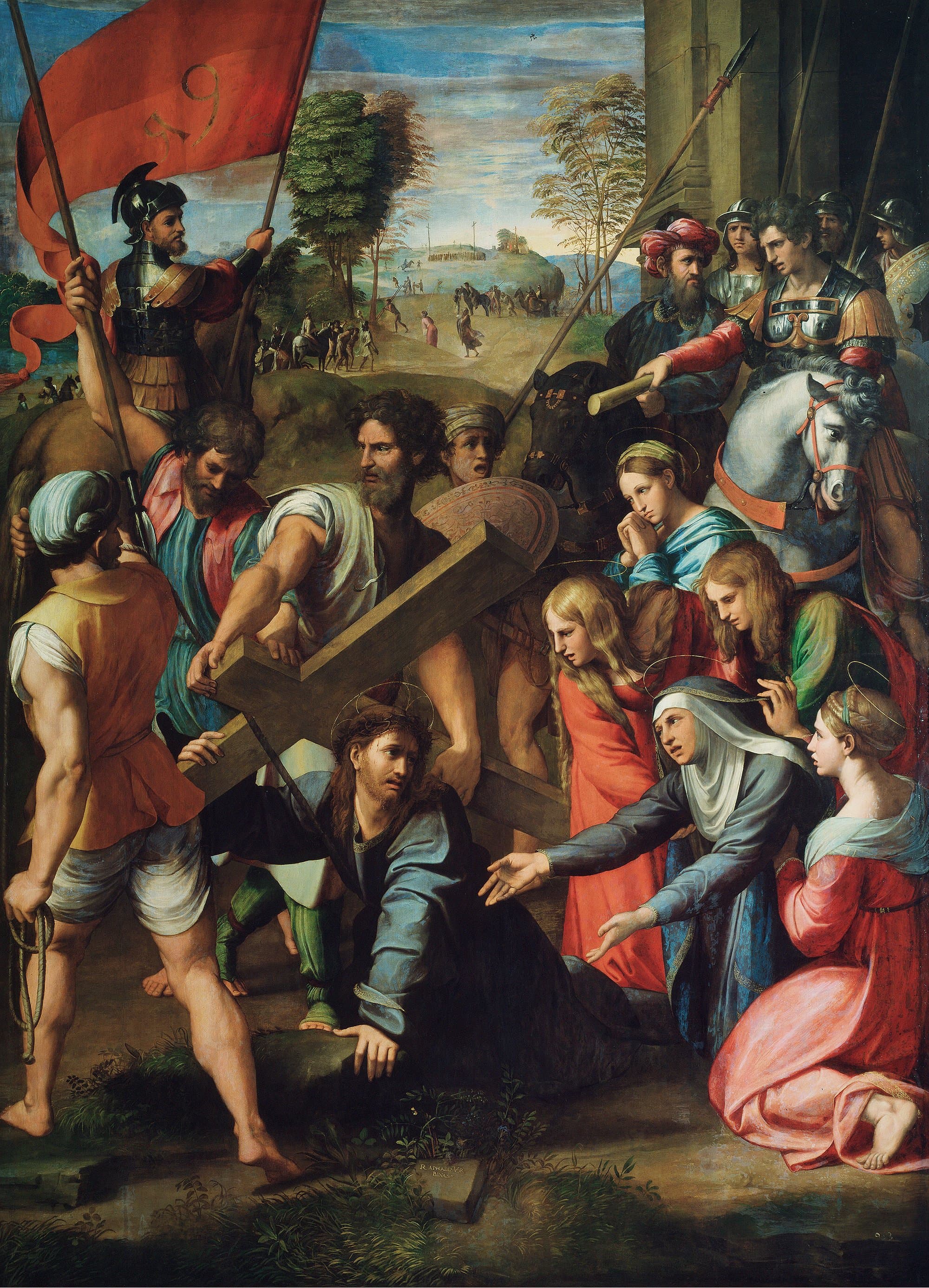
1 Peter 2 · Doctrine · Suffering
Christ Who Suffered for Us
First Peter 2 and Hebrews 2 teach why Christ suffered and what His suffering means for those who suffer now.
Peter had seen Christ suffer, and he called himself "a witness of Christ’s sufferings" (1 Peter 5:1).
He Himself bore our sins in His body on the tree, so that we might die to sin and live to righteousness. “By His stripes you are healed.”
- First taught
- Isaiah 53:3 “He was despised and rejected by men, a…”
- Fullest statement
- Hebrews 2:10 “In bringing many sons to glory, it was…”
Summary
Christ's suffering stands at the centre of the Christian answer to suffering, because the One Christians pray to has borne it. Peter and Hebrews hold two truths about that suffering together, the work He did for His people and the fellowship He shares with them in their weakness. His patience under abuse then becomes the pattern they trace.
- Christ carried His people's sins on the cross, and the example He left rests on that work.
- Isaiah 53 foretold the suffering Servant, and Peter reads its lines as fulfilled at the cross.
- Hebrews teaches that the Son shared flesh and blood, was tempted, and was made perfect through suffering.
- Because Christ was made like His brothers in every way, He is a merciful and faithful high priest who helps the tempted.
Christ Suffered for You
First Peter 2:21 is the hinge between Peter's counsel to servants and his account of the cross.
Every Christian who suffers asks what God has done about suffering. First Peter 2:21 to 25 and Hebrews 2:10 to 18 answer that God the Son has suffered, and they say why He did. The doctrine belongs to the trial of suffering because it is where Scripture sets the believer's suffering beside Christ's, in the place where He bore it for His people.
The question this study answers is how Christ's suffering is both the payment for sin and the help of those who suffer. It sets Peter's words beside the prophecy of Isaiah 53 that they quote, follows Hebrews on the High Priest made perfect through suffering, and gives the readings of the hardest phrase. The confession of the church and its teachers stand with the texts.
Peter was writing to household servants, some under masters who were "unreasonable", and he told them that to "suffer for doing good" and endure it "is commendable before God" (1 Peter 2:18 to 20).
For to this you were called, because Christ also suffered for you, leaving you an example, that you should follow in His footsteps:Peter gives the reason believers can bear unjust suffering, and he puts Christ's suffering for them before the example He left.
The Greek word for example in 1 Peter 2:21 is hypogrammos, which the STEP Bible lexicon glosses as an underwriting, a copy for imitation.
Isaiah 53 Behind 1 Peter 2
Peter's lines on Christ's innocence, His silence and the straying sheep take their words from Isaiah 53, and 1 Peter 2:24 draws on two more of its verses.
Peter takes the prophet's words for Christ's innocence, His silence and the people's straying.
| 1 Peter 2:22 to 25 | Isaiah 53 | Isaiah's verse |
|---|---|---|
| He committed no sin, and no deceit was found in His mouth. | although He had done no violence, nor was any deceit in His mouth | Isaiah 53:9 |
| When they heaped abuse on Him, He did not retaliate | yet He did not open His mouth | Isaiah 53:7 |
| you were like sheep going astray | We all like sheep have gone astray | Isaiah 53:6 |
First Peter 2:24 takes its sin-bearing from Isaiah 53:12, where the Servant "bore the sin of many". It takes its healing from Isaiah 53:5, "by His stripes we are healed", and Peter turns the prophet's we to you. The song opens at Isaiah 52:13, and Isaiah 53:3 calls the Servant "a man of sorrows, acquainted with grief".
The Saviour and the Example
Peter holds Christ's sin-bearing and His patience under abuse together, and the first is the ground of the second.
The purpose Peter gives for Christ's sin-bearing in 1 Peter 2:24 is a changed life, death to sin and life to righteousness.
The example itself is Christ under abuse, who made no threats and "entrusted Himself to Him who judges justly" (1 Peter 2:23). Matthew 11:28 to 30, where Jesus calls Himself gentle and humble in heart, is the other great text of that pattern.
Peter calls the cross a tree, xulon, the word of the law that pronounced the hanged man accursed in Deuteronomy 21:22 to 23.
How the cross saves, and where the example stands beside the sin-bearing, are argued by seven readings of the atonement with their holders.
The High Priest Who Suffered
Four verses of Hebrews 2 give what the Son's suffering won and what it made Him able to do.
In bringing many sons to glory, it was fitting for God, for whom and through whom all things exist, to make the author of their salvation perfect through suffering.This is the phrase every reading of the doctrine has to explain.
The word the Berean text renders author is archēgos, a chief leader, and the word for suffering in Hebrews 2:10 is pathēma, the noun of what is undergone.
Now since the children have flesh and blood, He too shared in their humanity, so that by His death He might destroy him who holds the power of death, that is, the devil, and free those who all their lives were held in slavery by their fear of death.These verses give the reason for the Incarnation in terms of death and the devil.
For this reason He had to be made like His brothers in every way, so that He might become a merciful and faithful high priest in service to God, in order to make atonement for the sins of the people.The verse joins Christ's likeness to His brothers with His work of atonement.
Because He Himself suffered when He was tempted, He is able to help those who are being tempted.This verse is the ground of the believer's confidence that Christ helps in temptation.
Hebrews 4:15 returns to the same point and says the High Priest can sympathize with our weaknesses, since He was tempted in every way that we are and was without sin. The full humanity of Christ, which these verses require, has its own study.
Hebrews 2:17, Hebrews 2:18
How the Church Confessed It
The Westminster Confession of 1646 names Christ's sufferings in His soul and His body in its chapter on the Mediator.
The Westminster Confession, chapter 8, section 4, says that Christ "endured most grievous torments immediately in His soul, and most painful sufferings in His body". Its next section says that by His obedience and sacrifice He has "fully satisfied the justice of His Father".
How the Church Has Read It
A bishop of the second century and a commentator of the eighteenth read Christ's suffering from these texts.
died 155 · Polycarp of Smyrna
Polycarp of Smyrna, in his letter to the Philippians, wrote that Jesus Christ "endured all things for us, that we might live in Him". He drew the example from the same sufferings and went on, "Let us then be imitators of His patience".
1662 to 1714 · Matthew Henry
Matthew Henry, in his Commentary on the Whole Bible (1710), wrote on Hebrews 2:18 that Christ's "temptations were not the least part of his sufferings".
Where Readers Disagree
Readers have divided over what it means that the sinless Son was made perfect through suffering.
What does made perfect through suffering mean?Adam Clarke, John Wesley, Albert Barnes
The verb in Hebrews 2:10 is teleioō, to complete or accomplish. Adam Clarke, in his Commentary on the Bible, read the perfecting as the completing of the work of salvation. He wrote, "Without suffering he could not have died, and without dying he could not have made an atonement for sin". John Wesley read it the same way and wrote that Christ "was made a perfect or complete sin-offering".
Albert Barnes read it of the Saviour Himself, "made complete in all respects by sufferings" for the work He had to do.
Although He was a Son, He learned obedience from what He suffered. And having been made perfect, He became the source of eternal salvation to all who obey HimHebrews ties the perfecting to the obedience the Son learned from what He suffered, which bears on both readings.
Sources
Scripture is the Berean Standard Bible.
- STEP Bible, the Brief lexicon of Extended Strongs for Greek based on Abbott-Smith (1922), Tyndale House, Cambridge, CC BY 4.0.
- STEP Bible, the Translators Amalgamated Greek New Testament (TAGNT), Tyndale House, Cambridge, CC BY 4.0.
- The Confession of Faith of the Assembly of Divines at Westminster (1646), chapter 8, sections 4 and 5, edited by S. W. Carruthers (1946)
- Polycarp of Smyrna, Epistle to the Philippians, chapter 8.
- John Wesley, Explanatory Notes upon the New Testament (1755), on Hebrews 2:10.
- Matthew Henry, Commentary on the Whole Bible (1710), on Hebrews 2:18.
- Adam Clarke, Commentary on the Bible (1832), on Hebrews 2:10.
- Albert Barnes, Notes, Explanatory and Practical, on the Old and New Testaments (1832 to 1869), on Hebrews 2:10.
Keep Studying
People and groups7