
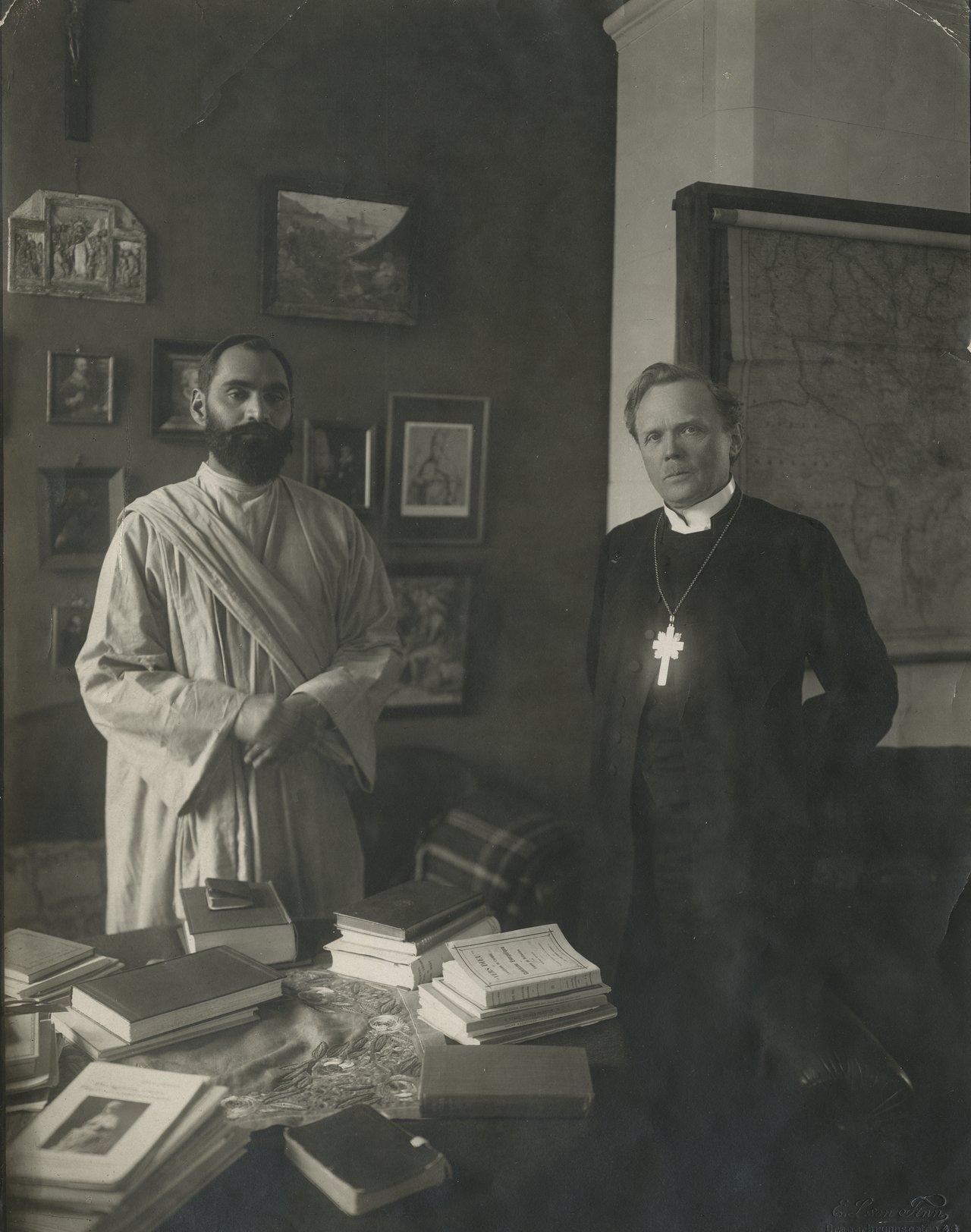
Sadhu Sundar Singh with Nathan Söderblom, Emil Finn, 1922. Public domain.
Punjab, the Himalayas and Tibet, 1889 to 1929 · Person · Featured Study
Sadhu Sundar Singh
He was a Sikh-born Christian who preached as a wandering sadhu in North India and Tibet from 1905.
Three days after he burned a Bible in front of his father, he told him he had become a Christian.
For it has been granted to you on behalf of Christ not only to believe in Him, but also to suffer for Him,
- Born
- 3 September 1889
- Died
- not known; he left Sabathu for Tibet in April 1929 and was not seen again (proposed)
- Family
- father: ; mother:
- Places
- Rampur, Simla, Kotgarh, Sabathu, Tibet
Summary
Sundar Singh was born in 1889 to a rich Sikh family in the Punjab. He dated his conversion to 18 December 1904. He then took the robe of a sadhu, a Hindu holy man, to preach Christ.
- He would not baptize his converts and sent them to the ministers of each place.
- From 1918 he preached across Asia, and later in Britain, America and Europe.
- No one is known to have seen him after he set out for Tibet in 1929.
The Texts He Leaned On
The voice he heard at his conversion echoes Acts 9, and the joy he found in suffering echoes Philippians 1.
The question of this life is how a Sikh youth came to follow Christ as a wandering holy man. Streeter and Appasamy, who questioned him at Oxford, and his friend Andrews are the witnesses.
He fell to the ground and heard a voice say to him, “Saul, Saul, why do you persecute Me?”The voice he reported in 1904 asked how long he would persecute, the question Saul heard on the Damascus road.
The Life in Order
The years to 1920 stand on Streeter and Appasamy, and the last years on Andrews.
He took the sadhu's robe as a Christian and still wore it when he last set out.
- 3 September 1889He was born at Rampur, in the state of PatialaStreeter and Appasamy
- 18 December 1904He reported a vision of Christ before dawnStreeter and Appasamy
- 3 September 1905He was baptized at Simla in the Church of EnglandStreeter and Appasamy; Andrews
- Late 1906Stokes joined him in his workStreeter and Appasamy
- 1909 and 1910He studied at St. John's Divinity College, LahoreStreeter and Appasamy
- About 1912He attempted a fast of forty days at twenty-threeStreeter and Appasamy
- Early 1918His preaching in South India and Ceylon began his tours abroadStreeter and Appasamy
- January 1920He sailed for EnglandStreeter and Appasamy
- 1922He visited Palestine and Europe, Sweden among its countriesAndrews; Uppsala University Library
- 18 April 1929He wrote his last letter before leaving Sabathu for TibetAndrews
- 1933The Government of India presumed his death and his will was provedAndrews
Each step of the life stands with its witness.
Early 1918, January 1920, 1922, 18 April 1929, 1933
From Rampur to the Roads of Tibet
A Sikh boy who burned the Bible became a Christian holy man who owned nothing but his robe.
Streeter and Appasamy say his parents kept Sikh and Hindu ways alike. His mother held up the life of a sadhu to him and died when he was fourteen. By seven he knew most of the Bhagavad Gita by heart, and he first met the Bible at the Presbyterian mission school in his village.
In one of his addresses at Kandy he said he tore up a Bible and burned it in his father's presence. Three days later he rose at three in the morning and prayed for an answer, meaning to lie on the railway line before the five o'clock train if none came. At half past four, he said, he saw a great light and the form of Jesus Christ, and found a peace that never left him.
He was baptized at Simla in the Church of England on his sixteenth birthday, and Andrews names Redman, the minister at Simla, as the friend who sheltered him. He took up the life of a sadhu, owning only his robe, his blanket and a New Testament and eating what his hearers gave him. His first tour covered the Punjab, Kashmir, Baluchistan and Afghanistan, and the hill village of Kotgarh became his base.
At Kotgarh late in 1906 he met Stokes, an American who had given up his goods to found a brotherhood on the pattern of Francis of Assisi. The two men worked in the leper asylum at Sabathu and in a plague camp near Lahore. From 1908 he spent half the year or more in Tibet and worked in India in the winter.
His visit to Madras early in 1918 made him known across India, and tours to Burma, China and Japan followed. He sailed for England early in 1920, spoke in Britain, America and Australia, and returned to India that September. Andrews says he reached Palestine in 1922 and came home from Europe worn out.
In April 1929 he left Sabathu for Tibet, meaning to go by Rishikesh and Badrinath over the Niti Pass. Watson of the Sabathu leper asylum wrote that no one seems to have noticed him after Kalka. Two friends, Riddle and Taylor, later went to trace him, and Andrews writes that the silence remained unbroken.
In Their Own Words
Four sayings that Streeter and Appasamy printed in 1921, on his conversion, suffering, healing and his hermit.
Sadhu Sundar Singh (1889 to 1929)
An address at Kandy, in B. H. Streeter and A. J. Appasamy, The Sadhu: A Study in Mysticism and Practical Religion (1921), chapter I, chapter I, page 6
How long will you persecute me?
“I heard a voice saying in Hindustani, 'How long will you persecute me? I have come to save you; you were praying to know the right way. Why do you not take it?'”
Indian Christian
About this saying1 paragraph
In one of his addresses at Kandy in Ceylon he told of a morning in December 1904.
Sadhu Sundar Singh
His words in the autumn of 1906, as S. E. Stokes reported them, in B. H. Streeter and A. J. Appasamy, The Sadhu (1921), chapter I, chapter I, page 34
The sweetness of suffering
“How sweet it is to suffer for His sake.”
Indian Christian
About this saying1 paragraph
S. E. Stokes heard him say this under his breath in the autumn of 1906, while he lay ill with fever.
Sadhu Sundar Singh
His account of a healing in Ceylon, in B. H. Streeter and A. J. Appasamy, The Sadhu (1921), chapter I, chapter I, page 39
Prayer for a dying son
“There is no power in these hands, only in the pierced hands of Christ.”
Indian Christian
About this saying1 paragraph
He told Streeter and Appasamy, who questioned him in 1920, why he gave up praying for the sick and what he had said to a mother in Ceylon.
Sadhu Sundar Singh
His words at Oxford, in B. H. Streeter and A. J. Appasamy, The Sadhu (1921), chapter I, chapter I, page 33
The hermit of Kailash
“The Maharishi is a man of prayer, and I have a great respect for him; but my work is, not to preach the Rishi, but to preach Christ.”
Indian Christian
About this saying1 paragraph
He said this at Oxford in 1920 of the hermit he reported finding on the Kailash range.
The People Around Him
The witnesses name his mother, his first companions, the men who wrote him down and the friends who searched for him.
His mother set the sadhu's life before him, and Christians gave it a new aim.
| Person | Tie to Sundar Singh | The witness |
|---|---|---|
| His mother | She taught him to seek peace and died when he was fourteen | Streeter and Appasamy |
| His father | He saw the Bible burned, and in 1918 asked his son to baptize him | Streeter and Appasamy |
| J. Redman | The aged minister at Simla who received him at his baptism | Andrews |
| S. E. Stokes | An American who shared his early work | Streeter and Appasamy |
| Mrs. Arthur Parker | A missionary at Trivandrum who wrote the first long account of him | Streeter and Appasamy |
| B. H. Streeter and A. J. Appasamy | The Oxford scholars who questioned him and wrote The Sadhu | Streeter and Appasamy |
| Nathan Söderblom | The Archbishop of Uppsala, who received him in Sweden in 1922 | Andrews; Uppsala University Library |
| C. F. Andrews | A friend who gathered the evidence of his last journey in 1933 | Andrews |
Nathan Söderblom, C. F. Andrews
The Places of His Life
His life runs from the plains of the Punjab to the hills near Simla and over the passes into Tibet.
Kotgarh and Sabathu were his bases between journeys.
| Place | What the witnesses say | The witness |
|---|---|---|
| Rampur, Patiala | He was born there and reported his vision there. | Streeter and Appasamy |
| Simla | He was baptized there. | Streeter and Appasamy; Andrews |
| Kotgarh | A hill village 55 miles from Simla, the start and end of his tours. | Streeter and Appasamy |
| Lahore | His divinity college stood there. | Streeter and Appasamy |
| Rasar, Tibet | He reported being thrown into a well there and drawn out. | Mrs. Parker, as Streeter and Appasamy print her |
| Sabathu | He worked in its leper asylum and set out from it on his last walk. | Streeter and Appasamy; Andrews |
A Christian in a Sadhu's Robe
He took a Hindu form of holy life and turned it to preaching Christ.
Streeter and Appasamy explain that a sadhu owns nothing but his saffron robe and is honoured by Hindus, so that feeding him counts as merit. They judge that the robe let him present Christ in an Indian form, and that it turned to persecution once hearers found he preached Christ.
In Tibet, by the account of his first biographer, a lama at Rasar had him thrown into a dry well among the bones of the dead. He said that on the third night someone opened the lid and drew him out by a rope, and the lama found the key on his own girdle.
How the Key Verse Was Taught
Clement of Alexandria, Tertullian, John Cassian and Matthew Henry read suffering for Christ as a gift.
Clement of Alexandria (died 215)
The Stromata Book 4
Clement of Alexandria cited the verse on bearing afflictions.
“But the apostle, writing to us with reference to the endurance of afflictions, says, ‘And this is of God, that it is given to you on behalf of Christ, not only to believe on Him, but also to suffer for His sake; having the same conflict which ye saw in me, and now hear to be in me.”
on Philippians 1:29Patristic
Tertullian (died 220)
Scorpiace
Tertullian set it beside Paul's words on things seen and unseen, in his book against those who fled martyrdom.
“For the things which are seen are temporal’-he is speaking of troubles; ‘but the things which are not seen are eternal’-he is promising rewards. But writing in bonds to the Thessalonians, he certainly affirmed that they were blessed, since to them it had been given not only to believe on Christ, but also to suffer for His sake.”
on Philippians 1:29Patristic
John Cassian (died 435)
CONFERENCES 3.15.2
John Cassian took from it that both the start and the endurance of faith are the Lord's gifts.
“Not only the beginning of our conversion but also the continuance of it through the endurance of suffering for it are gifts given to us by the Lord.”
on Philippians 1:29Patristic
Matthew Henry (1662 to 1714)
Commentary on the Whole Bible
Matthew Henry counted faith and suffering as two gifts given for Christ's sake.
“Here are two precious gifts given, and both on the behalf of Christ:-- 1. Faith is God's gift on the behalf of Christ, who purchased for us not only the blessedness which is the object of faith, but the grace of faith itself: the ability or disposition to believe is from God.”
on Philippians 1:29Puritan
What the Witnesses Leave Open
Critics doubted his visions, and his friends disagreed on how he died.
Whether his reported marvels happened as toldOskar Pfister; Friedrich Heiler; Streeter and Appasamy; Sundar Singh
Andrews describes Oskar Pfister's Die Legende Sundar Singhs (1926) as reading his alleged miraculous experiences from a psychopathic standpoint and rejecting them as hallucination. He calls Friedrich Heiler's The Gospel of Sadhu Sundar Singh the fullest account of his life, with a reply to that attack.
Streeter and Appasamy printed his visions from notes they checked against each other and he read, and they printed the Rasar story in Mrs. Parker's words. He himself told them that people had made too much of the hermit, and Andrews says he later ceased to speak in public of his visions.
How his life endedC. F. Andrews; friends quoted by the Bishop of Lahore
Andrews judged it very nearly certain that he died on the way in 1929, probably in May or June. His friends told Andrews that he had promised to come back in the autumn and would have written if alive.
The Bishop of Lahore wrote to Andrews that many held he was still living, among them Charles Ibrahim, the Indian priest at Sanawar. They believed he had withdrawn into the Himalayas to pray, and Andrews found the question still debated in India in 1933.
Books to Read Next
The Sadhu: A Study in Mysticism and Practical Religion
B. H. Streeter and A. J. Appasamy · 1921
Two Oxford scholars set down his life and teaching from their own talks with him.
Read Streeter and Appasamy free at the Internet ArchiveSadhu Sundar Singh: Called of God
Mrs. Arthur Parker · 1918; the copy read is the American edition of 1920
It is the first long account of him, and the source of the Rasar story as Streeter and Appasamy print it.
Read Parker's book free at the Internet ArchiveSadhu Sundar Singh: A Personal Memoir
C. F. Andrews · 1934
His friend wrote it to weigh the evidence of his last walk into Tibet and the dispute over his truthfulness.
Read Andrews free at the Internet ArchiveWhat Sundar Singh Left
He left books of his meditations and the pattern of an Indian Christian holy man who would not found an order. Archbishop Söderblom wrote that Sundar was the first to show the whole world the Gospel reflected in an Indian soul.
Sources
Scripture is the Berean Standard Bible.
- The Holy Bible, Berean Standard Bible (read 2026)
- B. H. Streeter and A. J. Appasamy, The Sadhu: A Study in Mysticism and Practical Religion (London: Macmillan, 1921)
- C. F. Andrews, Sadhu Sundar Singh: A Personal Memoir (New York and London: Harper and Brothers, 1934)
- Clement of Alexandria, The Stromata, book 4, on Philippians 1:29.
- Tertullian, Scorpiace, on Philippians 1:29.
- John Cassian, Conferences 3.15.2, on Philippians 1:29.
- Matthew Henry, Commentary on the Whole Bible (1710), on Philippians 1:29.
Keep Studying
People and groups2
Subjects1
Trials of life1