
Acts 2:17 and the Passion of Perpetua and Felicity · Story · Persecution
Perpetua and Felicity
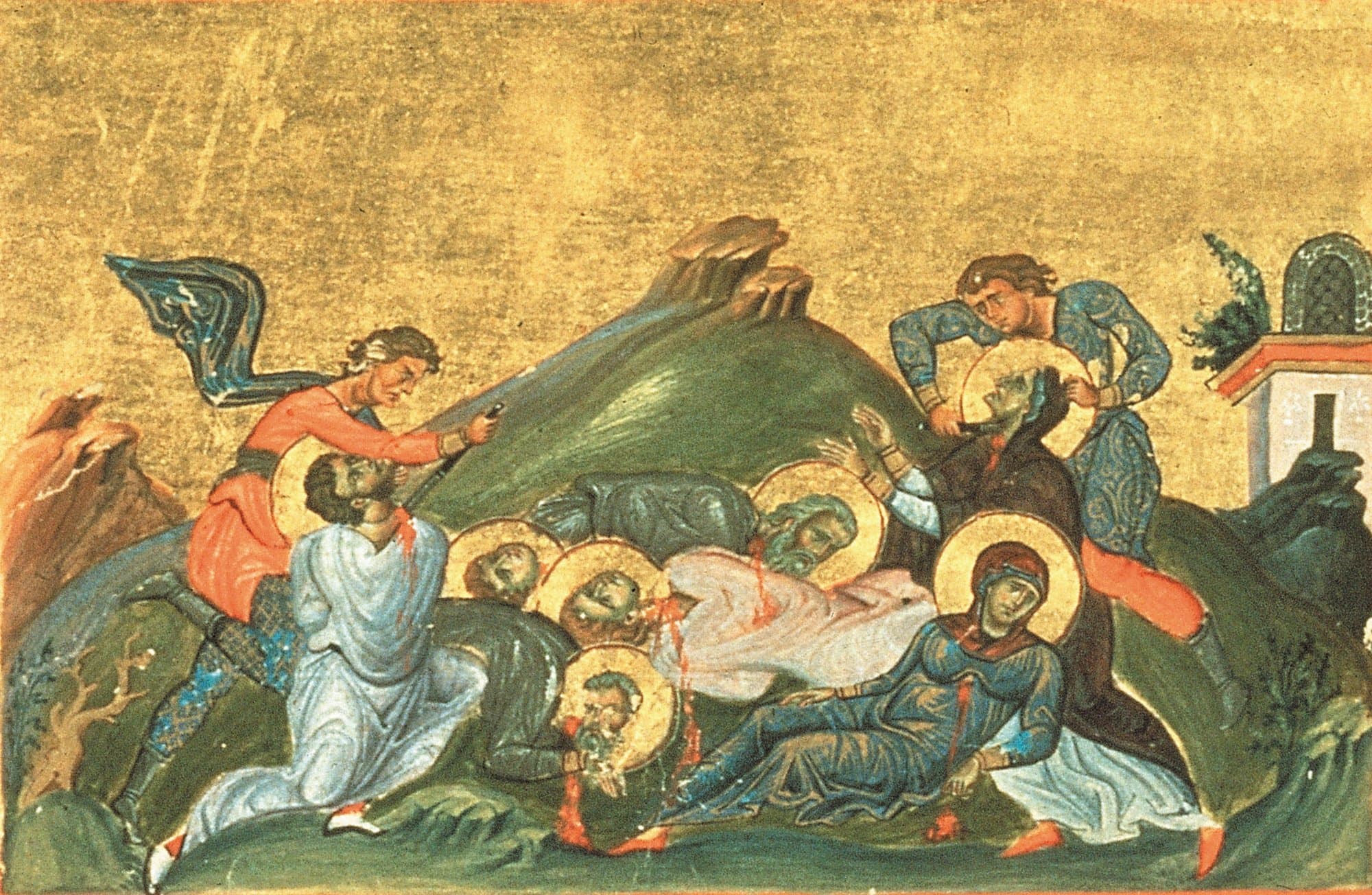
Vibia Perpetua and the slave Felicity were put to death with their companions in the arena at Carthage for confessing Christ.
Perpetua kept a prison diary, and another hand finished the story after her death.
‘In the last days, God says, I will pour out My Spirit on all people. Your sons and daughters will prophesy, your young men will see visions, your old men will dream dreams.
- Where
- Carthage
- When
- 7 March 203, as Kirsch dates it; Wallis gives about 202 (probable)
Summary
Early in the third century a young mother of good family, a pregnant slave and their fellow catechumens were arrested in Roman Africa under the emperor Septimius Severus. Perpetua refused her father's pleas and the governor's order to sacrifice for the emperors, and in prison she saw four visions. At the games they died for the faith, by the beasts and by the sword.
- Perpetua was about twenty-two, married and nursing an infant son when she was taken.
- Felicity bore a daughter in prison just before the games, and a sister of the church raised the child.
- The Passion gives the occasion of the deaths, a birthday of Geta Caesar, and no year.
The Passion of Perpetua and Felicity
The Passion of Perpetua and Felicity tells how a young mother, a slave woman and their companions met a Roman court's demand to sacrifice for the emperors. It shows what persecution cost them and how they answered it.
This study asks who these martyrs were, what the account says happened to them, and how far its words are their own. It gives the events in order from an English edition, tells the story with Perpetua's own words, sets out the setting and the date, and weighs three questions about the text. It is a story of the trial of persecution from the church's history.
R. E. Wallis translated the Passion into English for the Ante-Nicene Fathers, volume 3, published in 1885. The Passion's unnamed editor gives his reason for writing down new visions, "that so no weakness or despondency of faith may suppose that the divine grace abode only among the ancients".
The Days in Order
The Passion follows the companions from their arrest to the sword, and the visions fall between the hearings.
- The arrestFive catechumens takenThe young catechumens, Revocatus and his fellow-servant Felicitas, Saturninus and Secundulus, were apprehended (1.1)
- Within a few daysBaptized with the othersIn that same interval of a few days we were baptized (1.2)
- After a few daysTaken into the dungeonAfter a few days we are taken into the dungeon (1.2)
- After her brother askedThe vision of the ladderI saw a golden ladder of marvellous height, reaching up even to heaven (1.3)
- Another day, at dinnerThe hearing before HilarianusThe procurator then delivers judgment on all of us, and condemns us to the wild beasts (2.2)
- After the first vision of DinocratesMoved to the prison of the campwe passed over into the prison of the camp, for we were to fight in the camp-show (2.3)
- The day before the fightThe vision of the EgyptianThe day before that on which we were to fight, I saw in a vision (3.2)
- Three days before the gamesThe prayer for Felicitythey poured forth their prayer to the Lord three days before the exhibition (5.2)
- The day before the gamesThe last mealin that last meal, which they call the free meal (5.4)
- The day of the gamesLed into the amphitheatrethey proceeded from the prison into the amphitheatre, as if to an assembly (6.1)
- The end of the gamesPut to the swordThe rest indeed, immoveable and in silence, received the sword-thrust (6.4)
A timeline of eleven rows in the order of the events, each with the words of the Wallis translation of 1885 and its chapter and section.
The day before the fight, Three days before the games, The day before the games, The day of the games, The end of the games
From the Dungeon to the Arena
The Passion moves from the family and the dungeon to the court, the visions and the games.
When her father pressed her to turn back, she pointed to a pitcher and asked whether it could be called by any other name than what it was. Then she said, "Neither can I call myself anything else than what I am, a Christian" (1.2).
The darkness of the dungeon frightened her, and her fear for her child was worse. When he was allowed to stay with her, "the dungeon became to me as it were a palace" (1.2).
In her first vision a dragon crouched under the ladder, and she said, "In the name of the Lord Jesus Christ, he shall not hurt me" (1.3). She trod on its head as she began to climb, and she and her brother understood that she would suffer.
At the hearing her father came with her son and begged her to pity the child. Hilarianus told her to offer sacrifice for the well-being of the emperors, and she answered, "I will not do so", and then, "I am a Christian" (2.2). Her father was beaten with rods for trying to draw her away.
DinocratesThe Passion 2.3 to 2.4
Perpetua prayed for her brother Dinocrates, who had died of disease at seven years of age. She saw him first thirsty beside a pool he could not reach. After days of prayer she saw him clean and drinking, and she "understood that he was translated from the place of punishment" (2.4).
The EgyptianThe Passion 3.2
On the eve of the games she saw herself in the arena, fighting an Egyptian and treading on his head. She wrote, "I perceived that I was not to fight with beasts, but against the devil", and her own part ends, "what passed at the exhibition itself let who will write" (3.2).
Secundulus died in the prison before the games (5.1). Felicity grieved that she would be held back, "because pregnant women are not allowed to be publicly punished" (5.2).
A servant mocked her cries in labour. Felicity answered that now she suffered for herself, "but then there will be another in me, who will suffer for me, because I also am about to suffer for Him" (5.2).
Revocatus, Saturninus and Saturus threatened the watching crowd, and at its demand they were scourged as they passed the line of the hunters (6.1). The men faced a leopard, a bear and a boar, and the women a wild cow (6.2 to 6.3). Perpetua was thrown down, rose, and lifted Felicity up. At the end they kissed one another and were killed with the sword, Saturus the first of them (6.4).
Carthage under Septimius Severus
Scholars supply the city, the law and the year from outside the text.
The Passion names Hilarianus the procurator, who had received the power of life and death "in the place of the proconsul Minucius Timinianus, who was deceased" (2.2). Wallis's notice identifies Geta, named in the Passion at 2.3, as the son of Septimius Severus.
Johann Peter Kirsch, writing in the Catholic Encyclopedia of 1909, wrote that "By a rescript of Septimus Severus (193-211) all imperial subjects were forbidden under severe penalties to become Christians". He dated the deaths at Carthage to 7 March 203. Wallis's notice gives "about the year 202" and names Carthage as "the more general opinion", with Tuburbium in Mauritania held by some.
Remembered by the Church
Tertullian named Perpetua, Rome kept the feast, and Carthage built over the tomb.
Tertullian, in his Treatise on the Soul, called her "the most heroic martyr Perpetua" and recalled that on the day of her passion she saw only her fellow martyrs in Paradise.
Kirsch records that their names stand under 7 March in the Philocalian calendar, the list of martyrs honoured at Rome in the fourth century. A basilica was raised over their tomb at Carthage, where Delattre found an inscription bearing their names. Wallis's notice also points to sermons on their passion, numbered 281 and 282, credited to Augustine, "if indeed his".
Questions about the Text
Readers differ on who framed the account, whether it is Montanist, and how much of it is Perpetua's own.
Who framed the accountA. Cleveland Coxe, 1885; J. Armitage Robinson, 1891; J. P. Kirsch, 1909
A. Cleveland Coxe, the American editor of the Ante-Nicene Fathers, wrote, "I think Tertullian was the editor of the story, not its author." J. Armitage Robinson, in his edition of 1891, believed the redactor could be identified, and he argued for Tertullian from the style and the vocabulary.
The strongest objection is Kirsch's, "That Tertullian is the author of these Acts is an unproved assertion". Robinson himself granted that "there is no tradition connecting it with his name".
Whether the account is MontanistJ. Armitage Robinson, 1891; J. P. Kirsch, 1909
Robinson found "The distinctly Montanistic tone of the Martyrdom" in its stress on the present work of the Holy Spirit. Wallis's notice reports that some have held the writer, or the martyrs too, to be Montanists.
The strongest objection is Kirsch's, that the claim "lacks proof; at least there is no intimations of it in the Acts", and that Rome entered their feast in its calendar.
How much is Perpetua's ownR. E. Wallis, 1885; J. Armitage Robinson, 1891; Henry Hart Milman, History of Christianity
The Passion says Perpetua and Saturus wrote their own parts, and Wallis saw "no reason to doubt the statement". Robinson found that the most striking Greek words of the piece "occur in the writing of Perpetua", which would "confirm us in the belief that we had the actual words of the Martyrs themselves".
Henry Hart Milman, in his History of Christianity (volume 1, chapter 8) as Wallis quotes it, saw "strong indications that the acts of these African martyrs are translated from the Greek". Against him Kirsch held that "there is no doubt that the Latin text is the original".
Stand Fast in the Faith
Perpetua's last recorded words were a charge to the believers who stood by her.
After the cow had thrown her, Perpetua called her brother and a catechumen named Rusticus to her (6.3). She said, "Stand fast in the faith, and love one another, all of you, and be not offended at my sufferings."
Be on the alert. Stand firm in the faith. Be men of courage. Be strong.Paul gave the church at Corinth the same charge Perpetua gave her brother, to stand firm in the faith.
Sources
Scripture is the Berean Standard Bible.
- The Passion of the Holy Martyrs Perpetua and Felicity, translated by R. E. Wallis, Ante-Nicene Fathers, volume 3, edited by Alexander Roberts, James Donaldson and A. Cleveland Coxe (Buffalo, Christian Literature Publishing Co., 1885)
- The introductory notices to the Passion of Perpetua and Felicitas, by A. Cleveland Coxe and the translator R. E. Wallis, Ante-Nicene Fathers, volume 3 (1885)
- Johann Peter Kirsch, "Sts. Felicitas and Perpetua", The Catholic Encyclopedia, volume 6 (New York, Robert Appleton Company, 1909)
- J. Armitage Robinson, The Passion of S. Perpetua, Texts and Studies 1.2 (Cambridge, Cambridge University Press, 1891)
- The Martyrdom of Polycarp, translated by Alexander Roberts and James Donaldson, Ante-Nicene Fathers, volume 1 (Buffalo, Christian Literature Publishing Co., 1885)
- STEP Bible, the Brief lexicon of Extended Strongs for Greek, Tyndale House, Cambridge, CC BY 4.0, with Strong's definitions.
- Henry Hart Milman, History of Christianity, volume 1, chapter 8, as Wallis quotes him in his notice of 1885.
- Tertullian, A Treatise on the Soul, chapter 55.