
The record to 2026 · Subject · The Persecuted Church Today
Saudi Arabia and the Gulf
Reports of the Congressional Research Service and an old survey of Arabian missions give the record on Saudi Arabia and Qatar.
Most of the Christians on the Arabian side of the Gulf are workers from abroad, and in Qatar the law forbids them to worship in public.
For where two or three gather together in My name, there am I with them.”
- Books
- Matthew, Galatians
- Hold in memory
- Matthew 18:20
Summary
Saudi Arabia and Qatar each have their own rules for Christians. An American report says Saudi law gives no right to freedom of religion. The United States puts the kingdom on its list of the worst. Qatar makes its foreign churches register, and it keeps their worship out of public view.
- About one in seven people in Qatar is a Christian, by an estimate of 2020.
- Paul went into Arabia after the Lord called him.
- When Zwemer wrote on the missions to Arabia, he found much of the land without a single missionary.
The Verses for the Church in Arabia
Arabia stands in Paul's letters, and Jesus gave the promise that small gatherings keep.
Paul's letter to the Galatians twice names Arabia: he went there after his call, and he placed Mount Sinai there. Jesus promised to be with two or three gathered in His name, a word for congregations that meet behind closed doors. He sent His disciples to make disciples of all nations.
Arabia in Paul's letters
nor did I go up to Jerusalem to the apostles who came before me, but I went into Arabia and later returned to Damascus.
Paul's first years as a believer took him into Arabia before he went up to Jerusalem.
Now Hagar stands for Mount Sinai in Arabia and corresponds to the present-day Jerusalem, because she is in slavery with her children.
Paul places the mountain of the law in Arabia, the land of this page.
The promise and the command
Therefore go and make disciples of all nations, baptizing them in the name of the Father, and of the Son, and of the Holy Spirit, and teaching them to obey all that I have commanded you. And surely I am with you always, even to the end of the age.”
The command to make disciples names every nation, the peoples of the Gulf among them.
Matthew 28:19 to 20
The Two Countries Side by Side
The table sets the two countries side by side on the questions the American reports answer.
Qatar permits registered foreign congregations, and Saudi law guarantees no freedom of religion at all.
| Question | Saudi Arabia | Qatar |
|---|---|---|
| People | 35.9 million, 18.8 million of them citizens (2023) | About 2.9 million, nearly nine in ten from abroad |
| Christians | No figure in the opened report | 13.7 percent, workers from abroad included (2020) |
| What the law grants | Not guaranteed (CRS, 2023) | Practice allowed within public order (CRS, 2025) |
| American designation, 2023 | Country of Particular Concern, penalties waived | Not on the 2023 list |
The parent page sets out who counts the persecuted church and by what rule each body counts.
The Record on Saudi Arabia and Qatar
Two reports to Congress set out each country's rules.
A report of the Congressional Research Service of October 2023 says that Saudi law does not guarantee freedom of assembly, expression, religion, the press or association. It says the government strictly limits each of them.
In December 2023 the State Department kept Saudi Arabia among its Countries of Particular Concern. It issued a waiver in the national interest instead of new penalties.
The Service's report on Qatar of March 2025 says the constitution allows religious rites so long as they keep public order and morality. Islam is the state religion.
The same report says most foreign residents are not Muslims and names Catholics, Protestants, Copts and Orthodox Christians among them. Their groups must register with the government, and the law prohibits public worship or proselytization by non-Muslims.
The site names no believer in either country and no place where any congregation meets.
Missions to Arabia a Century Ago
Samuel Zwemer counted the missionaries of Arabia province by province in 1900.
The Rev. S. M. Zwemer published Arabia: the Cradle of Islam in 1900, a survey of the peninsula and of the mission work in it. He wrote that only about one twelfth of the peninsula was reached in any way by missionary effort.
He found the region of Bagdad and Busrah the best supplied. It had two stations and six foreign missionaries among a population of about a million.
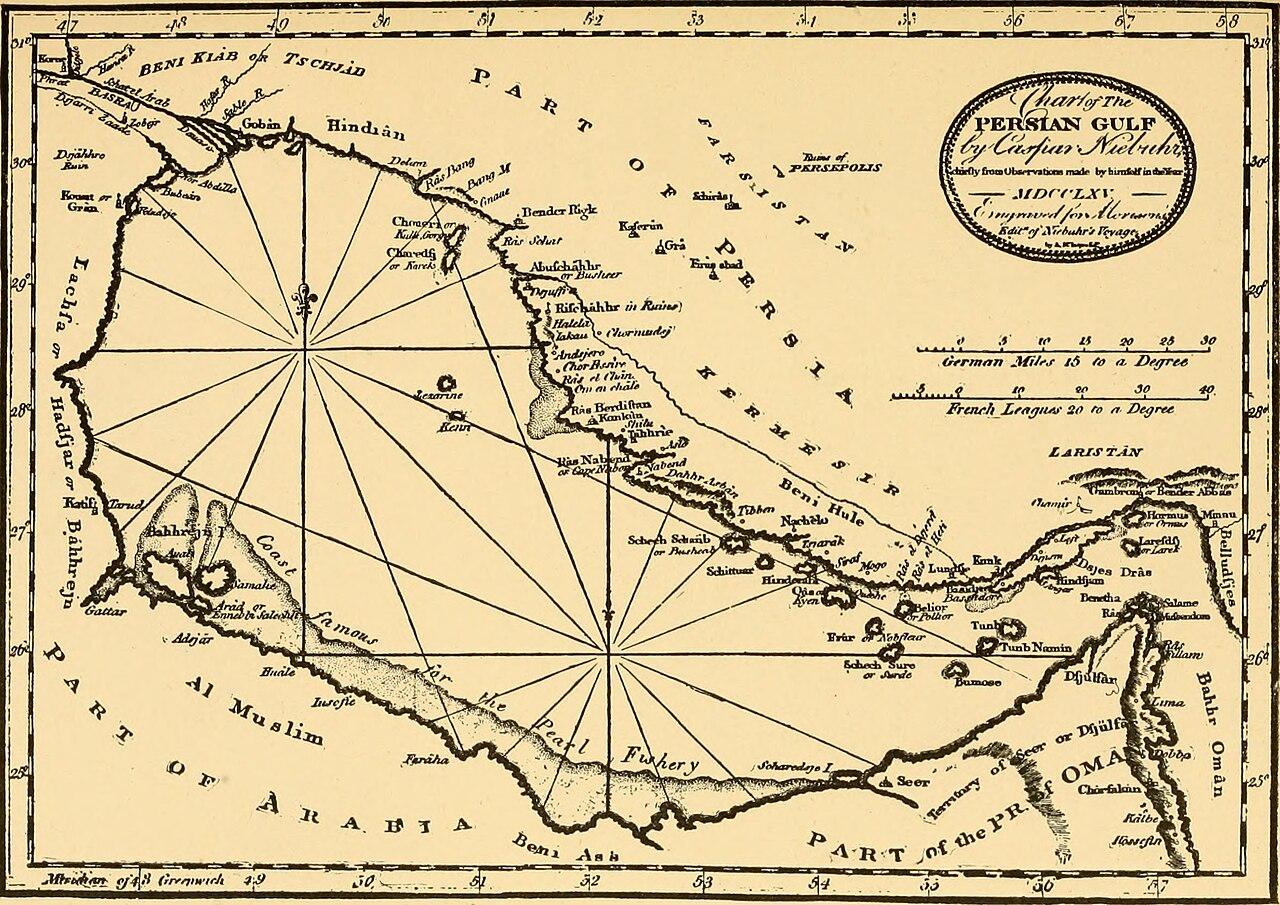
The chart at the head of the page is Carsten Niebuhr's chart of the Persian Gulf of 1765, which Zwemer printed in his book.
In Their Own Words
Jerome (died 420)
EPISTLE TO THE GALATIANS 1.1.17
Jerome said Paul sought Christ in the Scriptures while he was in Arabia.
“How are we to explain this narrative, if we read later that Paul went immediately to Arabia after the revelation of Christ? … He teaches that the Old Testament, that is, the son of the bondwoman, was established in Arabia. And so, as soon as Paul believed, he turned to the Law, the Prophets and the symbols of the Old Testament that were then lying in obscurity and sought in them the Christ whom he was commanded to preach to the Gentiles.”
on Galatians 1:17Patristic
About this saying1 paragraph
Jerome, who died in 420, asked why Paul went into Arabia before Jerusalem and found the answer in the Old Testament.
William Carey (1761 to 1834)
An Enquiry, Section I (1792)
William Carey said the commission bound the church to every country.
“This commission was as extensive as possible, and laid them under obligation to disperse themselves into every country of the habitable globe, and preach to all the inhabitants, without exception, or limitation.”
Particular Baptist
About this saying1 paragraph
Carey, who died in 1834, wrote this on Matthew 28:19 in An Enquiry, which he published in 1792.
Samuel M. Zwemer (1867 to 1952)
Arabia: the Cradle of Islam, page 382
Samuel Zwemer named the provinces of Arabia that had no missionary.
“Looking at Arabia by provinces: Hejaz has no missionary; Yemen (with the exception of Sheikh Othman and Aden) has no missionary; Hadramaut has no missionary; Nejd has no missionary; Hassa has no missionary”
Protestant missionary writer on Arabia
About this saying1 paragraph
Zwemer set this list down in 1900 in the closing chapter of his book on Arabia.
Books to Read Next
Arabia: the Cradle of Islam
Samuel M. Zwemer · 1900
The book's last chapters treat the problems of the Arabian field as Zwemer saw them.
Read Zwemer's book free at the Internet Archive.Saudi Arabia: Background and U.S. Relations
Congressional Research Service · 2023
The report's section on human rights sets out what Saudi law allows.
Read the Saudi report free at the Internet Archive.Qatar: Issues for the 119th Congress
Congressional Research Service · 2025
The report has a section on religious freedom in Qatar.
The Qatar report is free to read at the Internet Archive.What the Gulf Asks of the Church
In Qatar the believers gather in registered congregations that may not worship in public. Matthew 18:20 promises them the presence of Christ wherever two or three meet in His name.
Sources
Scripture is the Berean Standard Bible.
- The Holy Bible, Berean Standard Bible (read 2026)
- Congressional Research Service, Saudi Arabia: Background and U.S. Relations, RL33533, version 88, 2 October 2023, pages 4 and 14.
- Congressional Research Service, Qatar: Issues for the 119th Congress, R47467, version 12, 13 March 2025, pages 3 and 15.
- Michael A. Weber, Global Human Rights: International Religious Freedom Policy, Congressional Research Service IF10803, version 28, updated 3 June 2026, page 2.
- Samuel M. Zwemer, Arabia: the Cradle of Islam (New York: Fleming H. Revell, 1900), the title page and pages 381 to 382.
Keep Studying
Subjects22
Church history2
Trials of life1