
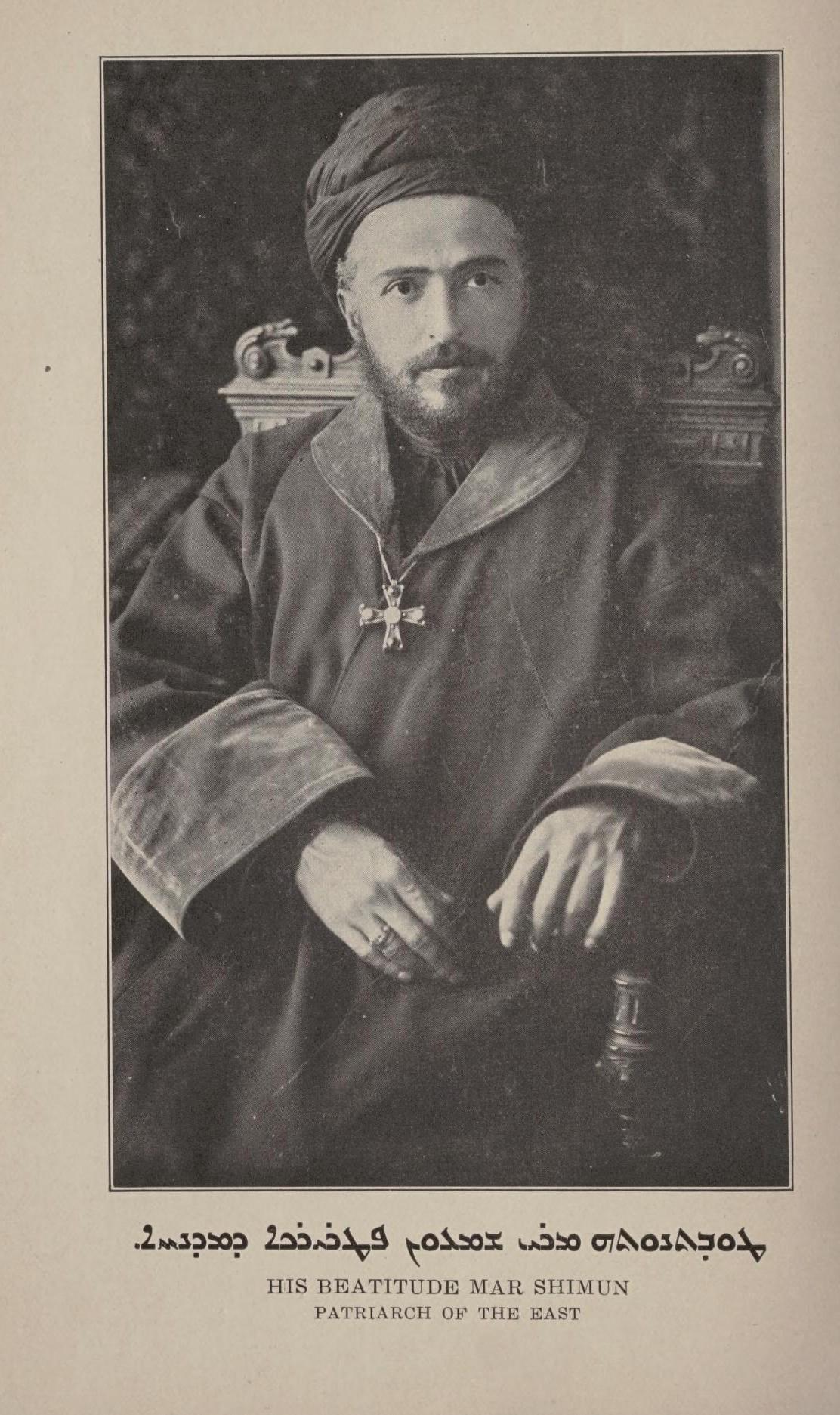
Mar Shimun, Patriarch of the East, 1916. Public domain.
1914 to 1918 · The churches · Featured Study
The Assyrian Martyrs
The Assyrian Christians of Urmia and Hakkiari suffered massacre under the Turkish and Kurdish occupation, then lost their Patriarch and their homes before the war ended.
Wigram wrote that in the last flight from Urmia fully a fourth of the whole nation must have perished.
Then one of the elders addressed me: “These in white robes,” he asked, “who are they, and where have they come from?” “Sir,” I answered, “you know.” So he replied, “These are the ones who have come out of the great tribulation; they have washed their robes and made them white in the blood of the Lamb.
Then one of the elders addressed me: “These in white robes,” he asked, “who are they, and where have they come from?” “Sir,” I answered, “you know.” So he replied, “These are the ones who have come out of the great tribulation; they have washed their robes and made them white in the blood of the Lamb.
Summary
The Assyrians are a Christian people of Persia and Kurdistan. In the Great War many were killed, and many more were driven from their homes.
- Turks and Kurds held their villages west of Lake Urmia for about five months.
- Their mountain villages in Hakkiari were destroyed as the Armenians' were.
- Their Patriarch was shot by the men of a Kurdish chief he had met under a promise of safety.
- Mrs. Cochran wrote that some were killed for refusing to deny their faith.
Out of the Great Tribulation
The texts come from Revelation 7, Matthew 10 and Hebrews 11.
John saw a multitude from every nation and tongue standing before the throne in white robes, and an elder told him who they were.
Jesus sent out the Twelve with a warning that they would be handed over, and He told them whom to fear.
Do not be afraid of those who kill the body but cannot kill the soul. Instead, fear the One who can destroy both soul and body in hell.The page reads the deaths at Urmia in the light of this word.
Women received back their dead, raised to life again. Others were tortured and refused their release, so that they might gain a better resurrection. Still others endured mocking and flogging, and even chains and imprisonment.Hebrews 11 honours the faithful who would not buy their lives with a denial.
Four Years of the Sword
Each event stands on the date its source gives.
The Christians of Urmia were overrun twice, and Hakkiari between the two.
- A Turkish army with Kurdish tribesmen enters AzerbaijanWinter 1914 to 1915
- The Russians retire northward, and many Christians flee with themearly January
- Turks and Kurds hold Urmia for twenty weeksJanuary to May
- The Russians re-enter Urmia24 May
- The communities of the Zab district in Hakkiari are destroyedJune 1915
- The Patriarch is shot after meeting SimkoFebruary 1918
- The flight from Urmiathat summer
A timeline of seven events, dated by the Blue Book or by Wigram's account.
Who They Were
The Blue Book knew them by three names, and they lived in the mountains and on the plain.
The Blue Book calls the Christians west of Lake Urmia a Semitic Christian people. They were called Nestorians from their religion, Syrians from their language and Chaldeans from their race. A larger number lived across the Ottoman border in Hakkiari, around the headwaters of the Greater Zab.
Wigram wrote that the whole nation was Christian from very early ages, with its own hierarchy and a Patriarch at its head. The headship was hereditary in one family, and Mar Shimun was the Patriarch's official name.
Their villages on the plain of Urmia lay among Shiah Moslem neighbours, and their mountain districts lay among the Kurdish tribes.
Urmia under Occupation
What the missionaries and the doctors of Urmia recorded during the occupation
When the Russians left, the Kurds and the Moslem neighbours fell on the villages. Mrs. J. P. Cochran of the American mission wrote from Urmia after the Turks and Kurds had left it.
“They also carried off women and tried to force Christians to become Moslems, keeping them safely if they would deny their faith or repeat the sentence which constituted the acceptance of Islam. In some cases they were successful in this, though, of course, many would not and some of them were killed for it.”
Mrs. J. P. Cochran · Her letter dated Urmia, 20 May 1915, communicated by the Board of Foreign Missions of the Presbyterian Church in the U.S.A., in James Bryce and Arnold Toynbee, editors, The Treatment of Armenians in the Ottoman Empire, 1915-16, document 32, document 32, from page 151Presbyterian
Dr. Jacob Sargis, a physician of Urmia, told a correspondent what happened at Gulpashan, the largest and wealthiest Syrian village. In one night seventy-nine men and boys were tied hand to hand, taken to a hill outside the village and shot.
The mission's medical report for that year records three graves its writer filled. Forty lay at Tcharbash with a bishop among them, fifty-one at Gulpashan, and seventy above the fort of Ismael Agha. He buried one hundred and sixty-one in all.
The Patriarch and the Flight
Wigram told how the Patriarch died and how the nation fled from Urmia.
When the Russian army broke up, the Kurdish chief Simko asked Mar Shimun to meet him under safe conduct. The Patriarch, then living in Salmas, went to the village of Koni Shehr. Wigram dates the meeting to 25 February 1918, and he tells what followed as Simko led his guest back to his carriage.
“That act was the signal; next instant there was one shot, and then a volley from the men previously posted on the roof, and the Patriarch lay dead in his carriage, a victim to his trust in the honour of a Kurd.”
W. A. Wigram · W. A. Wigram, Our Smallest Ally: A Brief Account of the Assyrian Nation in the Great War, chapter 1, In the Plains of Persia, page 40not recorded
The Armenians of the place took up the Patriarch's body and buried it in their own church. That summer the Assyrians of Urmia fled toward the British lines. Wigram writes that the march became a wild rush, with a hundred miles of plunder and massacre.
Wigram's estimate of the dead1 quotation, 1 paragraph
Wigram gives his estimate as a fraction of the nation and names no number.
“Men were slaughtered, women stripped and violated, girls carried off to Mussalman harems; fully a fourth of the whole nation must have perished in those terrible days.”
W. A. Wigram · W. A. Wigram, Our Smallest Ally: A Brief Account of the Assyrian Nation in the Great War, chapter 2, Migration to British Protection, page 52not recorded
What the Record Leaves Open
Two things the sources cannot settle
No count of the Assyrian dead was taken, and the witnesses give the numbers of single villages and graves rather than a total for the nation.
The fate of the mountain communities of Hakkiari is known mostly from those who reached Urmia and the Caucasus as refugees.
A Church That Kept Its Name
What the Assyrian martyrs show of an old church under the sword
The Church of the East had set up a stone at Ch'ang-an in China in 781, and in the war its people lost their villages, their mountain homes and their Patriarch. Those who would not deny their faith were among the dead.
Paul wrote that believers are struck down but not destroyed.
We are hard pressed on all sides, but not crushed; perplexed, but not in despair; persecuted, but not forsaken; struck down, but not destroyed.Paul's word on the sufferings of the apostles, which the page sets beside a church that outlived its losses.
How the Key Verse Was Taught
Tertullian and Matthew Henry read the multitude out of the great tribulation.
Tertullian (died 220)
Scorpiace
Tertullian, writing in the third century in defence of martyrdom, read the white-robed throng as the conquerors of the persecution.
“For yet again a countless throng are revealed, clothed in white and distinguished by palms of victory, celebrating their triumph doubtless over Antichrist, since one of the elders says, ‘These are they who come out of that great tribulation, and have washed their robes, and made them white in the blood of the Lamb.’ For the flesh is the clothing of the soul.”
on Revelation 7:14Patristic
Matthew Henry (1662 to 1714)
Commentary on the Whole Bible
Matthew Henry in 1710 read the washed robes as the work of the blood of the Lamb, which alone makes the saints clean.
“It is not the blood of the martyrs themselves, but the blood of the Lamb, that can wash away sin, and make the soul pure and clean in the sight of God. Other blood stains; this is the only blood that makes the robes of the saints white and clean. The blessedness to which they are now advanced, being thus prepared for it.”
on Revelation 7:14Puritan
In Their Own Words
The Blue Book of 1916 prints the words of a captive girl, a doctor of Urmia and the Patriarch's sister.
Sherin, daughter of Kasha David
Urmia during the Turco-Kurdish occupation: diary of a missionary, edited by Miss Mary Schauffler Platt, and published by the Board of Foreign Missions of the Presbyterian Church in the U.S.A., document 31 of Arnold Toynbee, editor, The Treatment of Armenians in the Ottoman Empire: Documents Presented to Viscount Grey of Fallodon, Secretary of State for Foreign Affairs, with a preface by Viscount Bryce (London: Hodder and Stoughton, 1916), the entry of Tuesday, 26 January 1915
Sherin's answer
“You may kill me, but I will never deny my faith.”
Church of the East
About this saying1 paragraph
A missionary's diary at Urmia, under 26 January 1915, records word that Sherin, the daughter of Kasha David, was held in a Kurd's house and pressed to turn Mohammedan. Her answer was always the same.
Jacob Sargis
Urmia: narrative of Dr. Jacob Sargis, recorded in a despatch, dated Petrograd, 12th February, 1916, from the correspondent at Petrograd of the American Associated Press, document 34 of Arnold Toynbee, editor, The Treatment of Armenians in the Ottoman Empire: Documents Presented to Viscount Grey of Fallodon, Secretary of State for Foreign Affairs, with a preface by Viscount Bryce (London: Hodder and Stoughton, 1916)
The doctor of Supurghan
“He was captured and told that since he had been a good doctor and had helped the wounded, they would not kill him, but that he must accept the Mohammedan faith. He refused, as almost all Christians did.”
Methodist
About this saying1 paragraph
In a despatch from Petrograd of 12 February 1916, Dr. Sargis told how Dr. Shimmun was captured after the Turks attacked Supurghan.
Surma, sister of Mar Shimun
Refugees from Hakkiari: letter, dated Diliman, 1st/14th April, 1916, from Surma, the sister of Mar Shimun, to Mrs. D. S. Margoliouth, of Oxford, document 40 of Arnold Toynbee, editor, The Treatment of Armenians in the Ottoman Empire: Documents Presented to Viscount Grey of Fallodon, Secretary of State for Foreign Affairs, with a preface by Viscount Bryce (London: Hodder and Stoughton, 1916)
Surma's letter from Diliman
“What will be the end? Is the world being refined? Who will endure to the last? We can only pray for mercy. His will be done.”
Church of the East
About this saying1 paragraph
In April 1916 the Patriarch's sister wrote to Oxford of her people, driven from the mountains of Hakkiari as refugees.
Martyrs Given No Choice
Two readings of whether those killed without a chance to recant are martyrs, each with its holders
Many Assyrians were killed with no offer of their lives on record, while others were offered their safety for a denial and refused it. Readers divide over whether the first are martyrs in the strict sense. Robert Coventry Forsyth faced the same question over the Chinese Christians killed in 1900.
“In many instances, say some, they were given no choice to confess or to recant, and hence they are not martyrs in the strict sense. . . . We call the little innocents whom Herod slew in Bethlehem the first martyrs for Christ. So also do these Chinese babes in Christ deserve the name.”
Robert Coventry Forsyth · The China MartyrsProtestant missions in China
A martyr is one who chose death over denialThose Forsyth answers, as he reports them
On this reading the name belongs to those who were given a choice to confess or to recant and confessed. The Urmia letter shows that some Assyrians were given that choice and were killed for refusing it.
The objection, from Forsyth: the church calls the infants of Bethlehem the first martyrs for Christ, though they were given no choice.
A martyr is one who died for belonging to ChristRobert Coventry Forsyth
On this reading those killed because they were Christians bear the name, whether or not anyone offered them their lives. Forsyth held that the Chinese babes in Christ deserved it as the innocents of Bethlehem did.
The objection: the Assyrians were also killed as a nation in a war. Some died for their people more than for their faith.
Books to Read Next
A record of the war years and an account written just after them.
The Treatment of Armenians in the Ottoman Empire, 1915-16
James Bryce and Arnold Toynbee, editors · 1916
Its fourth part gathers the letters, diaries and reports that came out of Urmia, Salmas and Hakkiari.
Our Smallest Ally: A Brief Account of the Assyrian Nation in the Great War
W. A. Wigram · 1920
Wigram tells the nation's war from the mountains of Hakkiari to the British camps.
What the Assyrian Martyrs Hand On
The Assyrian martyrs ask the reader to remember the old churches of the East and those who suffer in them.
Jesus promised that whoever acknowledges Him before men, He will acknowledge before His Father in heaven.
Sources
Scripture is the Berean Standard Bible.
- James Bryce and Arnold Toynbee, editors, The Treatment of Armenians in the Ottoman Empire, 1915-16, London: Hodder and Stoughton, 1916.
- Tertullian, Scorpiace.
- Matthew Henry, Commentary on the Whole Bible, on Revelation 7:14.
- Robert Coventry Forsyth, The China Martyrs.
Keep Studying
Read it1
Trials of life1
Symbols1
Subjects1
Doctrines1
Church history2