
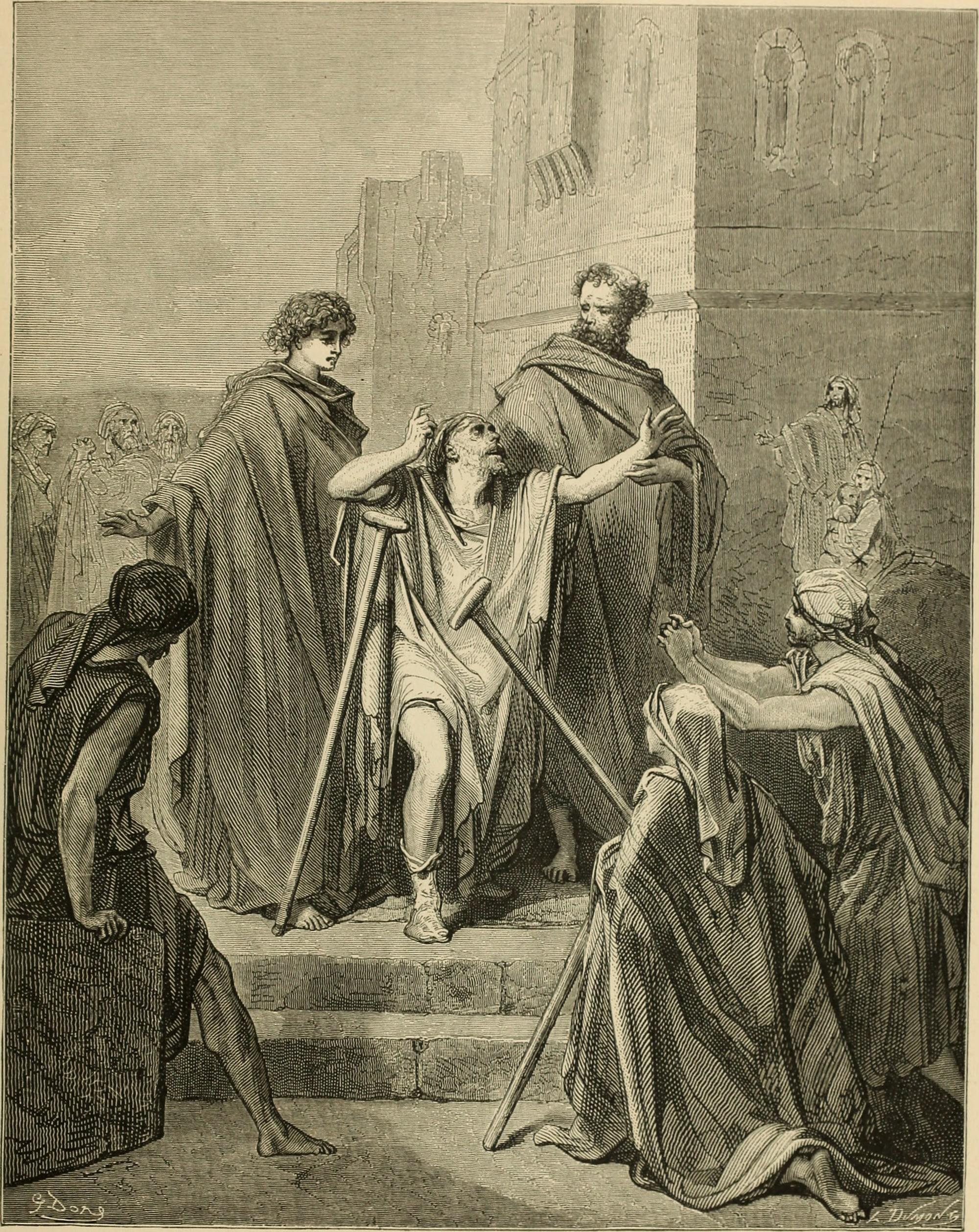
Gustave Doré, Peter and John Cure a Lame Man, printed 1891, public domain
Acts 4 to 28 · Subject · Featured Study
Acts Continued
Luke records arrest, witness and growth, and the same order appears in Pliny's trials, in Tertullian's Apology and in the church in China.
Luke ends Acts with Paul under guard in a rented house at Rome, welcoming all who came and preaching boldly and freely.
Boldly and freely he proclaimed the kingdom of God and taught about the Lord Jesus Christ.
- Book
- Acts
- Hold in memory
- Acts 4:20, Acts 12:24
Summary
Acts records a pattern that repeats. The church's witnesses are arrested, they keep speaking, and the word spreads. The pattern goes on after Luke's book ends.
- Peter and John told the council they could not stop speaking about what they had seen and heard.
- Pliny, a Roman governor, tried Christians and found the faith in the villages as well as the cities.
- Tertullian told Rome's magistrates that the blood of Christians is seed.
- Polycarp in the second century and Bunyan in the seventeenth wrote of suffering for Christ's name.
The Pattern in Acts
Four scenes in Acts set out the arrest, the witness and the growth, and the book closes on the last of them.
Arrest and witness
But Peter and John replied, “Judge for yourselves whether it is right in God’s sight to listen to you rather than God. For we cannot stop speaking about what we have seen and heard.”
Peter and John give the council their reason for going on.
At this, they yielded to Gamaliel. They called the apostles in and had them flogged. Then they ordered them not to speak in the name of Jesus, and released them.
The council flogs the apostles and forbids them to preach Jesus.
Acts 5:40BSB
The apostles left the Sanhedrin, rejoicing that they had been counted worthy of suffering disgrace for the Name. Every day, in the temple courts and from house to house, they did not stop teaching and proclaiming the good news that Jesus is the Christ.
The apostles leave the council rejoicing and keep teaching every day.
Prison and growth
So Peter was kept in prison, but the church was fervently praying to God for him.
Herod puts Peter in prison, and the church prays for him.
Acts 12:5BSB
But the word of God continued to spread and multiply.
Luke closes the chapter of Herod's death with the word spreading.
Acts 12:24BSB
The close of the book
Paul stayed there two full years in his own rented house, welcoming all who came to visit him.
Luke counts the years Paul spent waiting at Rome.
Acts 28:30BSB
for which I suffer to the extent of being chained like a criminal. But the word of God cannot be chained!
Paul writes from his chains that the word of God is not chained.
Acts 12:5, Acts 12:24, Acts 28:30, 2 Timothy 2:9
The Chain from Acts
The chain runs from the council at Jerusalem to a court in China.
The same three steps of arrest, witness and growth stand in Acts, in the second century and in China today.
1Peter and John before the council
- The witness
- They will keep telling what they saw and heard
- The record
- Acts 4:19 to 20
2The apostles beaten
- The witness
- They rejoiced to suffer disgrace for the Name and kept teaching
- The record
- Acts 5:41 to 42
3Peter in Herod's prison
- The witness
- Released by an angel, and the word multiplied
- The record
- Acts 12:7 and Acts 12:24
4Paul under guard at Rome
- The witness
- He preached boldly and freely for two years
- The record
- Acts 28:30 to 31
5Christians tried by Pliny in Bithynia
- The witness
- Those who persisted were punished, and the faith had reached the villages
- The record
- Pliny, Letters, book X, letter XCVII
6Christians before Rome's magistrates
- The witness
- The oftener we are mown down, the more in number we grow
- The record
- Tertullian, Apology, chapter 50
7The pastor of the Early Rain Covenant Church
- The witness
- Held and tried for his church
- The record
- MannaFest, The Chinese House Churches, from Reuters and Amnesty International
A chain of seven links, each with who was arrested or tried, the witness given, and the record that fixes it.
How Acts Ends
Luke closes with Paul's two years at Rome and leaves his trial untold.
Acts closes in Rome. Paul lived there for two years in a rented house and taught everyone who came to him about Christ.
Wesley reads the book's last words as a victory. He notes on Acts 28:30 that Luke wrote the book after these two years and long before Paul's death.
Earlier in the book the same order holds. Peter and John were forbidden to speak and answered that they could not stop. The apostles were flogged and left rejoicing. Herod jailed Peter while the church prayed, and the word of God continued to spread.
The Second Century
A Roman governor's letter and a Christian apologist's book show the pattern running on after the apostles.
Pliny the Younger, governor of Bithynia, wrote to the emperor Trajan to ask how Christians should be tried. He asked each one three times whether he was a Christian and ordered those who kept saying so to be punished.
Those who had left the faith told him that the Christians met on a stated day before dawn and bound themselves by an oath never to steal, commit adultery or break their word.
Pliny wrote that the faith had spread beyond the cities into the villages and the country, and that the temples had stood almost empty.
Trajan answered that Christians were not to be hunted out, but that any brought before the governor and proved to be Christians must be punished.
Tertullian addressed his Apology to the rulers of the Roman Empire. In its last chapter he answers the charge that Christians want to suffer, and writes that each time they are cut down they grow in number.
In China, MannaFest's page on the house churches records that on 30 December 2019 the Chengdu City Intermediate People's Court sentenced the pastor of the Early Rain Covenant Church to nine years.
In Their Own Words
Polycarp of Smyrna (died 155)
Epistle to the Philippians 8
Polycarp told the Philippians to glorify Christ if they suffered for His name.
“Let us then continually persevere in our hope, and the earnest of our righteousness, which is Jesus Christ, ‘who bore our sins in His own body on the tree,’ ‘who did no sin, neither was guile found in His mouth,’ but endured all things for us, that we might live in Him. Let us then be imitators of His patience; and if we suffer for His name's sake, let us glorify Him. For He has set us this example in Himself, and we have believed that such is the case.”
on Acts 5:41Patristic
About this saying1 paragraph
Polycarp, bishop of Smyrna, who died in 155, wrote this to the church at Philippi.
Tertullian (died 220)
Apology, chapter 50
Tertullian told the magistrates that the church grew under their sentences.
“The oftener we are mown down by you, the more in number we grow; the blood of Christians is seed.”
Early Church
About this saying1 paragraph
These lines stand in the last chapter of Tertullian's Apology to the magistrates who tried Christians, printed in English in 1885.
John Bunyan (died 1688)
A Relation of the Imprisonment of Mr. John Bunyan, the examination before Justice Keelin
Bunyan said he would preach again the day after his release.
“I told him, as to this matter, I was at a point with him; for if I were out of prison to-day, I would preach the Gospel again to-morrow, by the help of God.”
English Puritan
About this saying1 paragraph
John Bunyan gives this answer in his own account of his imprisonment; he died in 1688.
Pliny the Younger
Letters, book X, To the Emperor Trajan, letter XCVII in this edition
Pliny asked Trajan how to try the Christians.
“I asked them whether they were Christians; if they admitted it, I repeated the question twice, and threatened them with punishment; if they persisted, I ordered them to be at once punished”
Roman governor
About this saying1 paragraph
Pliny sets out his method at the start of his letter, before he describes what he learned of their meetings.
Where the Pattern Is Questioned
Tertullian said trials grew the church, and Pliny reported the temples filling again under his.
Tertullian holds that persecution multiplies the church, since each death makes more believers.
Pliny's own letter gives the other side of his trials. Some of the accused said they had left the faith years before, they offered wine and incense to the emperor's statue, and he reports that the temples were being visited again and the sacrifices sold.
Trajan's answer that Christians were not to be sought out meant that a Christian whom no one accused went untried.
Books to Read Next
Letters of Pliny
Pliny the Younger, translated by William Melmoth · first century, this translation revised by F. C. T. Bosanquet
Book X holds the letter on the Christians and Trajan's reply.
Free at Project GutenbergApology
Tertullian, translated by S. Thelwall · 1885
The Ante-Nicene Fathers printed this English translation in 1885.
Free at New AdventWhat the Close of Acts Hands On
Luke leaves Paul bound and the word free, and the record after him repeats the order he set down. Governors tried believers, the believers kept their witness, and the church went on growing.
Sources
Scripture is the Berean Standard Bible.
- The Holy Bible, Berean Standard Bible (read 2026)
- Pliny the Younger, Letters, book X, To the Emperor Trajan and Trajan to Pliny (letters XCVII and XCVIII in this edition), translated by William Melmoth, revised by F. C. T. Bosanquet.
- Tertullian, Apology, chapter 50, translated by S. Thelwall, Ante-Nicene Fathers, volume 3, ed. Alexander Roberts, James Donaldson and A. Cleveland Coxe (Buffalo: Christian Literature Publishing Co., 1885)
- The Martyrdom of Polycarp, Ante-Nicene Fathers, volume 1, ed. Alexander Roberts, James Donaldson and A. Cleveland Coxe (Buffalo: Christian Literature Publishing Co., 1885), the greeting, naming Polycarp bishop of the church in Smyrna.
Keep Studying
People and groups2
Trials of life1
Go further1