
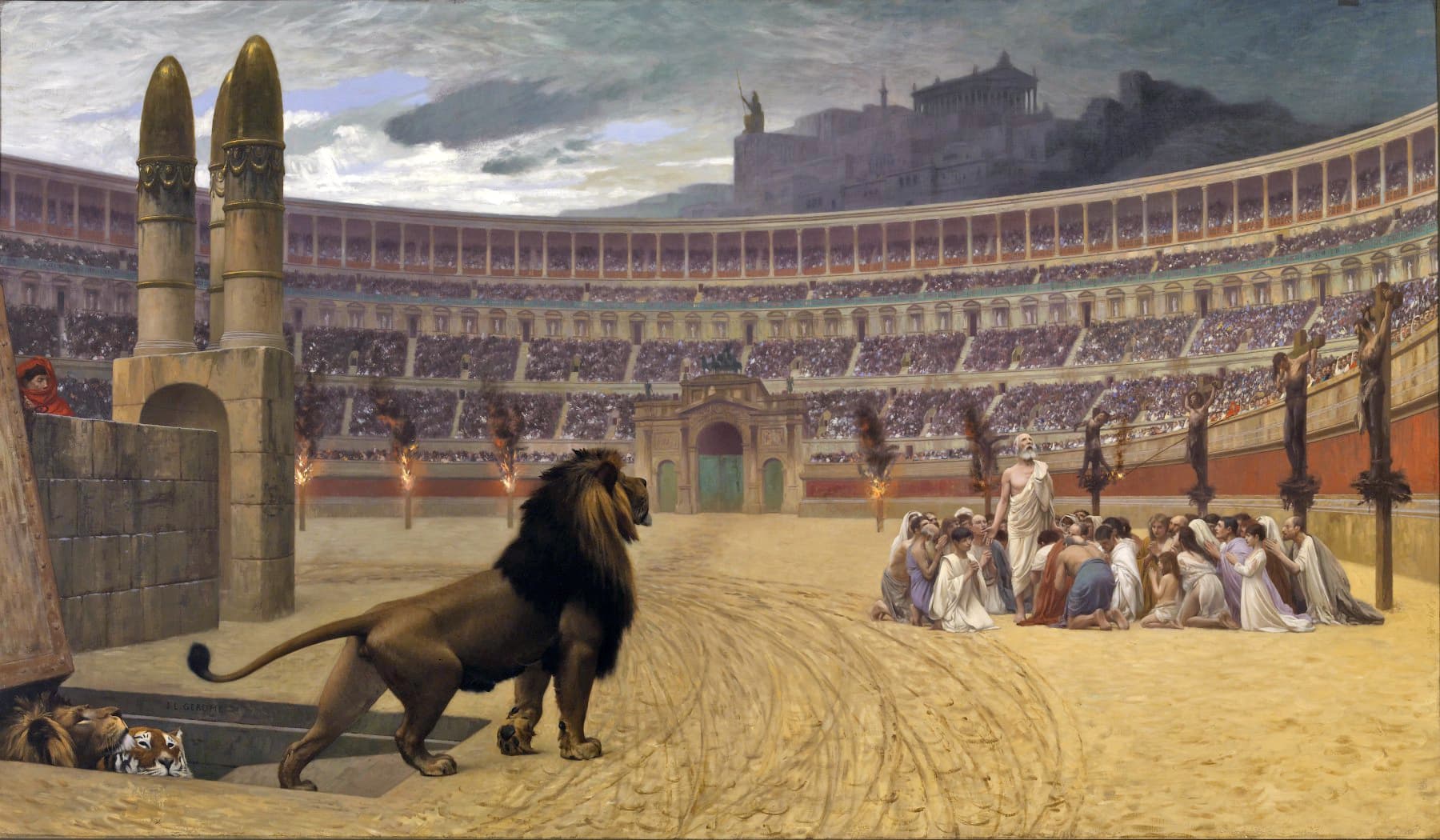
The story
A Christian in AD 200 could be executed for refusing to burn a pinch of incense before the emperor's image, and his neighbours thought the refusal was not piety but treason. He was accused of atheism, because he would not honour the gods who kept the city safe.
Start with a letter from a worried official. Around AD 112 Pliny the Younger, governing a province on the Black Sea, wrote to the emperor Trajan because he had been executing Christians and was no longer sure of the rules. He reported that they gathered before dawn, sang "a hymn to Christ as to a god," and swore an oath, not to commit any crime, but to avoid theft, fraud, and adultery. It is one of the earliest descriptions of a church service, and it was written by a man deciding whether to kill the people in it.
Do not fear what you are about to suffer. Look, the devil is about to throw some of you into prison to test you, and you will suffer tribulation for ten days. Be faithful even unto death, and I will give you the crown of life.Christ's own words to the church at Smyrna, "Be thou faithful unto death, and I will give thee the crown of life," spoken to the very congregation that would one day watch its bishop Polycarp burn.
Trajan's reply matters as much as the question. He told Pliny not to hunt Christians down, to ignore anonymous accusations, and to punish only those properly accused who refused to recant. That single ruling shaped the next hundred and forty years. Persecution was not a constant downpour; it was more like weather, long stretches of uneasy calm broken by local storms, usually started by a neighbor, a mob, a bad harvest, or an ambitious governor.
The charges sound absurd until you hear them the way Romans did. Christians had no images and refused the public sacrifices, so they were called atheists, people whose stubbornness might bring the gods' anger down on the whole city. They spoke of eating the body and drinking the blood of their Lord, so the rumor went out that they ate babies. They called each other brother and sister and greeted each other with a kiss, so the rumor went out that their love feasts were orgies. Above all, they would not say the three words that ended every trial: Caesar is Lord.
They have conquered him by the blood of the Lamb and by the word of their testimony. And they did not love their lives so as to shy away from death.They overcame by the blood of the Lamb and the word of their testimony, and loved not their life unto death; the Greek word for testimony here is the word we spell martyr.
So the deaths came in scattered, terrible bursts. Ignatius of Antioch was marched across Asia Minor around AD 107, writing letters the whole way. Polycarp of Smyrna, who had learned the faith from the apostle John himself, was burned in the stadium around 155; his congregation wrote down his answer to the governor and sent it to the next town over. In 177 a mob in Lyons turned on the church there, and among those who died was Blandina, a slave woman whose own household expected her to crack first. She did not.
In Carthage in the spring of 203, a young mother named Vibia Perpetua was arrested along with Felicity, a pregnant slave, and several companions. Perpetua kept a diary in prison, and it survives. Her father came again and again, begging her to think of her nursing son. The diary records her pointing to a jug on the ground and asking whether it could be called by any other name than what it was, and neither, she said, could she call herself anything but a Christian. Felicity gave birth two days before the games; they walked into the arena together.
Do not be afraid of those who kill the body but cannot kill the soul. Instead, fear the One who can destroy both soul and body in hell.Do not fear those who kill the body but cannot kill the soul, the sentence that made a Roman court's ultimate threat survivable.
Notice who keeps showing up in these accounts: women, slaves, tradespeople, the young. The faith moved along ordinary networks, households, workshops, marketplaces, families, rather than down from the top. It grew because Christians did specific, visible things: they took in babies left out to die, they fed widows who had no one, and when plague swept a city and everyone with means fled, they stayed and nursed the sick, sometimes catching it and dying themselves. The sociologist Rodney Stark argued in The Rise of Christianity that steady growth of roughly forty percent a decade could take the church from a few thousand believers in AD 100 to millions by 300; that is a model built from estimates, not a count, and other historians dispute the numbers. What is not disputed is the direction.
The catacombs deserve honesty. Those miles of tunnels under Rome were burial galleries, not hideouts. Christians buried their dead instead of burning them because they expected the resurrection of the body, land was scarce, and Roman law protected tombs, so the church dug down, gallery after gallery, and left painted shepherds and anchors and fish on the walls. Believers did gather there for memorials on a martyr's death day, and in the worst raids people sometimes sheltered underground. But the picture of a whole church living permanently in the dark comes from later storytelling, not from the era's own records.
Who shall separate us from the love of Christ? Shall trouble or distress or persecution or famine or nakedness or danger or sword?Paul's list of what cannot separate us from the love of Christ names peril and sword, and for two centuries believers read it as a description of Tuesday rather than a figure of speech.
The mood changed in 250. The emperor Decius ordered every inhabitant of the empire to sacrifice before a commission and collect a signed certificate. It was not aimed at Christians alone, but it caught them squarely, and it caught them soft after decades of relative peace. Many refused and died. Many more sacrificed. Others paid a friendly official for a certificate they had not earned, reasoning that they had not actually burned the incense. When the pressure lifted, the lapsed came back to the door and wanted in.
That question nearly broke the church, and it cost more than the persecution had. Some said the fallen must be readmitted only after long, hard repentance. Some said never, a church of the pure or nothing. Cyprian of Carthage argued for a middle path with the bishop as the one who judged each case, and a rigorist named Novatian split from Rome in 251 rather than accept it. Fifty years later, after Diocletian's men had burned the Scriptures, the same argument flared again in North Africa over the clergy who had handed the books over, and that quarrel would outlive the era. Grace and holiness both had defenders, and the church learned how hard it is to hold them together.
The era's writings, 1 to 3 of 12: each with its date and one line on what it holds.
| Writing | Date | What it holds |
|---|---|---|
| The Didache (The Teaching of the Twelve Apostles) | c. 90–120 | A short handbook carried over from the apostles' generation, telling a new congregation how to baptize, how to pray, how to keep the Lord's Supper, and how to spot a false teacher who is really after money. |
| The Letters of Ignatius (seven letters) | c. 107 | Written on the road to his own execution, they show a real church already ordered under bishops, guarding the truth that Jesus was genuinely born, genuinely bled, and genuinely rose. |
| The Martyrdom of Polycarp | c. 155–160 | A letter from the church at Smyrna to the church at Philomelium reporting how their bishop died, the earliest surviving account of a martyrdom outside the New Testament, and the pattern for every martyr story after it. |
Meanwhile a different kind of resistance was being written. The apologists took the charges one at a time and answered them in public. Justin Martyr, a philosopher who kept wearing the philosopher's cloak after his conversion, argued that whatever truth Greek thinkers had glimpsed came from the same Word made flesh in Jesus. Athenagoras answered the cannibalism slander by pointing out that Christians would not even attend the gladiator shows the accusers enjoyed. Tertullian, trained in law, argued that the trials broke Rome's own rules by punishing a name rather than a proven crime. Origen answered the sharpest pagan critic of all, Celsus, line by line, and was tortured under Decius, dying a few years later from what was done to him.
The era's writings, 4 to 6 of 12: each with its date and one line on what it holds.
| Writing | Date | What it holds |
|---|---|---|
| Justin Martyr, First Apology and Dialogue with Trypho | c. 155–160 | An open defense addressed to the emperor that also, almost by accident, gives us the oldest full description of Christian worship: on the day called Sunday they gathered, "and the memoirs of the apostles or the writings of the prophets are read, as long as time permits." |
| The Epistle to Diognetus | c. 150–200 (author unknown) | A short, beautiful letter explaining Christians to a curious outsider: "They dwell in their own countries, but simply as sojourners… every foreign land is to them as their native country, and every land of their birth as a land of strangers." |
| Irenaeus of Lyons, Against Heresies | c. 180 | The first great answer to the Gnostics: the true gospel is not a secret handed to insiders but the public teaching handed down from the apostles in plain daylight, and it can be checked against the churches they founded. |
By 303 the empire made its most determined attempt: Diocletian ordered the churches demolished, the Scriptures burned, the clergy jailed, and finally everyone to sacrifice. It ran eight years, savage in the East, comparatively mild in the West. And it failed. In April 311 the dying Galerius, who had pressed hardest for it, issued an edict letting Christians be Christians again and asking them to pray for him. Two years later Constantine and Licinius agreed at Milan that everyone in the empire could worship as they chose, with confiscated church property returned at public cost.
The era's writings, 7 to 9 of 12: each with its date and one line on what it holds.
| Writing | Date | What it holds |
|---|---|---|
| The Acts of the Scillitan Martyrs | 180 | A courtroom transcript, barely two pages long, in which twelve African believers decline to swear by the emperor's spirit and are sentenced, the oldest dated Christian writing in Latin. |
| Tertullian, Apology | c. 197 | A trained legal mind arguing that the trials themselves were illegal: Christians were convicted for a name rather than a crime, and the charges against them collapsed the moment anyone examined the evidence. |
| The Passion of Perpetua and Felicity | c. 203 | A martyr account built around Perpetua's own prison diary and the visions she recorded there, finished by an eyewitness editor after she died, a woman's voice from the early third century, preserved by the church that watched her. |
So the era that began with a nervous governor asking how to execute Christians ended with emperors handing their buildings back. Tertullian had said it a century early: cut them down and more come up, because the blood of Christians is seed. But legality is its own kind of test. The church that walked out of the arena would soon be offered land, money, influence, and the ear of the throne, and the next two centuries would ask whether it could survive being favored as well as it had survived being hunted.
The era's writings, 10 to 12 of 12: each with its date and one line on what it holds.
| Writing | Date | What it holds |
|---|---|---|
| The Muratorian Fragment | traditionally c. 170–200; some scholars argue 4th century | A damaged Latin list of the books read in church, the earliest known attempt to write down which writings belonged and which did not, showing the canon question already alive long before any council took it up. |
| Origen of Alexandria, Contra Celsum (Against Celsus) | c. 248 | A point-by-point reply to a pagan philosopher's attack written seventy years earlier, and because Origen quotes Celsus so fully, it is also our best window into what educated Romans actually said against the faith. |
| Cyprian of Carthage, On the Lapsed and On the Unity of the Church | 251 | A bishop's attempt to answer the hardest pastoral question of the century: what do you do with brothers and sisters who denied Christ under threat and now want to come home? |
Matthew 10:28, Romans 8:35