
Matthew 21:1
in Matthew 21As they approached Jerusalem and came to Bethphage on the Mount of Olives, Jesus sent out two disciples,
BSB
The same verse in ASV and KJV ▾
ASV
And when they drew nigh unto Jerusalem, and came unto Bethphage, unto the mount of Olives, then Jesus sent two disciples,
KJV
And when they drew nigh unto Jerusalem, and were come to Bethphage, unto the mount of Olives, then sent Jesus two disciples,
⋯
This verse in Matthew 21
Commentary
17 notes on this verseAnd when they drew nigh unto Jerusalem,.... The Syriac, Persic, and Ethiopic versions read, "when he drew nigh, or was near"; but not alone, his disciples were with him, and a multitude of people also; as is evident from the following account.
This site's exposition
unto the mount of Olives
on Matthew 21:1-3
Bethphage sits on the eastern slope of Olivet, the ridge Zechariah names as the place where the Lord's feet will one day stand, and Jesus turns that geography into the opening move of his last week. He sends two disciples for an ass tied and a colt with her, a detail no eyewitness could invent after the fact, and gives them a password rather than a plan: The Lord hath need of them. The bench reads the arrangement as prior word to the animal's owner rather than commandeered property, since straightway he will send them assumes a ready yes.
The record, by era
The Church Fathers5 voices
The Evangelist related above that the Lord departed from Galilee, and began to go up to Jerusalem. Being now occupied with telling what He did by the way, he proceeds in his purpose, saying, And when they drew nigh to Jerusalem, and were come to Bethphage. Bethphage was a small village of the priests, situated on the declivity of Mount Olivet, one mile distant from Jerusalem. For the priests who ministered in the temple their apportioned time, when their office of ministration was discharged, withdrew to this village to abide; as also did they who were to take their place. Because it was commanded by their Law that none should travel on the Sabbath more than a mile. The Lord therefore sent His disciples from mount Olivet to the village, when He guided the preachers forth from the primitive Church into the world. He sent two, because there were two orders of preachers, as the Apostle shows, saying, He that wrought in Peter to the Apostleship of circumcision, the same was mighty in me towards the Gentiles; (Gal. 2:8.) or, because the precepts of charity are two; or, because there are two testaments; or, because there is letter and spirit.
Mystically; The Lord draws near to Jerusalem departing from Jericho, and taking great multitudes with Him, because great and laden with great wares, that is, the salvation of believers that has been entrusted to Him, He seeks to enter the city of peace, the place of the beholding of God. And He comes to Bethphage, that is, to The house of the jawbones; He bare also the type of confession; and halted on Mount Olivet, where is the light of knowledge, and the repose from toils and pains. By the village over against the Apostles is denoted this world; for that was against the Apostles, and was not willing to receive the light of their teaching. Or, because there is theory and practice, that is, knowledge and works. By the ass which had been under the yoke, and was broken, the synagogue is understood. By the ass's colt wild and unbroken, the Gentile people; for the Jewish nation is towards God the mother of the Gentiles.
(Chapter 21, verses 1 onwards) And when he drew near to Jerusalem and came to Bethphage, to the Mount of Olives, then Jesus sent two disciples, saying to them, 'Go into the village opposite you, and immediately you will find a donkey tied, and a colt with her. Untie them and bring them to me. If anyone says anything to you, you shall say, 'The Lord needs them,' and he will send them at once.' He went out of Jericho, with a multitude following him, and many blind people were healed, and he approached Jerusalem, greatly enriched with merchandise.
A commentator
John ChrysostomHomily on the Gospel of Matthew 66 · Written in the 5th century.
proposed
Again, setting measures of sorrow, when He had need to mourn, He weeps moderately, everywhere setting us rules, as I have said, and limits how far one ought to proceed, and not any further. So for this intent now also, since it happens that some are weak and have need of beasts to carry them, in this too He fixes a measure, showing that one ought not to yoke horses or mules to be borne by them, but to use an ass, and not to proceed further, and everywhere to be limited by the want. But let us look also at the prophecy, that by words, that by acts. What then is the prophecy? "Behold, thy King cometh to thee, meek, and riding on an ass, and a young colt;" not driving chariots, like the rest of the kings, not demanding tributes, not thrusting men off, and leading about guards, but displaying His great meekness even hereby. Ask then the Jew, what King came to Jerusalem borne on an ass? Nay, he could not mention, but this alone.
A commentator
John ChrysostomHomily on the Gospel of Matthew 66 · Written in the 5th century.
proposed
And yet He had often entered Jerusalem before, but never with so much circumstance. What then is the cause? It was the beginning then of the dispensation; and neither was He very well known, nor the time of His passion near; wherefore He mixed with them with less distinction, and more disguising Himself. For He would not have been held in admiration, had He so appeared, and He would have excited them to greater anger. But when He had both given them sufficient proof of His power, and the cross was at the doors, He makes Himself then more conspicuous, and doeth with greater circumstance all the things that were likely to inflame them. For it was indeed possible for this to have been done at the beginning also; but it was not profitable nor expedient it should be so. But do thou observe, I pray thee, how many miracles are done, and how many prophecies are fulfilled. He said, "Ye shall find an ass;" He foretold that no man should hinder them, but that all, when they heard, should hold their peace. But this is no small condemnation of the Jews, if them that were never known to Him, neither had appeared before Him, He persuades to give up their own property, and to say nothing against it, and that by His disciples, while these, being present with Him at the working of His miracles, were not persuaded.
10 more voices on this verse
The Church Fathers4 voices
A commentator
John ChrysostomHomily on the Gospel of Matthew 66 · Written in the 5th century.
proposed
And do not account what was done to be a small thing. For who persuaded them, when their own property was taken from them, and that, when they were perhaps poor men and husbandmen, not to forbid it? Why say I not to forbid it? not to ask, or even if they asked, to hold their peace, and give it up. For indeed both things were alike marvellous, as well, if they said nothing, when their beasts were dragged away, or if having spoken, and heard, "The Lord hath need of them," they yielded and withstood not, and this when they see not Him, but His disciples. By these things He teaches them, that it was in His power to have entirely hindered the Jews also, even against their will, when they were proceeding to attack Him, and to have made them speechless, but He would not. And another thing again together with these doth He teach the disciples, to give whatever He should ask; and, though he should require them to yield up their very life, to give even this, and not to gainsay. For if even strangers gave up to Him, much more ought they to strip themselves of all things. And besides what we have said, He was fulfilling also another prophecy, one which was twofold, one part in words, and another in deeds. And that in deeds was, by the sitting on the ass; and that by words, the prediction of Zacharias; because he had said, that the King should sit on an ass. And He, having sat and having fulfilled it, gave to the prophecy another beginning again, by what He was doing typifying beforehand the things to come. How and in what manner? He proclaimed beforehand the calling of the unclean Gentiles, and that He should rest upon them, and that they should yield to Him and follow Him, and prophecy succeeded to prophecy. But to me He seemeth not for this object only to sit on the ass, but also as affording us a standard of self-denial. […]
A commentator
John ChrysostomHomily on the Gospel of Matthew 66 · Written in the 5th century.
proposed
But He did these things, as I said, signifying beforehand the things to come. For here the church is signified by the colt, and the new people, which was once unclean, but which, after Jesus sat on them, became clean. And see the image preserved throughout. I mean that the disciples loose the asses. For by the apostles, both they and we were called; by the apostles were we brought near. But because our acceptance provoked them also to emulation, therefore the ass appears following the colt. For after Christ hath sat on the Gentiles, then shall they also come moving us to emulation. And Paul declaring this, said, "That blindness in part is happened to Israel, until the fullness of the Gentiles be come in; and so all Israel shall be saved." For that it was a prophecy is evident from what is said. For neither would the prophet have cared to express with such great exactness the age of the ass, unless this had been so. But not these things only are signified by what is said, but also that the apostles should bring them with ease. For as here, no man gainsaid them so as to keep the asses, so neither with regard to the Gentiles was any one able to prevent them, of those who were before masters of them. But He doth not sit on the bare colt, but on the apostles' garments. For after they had taken the colt, they then gave up all, even as Paul also said, "I will very gladly spend and be spent for your souls." But mark how tractable the colt, how being unbroken, and having never known the rein, he was not restive, but went on orderly; which thing itself was a prophecy of the future, signifying the submissiveness of the Gentiles, and their sudden conversion to good order. For all things did that word work, which said, "Loose him, and bring him to me:" so that the unmanageable became orderly, and the unclean thenceforth clean.
A commentator
John ChrysostomHomily on the Gospel of Matthew 66 · Written in the 5th century.
proposed
But these things He did, not as displaying any pomp, but at once, as I have said, both fulfilling a prophecy, and teaching self-denial, and at the same time also comforting His disciples, who were grieving for His death, and showing them that He suffers all these things willingly. And mark thou, I pray thee, the accuracy of the prophet, how he foretold all things. And some things David, some things Zechariah, had proclaimed beforehand. Let us also do likewise, and let us sing hymns, and give up our garments to them that bear Him. For what should we deserve, when some clothe the ass on which He was set, and others strew the garments even under her feet; but we, seeing him naked, and not being even commanded to strip ourselves, but to spend of what is laid by, not even so are liberal? And when they indeed attend upon Him before and behind, but we, when He cometh unto us, send Him away, and thrust Him off and insult Him.
Whence Bethphage is interpreted, The house of the Shoulder; for the shoulder was the priest's portion in the Law...
The Medieval Church2 voices
He sat upon an ass for no other reason than to fulfill the prophecy and to show us that our means of conveyance should be humble, for He was mounted not on a horse but on a lowly ass. He fulfills the prophecy (Zech. 9:9) …
The Gospel of Matthew was divided above into three parts: in the first, he presents Christ's entry into the world, up to the third chapter; secondly, his progress in the world; in the third, his departure. Having completed the first two parts, here he treats …
The Nineteenth Century4 voices
A commentator
Albert Barnes1798–1870
Notes, Explanatory and Practical, on the Old and New Testaments (1832-1869)
And when they drew nigh unto Jerusalem - They were going up now from Jericho. Mat 20:29. The distance was about 19 miles. The most of the way was a desert, or filled with caves, and rocks, and woods - a suitable place for robbers. See Luk 10:30. The Mount of Olives, or “Olivet,” is on the east of Jerusalem. Between this and Jerusalem there runs a small stream called the brook Kidron, or Cedron. It is dry in the hot seasons of the year, but swells to a considerable size in time of heavy rains.
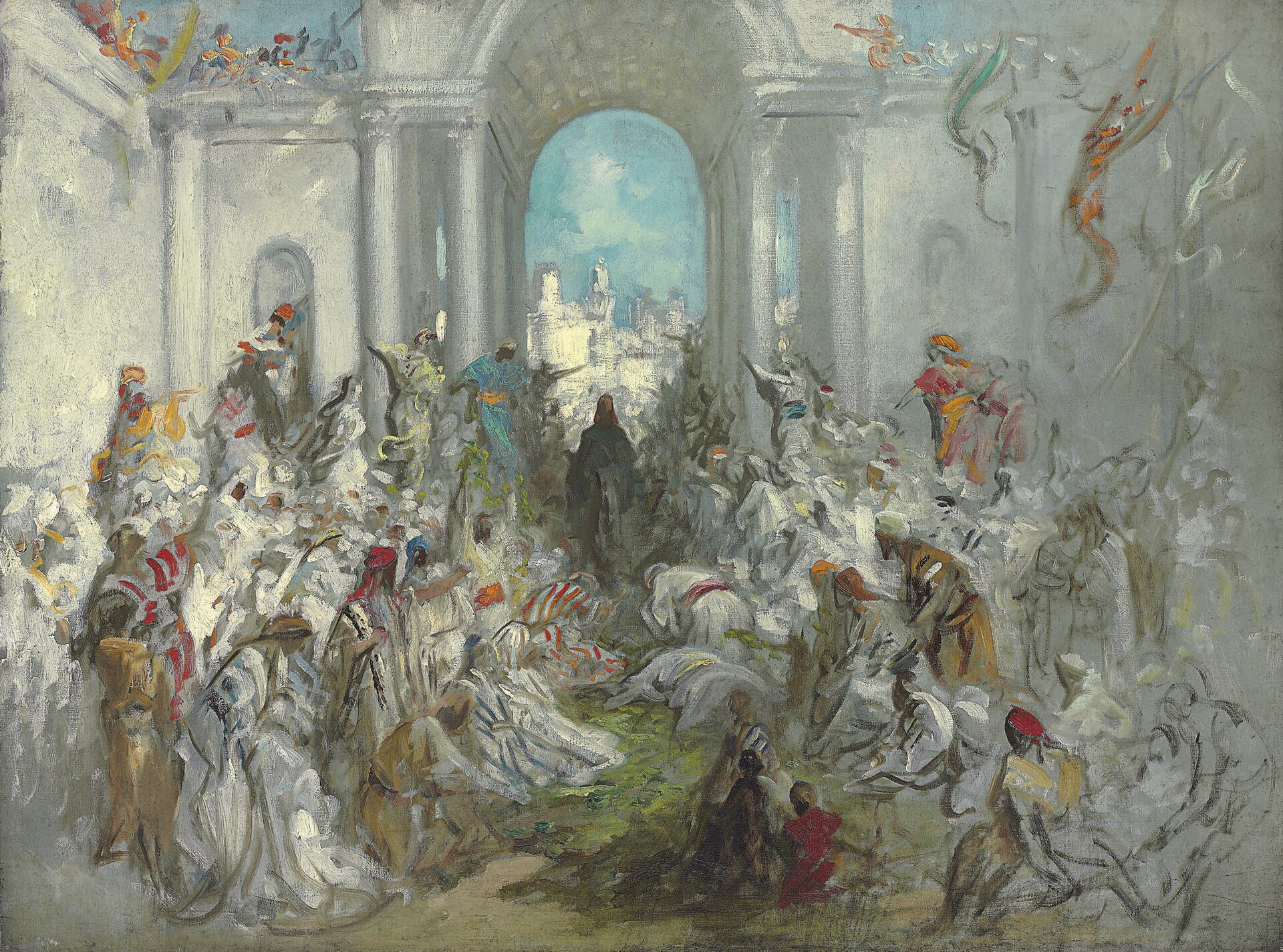
These verses contain a very remarkable passage in our Lord Jesus Christ’s life. They describe his public entry into Jerusalem when he came there for the last time, before he was crucified. There is something peculiarly striking in this incident in our Lord’s history. The narrative reads like the account of some royal conqueror’s return to his own city: “A very great multitude” accompanies him in a kind of triumphal procession. Loud cries and expressions of praise are heard around him: “All the city was moved.” The whole transaction is singularly at variance with the past tenor of our Lord’s life; it is curiously unlike the ways of him who did not “cry nor strive ” nor let his voice be heard “in the streets”—who withdrew himself from the multitude on other occasions, and sometimes said to those he healed, “See thou say nothing to any man.” ( Mark 1:44 ). And yet the whole transaction admits of explanation. The reasons of this public entry are not hard to find out. Let us see what they were. The plain truth is that our Lord knew well that the time of his earthly ministry was drawing to a close; he knew that the hour was approaching when he must finish the mighty work he came to do, by dying for our sins upon the cross. He knew that his last journey had been accomplished, and that there remained nothing now in his earthly ministry but to be offered as a sacrifice on Calvary. Knowing all this, he no longer, as in times past, sought secrecy; knowing all this, he thought it good to enter the place where he was to be delivered to death, with peculiar solemnity and publicity. It was not fitting that the Lamb of God should come to be slain on Calvary privately and silently. Before the great sacrifice for the sin of the world was offered up, it was right that every eye should be fixed on the victim.
These verses contain a very remarkable passage in our Lord Jesus Christ’s life. They describe his public entry into Jerusalem when he came there for the last time, before he was crucified. There is something peculiarly striking in this incident in our Lord’s history. The narrative reads like the account of some royal conqueror’s return to his own city: “A very great multitude” accompanies him in a kind of triumphal procession. Loud cries and expressions of praise are heard around him: “All the city was moved.”
Bethphage - A place on the west declivity of Mount Olivet, from which it is thought the whole declivity and part of the valley took their name. It is supposed to have derived its name from the fig-trees which grew there; בית beeth, signifying a region as well as a house, and פג phag, a green fig.
The words behind it
19 Greek wordsEvery Greek word of this verse in the order it stands, with what it means and the door to its own study. The last column counts the times a word stands in the whole Bible: the rarer the word, the more the places it appears belong together.
| Greek | Sound | Meaning | Word study | In the Bible |
|---|---|---|---|---|
| Καὶ | kai | And | G2532 → | 9120 times |
| ὅτε | hote | when | G3753 → | 103 times |
| ἤγγισαν | engisan | they drew near | G1448 → | 42 times |
| εἰς | eis | to | G1519 → | 1755 times |
| Ἱεροσόλυμα | hi'erosoluma | Jerusalem | G2414 → | 62 times |
| καὶ | kai | and | G2532 → | 9120 times |
| ἦλθον | elthon | came | G2064 → | 628 times |
| εἰς | eis | to | G1519 → | 1755 times |
| Βηθφαγὴ | bethphage | Bethphage | G967 → | |
| εἰς | eis | on | G1519 → | 1755 times |
| τὸ | to | the | G3588 → | 19766 times |
| ὄρος | oros | Mount | G3735 → | 62 times |
| τῶν | ton | <the> | G3588 → | 19766 times |
| ἐλαιῶν, | elaion | of Olives, | G1638 → | 11 times |
| τότε | tote | then | G5119 → | 160 times |
| Ἰησοῦς | iesous | Jesus | G2424 → | 908 times |
| ἀπέστειλεν | apesteilen | sent | G649 → | 132 times |
| δύο | duo | two | G1417 → | 133 times |
| μαθητὰς | mathetas | disciples | G3101 → | 260 times |
ΚαὶAnd
kaiG2532 →9120 times
ὅτεwhen
hoteG3753 →103 times
ἤγγισανthey drew near
engisanG1448 →42 times
εἰςto
eisG1519 →1755 times
ἹεροσόλυμαJerusalem
hi'erosolumaG2414 →62 times
καὶand
kaiG2532 →9120 times
ἦλθονcame
elthonG2064 →628 times
εἰςto
eisG1519 →1755 times
ΒηθφαγὴBethphage
bethphageG967 →
εἰςon
eisG1519 →1755 times
τὸthe
toG3588 →19766 times
ὄροςMount
orosG3735 →62 times
τῶν<the>
tonG3588 →19766 times
ἐλαιῶν,of Olives,
elaionG1638 →11 times
τότεthen
toteG5119 →160 times
ἸησοῦςJesus
iesousG2424 →908 times
ἀπέστειλενsent
apesteilenG649 →132 times
δύοtwo
duoG1417 →133 times
μαθητὰςdisciples
mathetasG3101 →260 times
A shaded row is a word that stands 400 times or fewer in the Bible.
The walk
8 stopsEach card is a verse this one points to, and under it the verses that one points to in turn. Where several paths arrive at the same place, that place is listed first: the text keeps returning to it.
Through
Zechariah 14:4On that day His feet will stand on the Mount of Olives, east of Jerusalem, and the Mount of Olives will be split in two from east to west, forming a great valley, with…
it leads to
- Micah 1:3–4
For behold, the LORD comes forth from His dwelling place; He will come down and tread on the high places of the earth.
- Ezekiel 11:23
And the glory of the LORD rose up from within the city and stood over the mountain east of the city.
- Acts 1:11–12
“Men of Galilee,” they said, “why do you stand here looking into the sky? This same Jesus, who has been taken from you into heaven, will come back in the same way you have…
- Zechariah 14:7
It will be a day known only to the LORD, without day or night; but when evening comes, there will be light.
- Joel 3:12–14
Let the nations be roused and advance to the Valley of Jehoshaphat, for there I will sit down to judge all the nations on every side.
- Micah 1:3–4
Through
Luke 21:37Every day Jesus taught at the temple, but every evening He went out to spend the night on the Mount of Olives.
it leads to
- Luke 22:39
Jesus went out as usual to the Mount of Olives, and the disciples followed Him.
Reached by 2 separate paths from here.
- Matthew 26:55
At that time Jesus said to the crowd, “Have you come out with swords and clubs to arrest Me as you would an outlaw? Every day I sat teaching in the temple courts, and…
- Luke 22:39
Through
Acts 1:12Then they returned to Jerusalem from the Mount of Olives, which is near the city, a Sabbath day’s journey away.
it leads to
- Luke 24:52
And they worshiped Him and returned to Jerusalem with great joy,
- Luke 24:52
Where this verse is studied
About Matthew
Who and where
1 name in this verse with a page on the site.
This page draws on 13 works. Open the list of works
This page draws on Adam Clarke, Commentary on the Bible; Albert Barnes, Notes, Explanatory and Practical, on the Gospels; Albert Barnes, Notes, Explanatory and Practical, on the Old and New Testaments (1832-1869); J.C. Ryle, Expository Thoughts on the Gospels: Matthew; Jerome, Catena Aurea by Aquinas; Jerome, Commentary on Matthew; John Chrysostom, Homily on the Gospel of Matthew 66; John Gill, Exposition of the New Testament (1746-1748); John Gill, Exposition of the New Testament; Origen of Alexandria, Catena Aurea by Aquinas; Remigius of Rheims, Catena Aurea by Aquinas; Theophylact of Ohrid, Commentary on Matthew and Thomas Aquinas, Commentary on Matthew.