
2 Samuel 18:14
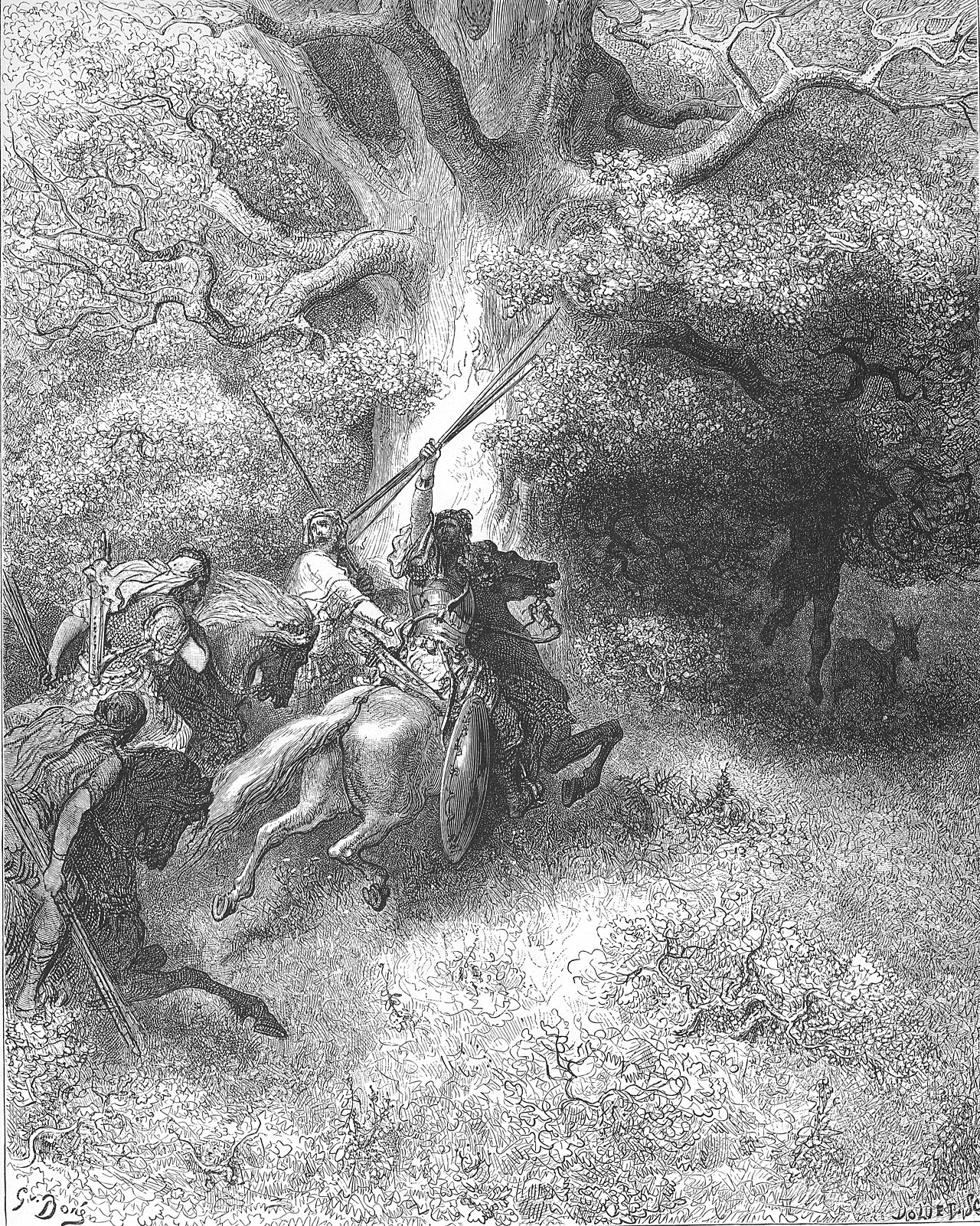
in 2 Samuel 18But Joab declared, “I am not going to wait like this with you!” And he took three spears in his hand and thrust them through the heart of Absalom while he was still alive in the oak tree.
BSB
The same verse in ASV and KJV ▾
ASV
Then said Joab, I may not tarry thus with thee. And he took three darts in his hand, and thrust them through the heart of Absalom, while he was yet alive in the midst of the oak.
KJV
Then said Joab, I may not tarry thus with thee. And he took three darts in his hand, and thrust them through the heart of Absalom, while he was yet alive in the midst of the oak.
⋯
This verse in 2 Samuel 18
Commentary
8 notes on this verseI may not tarry thus with thee - He had nothing to say in vindication of the purpose he had formed. Thrust them through the heart of Absalom - He was determined to make sure work, and therefore he pierced his heart. Joab should have obeyed the king’s commandment: and yet the safety of the state required the sacrifice of Absalom. But independently of this, his life was quadruply forfeited to the law: - 1. In having murdered his brother Amnon. 2. In having excited an insurrection in the state.
This site's exposition
three darts in his hand
on 2 Samuel 18:14-15
Joab will not tarry any longer over the man's excuse; he takes three darts and thrusts them through Absalom's heart while he still hangs alive in the oak, then ten of his own armorbearers close in and finish the killing. Henry will not excuse the plain disobedience to the king's own charge at verse five, while Jamieson Fausset and Brown read Joab as acting from a hard loyalty to David's throne rather than against David the father, a memory 1 Kings 2:5 shows David never let go of. Three darts against one charge is the chapter's plainest collision between mercy commanded and war's own logic.
The record, by era
The Church Fathers1 voice
It is becoming, therefore, that you also should be obedient to your bishop and contradict him in nothing, for it is a fearful thing to contradict any such person. For no one does [by such conduct] deceive him that is visible but does [in reality] …
The Puritans and the Awakening3 voices
I know not whether Joab can be justified in this direct disobedience to the command of his sovereign; was this to deal gently with the young man? Would David have suffered him to do it if he had been upon the spot?
): I may not tarry thus with thee. Superiors should consider a reproof before they give it, lest they be ashamed of it afterwards, and find themselves unable to make it good. He is (as I may say) embowelled and quartered, as traitors are, so pitifully mangled is he as he hangs there, and receives his death in such a manner as to see all its terrors and feel all its pain.
quarantine:debris (2026-07-29) — leading-punctuation+unbalanced-parens
Then said Joab, I may not tarry thus with thee,....
The Nineteenth Century1 voice
A commentator
Jamieson, Fausset & Brown1802–1910
Commentary Critical and Explanatory on the Whole Bible (1871)
Being a violation of the expressed wish, as well as of all the fond paternal feelings of David, it must have been deeply offensive to the king, nor was it ever forgotten (1Ki 2:5); and yet there is the strongest reason for believing that Joab, in doing it, was actuated by a sincere regard to the interests of David, both as a man and a monarch.
1 more voice on this verse
The Nineteenth Century1 voice
A commentator
Albert Barnes1798–1870
Notes, Explanatory and Practical, on the Old and New Testaments (1832-1869)
proposed
I may not tarry ... - i. e., lose time in such discourse.
How the passage was read
What the Jewish commentators add
"I will not ask you [any further]." I will not make any more requests of you because I will go myself.
This section is reception history: how the passage was read and kept in the Jewish tradition. Where a reading parts from an essential of the Christian faith, the section says so at that point.
Texts and citation data: Sefaria; each excerpt follows its version’s licence. 6 further sources are cited on this chapter that carry no English text this site may quote or only restate the verse.
The words behind it
17 Hebrew wordsEvery Hebrew word of this verse in the order it stands, with what it means and the door to its own study. The last column counts the times a word stands in the whole Bible: the rarer the word, the more the places it appears belong together.
| Hebrew | Sound | Meaning | Word study | In the Bible |
|---|---|---|---|---|
| וַיֹּ֣אמֶר | vaiyomer | and he said | H559 → | 5305 times |
| יוֹאָ֔ב | yoav | Joab | H3097 → | 144 times |
| לֹא־ | lo'- | not | H3808 → | 5168 times |
| כֵ֖ן | khen | thus | H3651 → | 771 times |
| אֹחִ֣ילָה | ʾochilah | I will wait | H3176 → | |
| לְפָנֶ֑יךָ | lefaneikha | <to> before you | H6440 → | 2123 times |
| וַיִּקַּח֩ | vaiyikach | and he took | H3947 → | 966 times |
| שְׁלֹשָׁ֨ה | sheloshah | three | H7969 → | 432 times |
| שְׁבָטִ֜ים | shevatim | spears | H7626 → | 190 times |
| בְּכַפּ֗וֹ | bekhapo | in hand his | H3709 → | 192 times |
| וַיִּתְקָעֵם֙ | vaiyitkaem | and he thrust them | H8628 → | 69 times |
| בְּלֵ֣ב | belev | in [the] heart of | H3820 → | 595 times |
| אַבְשָׁל֔וֹם | ʾavshalom | Absalom | H53 → | 110 times |
| עוֹדֶ֥נּוּ | odenu | still he | H5750 → | 490 times |
| חַ֖י | chai | [was] alive | H2416 → | 498 times |
| בְּלֵ֥ב | belev | in [the] heart of | H3820 → | 595 times |
| הָאֵלָֽה׃ | haelah | the oak | H424 → | 13 times |
וַיֹּ֣אמֶרand he said
vaiyomerH559 →5305 times
יוֹאָ֔בJoab
yoavH3097 →144 times
לֹא־not
lo'-H3808 →5168 times
כֵ֖ןthus
khenH3651 →771 times
אֹחִ֣ילָהI will wait
ʾochilahH3176 →
לְפָנֶ֑יךָ<to> before you
lefaneikhaH6440 →2123 times
וַיִּקַּח֩and he took
vaiyikachH3947 →966 times
שְׁלֹשָׁ֨הthree
sheloshahH7969 →432 times
שְׁבָטִ֜יםspears
shevatimH7626 →190 times
בְּכַפּ֗וֹin hand his
bekhapoH3709 →192 times
וַיִּתְקָעֵם֙and he thrust them
vaiyitkaemH8628 →69 times
בְּלֵ֣בin [the] heart of
belevH3820 →595 times
אַבְשָׁל֔וֹםAbsalom
ʾavshalomH53 →110 times
עוֹדֶ֥נּוּstill he
odenuH5750 →490 times
חַ֖י[was] alive
chaiH2416 →498 times
בְּלֵ֥בin [the] heart of
belevH3820 →595 times
הָאֵלָֽה׃the oak
haelahH424 →13 times
A shaded row is a word that stands 400 times or fewer in the Bible.
The walk
8 stopsEach card is a verse this one points to, and under it the verses that one points to in turn. Where several paths arrive at the same place, that place is listed first: the text keeps returning to it.
Through
Matthew 12:40For as Jonah was three days and three nights in the belly of the great fish, so the Son of Man will be three days and three nights in the heart of the earth.
it leads to
- Jonah 1:17
Now the LORD had appointed a great fish to swallow Jonah, and Jonah spent three days and three nights in the belly of the fish.
- Matthew 27:63–64
“Sir,” they said, “we remember that while He was alive that deceiver said, ‘After three days I will rise again.’
- John 2:19
Jesus answered, “Destroy this temple, and in three days I will raise it up again.”
- Matthew 17:23
They will kill Him, and on the third day He will be raised to life.” And the disciples were deeply grieved.
- Matthew 16:21
From that time on Jesus began to show His disciples that He must go to Jerusalem and suffer many things at the hands of the elders, chief priests, and scribes, and that He must…
- Jonah 1:17
Through
Psalms 45:5Your arrows pierce the hearts of the king’s foes; the nations fall beneath your feet.
it leads to
- Psalms 21:12
For You will put them to flight when Your bow is trained upon them.
- Numbers 24:8
God brought him out of Egypt with strength like a wild ox, to devour hostile nations and crush their bones, to pierce them with arrows.
- Psalms 38:2
For Your arrows have pierced me deeply, and Your hand has pressed down on me.
- Psalms 21:12
Where this verse is studied
On this page
Studies1
About 2 Samuel
This page draws on Adam Clarke, Commentary on the Bible; Albert Barnes, Notes, Explanatory and Practical, on the Old and New Testaments (1832-1869); Jamieson Fausset and Brown, Commentary Critical and Explanatory on the Whole Bible; Jamieson, Fausset & Brown, Commentary Critical and Explanatory on the Whole Bible; John Gill, Exposition of the Old Testament (1748-1763); Matthew Henry, Commentary on the Whole Bible and Pseudo-Ignatius, LETTER TO THE MAGNESIANS 3.