
1 Thessalonians 4 · Passage · Grief and Loss
Not as Those without Hope
Paul tells the church at Thessalonica that believers grieve their dead in the hope of the resurrection.
Three times in six verses Paul calls the believing dead those who have fallen asleep.
Brothers, we do not want you to be uninformed about those who sleep in death, so that you will not grieve like the rest, who are without hope.
- The passage
- 1 Thessalonians 4:13 to 18
- Book
- 1 Thessalonians
- Hold in memory
- 1 Thessalonians 4:14, 1 Thessalonians 4:13
Summary
Paul sets the believing dead inside the hope of Christ's coming, so that the dead lose nothing by dying first and the living gain nothing by remaining. The tears are left in place and given a reason for hope, because the One who died and rose will bring His people with Him.
- The ground of the hope is the death and resurrection of Jesus (1 Thessalonians 4:14).
- Paul sets out the order of the coming as something the Lord Himself has said (1 Thessalonians 4:15 to 17).
- The believing dead and the living will be with the Lord together and for ever (1 Thessalonians 4:17).
Grief That Has Hope
1 Thessalonians 4:13 to 18 closes the fourth chapter of the letter.
Grief and loss, the trial this study belongs to, stands behind 1 Thessalonians 4:13 to 18. Members of the young church at Thessalonica had died before the Lord's coming, and Paul wrote to the living about them.
The question this study answers is how a believer grieves with hope, and what that hope rests on. It sets out Paul's answer step by step, follows his argument from the death of Jesus to the meeting in the air, and reads the word he uses for the death of believers. It names the question of timing that readers dispute and gives the words of two teachers who wrote on the passage for mourners.
Paul's Answer, Verse by Verse
Paul answers the grief of 1 Thessalonians 4:13 in five verses, taken one at a time.
Paul moves from the church's grief to its ground in Jesus, the order of His coming and a call to encourage one another.
| Step | Verse | The words in the Berean text |
|---|---|---|
| 1 The ground and the promise | 1 Thessalonians 4:14 | God will bring with Jesus those who have fallen asleep in Him |
| 2 The word of the Lord | 1 Thessalonians 4:15 | will by no means precede those who have fallen asleep |
| 3 The rising | 1 Thessalonians 4:16 | the dead in Christ will be the first to rise |
| 4 The meeting | 1 Thessalonians 4:17 | And so we will always be with the Lord. |
| 5 The task | 1 Thessalonians 4:18 | Therefore encourage one another with these words. |
Paul's Argument in Order
Paul grounds the hope in Jesus, sets out the order of the coming and ends with a charge to the church.
Paul builds the hope on a belief the church already held about Jesus, and from it he draws the promise that God will bring with Jesus the believers who have died (1 Thessalonians 4:14).
But Christ has indeed been raised from the dead, the firstfruits of those who have fallen asleep.Paul names the risen Christ as the first of the harvest, so His rising promises theirs.
Believers who are alive at the coming will not go ahead of those who have died (1 Thessalonians 4:15).
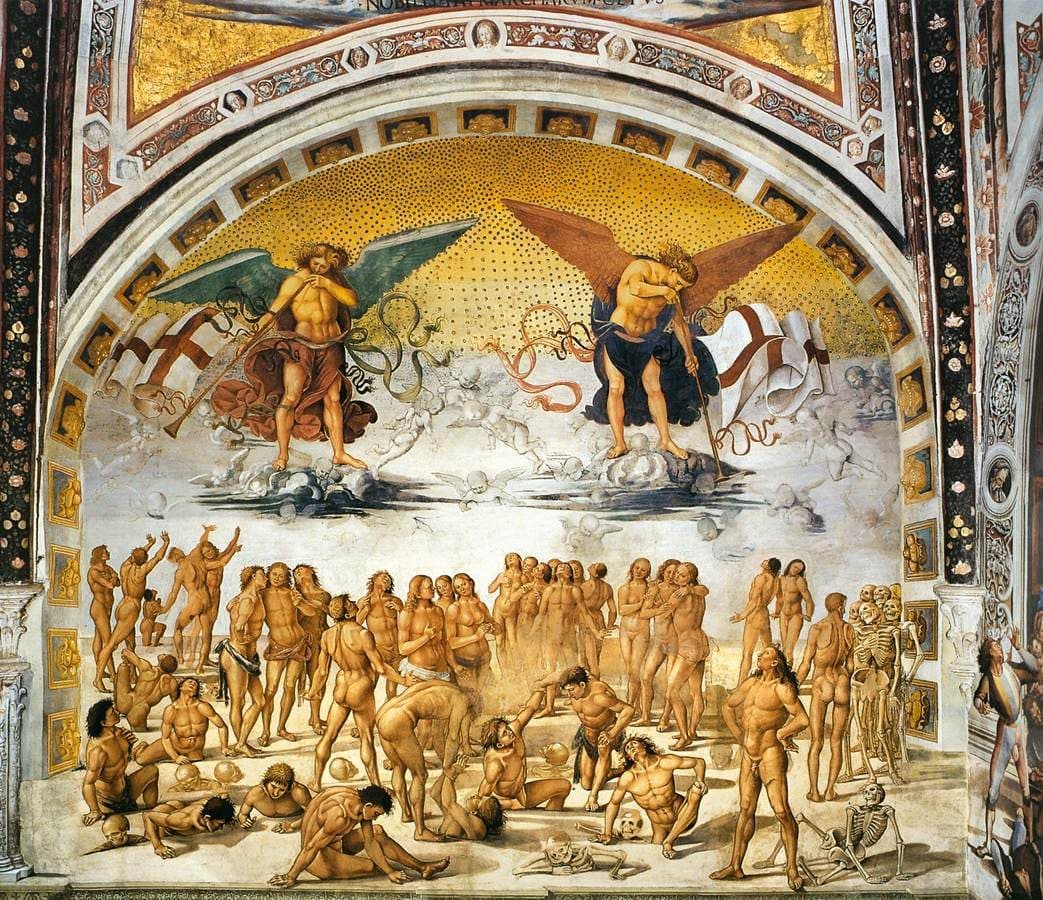
The Lord Himself comes down from heaven with a loud command, the voice of an archangel and the trumpet of God. The believing dead rise, and then the living are caught up together with them in the clouds to meet the Lord in the air (1 Thessalonians 4:16 to 17).
Listen, I tell you a mystery: We will not all sleep, but we will all be changed— in an instant, in the twinkling of an eye, at the last trumpet. For the trumpet will sound, the dead will be raised imperishable, and we will be changed.The verses stand here because Paul describes the same coming in his letter to Corinth.
Readers disagree over when this meeting takes place in relation to the tribulation, and the study of the rapture weighs the four answers.
Paul gives the grieving church a task, and he repeats it after his teaching on the day of the Lord.
He died for us so that, whether we are awake or asleep, we may live together with Him. Therefore encourage and build one another up, just as you are already doing.Paul returns to the living and the dead in one sentence and gives the same charge to encourage one another.
The Church at Thessalonica and the Word Sleep
Paul's first preaching in the city, Timothy's report and the word Paul chose for death stand behind the passage.
As was his custom, Paul went into the synagogue, and on three Sabbaths he reasoned with them from the Scriptures, explaining and proving that the Christ had to suffer and rise from the dead. “This Jesus I am proclaiming to you is the Christ,” he declared.On his three Sabbaths in the synagogue Paul taught the suffering and rising of the Christ, the ground he gives the grieving church.
But just now, Timothy has returned from his visit with the good news about your faith, your love, and the fond memories you have preserved, longing to see us just as we long to see you.Timothy's report of the church's faith and love came to Paul before he wrote to them about their dead.
The Greek verb for falling asleep is koimaō, and it stands in 18 verses of the New Testament, among them Luke's account of the death of Stephen (Acts 7:60).
After He had said this, He told them, “Our friend Lazarus has fallen asleep, but I am going there to wake him up.” His disciples replied, “Lord, if he is sleeping, he will get better.” They thought that Jesus was talking about actual sleep, but He was speaking about the death of Lazarus. So Jesus told them plainly, “Lazarus is dead,John's account explains the word for its reader, so Paul's use of it in 1 Thessalonians 4 is clear.
Paul's words for the rest, those not having hope, are mē echontes elpida in the Greek of 1 Thessalonians 4:13. He uses the same three words in Ephesians, in the order elpida mē echontes. There they describe the Gentiles before they knew Christ.
remember that at that time you were separate from Christ, alienated from the commonwealth of Israel, and strangers to the covenants of the promise, without hope and without God in the world.The verse shows whom Paul means by the rest, people separate from Christ and without God in the world.
John 11:11 to 14, Ephesians 2:12
What the Hope Changes
Paul's other letters and the words of Jesus at Bethany show what the hope means for a mourner.
Rejoice with those who rejoice; weep with those who weep.Paul tells the church at Rome to weep with those who weep, so grief shared among believers is part of the church's love.
I am torn between the two. I desire to depart and be with Christ, which is far better indeed.Paul calls departing to be with Christ far better, the same company with the Lord that the coming brings to all His people.
The hope of the passage rests on the One who told Martha, as she grieved for her brother, "I am the resurrection and the life" (John 11:25).
How the Passage Has Been Read
Augustine and Matthew Henry read the passage for mourners.
died 430 · Augustine of Hippo
Sermons 173.3
Augustine on grief that hope consoles
The quotation1 quotation
“Therefore, the Apostle also says: ‘Concerning those who are asleep, I do not want you to be ignorant, brothers, so that you do not grieve as others who have no hope.’ He did not merely say: ‘so that you do not grieve;’ but, ‘so that you do not grieve as others who have no hope.’ For it is necessary that you grieve: but where you grieve, let hope console you. For how can you not grieve, when the body that lives by the soul becomes lifeless, with the soul departing? He who walked now lies down, he who spoke is silent, shut eyes do not perceive light, ears are not open to any sound: all the functions of the members have ceased; there is no one to move steps for walking, hands for working, or senses for perceiving. … This is the cause of grief. If this is the cause of grief, let this grief have consolation. What consolation? Because the Lord himself, with a command and with the voice of the archangel, and with the last trumpet, will descend from heaven, and the dead in Christ will rise first: then we who are alive, who remain, will be caught up together with them in the clouds to meet Christ in the air. … And thus we shall always be with the Lord. Let sorrow perish where there is such great consolation; let mourning be wiped away from the soul, let faith expel grief.”
Augustine of Hippo · Sermons 173.3 · on 1 Thessalonians 4:13Patristic
1662 to 1714 · Matthew Henry
Commentary on the Whole Bible
The quotation1 quotation
“We should endeavour to support one another in times of sorrow, not deaden one another's spirits, nor weaken one another's hands, but should comfort one another; and this may be done by serious consideration and discourse on the many good lessons to be learned from the doctrine of the resurrection of the dead, the second coming of Christ, and the glory of the saints in that day.”
Matthew Henry · Commentary on the Whole Bible · on 1 Thessalonians 4:18Puritan
Comfort Passed On
The comfort the passage gives is meant to be spoken by one believer to another.
The passage gives a grieving church a hope grounded in the risen Jesus and words to say to one another at the graveside.
Blessed be the God and Father of our Lord Jesus Christ, the Father of compassion and the God of all comfort, who comforts us in all our troubles, so that we can comfort those in any trouble with the comfort we ourselves have received from God.Paul gives here the reason a grieving church can console others, since it has itself been consoled by God.
Sources
Scripture is the Berean Standard Bible.
- STEP Bible, the Translators Amalgamated Greek New Testament (TAGNT), Tyndale House, Cambridge, CC BY 4.0, with Strong's numbers, morphology, glosses and transliterations.
- STEP Bible, the Brief lexicon of Extended Strongs for Greek based on Abbott-Smith (1922), Tyndale House, Cambridge, CC BY 4.0.
- Augustine of Hippo, Sermons, 173.3, on 1 Thessalonians 4:13.
- Matthew Henry, Commentary on the Whole Bible (1710), on 1 Thessalonians 4:18.
Keep Studying
Studies5
Places1