
Genesis 23:2
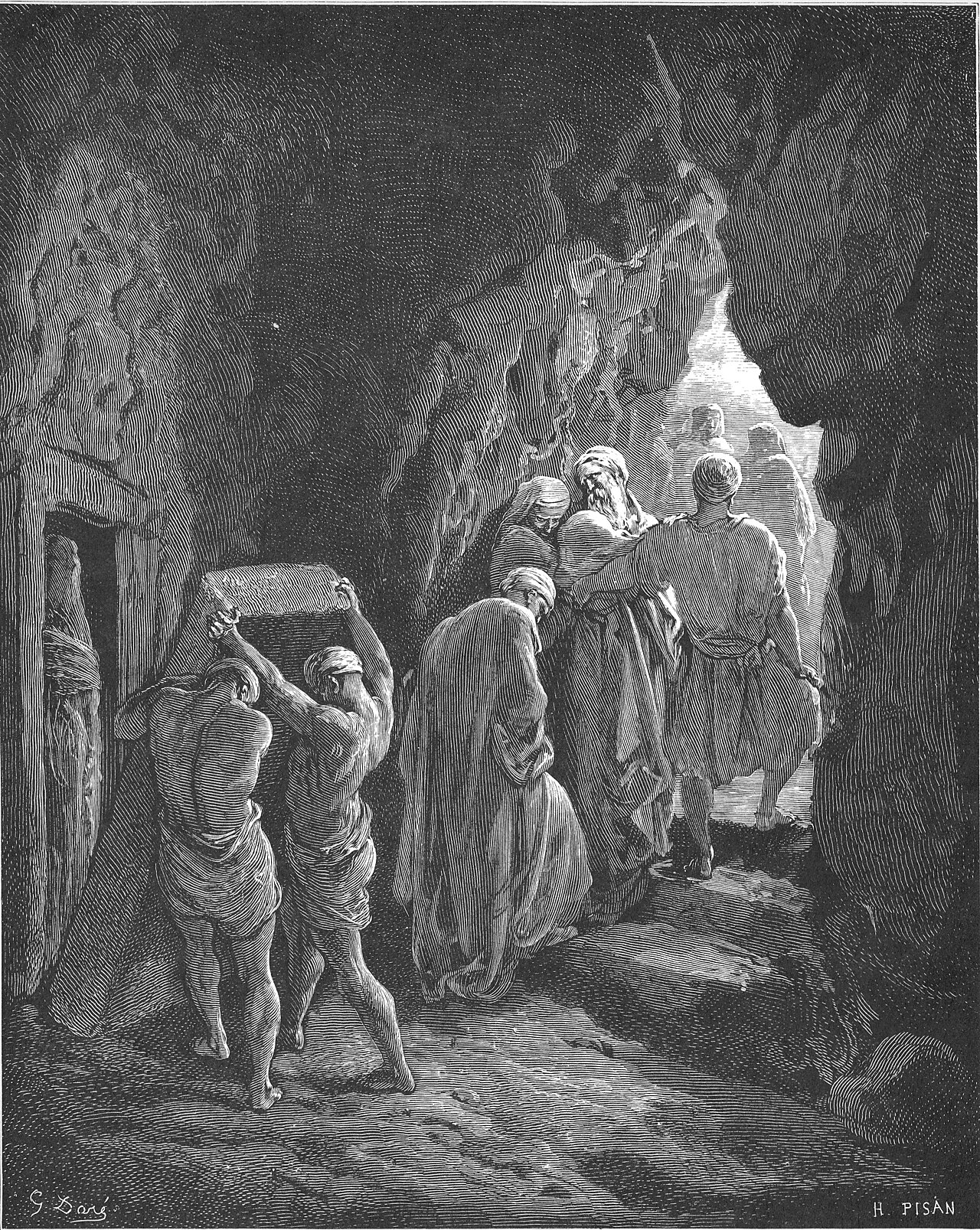
in Genesis 23She died in Kiriath-arba (that is, Hebron) in the land of Canaan, and Abraham went out to mourn and to weep for her.
BSB
The same verse in ASV and KJV ▾
ASV
And Sarah died in Kiriath-arba (the same is Hebron), in the land of Canaan: and Abraham came to mourn for Sarah, and to weep for her.
KJV
And Sarah died in Kirjath–arba; the same is Hebron in the land of Canaan: and Abraham came to mourn for Sarah, and to weep for her.
⋯
This verse in Genesis 23
Commentary
8 notes on this verseSarah died in Kirjath-arba - Literally in the city of the four. Some suppose this place was called the city of the four because it was the burial place of Adam, Abraham, Isaac, and Jacob; others, because according to the opinion of the rabbins, Eve was buried there. with Sarah, Rebekah, and Leah.
This site's exposition
to mourn and to weep for her
Kiriath-arba, which is Hebron, means the city of Arba, and Joshua 14:15 calls Arba the greatest man among the Anakim. The first grave in the covenant family is dug in the town named after him. Two verbs stand over Abraham, mourn and weep. Henry takes the pair as grief that was felt as well as shown.
The record, by era
The Church Fathers1 voice
A brother asked an old man, "What shall I do for my sins?" He replied, "He who desires to be free from his sins shall be freed from them by weeping, and he who wishes to build virtues in himself will build them by weeping.
The Reformation2 voices
And Sarah died in Kirjath-arba. It appears from Joshua 15:54, that this was the more ancient name of the city, which afterwards began to be called Hebron. But there is a difference of opinion respecting the etymology.
And Sarah died in Kirjath-arba. It appears from Joshua 15:54, that this was the more ancient name of the city, which afterwards began to be called Hebron. But there is a difference of opinion respecting the etymology.
The Puritans and the Awakening2 voices
Abraham's mourning for her; and he was a true mourner. He did not only perform the ceremonies of mourning according to the custom of those time, as the mourners that go about the streets, but he did sincerely lament the great loss he had of a good wife, and gave proof of the constancy of his affection to her to the last. Two words are used: he came both to mourn and to weep.
And Sarah died in Kirjatharba,....
1 more voice on this verse
The Puritans and the Awakening1 voice
Abraham's mourning for her; and he was a true mourner. He did not only perform the ceremonies of mourning according to the custom of those time, as the mourners that go about the streets, but he did sincerely lament the great loss he had of a good wife, and gave proof of the constancy of his affection to her to the last. Two words are used: he came both to mourn and to weep.
How the passage was read
What the Jewish commentators add
On the verses either side of this one
A HUNDRED AND TWENTY YEARS Rashi comments: “The reason the word ‘years’ is written at every term is that it informs you that each term must be interpreted by itself.
This section is reception history: how the passage was read and kept in the Jewish tradition. Where a reading parts from an essential of the Christian faith, the section says so at that point.
Texts and citation data: Sefaria; each excerpt follows its version’s licence. 5 further sources are cited on this chapter that carry no English text this site may quote or only restate the verse.
The words behind it
13 Hebrew wordsEvery Hebrew word of this verse in the order it stands, with what it means and the door to its own study. The last column counts the times a word stands in the whole Bible: the rarer the word, the more the places it appears belong together.
| Hebrew | Sound | Meaning | Word study | In the Bible |
|---|---|---|---|---|
| וַתָּ֣מָת | vatamot | and she died | H4191 → | 839 times |
| שָׂרָ֗ה | sarah | Sarah | H8283 → | 38 times |
| בְּקִרְיַ֥ת | bekiryat | at Kiriath | H7153 → | 18 times |
| אַרְבַּ֛ע | ʾarba' | Arba | H7153 → | 18 times |
| הִ֥וא | hi' | that | H1931 → | 1879 times |
| חֶבְר֖וֹן | chevron | [is] Hebron | H2275 → | 72 times |
| בְּאֶ֣רֶץ | beeretz | in [the] land of | H776 → | 2504 times |
| כְּנָ֑עַן | kenaan | Canaan | H3667 → | 94 times |
| וַיָּבֹא֙ | vaiyavo' | and he went | H935 → | 2568 times |
| אַבְרָהָ֔ם | ʾavraham | Abraham | H85 → | 175 times |
| לִסְפֹּ֥ד | lispod | to mourn | H5594 → | |
| לְשָׂרָ֖ה | lesarah | for Sarah | H8283 → | 38 times |
| וְלִבְכֹּתָֽהּ׃ | velivkotah | and to weep for her | H1058 → | 114 times |
וַתָּ֣מָתand she died
vatamotH4191 →839 times
שָׂרָ֗הSarah
sarahH8283 →38 times
בְּקִרְיַ֥תat Kiriath
bekiryatH7153 →18 times
אַרְבַּ֛עArba
ʾarba'H7153 →18 times
הִ֥ואthat
hi'H1931 →1879 times
חֶבְר֖וֹן[is] Hebron
chevronH2275 →72 times
בְּאֶ֣רֶץin [the] land of
beeretzH776 →2504 times
כְּנָ֑עַןCanaan
kenaanH3667 →94 times
וַיָּבֹא֙and he went
vaiyavo'H935 →2568 times
אַבְרָהָ֔םAbraham
ʾavrahamH85 →175 times
לִסְפֹּ֥דto mourn
lispodH5594 →
לְשָׂרָ֖הfor Sarah
lesarahH8283 →38 times
וְלִבְכֹּתָֽהּ׃and to weep for her
velivkotahH1058 →114 times
A shaded row is a word that stands 400 times or fewer in the Bible.
The walk
8 stopsEach card is a verse this one points to, and under it the verses that one points to in turn. Where several paths arrive at the same place, that place is listed first: the text keeps returning to it.
Through
Genesis 13:18So Abram moved his tent and went to live near the Oaks of Mamre at Hebron, where he built an altar to the LORD.
it leads to
- Genesis 14:13
Then an escapee came and reported this to Abram the Hebrew. Now Abram was living near the Oaks of Mamre the Amorite, a brother of Eshcol and Aner, all of whom were bound by…
- Genesis 35:27
Jacob returned to his father Isaac at Mamre, near Kiriath-arba (that is, Hebron), where Abraham and Isaac had stayed.
- Genesis 18:1
Then the LORD appeared to Abraham by the Oaks of Mamre in the heat of the day, while he was sitting at the entrance of his tent.
- Genesis 8:20
Then Noah built an altar to the LORD. And taking from every kind of clean animal and clean bird, he offered burnt offerings on the altar.
- Genesis 12:7–8
Then the LORD appeared to Abram and said, “I will give this land to your offspring.” So Abram built an altar there to the LORD, who had appeared to him.
- Genesis 14:13
Through
2 Samuel 1:17Then David took up this lament for Saul and his son Jonathan,
it leads to
- 2 Chronicles 35:25
Then Jeremiah lamented over Josiah, and to this day all the choirs of men and women sing laments over Josiah. They established them as a statute for Israel, and indeed they are written in…
- 2 Samuel 1:19
“Your glory, O Israel, lies slain on your heights. How the mighty have fallen!
- 2 Chronicles 35:25
Through
Judges 1:10Judah also marched against the Canaanites who were living in Hebron (formerly known as Kiriath-arba), and they struck down Sheshai, Ahiman, and Talmai.
it leads to
- Joshua 14:15
(Hebron used to be called Kiriath-arba, after Arba, the greatest man among the Anakim.) Then the land had rest from war.
- Joshua 14:15
Where this verse is studied
On this page
About Genesis
Who and where
3 names in this verse with a page on the site.
- PersonPatriarchsAbrahamCalled out of Ur, the father of all who believe, justified by faith, and the friend of God through whose seed all nations are bles…
- PlaceThe LevantCanaanThe land God promised to Abraham's seed, walked and marked with altars by the patriarchs and possessed under Joshua four centuries…
- PlaceJudean hill countryHebronThe city of the patriarchs, where Abraham bought the cave of Machpelah, Caleb took his inheritance, and David reigned seven years…
This page draws on Adam Clarke, Commentary on the Bible; John Calvin, Commentaries; John Gill, Exposition of the Old Testament; John Gill, Exposition of the Old Testament (1748-1763); Martin of Braga, SAYINGS OF THE EGYPTIAN FATHERS 33-34 and Matthew Henry, Commentary on the Whole Bible.