
Job 2:13
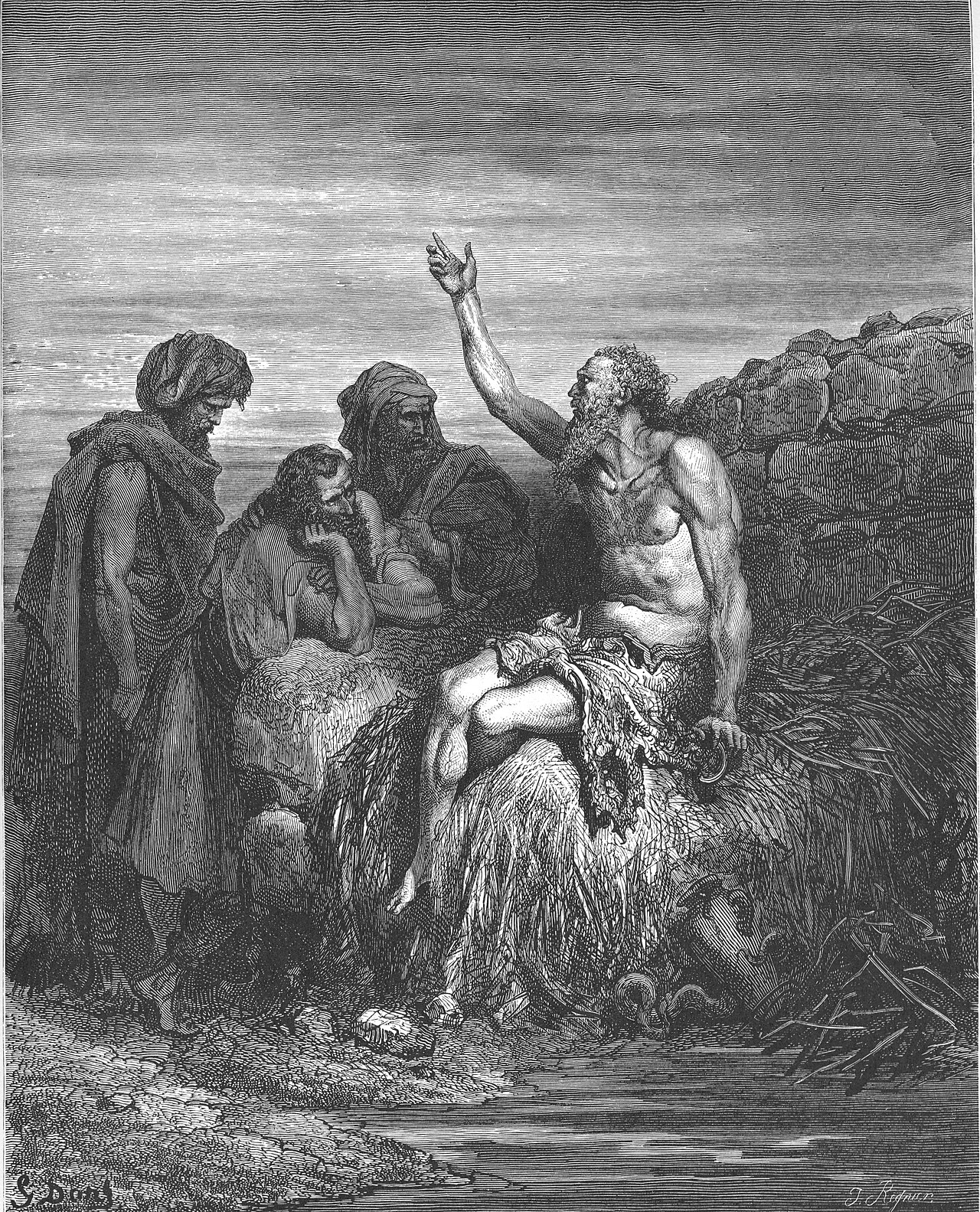
in Job 2Then they sat on the ground with him for seven days and seven nights, but no one spoke a word to him because they saw how intense his suffering was.
BSB
The same verse in ASV and KJV ▾
ASV
So they sat down with him upon the ground seven days and seven nights, and none spake a word unto him: for they saw that his grief was very great.
KJV
So they sat down with him upon the ground seven days and seven nights, and none spake a word unto him: for they saw that his grief was very great.
⋯
This verse in Job 2
Commentary
12 notes on this verseA commentator
Albert Barnes1798–1870
Notes, Explanatory and Practical, on the Old and New Testaments (1832-1869)
So they sat down with him upon the ground; - see Job 1:20, note; Job 2:8, note; compare Ezr 9:3, “I rent my garment and my mantle, and plucked off the hair of my head, and my beard, and sat down astonished.” Seven days and seven nights - Seven days was the usual time of mourning among the Orientals. Thus, they made public lamentation for Jacob seven days, Gen 50:10. Thus, on the death of Saul, they fasted seven days, 1Sa 31:
This site's exposition
heard about all this adversity
on Job 2:11-13
Eliphaz the Temanite, Bildad the Shuhite and Zophar the Naamathite arrive, and Eliphaz bears a town name from Edom, where the opening verse placed Job. They tear their robes and sit on the ground and "no one spoke a word to him because they saw how intense his suffering was".
This site's exposition
Then they sat on the ground with him for seven days and seven nights
Seven days and seven nights was the usual time of mourning. Wesley notes that the friends kept the mourning for the dead, both for the children and for Job himself, a man dead while he lived. Jamieson, Fausset and Brown read the silence as suffering too intense for any word.
The record, by era
The Medieval Church4 voices
HISTORICAL INTERPRETATION. So they sat down with him upon the ground seven days and seven nights, and none spake a word unto him; for they saw that his grief was very great. Whether they sat with the afflicted Job for seven days and seven nights together, or possibly for seven days and as many nights kept by him in assiduous and frequent visiting, we cannot tell. For we are often said to be doing any thing for so many days, though we may not be continually busied therein all those days. And often holy Scripture is wont to put the whole for a part, in like manner as it does a part for the whole. Thus it speaks of a part for the whole, as where, in describing Jacob's household, it says, All the souls of the house of Jacob which came into Egypt were threescore and ten. Where indeed, while it makes mention of souls, it clearly takes in the bodies also of the comers. Again it puts in the whole for a part, as where at the tomb Mary complains, saying, They have taken away my Lord, and I know not where they have laid Him. For it was the Body of the Lord only that she had come to seek, and yet she bewails the Lord as though His whole Person had been altogether taken away; and so in this place too it is doubtful whether the whole is put for a part. Yet this circumstance, viz. that they were a long while silent, and yet in speaking after all were condemned, must not be passed over carelessly. For there are some men who both begin to speak with precipitation, and follow out that unchecked beginning with still less check. While there are some who are indeed backward to begin to speak, but having once begun know not how to set limits to their words. Accordingly the friends of blessed Job, upon seeing his grief, were for long silent, yet, whilst slow to begin, they spoke with indiscretion, because they would not spare him in his grief. […]
MORAL INTERPRETATION. So they sat down with him upon the ground seven days and seven nights. But these vices which the old enemy hides under the semblance of virtues, are very minutely examined by the hand of compunction. For he that really grieves within, resolutely foredetermines what things are to be done outwardly, and what are not. For if the virtue of compunction moves us in our inward parts, all the clamouring of evil dictates is made mute; and hence it follows. And none spake a word unto him; for they saw that his grief was very great. For if the heart feels true sorrow, the vices have no tongue against it. And when the life of uprightness is sought with an entire aim, the fruitless prompting of evil is closed up. But oftentimes if we brace ourselves with strong energy against the incitements of evil habits, we turn even those very evil habits to the account of virtue. For some are possessed by anger, but while they submit this to reason, they convert it into service rendered to holy zeal. Some are lifted up by pride. But whilst they bow down the mind to the fear of God, they change this into the free tone of unrestrained authority in defence of justice. Strength of the flesh is a snare to some; but whilst they bring under the body by practising works of mercy, from the same quarter, whence they were exposed to the goading of wickedness, they purchase the gains of pitifulness. And hence it is well that this blessed Job, after a multitude of conflicts, sacrifices a victim for his friends. […]
They consoled him not only by showing compassion to him, but also by showing their fellowship with him; for there follows, "they sat with him on the ground seven days and seven nights." Nevertheless one must not understand this to mean a continuous period, but …
ALLEGORICAL INTERPRETATION. So they sat down with him upon the ground seven days and seven nights. In the day we make out the objects that we look at, but in the night, either from the blindness we discern nothing, or from the uncertainty we are bewildered. Accordingly by 'day' we have 'understanding' represented, and by 'night,' 'ignorance.' And by the number seven the sum of completeness is expressed; and hence in seven days, and no more, the whole of this transitory period is accomplished.
The Puritans and the Awakening1 voice
Seven days - Which was the usual time of mourning for the dead, and therefore proper both for Job's children, and for Job himself, who was in a manner dead, while he lived: not that they continued in this posture so long together, which the necessities of nature could not bear; but they spent the greatest part of that time in sitting with him, and silent mourning over him.
4 more voices on this verse
The Puritans and the Awakening2 voices
So they sat down with him upon the ground seven days and seven nights,....
One would have thought that he had enough of his former attempt upon Job, in which he was so shamefully baffled and disappointed; but malice is restless: the devil and his instruments are so.
The Nineteenth Century2 voices
A commentator
Jamieson, Fausset & Brown1802–1910
Commentary Critical and Explanatory on the Whole Bible (1871)
proposed
Sitting on the earth marked mourning (La 2:10). Seven days was the usual length of it (Ge 50:10; This silence may have been due to a rising suspicion of evil in Job; but chiefly because it is only ordinary griefs that find vent in language; extraordinary griefs are too great for utterance.
quarantine:debris (2026-07-29) — unbalanced-parens
They sat down with him upon the ground seven days - They were astonished at the unprecedented change which had taken place in the circumstances of this most eminent man; they could not reconcile his present situation with any thing they had met with in the history of Divine providence. The seven days mentioned here were the period appointed for mourning. The Israelites mourned for Jacob seven days, Gen 50:10. And the men of Jabesh mourned so long for the death of Saul, 1Sa 31:13; 1Ch 10:12. And Ezekiel sat on the ground with the captives at Chebar, and mourned with and for them seven days. Eze 3:15. The wise son of Sirach says, “Seven days do men mourn for him that is dead;” Sirach 22:12. So calamitous was the state of Job, that they considered him as a dead man: and went through the prescribed period of mourning for him. They saw that his grief was very great - This is the reason why they did not speak to him: they believed him to be suffering for heavy crimes, and, seeing him suffer so much, they were not willing to add to his distresses by invectives or reproach. Job himself first broke silence.
How the passage was read
What the Jewish commentators add
On the verses either side of this one
but they did not recognize him because his face had changed as a result of the agonies.
This section is reception history: how the passage was read and kept in the Jewish tradition. Where a reading parts from an essential of the Christian faith, the section says so at that point.
Texts and citation data: Sefaria; each excerpt follows its version’s licence. 5 further sources are cited on this chapter that carry no English text this site may quote or only restate the verse.
The words behind it
17 Hebrew wordsEvery Hebrew word of this verse in the order it stands, with what it means and the door to its own study. The last column counts the times a word stands in the whole Bible: the rarer the word, the more the places it appears belong together.
| Hebrew | Sound | Meaning | Word study | In the Bible |
|---|---|---|---|---|
| וַיֵּשְׁב֤וּ | vaiyeshevu | and they sat | H3427 → | 1079 times |
| אִתּוֹ֙ | ʾito | with him | H854 → | 929 times |
| לָאָ֔רֶץ | laaretz | to the ground | H776 → | 2504 times |
| שִׁבְעַ֥ת | shivat | seven | H7651 → | 394 times |
| יָמִ֖ים | yamim | days | H3117 → | 2304 times |
| וְשִׁבְעַ֣ת | veshivat | and seven | H7651 → | 394 times |
| לֵיל֑וֹת | leilot | nights | H3915 → | 233 times |
| וְאֵין־ | veein- | and not | H369 → | 789 times |
| דֹּבֵ֤ר | dover | [anyone was] speaking | H1696 → | 1141 times |
| אֵלָיו֙ | ʾelav | to him | H413 → | 5510 times |
| דָּבָ֔ר | davar | a word | H1697 → | 1440 times |
| כִּ֣י | ki | for | H3588 → | 4482 times |
| רָא֔וּ | rau | they saw | H7200 → | 1300 times |
| כִּֽי־ | ki- | that | H3588 → | 4482 times |
| גָדַ֥ל | gadal | it was great | H1431 → | 117 times |
| הַכְּאֵ֖ב | hakeev | the pain | H3511 → | |
| מְאֹֽד׃ | meod | exceedingly | H3966 → | 300 times |
וַיֵּשְׁב֤וּand they sat
vaiyeshevuH3427 →1079 times
אִתּוֹ֙with him
ʾitoH854 →929 times
לָאָ֔רֶץto the ground
laaretzH776 →2504 times
שִׁבְעַ֥תseven
shivatH7651 →394 times
יָמִ֖יםdays
yamimH3117 →2304 times
וְשִׁבְעַ֣תand seven
veshivatH7651 →394 times
לֵיל֑וֹתnights
leilotH3915 →233 times
וְאֵין־and not
veein-H369 →789 times
דֹּבֵ֤ר[anyone was] speaking
doverH1696 →1141 times
אֵלָיו֙to him
ʾelavH413 →5510 times
דָּבָ֔רa word
davarH1697 →1440 times
כִּ֣יfor
kiH3588 →4482 times
רָא֔וּthey saw
rauH7200 →1300 times
כִּֽי־that
ki-H3588 →4482 times
גָדַ֥לit was great
gadalH1431 →117 times
הַכְּאֵ֖בthe pain
hakeevH3511 →
מְאֹֽד׃exceedingly
meodH3966 →300 times
A shaded row is a word that stands 400 times or fewer in the Bible.
The walk
8 stopsEach card is a verse this one points to, and under it the verses that one points to in turn. Where several paths arrive at the same place, that place is listed first: the text keeps returning to it.
Through
Nehemiah 1:4When I heard these words, I sat down and wept. I mourned for days, fasting and praying before the God of heaven.
it leads to
- Psalms 137:1
By the rivers of Babylon we sat and wept when we remembered Zion.
Reached by 2 separate paths from here.
- Daniel 9:3
So I turned my attention to the Lord God to seek Him by prayer and petition, with fasting, sackcloth, and ashes.
- Ezra 10:1
While Ezra prayed and made this confession, weeping and falling facedown before the house of God, a very large assembly of Israelites—men, women, and children—gathered around him, and the people wept bitterly as well.
- Nehemiah 2:4
“What is your request?” replied the king. So I prayed to the God of heaven
- Psalms 102:13–14
You will rise up and have compassion on Zion, for it is time to show her favor— the appointed time has come.
- Psalms 137:1
Through
Genesis 50:10When they reached the threshing floor of Atad, which is across the Jordan, they lamented and wailed loudly, and Joseph mourned for his father seven days.
it leads to
- Acts 8:2
God-fearing men buried Stephen and mourned deeply over him.
- 2 Samuel 1:17
Then David took up this lament for Saul and his son Jonathan,
- Acts 8:2
Through
Psalms 77:4You have kept my eyes from closing; I am too troubled to speak.
it leads to
- Job 7:13–15
When I think my bed will comfort me and my couch will ease my complaint,
- Job 7:13–15
Where this verse is studied
On this page
Studies4
On this verse
On this chapter
About Job
This page draws on Adam Clarke, Commentary on the Bible; Albert Barnes, Notes, Explanatory and Practical, on the Old and New Testaments (1832-1869); Gregory the Dialogist, Morals on the Book of Job, Book III; Jamieson, Fausset & Brown, Commentary Critical and Explanatory on the Whole Bible; John Gill, Exposition of the Old Testament (1748-1763); John Wesley, Explanatory Notes upon the Old Testament; Matthew Henry, Commentary on the Whole Bible and Thomas Aquinas, Commentary on Job.