
1 Samuel 15:32
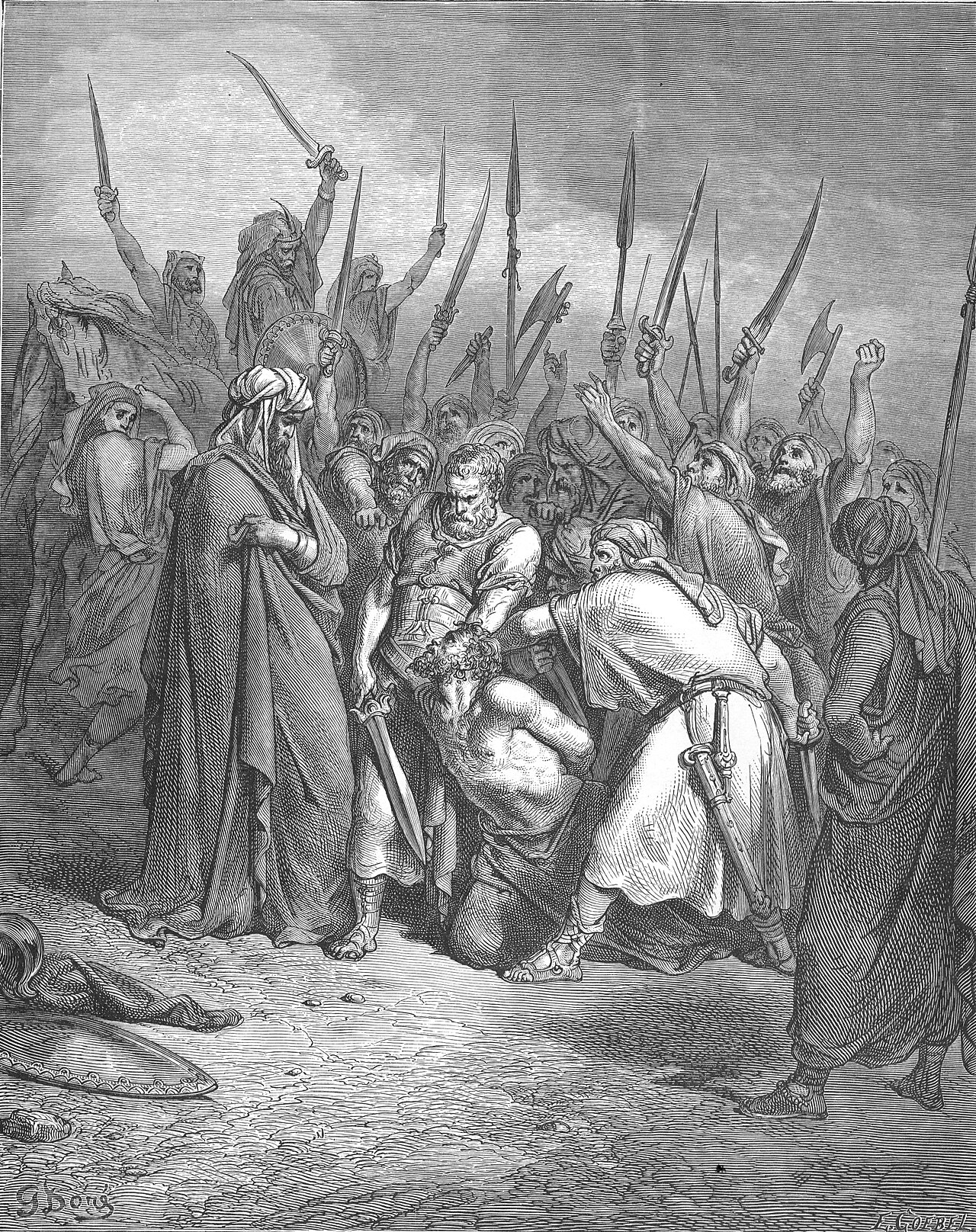
in 1 Samuel 15Then Samuel said, “Bring me Agag king of the Amalekites.” Agag came to him cheerfully, for he thought, “Surely the bitterness of death is past.”
BSB
The same verse in ASV and KJV ▾
ASV
Then said Samuel, Bring ye hither to me Agag the king of the Amalekites. And Agag came unto him cheerfully. And Agag said, Surely the bitterness of death is past.
KJV
Then said Samuel, Bring ye hither to me Agag the king of the Amalekites. And Agag came unto him delicately. And Agag said, Surely the bitterness of death is past.
⋯
This verse in 1 Samuel 15
Commentary
8 notes on this verseAgag came unto him delicately - The Septuagint have τρεμων, trembling; the original, מעדנת maadannoth, delicacies; probably איש ish, man, understood; a man of delights, a pleasure-taker: the Vulgate, pinguissimus et tremens, “very fat and trembling.” Surely the bitterness of death is past - Almost all the versions render this differently from ours. Surely death is bitter, is their general sense; and this seems to be the true meaning.
This site's exposition
Surely the bitterness of death is past
on 1 Samuel 15:32-33
Agag comes before Samuel delicately, expecting the courtesy shown to a captured king, and his own words betray the hope: Surely the bitterness of death is past. Samuel's sentence answers Agag's own record, as thy sword hath made women childless, so shall thy mother be childless among women, and he carries out with his own hand the destruction Saul had left undone. Agag's line is picked up centuries later at Esther 3:1, which names Haman the Agagite; the descent from this king to that enemy of the Jews is the church's tradition rather than a stated genealogy, and it is held so.
The record, by era
The Medieval Church2 voices
A commentator
Gregory the DialogistCommentary on 1 Kings, Book 6, Chapter 2 · Written before 604.
proposed
36. Kings adore the Lord when the proud and scornful humble themselves to carry out the Lord's commands. The unchaste adore when they are subjected to God through the obedience of chastity. But sometimes they pretend to adore, because some have a pretext of humility or chastity, yet while they are believed to truly possess the good, others through the good they believe them to have lose the practice of good works. Therefore they hand over King Agag to Samuel, because by confessing they bring forth the vigor of their sensuality.
And Samuel said: Bring Agag to me, etc. Agag, as mentioned above, means 'covered'; Amalek is called a people of locusts or a people who lick. Therefore, prophetic Scripture says and its ministers and dispensers tell their listeners to bring out into the open the …
The Puritans and the Awakening3 voices
He illustrated the sentence by a sign, which Saul himself, by his rudeness, gave occasion for. When Samuel was turning from him he tore his clothes to detain him (
quarantine:debris (2026-07-29) — unbalanced-parens
Having escaped the sword of Saul," that man of war, he thought he was in no danger from Samuel, and old prophet, a man of peace. Note, (1.) There is bitterness in death, it is terrible to nature. Surely death is bitter, so divers versions read those words of Agag; as the LXX. read the former clause, He came trembling.
quarantine:debris (2026-07-29) — odd-straight-quotes
Then said Samuel, bring you hither to me Agag the king of the Amalekites,....
1 more voice on this verse
The Nineteenth Century1 voice
A commentator
Albert Barnes1798–1870
Notes, Explanatory and Practical, on the Old and New Testaments (1832-1869)
proposed
Delicately - This phrase is very obscure. The meaning of the word so rendered is “dainties, delights” Gen 49:20; Pro 29:17; Lam 4:5, which hardly gives a tolerable sense here. Some understand it “fawningly, flatteringly,” with a view of appeasing Samuel. (Others alter the reading, and translate “in bonds.”) Surely the bitterness ... - Agag hopes that his life will be spared, and so expresses his confident belief that the bitterness of death is over.
The words behind it
18 Hebrew wordsEvery Hebrew word of this verse in the order it stands, with what it means and the door to its own study. The last column counts the times a word stands in the whole Bible: the rarer the word, the more the places it appears belong together.
| Hebrew | Sound | Meaning | Word study | In the Bible |
|---|---|---|---|---|
| וַיֹּ֣אמֶר | vaiyomer | and he said | H559 → | 5305 times |
| שְׁמוּאֵ֗ל | shemuel | Samuel | H8050 → | 141 times |
| הַגִּ֤ישׁוּ | hagishu | bring near | H5066 → | 125 times |
| אֵלַי֙ | ʾelai | to me | H413 → | 5510 times |
| אֶת־ | ʾet- | <obj.> | H853 → | 10935 times |
| אֲגַג֙ | ʾagag | Agag | H90 → | 8 times |
| מֶ֣לֶךְ | melekh | [the] king of | H4428 → | 2525 times |
| עֲמָלֵ֔ק | ʾamalek | Amalek | H6002 → | 39 times |
| וַיֵּ֣לֶךְ | vaiyelekh | and he came | H1980 → | 1546 times |
| אֵלָ֔יו | ʾelav | to him | H413 → | 5510 times |
| אֲגַ֖ג | ʾagag | Agag | H90 → | 8 times |
| מַעֲדַנֹּ֑ת | maadanot | bonds | H4575 → | |
| וַיֹּ֣אמֶר | vaiyomer | and he said | H559 → | 5305 times |
| אֲגָ֔ג | ʾagag | Agag | H90 → | 8 times |
| אָכֵ֖ן | ʾakhen | truly | H403 → | |
| סָ֥ר | sar | it has departed | H5493 → | 299 times |
| מַר־ | mar- | [the] bitterness of | H4751 → | 37 times |
| הַמָּֽוֶת׃ ס | hamavet | <the> death | H4194 → | 156 times |
וַיֹּ֣אמֶרand he said
vaiyomerH559 →5305 times
שְׁמוּאֵ֗לSamuel
shemuelH8050 →141 times
הַגִּ֤ישׁוּbring near
hagishuH5066 →125 times
אֵלַי֙to me
ʾelaiH413 →5510 times
אֶת־<obj.>
ʾet-H853 →10935 times
אֲגַג֙Agag
ʾagagH90 →8 times
מֶ֣לֶךְ[the] king of
melekhH4428 →2525 times
עֲמָלֵ֔קAmalek
ʾamalekH6002 →39 times
וַיֵּ֣לֶךְand he came
vaiyelekhH1980 →1546 times
אֵלָ֔יוto him
ʾelavH413 →5510 times
אֲגַ֖גAgag
ʾagagH90 →8 times
מַעֲדַנֹּ֑תbonds
maadanotH4575 →
וַיֹּ֣אמֶרand he said
vaiyomerH559 →5305 times
אֲגָ֔גAgag
ʾagagH90 →8 times
אָכֵ֖ןtruly
ʾakhenH403 →
סָ֥רit has departed
sarH5493 →299 times
מַר־[the] bitterness of
mar-H4751 →37 times
הַמָּֽוֶת׃ ס<the> death
hamavetH4194 →156 times
A shaded row is a word that stands 400 times or fewer in the Bible.
The walk
8 stopsEach card is a verse this one points to, and under it the verses that one points to in turn. Where several paths arrive at the same place, that place is listed first: the text keeps returning to it.
Through
1 Thessalonians 5:3While people are saying, “Peace and security,” destruction will come upon them suddenly, like labor pains on a pregnant woman, and they will not escape.
it leads to
- Luke 21:34–35
But watch yourselves, or your hearts will be weighed down by dissipation, drunkenness, and the worries of life—and that day will spring upon you suddenly like a snare.
- Matthew 24:37–39
As it was in the days of Noah, so will it be at the coming of the Son of Man.
- Luke 17:26–30
Just as it was in the days of Noah, so also will it be in the days of the Son of Man:
- Revelation 18:7–8
As much as she has glorified herself and lived in luxury, give her the same measure of torment and grief. In her heart she says, ‘I sit as queen; I am not a widow…
- Hebrews 2:3
how shall we escape if we neglect such a great salvation? This salvation was first announced by the Lord, was confirmed to us by those who heard Him,
- Luke 21:34–35
Through
Revelation 18:7As much as she has glorified herself and lived in luxury, give her the same measure of torment and grief. In her heart she says, ‘I sit as queen; I am not a widow…
it leads to
- Isaiah 47:7–9
You said, ‘I will be queen forever.’ You did not take these things to heart or consider their outcome.
- Zephaniah 2:15
This carefree city that dwells securely, that thinks to herself: “I am it, and there is none besides me,” what a ruin she has become, a resting place for beasts. Everyone who passes by…
- Ezekiel 28:2–10
“Son of man, tell the ruler of Tyre that this is what the Lord GOD says: Your heart is proud, and you have said, ‘I am a god; I sit in the seat of…
- Isaiah 47:7–9
Where this verse is studied
About 1 Samuel
Who and where
2 names in this verse with a page on the site.
- PersonJudges to monarchySamuelAsked of God by Hannah and lent to the LORD at Shiloh; the last judge and first of the prophets after Moses, who anointed both Sau…
- PersonEarly monarchyAgagKing of Amalek, spared by Saul against the express command — the partial obedience that cost Saul the kingdom; hewed in pieces bef…
This page draws on Adam Clarke, Commentary on the Bible; Albert Barnes, Notes, Explanatory and Practical, on the Old and New Testaments (1832-1869); Bede, Commentary on Samuel; Gregory the Dialogist, Commentary on 1 Kings, Book 6, Chapter 2; John Gill, Exposition of the Old Testament (1748-1763) and Matthew Henry, Commentary on the Whole Bible.