
1 Samuel 15:8
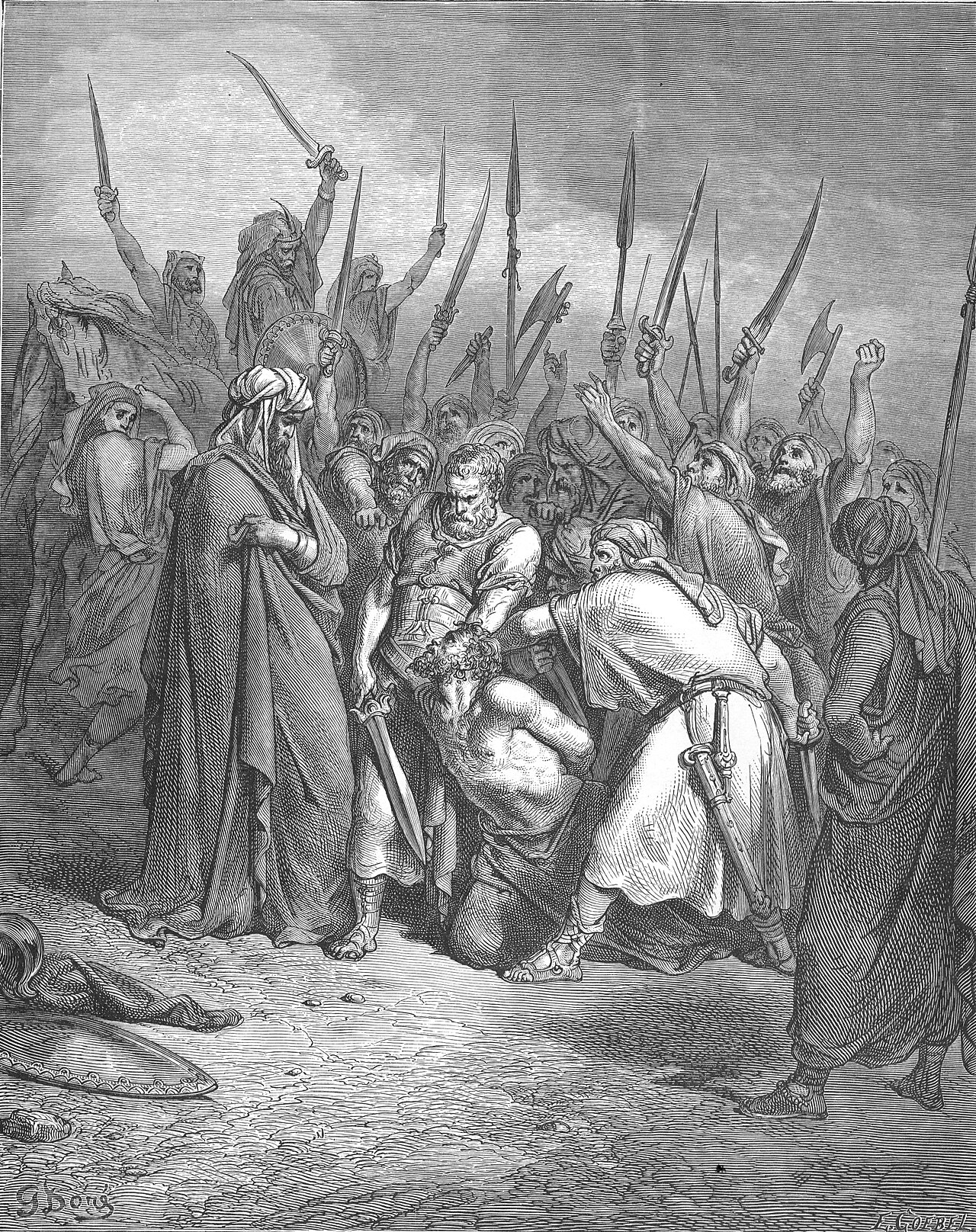
in 1 Samuel 15He captured Agag king of Amalek alive, but devoted all the others to destruction with the sword.
BSB
The same verse in ASV and KJV ▾
ASV
And he took Agag the king of the Amalekites alive, and utterly destroyed all the people with the edge of the sword.
KJV
And he took Agag the king of the Amalekites alive, and utterly destroyed all the people with the edge of the sword.
⋯
This verse in 1 Samuel 15
Commentary
8 notes on this verseAnd he took Agag the king of the Amalekites alive,.... This name seems to be a common name of the kings of these people, as Pharaoh was of the Egyptians, see Num 24:
This site's exposition
from Havilah until thou comest
on 1 Samuel 15:7-9
Saul carries the campaign the length of Amalek's territory, from Havilah to Shur on the border of Egypt, and takes Agag alive. Verse 9 states the failure plainly: Saul and the people spared the king and the best of the flocks and herds, keeping back exactly what verse 3 had named for destruction, and destroyed only what was already worthless. Barnes reads the sparing of Agag as a king's calculation, a captive kept to be paraded, and the text itself gives no motive beyond an appetite for what was good.
The record, by era
The Church Fathers1 voice
A commentator
Apostolic ConstitutionsCONSTITUTIONS OF THE HOLY APOSTLES 2.10 · Written before 380.
proposed
But he who does not consider these things, will, contrary to justice, spare him who deserves punishment; as Saul spared Agag, and Eli his sons, "who knew not the Lord." Such a one profanes his own dignity and that church of God which is in his parish. Such a one is esteemed unjust before God and holy men, as affording occasion of scandal to many of the newly baptized and to the catechumens; as also to the youth of both sexes, to whom a woe belongs, add "a millstone about his neck," and drowning, on account of his guilt. For, observing what a person their governor is, through his wickedness and neglect of justice they will grow skeptical, and, indulging the same disease, will be compelled to perish with him; as was the case of the people joining with Jeroboam, and those which were in the conspiracy with Korah.
The Medieval Church2 voices
And he took Agag, king of Amalek, alive, etc. Thus far, Saul's struggle distinguished him as an excellent and discerning ruler, either of himself or of the people subject to him. From this point on, it marks him as indolent and reprobate, who rightly spared …
A commentator
Gregory the DialogistCommentary on 1 Kings, Book 6, Chapter 2 · Written before 604.
proposed
1. King Saul, who had good beginnings but by no means persevered in the good things he had begun, is presented through the text of sacred History, so that in him we may see what is to be imitated and what is to be avoided. Thus indeed we also pick from badly cultivated fields, which rise up to harvest mixed with thorns. He truly knows how to gather well from them, who takes care to pick the ears of grain while striving to avoid the thorns.
The Puritans and the Awakening1 voice
They were idolaters, and were guilty of many other sins, for which they deserved to fall under the wrath of God; yet, when God would reckon with them, he fastened upon the sin of their ancestors in abusing his Israel as the ground of his quarrel. Lord, How unsearchable are thy judgments, yet how incontestable is thy righteousness!
The Nineteenth Century1 voice
A commentator
Jamieson, Fausset & Brown1802–1910
Commentary Critical and Explanatory on the Whole Bible (1871)
8, 9. he took Agag . . . alive--This was the common title of the Amalekite kings. He had no scruple about the apparent cruelty of it, for he made fierce and indiscriminate havoc of the people. But he spared Agag, probably to enjoy the glory of displaying so distinguished a captive, and, in like manner, the most valuable portions of the booty, as the cattle.
1 more voice on this verse
The Nineteenth Century1 voice
A commentator
Albert Barnes1798–1870
Notes, Explanatory and Practical, on the Old and New Testaments (1832-1869)
proposed
The saving Agag alive was in direct violation of the devotion to destruction.
The words behind it
12 Hebrew wordsEvery Hebrew word of this verse in the order it stands, with what it means and the door to its own study. The last column counts the times a word stands in the whole Bible: the rarer the word, the more the places it appears belong together.
| Hebrew | Sound | Meaning | Word study | In the Bible |
|---|---|---|---|---|
| וַיִּתְפֹּ֛שׂ | vaiyitpos | and he seized | H8610 → | |
| אֶת־ | ʾet- | <obj.> | H853 → | 10935 times |
| אֲגַ֥ג | ʾagag | Agag | H90 → | 8 times |
| מֶֽלֶךְ־ | melekh- | [the] king of | H4428 → | 2525 times |
| עֲמָלֵ֖ק | ʾamalek | Amalek | H6002 → | 39 times |
| חָ֑י | chai | alive | H2416 → | 498 times |
| וְאֶת־ | veet | and <obj.> | H853 → | 10935 times |
| כָּל־ | kol- | all | H3605 → | 5413 times |
| הָעָ֖ם | haam | the people | H5971 → | 1873 times |
| הֶחֱרִ֥ים | hecherim | he totally destroyed | H2763 → | 52 times |
| לְפִי־ | lefi- | to [the] mouth of | H6310 → | 498 times |
| חָֽרֶב׃ | charev | [the] sword | H2719 → | 413 times |
וַיִּתְפֹּ֛שׂand he seized
vaiyitposH8610 →
אֶת־<obj.>
ʾet-H853 →10935 times
אֲגַ֥גAgag
ʾagagH90 →8 times
מֶֽלֶךְ־[the] king of
melekh-H4428 →2525 times
עֲמָלֵ֖קAmalek
ʾamalekH6002 →39 times
חָ֑יalive
chaiH2416 →498 times
וְאֶת־and <obj.>
veetH853 →10935 times
כָּל־all
kol-H3605 →5413 times
הָעָ֖םthe people
haamH5971 →1873 times
הֶחֱרִ֥יםhe totally destroyed
hecherimH2763 →52 times
לְפִי־to [the] mouth of
lefi-H6310 →498 times
חָֽרֶב׃[the] sword
charevH2719 →413 times
A shaded row is a word that stands 400 times or fewer in the Bible.
The walk
8 stopsEach card is a verse this one points to, and under it the verses that one points to in turn. Where several paths arrive at the same place, that place is listed first: the text keeps returning to it.
Through
Esther 3:1After these events, King Xerxes honored Haman son of Hammedatha, the Agagite, elevating him to a position above all the princes who were with him.
it leads to
- Numbers 24:7
Water will flow from his buckets, and his seed will have abundant water. His king will be greater than Agag, and his kingdom will be exalted.
- Esther 5:11
Haman recounted to them his glorious wealth, his many sons, and all the ways the king had honored and promoted him over the other officials and servants.
- Daniel 6:2
and over them three administrators, including Daniel, to whom these satraps were accountable so that the king would not suffer loss.
- 1 Samuel 15:33
But Samuel declared: “As your sword has made women childless, so your mother will be childless among women.” And Samuel hacked Agag to pieces before the LORD at Gilgal.
- Numbers 24:7
Through
Numbers 24:7Water will flow from his buckets, and his seed will have abundant water. His king will be greater than Agag, and his kingdom will be exalted.
it leads to
- 2 Samuel 5:12
And David realized that the LORD had established him as king over Israel and had exalted his kingdom for the sake of His people Israel.
- 2 Samuel 5:12
Through
1 Samuel 30:1On the third day David and his men arrived in Ziklag, and the Amalekites had raided the Negev, attacked Ziklag, and burned it down.
it leads to
- 1 Samuel 29:11
So David and his men got up early in the morning to return to the land of the Philistines. And the Philistines went up to Jezreel.
- 1 Samuel 15:7
Then Saul struck down the Amalekites all the way from Havilah to Shur, which is east of Egypt.
- 1 Samuel 29:11
Through
1 Kings 20:30The rest of them fled into the city of Aphek, where the wall fell on twenty-seven thousand of the remaining men. Ben-hadad also fled to the city and hid in an inner room.
it leads to
- 1 Kings 22:25
Micaiah replied, “You will soon see, on that day when you go and hide in an inner room.”
- 1 Kings 22:25
Where this verse is studied
About 1 Samuel
Who and where
1 name in this verse with a page on the site.
This page draws on 9 works. Open the list of works
This page draws on Albert Barnes, Notes on the Old Testament; Albert Barnes, Notes, Explanatory and Practical, on the Old and New Testaments (1832-1869); Apostolic Constitutions, CONSTITUTIONS OF THE HOLY APOSTLES 2.10; Bede, Commentary on Samuel; Gregory the Dialogist, Commentary on 1 Kings, Book 6, Chapter 2; Jamieson, Fausset & Brown, Commentary Critical and Explanatory on the Whole Bible; John Gill, Exposition of the Old Testament (1748-1763); John Wesley, Explanatory Notes upon the Old Testament and Matthew Henry, Commentary on the Whole Bible.