
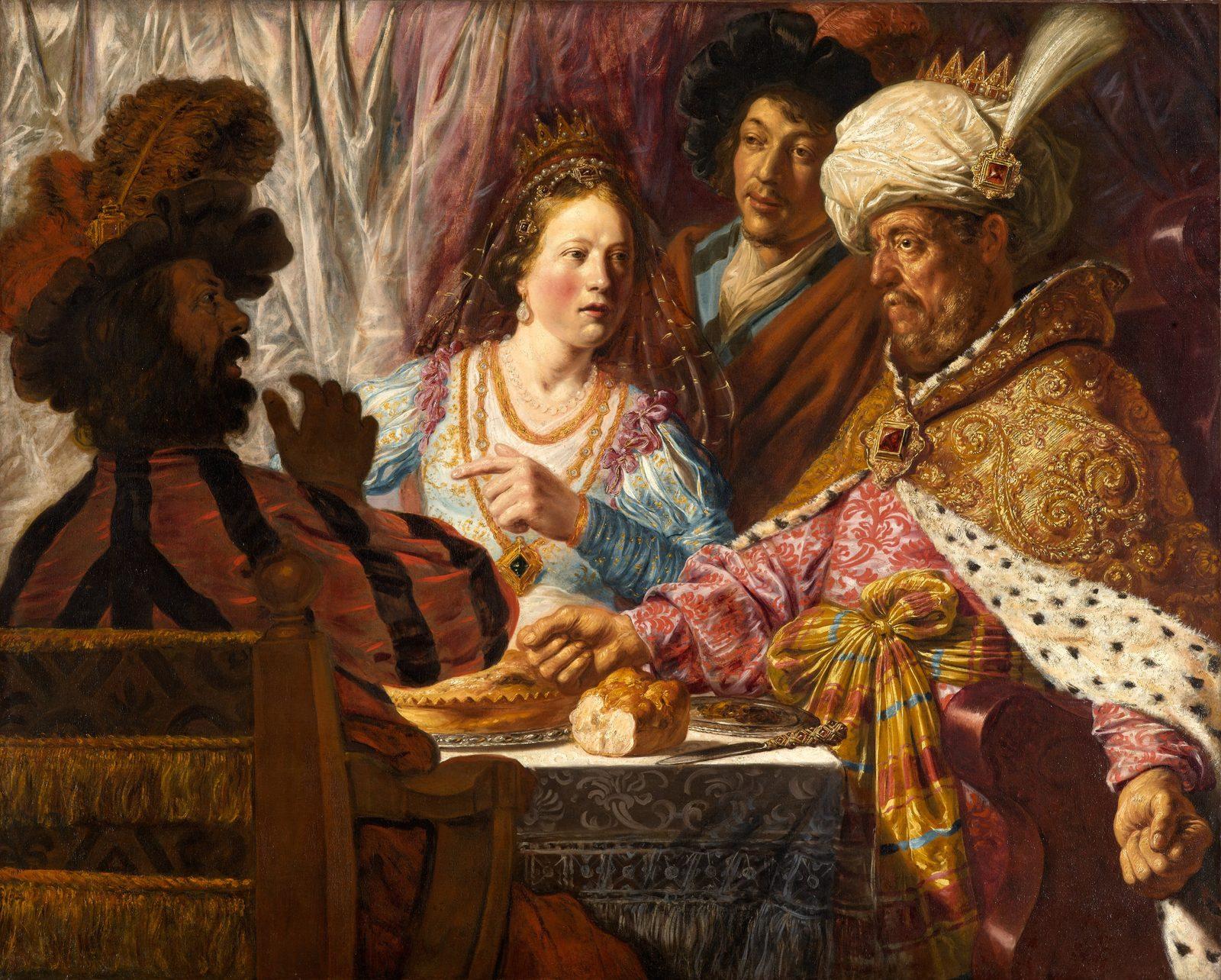
Jan Lievens, The Feast of Esther, about 1625. Public domain.
Esther 3 to 9 · Person · Featured Study
Haman
Haman son of Hammedatha, the Agagite, was the highest official of King Xerxes and the enemy of the Jews.
So they hanged Haman on the gallows he had prepared for Mordecai. Then the fury of the king subsided.
- Family
- father: Hammedatha; wife: Zeresh; sons: Parshandatha, Dalphon, Aspatha, Poratha, Adalia, Aridatha, Parmashta, Arisai, Aridai and Vaizatha
- Places
- Susa
- First named
- Esther 3:1 “…these events, King Xerxes honored Haman son of…”
- Last named
- Esther 9:24 “For Haman son of…”
He offered the king ten thousand talents of silver to destroy a people.
Summary
Haman rose above all the princes of the court and turned his anger at one man into an edict against a whole people. Within a day of his last banquet he was dead.
- The signet ring he had held was given to Mordecai on the day of his death.
- Esther 8:7 gives the reason for his hanging: he attacked the Jews.
- His ten sons died in the citadel of Susa on the thirteenth of Adar.
Where Haman Stands in Scripture
Every verse that names him stands in the book of Esther.
The Hebrew name Haman stands 54 times in 45 verses.
After these events, King Xerxes honored Haman son of Hammedatha, the Agagite, elevating him to a position above all the princes who were with him.His rise opens the danger of the book.
Esther 3:10 calls him the enemy of the Jews.
His Rise and Fall
His story runs from the highest seat of the princes to the queen's second banquet.
Haman's rise fills one verse, and his fall fills two chapters.
- Raised above all the princes of the courtThe courtEsther 3:1
- Filled with rage at the man who would not bowThe king's gateEsther 3:5
- Seeks to destroy all of Mordecai's peopleThe kingdom of XerxesEsther 3:6
- Seals the edict with the king's ringSusaEsther 3:10 to 12
- Sits down to drink with the kingSusaEsther 3:15
- Proposes the honour he wants for himselfThe courtEsther 6:6 to 9
- Begs Queen Esther for his lifeThe banquet hallEsther 7:7
- Is hanged at the king's wordHis houseEsther 7:9 to 10
Each turn of his story stands with the verse that records it.
Begs Queen Esther for his life, Is hanged at the king's word
The Honour He Proposed
He named the honour he wanted for himself, and the king gave it to another.
Haman entered, and the king asked him, “What should be done for the man whom the king is delighted to honor?” Now Haman thought to himself, “Whom would the king be delighted to honor more than me?”His own thought sets the turn of the chapter.
Matthew Henry reads the verse as a man who thought better of his standing than he had cause to. Henry warns his readers to suspect that others esteem them less than they profess.
Haman told his wife Zeresh and all his friends everything that had happened. His advisers and his wife Zeresh said to him, “Since Mordecai, before whom your downfall has begun, is Jewish, you will not prevail against him—for surely you will fall before him.”His advisers read his fall in the people of the man he hated.
The Price He Offered
Albert Barnes measures the offer against the revenue of Persia.
Barnes reports from Herodotus that the regular revenue of the Persian king was 14,560 silver talents. If the same talent is meant, his offer in Esther 3:9 passed two thirds of a year's revenue.
Barnes also reports from Herodotus that the Persians counted many sons the greatest proof of manhood after valour in arms. Haman boasted of his sons in Esther 5:11.
The House of Haman
Fourteen people and a band of friends stand around him in the text.
His family stands beside him in the text, with the king and the eunuch who sealed his end.
| Person | Generation | Tie to Haman |
|---|---|---|
| Hammedatha | 1 | His father |
| Zeresh | 2 | His wife, who joined his friends in advising the gallows |
| Parshandatha, Dalphon and Aspatha | 3 | His sons |
| Poratha, Adalia and Aridatha | 3 | His sons |
| Parmashta, Arisai, Aridai and Vaizatha | 3 | His sons |
| His friends | They heard his boast of his wealth, his sons and his honours, and advised the gallows | |
| King Xerxes | The king who raised him and ordered him hanged | |
| Harbonah | The eunuch who told the king of the gallows at his house |
King Xerxes, Harbonah
The Places of His Life
His story stands in the citadel of Susa, from the gate to his own house.
Haman went from the king's gate to the outer court to his own gallows.
| Place | What Scripture tells of it |
|---|---|
| The citadel of Susa | His edict against the Jews was issued here, and the city fell into confusion while he sat down to drink with the king. |
| The king's gate | He saw Mordecai here after the first banquet, and Mordecai did not rise for him. |
| The outer court | He came here to ask the king to hang Mordecai on the gallows he had prepared, and the king called him in. |
| His house | The gallows he had built for Mordecai stood here, and he was hanged on it. |
Questions His Life Raises
Two questions are answered from the text and its commentators.
Why did he seek to destroy all the Jews?Esther 3:6, with John Wesley and Albert Barnes
John Wesley names three causes: an Amalekite's hatred of the Jews, rage at Mordecai, and Mordecai's reason, which held for every Jew.
Albert Barnes answers that massacres of whole peoples were known in the East. He names the Magophonia, the great killing of the Magi at the accession of Darius, kept every year and then less than fifty years old.
Did the king think Haman would assault the queen?Esther 7:8, with Adam Clarke
Just as the king returned from the palace garden to the banquet hall, Haman was falling on the couch where Esther was reclining. The king exclaimed, “Would he actually assault the queen while I am in the palace?” As soon as the words had left the king’s mouth, they covered Haman’s face.The king's charge stands in this verse.
Adam Clarke holds that the king professed to think so, though he must have known that a man begging for his life meant no such thing. Clarke reads the covering of Haman's face as a sign that the attendants saw his death decided.
What the Text Leaves Unsaid
The Hebrew text names Zeresh last in Esther 6:13 and tells nothing of her end.
Henry reports the Chaldee paraphrase, which says that Zeresh escaped with seventy more of Haman's children and begged her bread from door to door.
Caught in His Own Net
Jamieson, Fausset and Brown read his end as a snare closing on the one who set it.
Jamieson, Fausset and Brown set Haman beside the plotters of Psalm 9:15, whose feet are caught in the net they hid. They call his condemnation as just as any ever passed.
The nations have fallen into a pit of their making; their feet are caught in the net they have hidden.The psalm gives the pattern they see in his death.
Voices on Haman
Matthew Henry set the morning and the evening of one day side by side.
Matthew Henry (1662 to 1714)
Commentary on the Whole Bible
Henry wrote his commentary early in the eighteenth century.
“The enemies of God's church have often been thus taken in their own craftiness. In the morning Haman was designing himself for the robes and Mordecai for the gallows; but the tables are turned: Mordecai has the crown, Haman the cross. The Lord is known by such judgments.”
on Esther 7:10Puritan
What Agagite Means
Readers give three accounts of the name Agagite.
The Hebrew word Agagite stands in five verses of Esther. The war with Amalek, from Genesis to Esther, is traced on its own page.
A descendant of Agag, king of AmalekJosephus; the Targum; the Cambridge Bible for Schools and Colleges
Josephus, in his Antiquities, calls Haman an Amalekite by birth. The Cambridge Bible reports that Josephus and the Targum, the Aramaic paraphrase, read the name as descent from Agag.
The Cambridge Bible holds that the writer set Haman against Mordecai, of the line of Kish, as hereditary enemies.
The objection: the Pulpit Commentary finds the term inexplicable as a line of descent, with present knowledge.
A local name for his birthplaceThe Pulpit Commentary
The Pulpit Commentary holds that the term is most probably local, marking the place of Haman's birth or upbringing. It notes that the Septuagint, the Greek translation, reads Bougaean in its place.
The objection: the Cambridge Bible notes that the Septuagint gives Bougaean in some verses and the Macedonian in others.
Possible, and unprovedC. F. Keil
Keil grants that Haman may descend from the Amalekite king, but holds that it can by no means be proved.
The objection: Josephus states the Amalekite descent as plain history.
The Letters Recall His Plot
His name stands in the book for the last time in the letters that founded Purim.
For Haman son of Hammedatha, the Agagite, the enemy of all the Jews, had plotted against the Jews to destroy them and had cast the Pur (that is, the lot) to crush and destroy them.The letters of Purim recall his plot and his lot.
Sources
Scripture is the Berean Standard Bible.
- Strong's Hebrew lexicon, h2001 and h91, with the index of every use.
- Matthew Henry, Commentary on the Whole Bible (1710), on Esther 6:6, 7:10 and 9:10.
- Albert Barnes, Notes, Explanatory and Practical, on the Old and New Testaments (1832 to 1869), on Esther 3:6, Esther 3:9 and Esther 5:11.
- John Wesley, Explanatory Notes upon the Old Testament (1765), on Esther 3:6.
- Adam Clarke, Commentary on the Bible (1832), on Esther 7:8.
- Jamieson, Fausset and Brown, Commentary Critical and Explanatory on the Whole Bible (1871), on Esther 7:10.
- Flavius Josephus, Antiquities of the Jews 11.6.5, translated by William Whiston.
- The Cambridge Bible for Schools and Colleges; the Pulpit Commentary; C. F. Keil, Biblical Commentary (1873), each on Esther 3:1.
Keep Studying
Read it4
Studies1
People and groups5
Places1
Doctrines2
Subjects5