
Also called: disgrace, reproach, hiding, ashamed, naked, dishonour
This subject covers the hiding that started in Eden and the covering God provides. Guilt for a specific act, and its release, belong to Forgiveness. The self lifted above God belongs to Pride.
What Shame covers, and where it stops
This subject covers the hiding that started in Eden and the covering God provides. Guilt for a specific act, and its release, belong to Forgiveness. The self lifted above God belongs to Pride.
On this page, 6 sections
The one drawing
Across the canon
11 passages
Where Scripture speaks
The passages this subject stands on, in canon order.
And the man and his wife were both naked, and they were not ashamed.And the eyes of both of them were opened, and they knew that they were naked; so they sewed together fig leaves and made coverings for themselves.“I heard Your voice in the garden,” he replied, “and I was afraid because I was naked; so I hid myself.”Surely none who wait for You will be put to shame; but those who are faithless without cause will be disgraced.Those who look to Him are radiant with joy; their faces shall never be ashamed.Do not be afraid, for you will not be put to shame; do not be intimidated, for you will not be humiliated. For you will forget the shame of your youth and will remember no more the reproach of your widowhood.Are they ashamed of the abomination they have committed? No, they have no shame at all; they do not even know how to blush. So they will fall among the fallen; when I punish them, they will collapse,” says the LORD.I am not ashamed of the gospel, because it is the power of God for salvation to everyone who believes, first to the Jew, then to the Greek.It is just as the Scripture says: “Anyone who believes in Him will never be put to shame.”Let us fix our eyes on Jesus, the author and perfecter of our faith, who for the joy set before Him endured the cross, scorning its shame, and sat down at the right hand of the throne of God.But if you suffer as a Christian, do not be ashamed, but glorify God that you bear that name.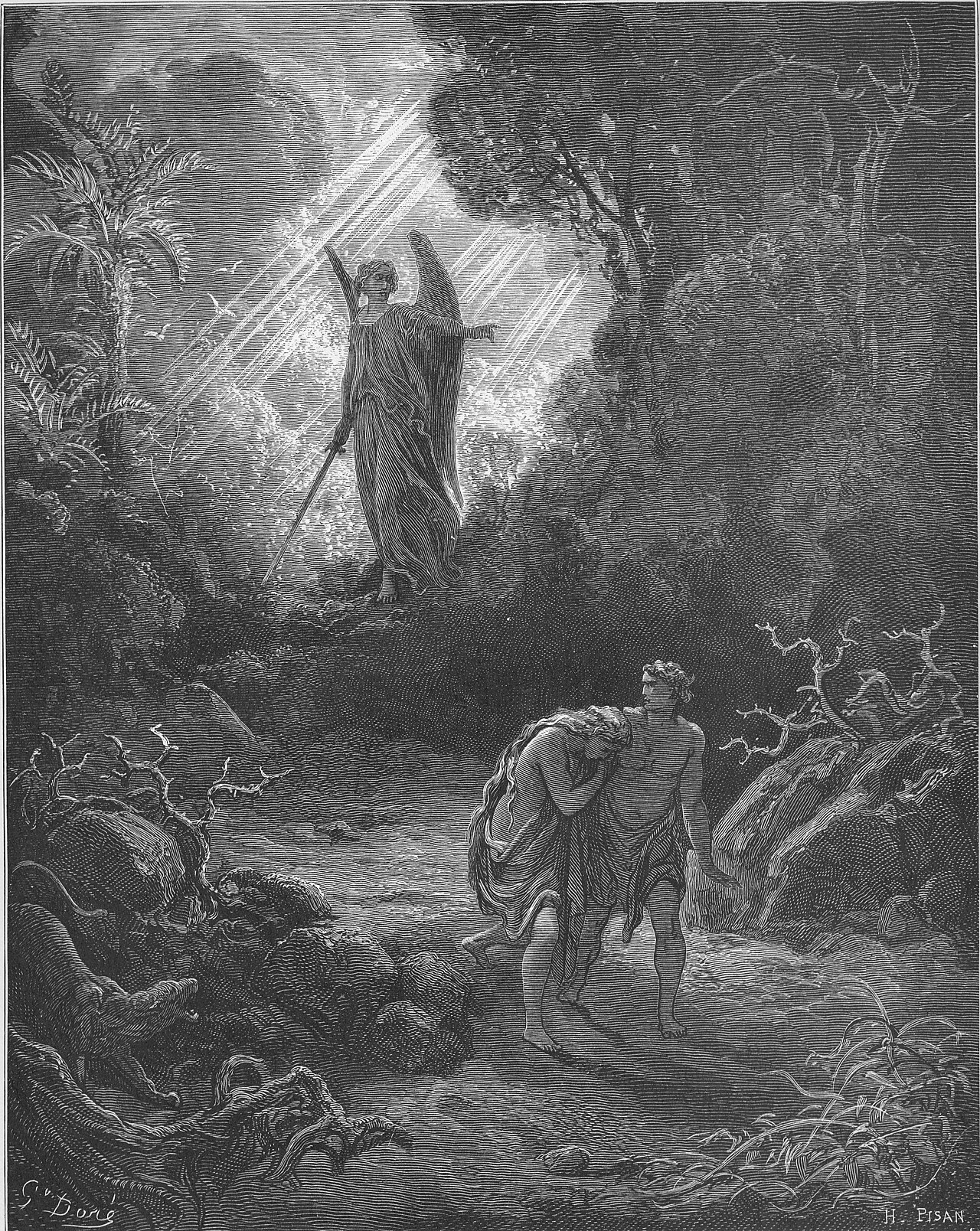
Shame in Scripture, in full
Before sin, there was no shame. Adam and Eve were both naked, and were not ashamed (Genesis 2:25). Nakedness before God and each other was simply how things were; nothing needed to be hidden, because nothing was wrong. That innocence lasted exactly until the moment they disobeyed.
The instant they ate the forbidden fruit, the eyes of them both were opened, and they knew that they were naked (Genesis 3:7). Their first response was not confession; it was concealment. They sewed fig leaves together to cover themselves, then hid from God among the trees. When God called out to Adam, his answer revealed the new condition perfectly: he was afraid, because he was naked, and he hid himself (Genesis 3:10). Shame and hiding entered the world in the same breath.
Fig leaves were never going to be enough. They were a human solution to a problem only God could actually fix. So God made better coverings, killing an animal to clothe Adam and Eve with skins (Genesis 3:21): the first sacrifice in Scripture, offered so that shame could be covered rather than merely hidden. From that point forward, the Bible treats shame as something God covers, not something people are left to manage on their own.
Shame shows up throughout Scripture as more than an emotion; it is a condition tied to disgrace, exposure, and broken trust. The psalmists cried out repeatedly that those who wait on God would not be put to shame (Psalm 25:3), trusting that hope placed in Him would not end in humiliation. The prophet Isaiah promised Israel, exiled and disgraced, that a day was coming when they would forget the shame of their youth (Isaiah 54:4): not manage it, not explain it away, but actually forget it, because God himself would take it from them.
Not every kind of shame is the same. Jeremiah rebuked a people who had lost the capacity to feel it at all; they had committed abomination and were not at all ashamed, unable even to blush (Jeremiah 6:15). A conscience too seared to feel shame is not free; it is in worse danger than the person still wincing under it. Rightly felt shame can be the first honest step toward God. Wrongly carried shame, the kind that convinces a person they are permanently disqualified, is a weight Christ came to remove.
The cross is where shame meets its deepest reversal. Crucifixion was designed by Rome to be the most shameful death possible: public, humiliating, reserved for criminals and slaves. Hebrews says that Jesus endured the cross, despising the shame of it (Hebrews 12:2), not because it did not hurt him, but because he refused to let it be the last word. He took the most shameful death in the ancient world and turned it into the place where sinners get covered rather than exposed.
That is why Paul could write, without hesitation, that he was not ashamed of the gospel of Christ (Romans 1:16). The very message that centers on a shameful death became, in Christ, nothing to be ashamed of at all. What fig leaves could only hide, and what the law could only regulate, the gospel actually removes. The hiding that began in Eden ends at an empty tomb, where the one who bore the shame now offers, to everyone who comes to him, a covering that will never need mending again.
4 voices
What teachers have said
Why are people ashamed of being thought religious? Because they know nothing of religion. He who knows his Maker may glory in his God, for without him what has any soul but disgrace, pain, shame, and perdition? How strange is it that those who fear God should be ashamed to own it, while sinners boldly proclaim their relationship to Satan!
Adam Clarke · Commentary on the Bible
Written before 1832.
Now to none but my Christ can be assigned the occasion of such a shame as this. His whole course was so exposed to shame as to open a way for even the taunts of heretics, declaiming with all the bitterness in their power against the utter disgrace of His birth and bringing-up, and the unworthiness of His very flesh.
Tertullian · Against Marcion Book IV
Written before 220.
The wicked, again, even though they are exalted, are exalted only so as to have greater dishonour. For as one does not honour an ugly and mis-shapen fellow, if he exalts him, but only dishonours him the more, by making his shame manifest to a larger number
Hippolytus of Rome · Hippolytus Exegetical Fragments
Written before 235.
How astonishing the grace which at that moment gave promise of a Saviour and conferred on her who had the disgrace of introducing sin the future honor of introducing that Deliverer
Jamieson, Fausset & Brown · Commentary Critical and Explanatory on the Whole Bible, 1871
The words underneath
Each card is one Hebrew or Greek word behind shame. It gives the sense, the count across the canon, and the number in Strong's 1890 concordance.
bosheth: shame
Hebrew · H1322Strong's entry: shame (the feeling and the condition, as well as its cause); by implication (specifically) an idol
sometimes stands for an idol
30 times in the Old Testament · bosheth, in full →
bush: be ashamed
Hebrew · H954Strong's entry: properly, to pale, i.e. by implication to be ashamed; also (by implication) to be disappointed or delayed
behind almost every 'ashamed' in the Old Testament
127 times in the Old Testament · bush, in full →
epaischynomai: be ashamed of
Greek · G1870Strong's entry: to feel shame for something
'ashamed of' in the NT
11 times in the New Testament · epaischynomai, in full →
kataischyno: to dishonor
Greek · G2617Strong's entry: to shame down, i.e. disgrace or (by implication) put to the blush
the NT word for public shame
13 times in the New Testament · kataischyno, in full →
Life questions