
Luke 7:36 to 50 · Story · Shame and Guilt
The Woman Who Anointed His Feet
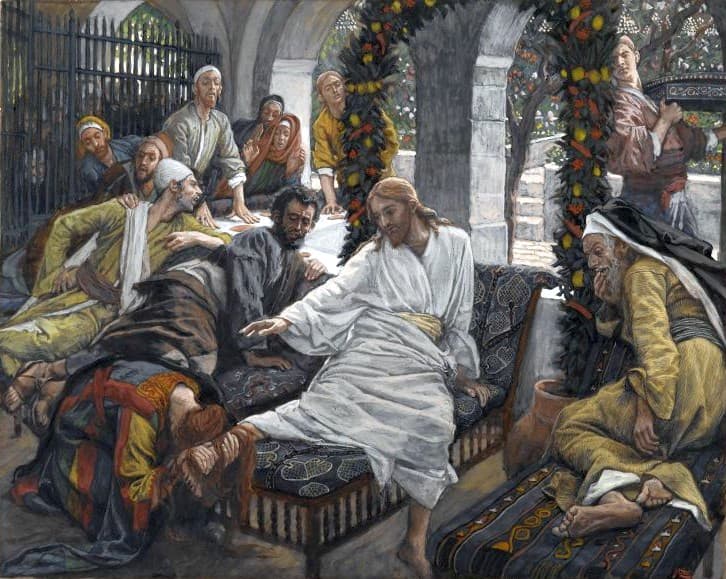
A sinful woman of the town wept over Jesus' feet at a Pharisee's dinner and heard that her sins were forgiven.
The woman says nothing in Luke's account, and all that is said of her at the table is said by Simon and by Jesus.
Therefore I tell you, because her many sins have been forgiven, she has loved much. But he who has been forgiven little loves little.”
- Who
- Jesus of Nazareth
Summary
Luke sets a respected host and a woman with a bad name at one table and lets Jesus judge between them. Her tears and perfume showed great love, and Jesus read that love as the mark of great forgiveness. Simon's welcome, measured beside hers, showed how little he thought he owed.
- Jesus answered Simon's objection with a parable in which a moneylender cancels two debts, one ten times the other, and asks which debtor will love him more.
- Luke 7:47 has been read as making her love the ground of her forgiveness and as making it the fruit, and readers have held both.
- Jesus' last words to the woman credit her faith with saving her.
- Luke gives the woman no name, and Gregory the Great's identification of her with Mary Magdalene and Mary of Bethany is disputed by John Gill and Albert Barnes.
A Woman at Simon's Table
Luke tells the account a few verses after Jesus repeated the charge that He was a friend of sinners (Luke 7:34).
Luke 7:36 to 50 belongs to the trial of shame and guilt because a woman the town knew as a sinner came to Jesus at a Pharisee's table. This study asks how Jesus answered the man who judged her and what He said her love meant.
It reads the account in order. It explains the parable of the two debtors and the Greek of Luke 7:47. It names the holders on each side of two questions, whether her love came before her forgiveness and whether she is Mary Magdalene.
When a sinful woman from that town learned that Jesus was dining there, she brought an alabaster jar of perfume. As she stood behind Him at His feet weeping, she began to wet His feet with her tears and wipe them with her hair. Then she kissed His feet and anointed them with the perfume.They stand first because they give all that the woman did before anyone spoke.
Simon's Welcome and Hers
Jesus spoke these words to Simon as He turned toward the woman (Luke 7:44).
Where Simon gave Jesus no water, kiss or oil, the woman gave tears, kisses and perfume, all of them to His feet.
| Courtesy | What Simon did | What the woman did |
|---|---|---|
| Water | You did not give Me water for My feet. | She wet My feet with her tears and wiped them with her hair. |
| A kiss | You did not greet Me with a kiss. | She has not stopped kissing My feet since I arrived. |
| Oil | You did not anoint My head with oil. | She has anointed My feet with perfume. |
The Story Told in Order
The account moves from Simon's silent objection to Jesus' last word to the woman.
When Simon saw the woman touching Jesus, he reasoned that a prophet "would know who this is and what kind of woman is touching Him" (Luke 7:39).
But Jesus answered him, “Simon, I have something to tell you.” “Tell me, Teacher,” he said. “Two men were debtors to a certain moneylender. One owed him five hundred denarii, and the other fifty. When they were unable to repay him, he forgave both of them. Which one, then, will love him more?” “I suppose the one who was forgiven more,” Simon replied. “You have judged correctly,” Jesus said.Jesus meets Simon's thought with a parable, and Simon himself gives the answer that will judge his own welcome.
After the parable came the three contrasts and the verdict of Luke 7:44 to 47.
Then Jesus said to her, “Your sins are forgiven.” But those at the table began to say to themselves, “Who is this who even forgives sins?” And Jesus told the woman, “Your faith has saved you; go in peace.”They stand last because they are the first words Jesus speaks to the woman herself.
The Word Because in Luke 7:47
The Greek order of the verse can be read two ways, and English versions render it both ways.
In the Greek the forgiveness comes first, in the perfect passive apheōntai, have been forgiven, and the love follows after the word hoti, which the STEP Bible's word-by-word gloss renders "for" in this verse.
The American Standard Version gives her love as the reason, "Her sins, which are many, are forgiven; for she loved much". The Berean Standard Bible makes the forgiveness the reason and the love its result, which is the order of the parable of the two debtors.
Shame Answered in Public
Luke and John record two women whom Jesus met in their shame.
Luke names the woman by what her town knew of her, and Simon's thought names her the same way (Luke 7:37 and Luke 7:39). At the table where she had been judged, He declared her many sins forgiven.
John records a second such meeting, with the Samaritan at the well. She "left her water jar, went back into the town" and said to the people, "Come, see a man who told me everything I ever did" (John 4:28 to 29).
Where Readers Differ
Readers have differed on the order of love and forgiveness in Luke 7:47 and on the woman's name.
Her love was the ground of her forgivenessGregory the Great; Bede
Gregory the Great read her love as the cause of her forgiveness. Thomas Aquinas gives a passage of Gregory's thirty-third homily on the Gospels in the Catena Aurea. There Gregory wrote, "The more then the heart of the sinner is burnt up by the great fire of charity, so much the more is the rust of sin consumed."
Bede used the same picture in his commentary On the Gospel of Luke, "What do we believe love to be, if not fire? And what are faults, if not rust?"
The objection is that the parable makes love the debtor's answer to a cancelled debt (Luke 7:42 to 43).
Her love was the fruit of a forgiveness already givenJohn Wesley; Adam Clarke
John Wesley wrote in his Explanatory Notes upon the New Testament (1755) that "her love is mentioned as the effect and evidence, not the cause of her pardon". Adam Clarke, in his Commentary on the Bible (1832), judged that "It appears to have been a consciousness of God’s forgiving love that brought her at this time to the Pharisee’s house."
The objection is that Luke records no earlier meeting between the woman and Jesus, and the Greek gives her love with hoti, which STEP's brief lexicon glosses "that" or "since".
She was Mary MagdaleneGregory the Great; Bede
Gregory the Great named her in the same homily. "This woman whom Luke calls a sinful woman, John names Mary," he said, "and we believe her to be that Mary from whom Mark testifies seven demons were cast out". Bede, in the Catena Aurea on Luke 8:2, wrote, "Mary Magdalene is the same of whose repentance, without mention of her name, we have just read."
The objection is that Luke brings in "Mary called Magdalene, from whom seven demons had gone out" in the next chapter with no word that ties her to the dinner (Luke 8:2). John sets the anointing by Mary of Bethany at Bethany, six days before the Passover (John 12:1 to 3).
She was a woman Luke leaves unnamedJohn Gill; Albert Barnes
John Gill, in his Exposition of the New Testament (1746 to 1748), called her "a different person, who had not been taken notice of by the evangelist before". Albert Barnes wrote in his Notes, "There is no evidence that this was the woman commonly called Mary Magdalene."
The objection is that John says Mary of Bethany "was to anoint the Lord with perfume and wipe His feet with her hair" (John 11:2). Those are the acts Luke records here, and that likeness is the ground of Gregory's reading.
Who Is This?
The guests asked among themselves who this was who even forgives sins (Luke 7:49).
Luke tells nothing more of the woman after that meal, so what Jesus said to her is the last the reader hears of her. For a reader who carries shame, the account sets what Jesus said of her above what her host thought of her.
Sources
Scripture is the Berean Standard Bible.
- The Holy Bible, American Standard Version (1901)
- STEP Bible, Translators Amalgamated Greek New Testament (TAGNT), Tyndale House, Cambridge, CC BY 4.0.
- STEP Bible, the Brief lexicon of Extended Strongs for Greek (TBESG), Tyndale House, Cambridge, CC BY 4.0, based on G. Abbott-Smith (1922)
- Gregory the Great, Homily 33 on the Gospels, in Thomas Aquinas, Catena Aurea on Luke 7:47.
- Gregory the Great, Forty Gospel Homilies, Homily 33, on Luke 7:36 to 50.
- Bede, On the Gospel of Luke, on Luke 7:47.
- Bede, in Thomas Aquinas, Catena Aurea on Luke 8:2.
- John Wesley, Explanatory Notes upon the New Testament (1755), on Luke 7:47.
- Adam Clarke, Commentary on the Bible (1832), on Luke 7:47.
- John Gill, Exposition of the New Testament (1746 to 1748), on Luke 7:37.
- Albert Barnes, Notes, Explanatory and Practical (1832 to 1869), on Luke 7:37.
Keep Studying
Studies1
In this trial6
People and groups9
Values2