
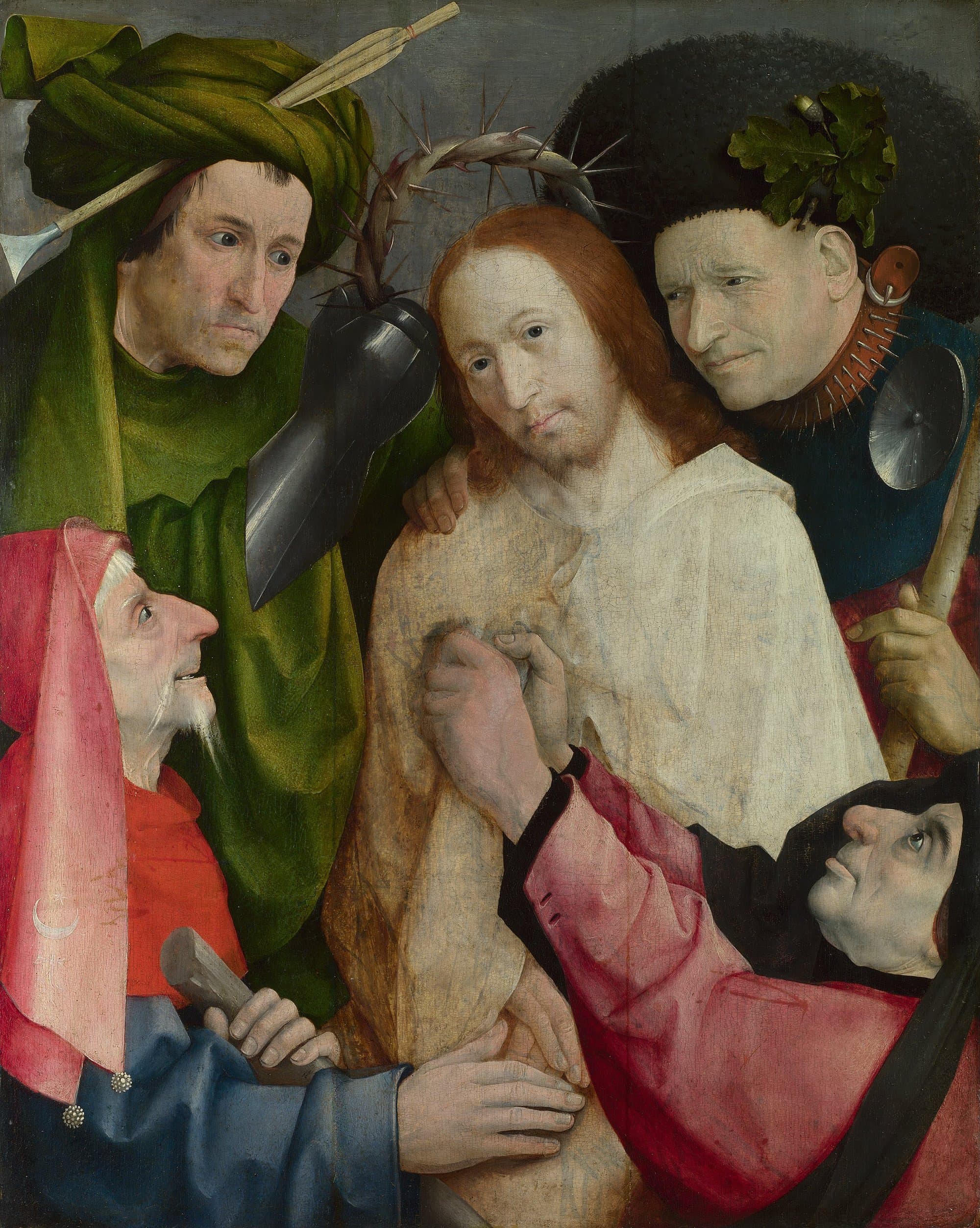
Hebrews 12:1 to 3 · Passage · Shame and Guilt
Scorning Its Shame
Hebrews 12:1 to 3 and Isaiah 53:3 tell how the Son of God bore the disgrace of the cross.
Hebrews uses one Greek word for the reproach Christ bore and for the ridicule its first readers had already met.
Let us fix our eyes on Jesus, the author and perfecter of our faith, who for the joy set before Him endured the cross, scorning its shame, and sat down at the right hand of the throne of God.
- The passage
- Hebrews 12:1 to 3, Isaiah 53:3
- Books
- Hebrews, Isaiah
- Hold in memory
- Hebrews 13:13
Summary
Hebrews 12:1 to 3 sets Jesus before believers who were growing weary under hostility from those around them. The mockery of the crowd belonged to His death on the cross, and He went through all of it without turning back. What He bore became the ground on which His people endure.
- Isaiah foretold a Servant despised and rejected, from whom men hid their faces (Isaiah 53:3).
- Crucifixion carried the curse the Law spoke over one hung on a tree (Deuteronomy 21:23).
- Galatians 3:13 applies that curse to Christ, who bore it on behalf of His people.
- The disgrace He bore outside the city gate is the believer's road, taken in hope of a lasting city (Hebrews 13:12 to 14).
Looking to Jesus
Hebrews 12:1 to 3 is one call to run, to look and to consider.
This study reads Hebrews 12:1 to 3 beside Isaiah 53:3. It belongs to the trial of shame and guilt because the cross it describes was a disgrace that Christ chose to bear, and it calls His people to follow Him through theirs.
The question it answers is what the shame of the cross was and what it means that Jesus scorned it. It gives the shame Scripture lays on Christ beside what it won for His people, the words Hebrews and Isaiah use for disgrace, and two teachers of the passage. It sets out two questions readers argue over, what the scorning was and what the joy set before Him was.
The sentence opens in Hebrews 12:1, where the readers, surrounded by "such a great cloud of witnesses", are told to throw off every encumbrance and run with endurance.
Consider Him who endured such hostility from sinners, so that you will not grow weary and lose heart.It stands beside Hebrews 12:2 because it gives the reason for looking to Jesus.
The joy set before Him has its own study, which sets out the two ways the Greek preposition anti has been read.
The Shame and What It Won
The four pairs come from Isaiah, Deuteronomy with Galatians, 1 Peter and Hebrews.
Each shame Scripture lays on Christ stands beside a gift it won for His people.
| The shame laid on Him | Verse | What it won for His people | Verse |
|---|---|---|---|
| "despised and rejected by men" | Isaiah 53:3 | "by His stripes we are healed" | Isaiah 53:5 |
| "anyone who is hung on a tree is under God’s curse" | Deuteronomy 21:23 | "Christ redeemed us from the curse of the law" | Galatians 3:13 |
| "When they heaped abuse on Him, He did not retaliate" | 1 Peter 2:23 | "so that we might die to sin and live to righteousness" | 1 Peter 2:24 |
| "Jesus also suffered outside the city gate" | Hebrews 13:12 | "to sanctify the people by His own blood" | Hebrews 13:12 |
Mark 15:29 to 32 records the mockery at the cross itself, from those who passed by, from the chief priests and scribes and from the men crucified with Him.
The Words for Disgrace
Isaiah and Hebrews name the disgrace of the Servant with words Scripture uses of other sufferers as well.
Isaiah 53:3 uses the Hebrew verb bazah, glossed "to disesteem", twice, at its opening and near its close. Psalm 22:6 uses the same verb of the sufferer who is "scorned by men and despised by the people".
Therefore let us go to Him outside the camp, bearing the disgrace He bore.It stands in this section because its word for disgrace is one of the words the section studies.
The disgrace of Hebrews 13:13 is the Greek noun oneidismos, which Strong's glosses "contumely" and counts 5 times. Hebrews 11:26 uses it of Moses, who "valued disgrace for Christ above the treasures of Egypt", and Romans 15:3 of Christ, on whom "The insults of those who insult You have fallen".
Hebrews 13:11 recalls that the bodies of the sin offerings were burned outside the camp, and the writer reads Christ's death outside the gate in that light.
How the Passage Has Been Taught
A bishop of the fourth century and a preacher of the eighteenth taught what Christ's shame means for His people.
died 386 · Cyril of Jerusalem
Cyril of Jerusalem taught that the Christ who endured the cross in His first coming will come again in glory.
The reading1 paragraph
Cyril of Jerusalem said in his fifteenth Catechetical Lecture, in the translation of Edwin Hamilton Gifford (1894), that "In His first coming, He endured the Cross, despising shame". He went on, "in His second, He comes attended by a host of Angels, receiving glory".
1703 to 1791 · John Wesley
John Wesley taught that the servants of Christ must expect to bear something of what He bore.
The reading1 paragraph
John Wesley wrote on Hebrews 12:3 in his Explanatory Notes upon the New Testament (1755), "The Lord bore all this; and shall his servants bear nothing?"
Where Readers Differ
Readers differ on what the scorning of the shame was and on the joy set before Him, and each reading stands with its holder and the strongest objection to it.
Jesus chose the shame and set it at noughtJohn Chrysostom
John Chrysostom, in his Homily 28 on Hebrews, explained "Despising the shame" with the words "He chose, he means, that ignominious death". He said Christ did so "to teach us to make no account of glory from men". He asked why the writer named shame and not pain, and answered, "Because it was not with pain that He bore these things."
The objection is that before His arrest Jesus said, "My soul is consumed with sorrow to the point of death" (Matthew 26:38).
Jesus disregarded the ignominy of the crossAlbert Barnes
Albert Barnes, in his Notes on Hebrews 12:2, read the words as "Disregarding the ignominy of such a mode of death". He set the cross beside the guillotine, the block and the gallows and wrote that "the ignominy of the cross was greater than that."
The objection is that the verb kataphroneo is the verb Jesus uses of the servant who will "despise the other" master (Matthew 6:24). That use is a judgment of worth more than a turning of the attention.
The joy was a joy ahead, the salvation of His peopleTheodoret of Cyrus
Theodoret of Cyrus, in his Interpretation of Hebrews, wrote that "The Savior's joy is the salvation of human beings; for it he endured the suffering".
The objection is that Hebrews 12:2 goes on to His enthronement, so the joy may be His own exaltation as well as the salvation of His people.
The joy was the glory He gave upThe Pseudo-Oecumenian Catena on Hebrews
The Pseudo-Oecumenian Catena on Hebrews gives a reading under the name of Gregory, with no further title. That reading holds that Christ took the cross "instead of the joy set before him", since "it was free for him to remain in his own glory and divinity".
The objection is that the joy is "set before Him" with the verb Hebrews 12:1 uses of the race "set out for us", which lies ahead of the runner.
Outside the Camp
The passage leaves its readers with Jesus enthroned and a road outside the camp.
The study of the right hand traces where Hebrews places Him after the cross.
A believer ridiculed or disgraced for Christ is given Jesus to look at, who went through greater shame and was not overcome by it. Where shame lasts and darkens the mind, the care of a pastor and of a doctor belongs beside prayer.
Psalm 32 tells of shame that ends in a shout of joy.
Sources
Scripture is the Berean Standard Bible.
- STEP Bible, the tagged Greek New Testament and Hebrew Bible (Tyndale House, Cambridge), CC BY 4.0.
- STEP Bible brief lexicons of Extended Strongs for Greek and Hebrew (Tyndale House, Cambridge), CC BY 4.0, with the Strong's glosses.
- John Chrysostom, Homily 28 on Hebrews (Nicene and Post-Nicene Fathers, first series, volume 14, ed. Philip Schaff)
- Albert Barnes, Notes, Explanatory and Practical, on the Epistle to the Hebrews, on Hebrews 12:2.
- Theodoret of Cyrus, Interpretation of Hebrews, on Hebrews 12:2, in a modern English translation (cited under fifty words)
- The Pseudo-Oecumenian Catena on Hebrews, at Hebrews 12:2, translated into English (cited under fifty words)
- Cyril of Jerusalem, Catechetical Lecture 15, section 1, translated by Edwin Hamilton Gifford, Nicene and Post-Nicene Fathers, second series, volume 7 (Buffalo: Christian Literature Publishing, 1894)
- John Wesley, Explanatory Notes upon the New Testament (1755), on Hebrews 12:3.
Keep Studying
In this trial6
People and groups7
Places1
Symbols2