
Luke 15:21
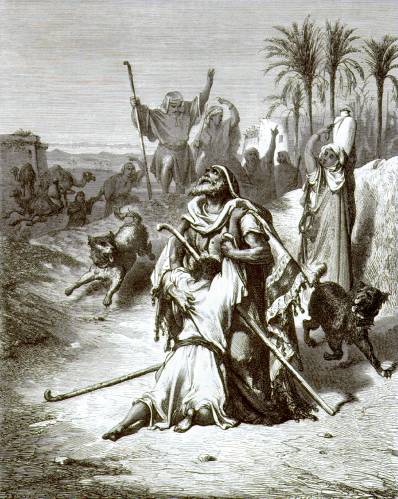
in Luke 15The son declared, ‘Father, I have sinned against heaven and against you. I am no longer worthy to be called your son.’
BSB
The same verse in ASV and KJV ▾
ASV
And the son said unto him, Father, I have sinned against heaven, and in thy sight: I am no more worthy to be called thy son.
KJV
And the son said unto him, Father, I have sinned against heaven, and in thy sight, and am no more worthy to be called thy son.
⋯
This verse in Luke 15
Commentary
21 notes on this verseThen he shall get up, come to his father, and confess to him, "I have sinned against heaven and before you. I am no longer worthy to be called your son. Treat me like one of your hired servants."When he confesses like that, he will be considered worthy of more than that for which he prayed. His father neither takes him in like a hired servant nor treats him like a stranger. Oh no, he kisses him as a son. He accepts him as a dead man come back to life again.
This site's exposition
was filled with compassion
on Luke 15:20-24
His father saw him while he was still in the distance and was filled with compassion, splanchnizomai, the verb Luke keeps for the deepest mercy. He ran to his son, which no dignified householder did, and the confession stops short of the hired-servant clause as the father calls for the best robe, a ring, sandals, and the fattened calf. The father states the verdict as resurrection: this son of mine was dead and is alive again.
This site's exposition
no longer worthy to be called your son
The son says he has sinned only after his father's kiss, and he leaves out the plan to be made a hired servant. Adam Clarke notes that some manuscripts add it back, and he held that the shorter text keeps the beauty of the scene. His father said no word of rebuke, Matthew Henry notes.
The record, by era
The Church Fathers5 voices
But if any one returns, and shows forth the fruit of repentance, then do ye receive him to prayer, as the lost son, the prodigal, who had consumed his father's substance with harlots, who fed swine, and desired to be fed with husks, and could not obtain it.
But already planted in the Church, he begins to confess his sins, nor says he all that he promised he would say. For it follows, And his son said unto him, &c. He wishes that to be done by grace, of which he confesses himself unworthy by any merits of his own. He does not add what he had said, when meditating beforehand, Make me as one of thy hired servants. For when he had not bread, he desired to be even a hired servant, which after the kiss of his father he now most nobly disdained.
Leaving those that have not strayed, the good Shepherd seeks you. If you will surrender yourself, he will not hold back. In his kindness, he will lift you up on his shoulders, rejoicing that he has found his sheep that was lost. The Father stands and awaits your return from your wandering. Only turn to him, and while you are still afar off, he will run and embrace your neck. With loving embraces, he will enfold you, now cleansed by your repentance.… He says, "Truly I say to you that there is joy in heaven before God over one sinner who repents." If any one of those who seem to stand will bring a charge that you have been quickly received, the good Father himself will answer for you. He will say, "It is fitting that we should celebrate and be glad, for this my daughter was dead and is come to life again. She was lost and is found."
It is the opinion of some that the two sons signify the holy angels and us earth dwellers. The elder one, who lived soberly, represents the company of the holy angels, while the younger and prodigal son is the human race. Some among us give it a different explanation, arguing that the older and well-behaved son signifies Israel after the flesh. The other son, who chose to live in the lust of pleasures and moved far away from his father, depicts the company of the Gentiles.
What is the object of the parable? Let us examine the occasion that led to it so we will learn the truth. The blessed Luke had said a little before of Christ the Savior of us all.… The Pharisees and scribes made this outcry at his gentleness and love to people. They wickedly and impiously blamed him for receiving and teaching people whose lives were impure. Christ very necessarily set before them the present parable. He clearly shows them that the God of all requires even him who is thoroughly steadfast, firm, holy, and has attained to the highest praise for sobriety of conduct to be earnest in following his will. When any are called to repentance, even if they have a bad reputation, he must rejoice rather and not give way to an unloving irritation because of them.
13 more voices on this verse
The Church Fathers1 voice
He now comes back to his Father and cries, "Father, I have sinned against heaven and before you." Every day in its prayer, the church testifies that the younger son has returned to his Father's house and is calling God his Father. [The church] prays, …
The Medieval Church2 voices
And the son said to him: Father, I have sinned against heaven and before you. I am no longer worthy to be called your son. Now he begins, established in the Church, to confess his sins, and he does not say all he had promised …
Second, with respect to the reverence of the son accusing himself he adds: And the son said to him: Father, I have sinned against heaven, namely through contempt of the Majesty presiding over all things: Job 11: "It is higher than heaven, and what will …
The Puritans and the Awakening4 voices
And the son said unto him, father,.... Or "my father", as the Syriac version reads; and the Persic version adds, "pardon me": sin lay heavy on him, and he wanted a view and application of pardoning grace, though he seems to be prevented making this request by the kiss he received from his father: I have sinned against heaven, and in thy sight; this is what he determined to say, and was allowed to say, having a deep sense of his sin and vileness, and which was increased by the love and kindness his father had shown him.
They are sometimes ranked with harlots ( Matt. xxi. 32 ); here and elsewhere with sinners, such as were openly vicious, that traded with harlots, known rakes. Some think that the sinners here meant were heathen, and that Christ was now on the other side Jordan, or in Galilee of the Gentiles.
When he had received the kiss which sealed his pardon, yet he said, Father, I have sinned. Note, Even those that have received the pardon of their sins, and the comfortable sense of their pardon, must have in their hearts a sincere contrition for it, and with their mouths must make a penitent confession of it, even of those sins which they have reason to hope are pardoned.
It is strange that here is not one word of rebuke: "Why did you not stay with your harlots and your swine? You could never find the way home till beaten hither with your own rod." No, here is nothing like this; which intimates that, when God forgives the sins of true penitents, he forgets them, he remembers them no more, they shall not be mentioned against them, Ezek. xviii.
The Nineteenth Century6 voices
Make me as one of thy hired servants, is added here by several MSS. and versions; but it is evident this has been added, merely to make his conduct agree with his resolution, Luk 15:19. But by this a very great beauty is lost: for the design of the inspired penman is to show, not merely the depth of the profligate son’s repentance, and the sincerity of his conversion, but to show the great affection of the father, and his readiness to forgive his disobedient son.
A commentator
Jamieson, Fausset & Brown1802–1910
Commentary Critical and Explanatory on the Whole Bible (1871)
Father, I have sinned, &c.--"This confession is uttered after the kiss of reconciliation" (Eze 16:63) [TRENCH].
A commentator
J.C. Ryle1816–1900
Expository Thoughts on the Gospels: Luke (lightly modernized text, Grace Gems edition) (1858)
proposed
The parable before us is commonly known as the parable of "the prodigal son." It may be truly called a mighty spiritual picture. Unlike some of our Lord's parables, it does not convey to us one great lesson only, but many. Every part of it is particularly rich in instruction. We see, firstly, in this parable — a man following the natural bent of his own heart. Our Lord shows us a "younger son" making haste to go far away from a kind father's house, and "wasting his substance in riotous living." We have in these words, a faithful portrait of the mind with which we are all born. This is our likeness. We are all naturally proud and self-willed. We have no pleasure in fellowship with God. We long to depart, and go afar away from Him. We spend our time, and strength, and faculties, and affections — on things that cannot profit. The covetous man does it in one way; the slave of lusts and passions in another way; and the lover of pleasure in another way. In one point alone are all agreed. Like sheep, we all naturally "go astray, and turn every one to his own way." (Isaiah 53:6.) In the younger son's initial conduct, we see the natural heart of every man. He who knows nothing of these things, has yet much to learn. He is spiritually blind. The eyes of his understanding need to be opened. The worst ignorance in the world, is not to know ourselves. Happy is he who has been delivered from the kingdom of darkness — and been made acquainted with himself! Of too many it may be said, "They know not, neither will they understand. They walk on in darkness." (Psalm 82:5.) We see, secondly, in this parable — man finding out by bitter experience, that the ways of sin are hard.
A commentator
Charles Spurgeon1834–1892
The Metropolitan Tabernacle Pulpit, Sermon No. 2520: “A Program Never Carried Out” (lightly modernized text, CCEL edition) · Written before 1892.
proposed
I THOUGHT I would hardly preach a set discourse from this familiar text, but just give you some odds and ends of thought upon these words. You know that there are many people who are in such a low state of mind—and who have such a humble opinion of themselves that if I bring them a loaf of bread, they will be afraid to eat it—so I have only brought a few crumbs, this time, and my hope is that they will say with the Syrophenician woman, "Truth, Lord: yet the little dogs eat of the crumbs which fall from their masters' table." May any such persons who are here feel able to pick up a stray thought which shall be spiritual food to them, even manna sent from Heaven and, perhaps, when they have eaten one morsel of it, they may then dare to eat more, and yet more, until their souls are satisfied and they learn to rejoice in the God of their salvation! I am going to take a roving commission and ramble about somewhat more than usual—and I shall do so because I know there are many here who are, themselves, rambling. Perhaps if I ramble, I may come across them. If I keep along the city road, some of the hedge birds that are out of the way may get missed, but if I go over hedge and ditch and say something unusual here and something startling there—it may be that they will wonder how I went just where they happened to be as much as I marvel how they have managed to go where they are! My one thought at this time is not concerning my subject, but my objective.
A commentator
J.C. Ryle1816–1900
Expository Thoughts on the Gospels: Luke (lightly modernized text, Grace Gems edition) (1858)
proposed
The parable before us is commonly known as the parable of "the prodigal son." It may be truly called a mighty spiritual picture. Unlike some of our Lord's parables, it does not convey to us one great lesson only, but many. Every part of it is particularly rich in instruction. We see, firstly, in this parable — a man following the natural bent of his own heart. Our Lord shows us a "younger son" making haste to go far away from a kind father's house, and "wasting his substance in riotous living."
A commentator
Charles Spurgeon1834–1892
The Metropolitan Tabernacle Pulpit, Sermon No. 2520: “A Program Never Carried Out” (lightly modernized text, CCEL edition) · Written before 1892.
proposed
I THOUGHT I would hardly preach a set discourse from this familiar text, but just give you some odds and ends of thought upon these words.
The words behind it
19 Greek wordsEvery Greek word of this verse in the order it stands, with what it means and the door to its own study. The last column counts the times a word stands in the whole Bible: the rarer the word, the more the places it appears belong together.
| Greek | Sound | Meaning | Word study | In the Bible |
|---|---|---|---|---|
| εἶπεν | eipen | Said | G2036 → | 925 times |
| δὲ | de | then | G1161 → | 2765 times |
| ὁ | ho | the | G3588 → | 19766 times |
| υἱὸς | huios | son | G5207 → | 377 times |
| αὐτῷ· | auto | to him: | G846 → | 5565 times |
| πάτερ, | pater | Father, | G3962 → | 410 times |
| ἥμαρτον | hemarton | I have sinned | G264 → | 42 times |
| εἰς | eis | against | G1519 → | 1755 times |
| τὸν | ton | <the> | G3588 → | 19766 times |
| οὐρανὸν | ouranon | heaven | G3772 → | 272 times |
| καὶ | kai | and | G2532 → | 9120 times |
| ἐνώπιόν | enopion | before | G1799 → | 94 times |
| σου· | sou | you; | G4771 → | 2973 times |
| οὐκέτι | ouketi | no longer | G3756 →G2089 → | 140 times |
| εἰμὶ | eimi | am I | G1510 → | 2333 times |
| ἄξιος | axios | worthy | G514 → | 41 times |
| κληθῆναι | klethenai | to be called | G2564 → | 147 times |
| υἱός | huios | son | G5207 → | 377 times |
| σου | sou | of you | G4771 → | 2973 times |
εἶπενSaid
eipenG2036 →925 times
δὲthen
deG1161 →2765 times
ὁthe
hoG3588 →19766 times
υἱὸςson
huiosG5207 →377 times
αὐτῷ·to him:
autoG846 →5565 times
πάτερ,Father,
paterG3962 →410 times
ἥμαρτονI have sinned
hemartonG264 →42 times
εἰςagainst
eisG1519 →1755 times
τὸν<the>
tonG3588 →19766 times
οὐρανὸνheaven
ouranonG3772 →272 times
καὶand
kaiG2532 →9120 times
ἐνώπιόνbefore
enopionG1799 →94 times
σου·you;
souG4771 →2973 times
οὐκέτιno longer
εἰμὶam I
eimiG1510 →2333 times
ἄξιοςworthy
axiosG514 →41 times
κληθῆναιto be called
klethenaiG2564 →147 times
υἱόςson
huiosG5207 →377 times
σουof you
souG4771 →2973 times
A shaded row is a word that stands 400 times or fewer in the Bible.
The walk
8 stopsEach card is a verse this one points to, and under it the verses that one points to in turn. Where several paths arrive at the same place, that place is listed first: the text keeps returning to it.
Through
Romans 2:4Or do you disregard the riches of His kindness, tolerance, and patience, not realizing that God’s kindness leads you to repentance?
it leads to
- 2 Peter 3:9
The Lord is not slow in keeping His promise as some understand slowness, but is patient with you, not wanting anyone to perish but everyone to come to repentance.
- Isaiah 30:18
Therefore the LORD longs to be gracious to you; therefore He rises to show you compassion, for the LORD is a just God. Blessed are all who wait for Him.
- Exodus 34:6
Then the LORD passed in front of Moses and called out: “The LORD, the LORD God, is compassionate and gracious, slow to anger, abounding in loving devotion and faithfulness,
- Titus 3:4–6
But when the kindness of God our Savior and His love for mankind appeared,
- Romans 9:22–23
What if God, intending to show His wrath and make His power known, bore with great patience the vessels of His wrath, prepared for destruction?
- 2 Peter 3:9
Through
Psalms 51:4Against You, You only, have I sinned and done what is evil in Your sight, so that You may be proved right when You speak and blameless when You judge.
it leads to
- 2 Samuel 12:13–14
Then David said to Nathan, “I have sinned against the LORD.” “The LORD has taken away your sin,” Nathan replied. “You will not die.
- Genesis 39:9
No one in this house is greater than I am. He has withheld nothing from me except you, because you are his wife. So how could I do such a great evil and sin…
- Genesis 20:6
Then God said to Abimelech in the dream, “Yes, I know that you did this with a clear conscience, and so I have kept you from sinning against Me. That is why I did…
- 2 Samuel 12:13–14
Where this verse is studied
About Luke
This page draws on 15 works. Open the list of works
This page draws on Adam Clarke, Commentary on the Bible; Alexander Maclaren, Expositions of Holy Scripture, Luke; Apostolic Constitutions, Constitutions of the Holy Apostles Book 2; Athanasius of Alexandria, FESTAL LETTER 7; Augustine of Hippo, Catena Aurea by Aquinas; Basil of Caesarea, LETTER 46; Bede, On the Gospel of Luke; Bonaventure, Commentary on Luke, Chapter 15; Charles Spurgeon, The Metropolitan Tabernacle Pulpit, Sermon No. 2520: “A Program Never Carried Out” (lightly modernized text, CCEL edition); Cyril of Alexandria, COMMENTARY ON LUKE, HOMILY 107; J.C. Ryle, Expository Thoughts on the Gospels: Luke (lightly modernized text, Grace Gems edition); Jamieson, Fausset & Brown, Commentary Critical and Explanatory on the Whole Bible; John Gill, Exposition of the New Testament (1746-1748); Matthew Henry, Commentary on the Whole Bible and Peter Chrysologus, SERMON 5.