
2 Samuel 13:13
in 2 Samuel 13Where could I ever take my shame? And you would be like one of the fools in Israel! Please speak to the king, for he will not withhold me from you.”
BSB
The same verse in ASV and KJV ▾
ASV
And I, whither shall I carry my shame? and as for thee, thou wilt be as one of the fools in Israel. Now therefore, I pray thee, speak unto the king; for he will not withhold me from thee.
KJV
And I, whither shall I cause my shame to go? and as for thee, thou shalt be as one of the fools in Israel. Now therefore, I pray thee, speak unto the king; for he will not withhold me from thee.
⋯
This verse in 2 Samuel 13
Commentary
8 notes on this verseAs if to show that near relationship is no safeguard, Amnon burned with illicit passion for his sister Tamar.
This site's exposition
no such thing ought to be done in Israel
on 2 Samuel 13:12-14
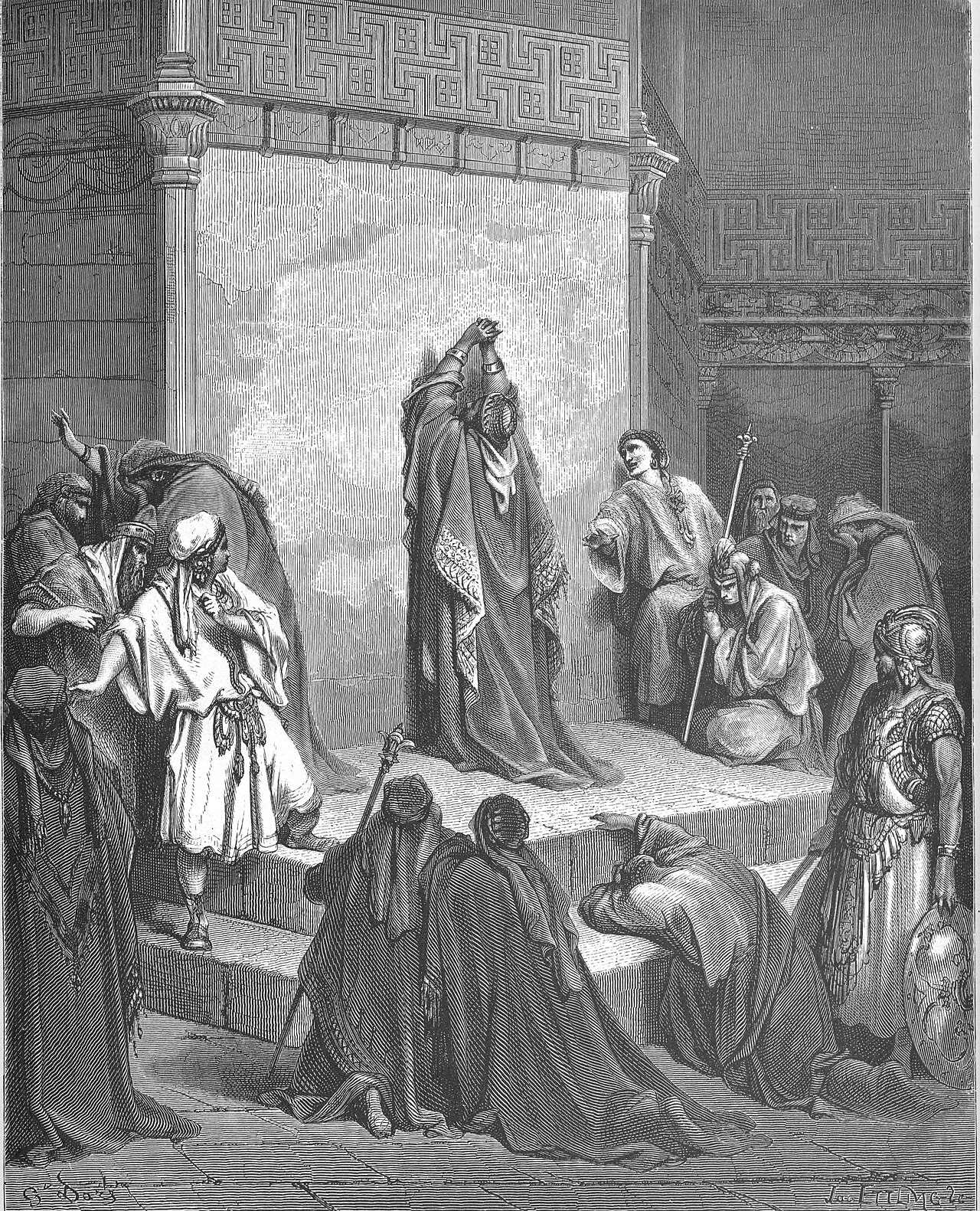
Tamar's plea moves past emotion into law: she calls what he intends folly, warns it will leave him as one of the fools in Israel, then offers marriage to the king as her last hope of escape. Albert Barnes reads that offer as a bid to get free of the room rather than proof such marriages were lawful, since the law already forbade them. Amnon will not hear her. He simply overpowers her, and the narrator states the fact without ornament: forced her, and lay with her.
This site's exposition
take my shame
Albert Barnes renders shame as reproach and compares Genesis 34:14, the same disgrace Dinah's brothers named. The marriage offer divides readers. Adam Clarke took it that Tamar expected the king to consent, while Jamieson, Fausset & Brown hold she said whatever might free her from his hands.
The record, by era
The Medieval Church1 voice
No man shall rely upon chastity in the past, for none whose hearts are tainted by women can become holier than David or wiser than Solomon. That none may assume that his chastity is safe in the presence of a woman related to him, let …
The Puritans and the Awakening1 voice
And I, whither shall I cause my shame to go?....
The Nineteenth Century3 voices
A commentator
Albert Barnes1798–1870
Notes, Explanatory and Practical, on the Old and New Testaments (1832-1869)
My shame - Better, “my reproach.” Compare Gen 30:23; Gen 34:14; 1Sa 11:2. Speak unto the king ... - It cannot be inferred with certainty from this that marriages were usual among half brothers and sisters in the time of David. The Levitical law forbade them (marginal reference), and Tamar may have merely wished to temporize.
A commentator
Jamieson, Fausset & Brown1802–1910
Commentary Critical and Explanatory on the Whole Bible (1871)
In bidding him, however, "speak to the king, for he will not withhold me from thee," it is probable that she urged this as her last resource, saying anything she thought would please him, in order to escape for the present out of his hands.
Speak unto the king - So it appears that she thought that the king, her father, would give her to him as wife. This is another strong mark of indelicacy in those simple but barbarous times. There might have been some excuse for such connections under the patriarchal age, but there was none now. But perhaps she said this only to divert him from his iniquitous purpose, that she might get out of his hands.
How the passage was read
What the Jewish commentators add
Because he will not keep me from you. I am permitted to you because my mother became pregnant with me when she was still a gentile, pretty woman. The laws concerning the taking of gentile woman during war is discused in Devorim begginning in:10.
This section is reception history: how the passage was read and kept in the Jewish tradition. Where a reading parts from an essential of the Christian faith, the section says so at that point.
Texts and citation data: Sefaria; each excerpt follows its version’s licence. 5 further sources are cited on this chapter that carry no English text this site may quote or only restate the verse.
The words behind it
19 Hebrew wordsEvery Hebrew word of this verse in the order it stands, with what it means and the door to its own study. The last column counts the times a word stands in the whole Bible: the rarer the word, the more the places it appears belong together.
| Hebrew | Sound | Meaning | Word study | In the Bible |
|---|---|---|---|---|
| וַאֲנִ֗י | vaani | and I | H589 → | 874 times |
| אָ֤נָה | ʾanah | where? | H575 → | |
| אוֹלִיךְ֙ | ʾolikh | will I bring | H1980 → | 1546 times |
| אֶת־ | ʾet- | <obj.> | H853 → | 10935 times |
| חֶרְפָּתִ֔י | cherpati | reproach my | H2781 → | |
| וְאַתָּ֗ה | veatah | and you | H859 → | 1094 times |
| תִּהְיֶ֛ה | tihyeh | you will be | H1961 → | 3559 times |
| כְּאַחַ֥ד | keachad | like one of | H259 → | 971 times |
| הַנְּבָלִ֖ים | hanevalim | the fools | H5036 → | |
| בְּיִשְׂרָאֵ֑ל | beyisrael | in Israel | H3478 → | 2507 times |
| וְעַתָּה֙ | veatah | and now | H6258 → | 433 times |
| דַּבֶּר־ | daber- | speak | H1696 → | 1141 times |
| נָ֣א | na' | please | H4994 → | 404 times |
| אֶל־ | ʾel- | to | H413 → | 5510 times |
| הַמֶּ֔לֶךְ | hamelekh | the king | H4428 → | 2525 times |
| כִּ֛י | ki | for | H3588 → | 4482 times |
| לֹ֥א | lo' | not | H3808 → | 5168 times |
| יִמְנָעֵ֖נִי | yimnaeni | he will withhold me | H4513 → | |
| מִמֶּֽךָּ׃ | mimeka | from you | H4480 → | 1188 times |
וַאֲנִ֗יand I
vaaniH589 →874 times
אָ֤נָהwhere?
ʾanahH575 →
אוֹלִיךְ֙will I bring
ʾolikhH1980 →1546 times
אֶת־<obj.>
ʾet-H853 →10935 times
חֶרְפָּתִ֔יreproach my
cherpatiH2781 →
וְאַתָּ֗הand you
veatahH859 →1094 times
תִּהְיֶ֛הyou will be
tihyehH1961 →3559 times
כְּאַחַ֥דlike one of
keachadH259 →971 times
הַנְּבָלִ֖יםthe fools
hanevalimH5036 →
בְּיִשְׂרָאֵ֑לin Israel
beyisraelH3478 →2507 times
וְעַתָּה֙and now
veatahH6258 →433 times
דַּבֶּר־speak
daber-H1696 →1141 times
נָ֣אplease
na'H4994 →404 times
אֶל־to
ʾel-H413 →5510 times
הַמֶּ֔לֶךְthe king
hamelekhH4428 →2525 times
כִּ֛יfor
kiH3588 →4482 times
לֹ֥אnot
lo'H3808 →5168 times
יִמְנָעֵ֖נִיhe will withhold me
yimnaeniH4513 →
מִמֶּֽךָּ׃from you
mimekaH4480 →1188 times
A shaded row is a word that stands 400 times or fewer in the Bible.
The walk
8 stopsEach card is a verse this one points to, and under it the verses that one points to in turn. Where several paths arrive at the same place, that place is listed first: the text keeps returning to it.
Through
Genesis 19:8Look, I have two daughters who have never slept with a man. Let me bring them to you, and you can do to them as you please. But do not do anything to these…
it leads to
- Judges 19:24
Look, let me bring out my virgin daughter and the man’s concubine, and you can use them and do with them as you wish. But do not do such a vile thing to this…
- Romans 3:8
Why not say, as some slanderously claim that we say, “Let us do evil that good may result”? Their condemnation is deserved!
Reached by 2 separate paths from here.
- Genesis 19:31–38
One day the older daughter said to the younger, “Our father is old, and there is no man in the land to sleep with us, as is the custom over all the earth.
- Genesis 18:5
And I will bring a bit of bread so that you may refresh yourselves. This is why you have passed your servant’s way. After that, you may continue on your way.” “Yes,” they replied,…
- Genesis 42:37
Then Reuben said to his father, “You may kill my two sons if I fail to bring him back to you. Put him in my care, and I will return him.”
- Judges 19:24
Through
Judges 19:24Look, let me bring out my virgin daughter and the man’s concubine, and you can use them and do with them as you wish. But do not do such a vile thing to this…
it leads to
- Genesis 19:8
Look, I have two daughters who have never slept with a man. Let me bring them to you, and you can do to them as you please. But do not do anything to these…
- Deuteronomy 21:14
And if you are not pleased with her, you are to let her go wherever she wishes. But you must not sell her for money or treat her as a slave, since you have…
- Genesis 19:8
Through
Genesis 20:12Besides, she really is my sister, the daughter of my father—though not the daughter of my mother—and she became my wife.
it leads to
- Genesis 11:29
And Abram and Nahor took wives for themselves. Abram’s wife was named Sarai, and Nahor’s wife was named Milcah; she was the daughter of Haran, who was the father of both Milcah and Iscah.
- Genesis 11:29
Where this verse is studied
On this page
About 2 Samuel
This page draws on Adam Clarke, Commentary on the Bible; Albert Barnes, Notes on the Old Testament; Albert Barnes, Notes, Explanatory and Practical, on the Old and New Testaments (1832-1869); Fructuosus of Braga, GENERAL RULE FOR MONASTERIES 17; Jamieson, Fausset & Brown, Commentary Critical and Explanatory on the Whole Bible; Jerome, LETTER 22.12; John Gill, Exposition of the Old Testament and John Gill, Exposition of the Old Testament (1748-1763).