
Numberschapter 13
33 verses · Moses, by tradition · 15th to 13th century BC · The Law
Key verse
We even saw the Nephilim there—the descendants of Anak that come from the Nephilim! We seemed like grasshoppers in our own sight, and we must have seemed the same to them!”
It stands in A good land: but we were as grasshoppers, verses 26 to 33.
The chapter
Chapter summary
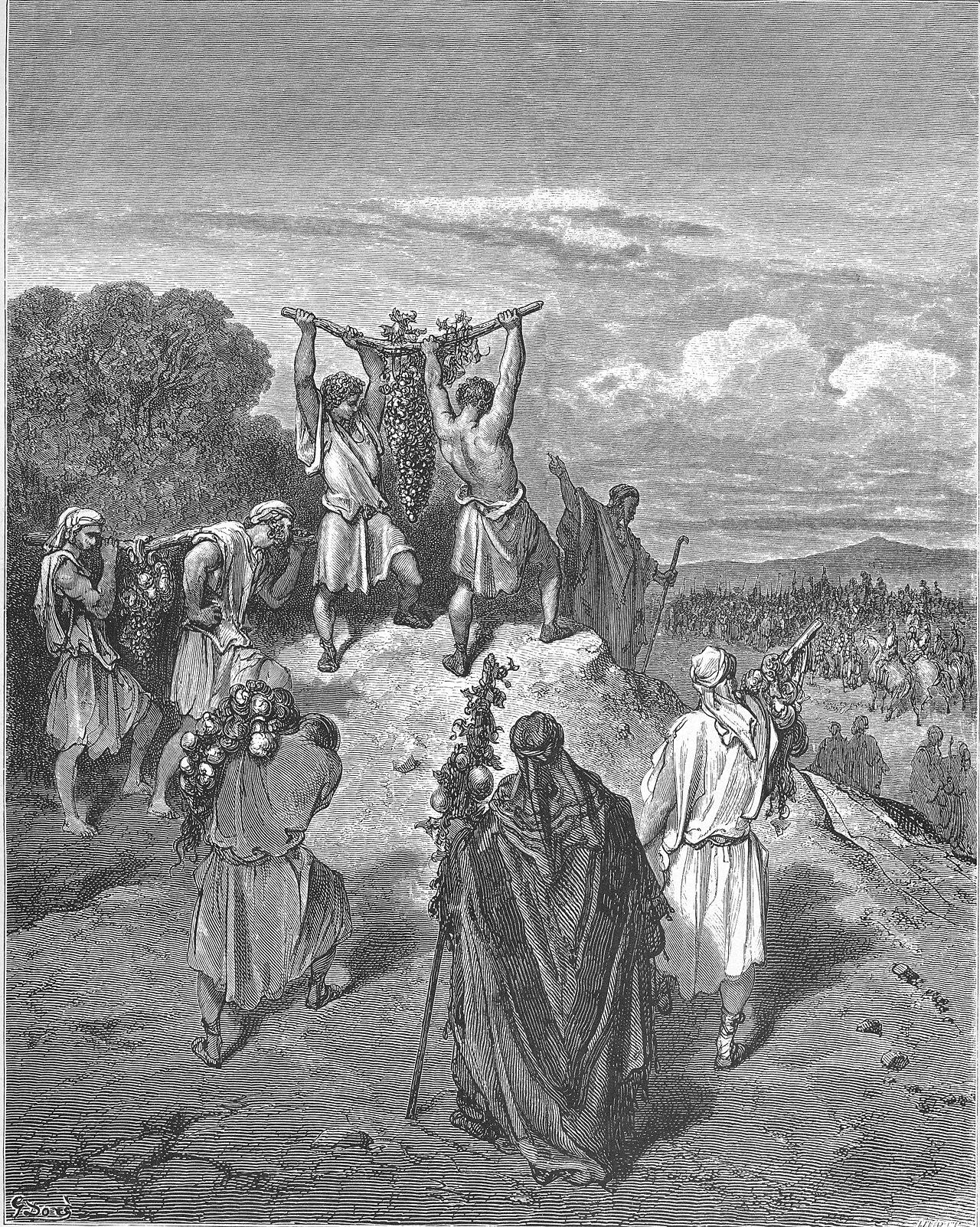
The twelve spies sent. One from each tribe, heads of the children of Israel. Moses renames Oshea son of Nun, Jehoshua (Joshua: ‘the LORD saves’). The reconnaissance. Forty days. To Hebron, to Eshcol where they cut a cluster of grapes borne between two on a staff. They return with the fruit and the report: the land flows with milk and honey; nevertheless the people are strong, the cities walled and great; Anakim there. Caleb stilled the people: ‘let us go up at once, and possess it; for we are well able to overcome it’. But his fellow spies: ‘we are not able … there we saw the giants … and we were in our own sight as grasshoppers’.
Context
Law · Moses · Numbers overview
The world behind this chapter
Numbers 13The history
The chapter belongs to Moses, who was the head of the nation and the man the scouts were sent out by and reported back to. The twelve he sent were leaders in their own tribes, so the report would carry the weight of the men who brought it. The year is the second after the Exodus, on the traditional reckoning this book uses, and the season is fixed by the text itself at the time of the first ripe grapes.
The rest of the history, and what it meant to them
The camp stood at Kadesh in the Wilderness of Paran, at the southern approach to Canaan. The errand ran the length of the country, from the Wilderness of Zin in the south to Rehob near the approach to Hamath.
Numbers 13:1-2 has the order come from the LORD, and Deuteronomy 1:22 records the people coming to Moses first with the proposal.
Canaan in this period was a patchwork of small city-states, each with its own ruler and most of them under Egyptian oversight. That is the arrangement the diplomatic letters found at Amarna in Egypt show, with local kings writing to pharaoh for troops. Their towns had real defensive walls built on earthen ramparts, and to men who had spent a year in tents they would have looked enormous. The note that Hebron was built seven years before Zoan is an Egyptian anchor, since Zoan is Tanis in the Nile delta, which Adam Clarke names as the capital of Lower Egypt.
What it meant to them
Ten men and two men saw the same walls, the same fruit and the same tall warriors, and the difference between them was whether God was counted in the sum. The first hearers of Numbers were the next generation, camped on the plains of Moab and about to try again. For them this chapter was the case file on why their parents were buried in the desert.
Sources cited
- K. A. Kitchen, On the Reliability of the Old Testament
- John H. Walton, Victor H. Matthews and Mark W. Chavalas, The IVP Bible Background Commentary: Old Testament
- Adam Clarke, Commentary on the Bible , 1832, on Numbers 13:22
- Jamieson, Fausset and Brown, Commentary Critical and Explanatory on the Whole Bible , 1871, on Numbers 13:20
- John Wesley, Explanatory Notes upon the Old Testament , 1765, on Numbers 13:21 and 13:26
Where the chapter sits
Numbers 13 falls in From Sinai to Kadesh (chapters 11–14). Murmuring over food, Miriam and Aaron against Moses, the twelve spies, the forty-year sentence.
The twelve spies. Ten see giants; two see God. The ten-majority report becomes the unbelief that turns the nation back into the wilderness.
Before it: First census and camp order, chapters 1–10. After it: Wilderness rebellions and instruction, chapters 15–20.
The whole shape of Numbers→The structure of this chapter
Threads running through this chapter
- The giants left in GathPattern, v. 33
The heads below are this chapter's scenes. The numbered points under each are its verses.
A. Twelve men, one ruler from each tribe
1. (vv. 1-2)
Numbers 13:1
“And the Lord Spake unto Moses,....”
2 more voices on this verseWhat preachers and commentators have said about this verse, in their own words.
Numbers 13:1
“And the Lord spake - The mission of the spies was first suggested by the Israelites themselves. See Deu 1:22.”
Numbers 13:1
“But thus we ruin ourselves by giving more credit to the reports and representations of sense than to divine revelation; we walk by sight, not by faith; whereas, if we will receive the witness of men, without doubt the witness of God is greater.”
Matthew Henry· Commentary on the Whole Bible (1707-1721)puritan
Numbers 13:2
“Send thou men, that they may search - It appears from Deu 1:19-24 that this was done in consequence of the request of the people, after the following address of Moses: “And when we departed from Horeb, we went through all that great and terrible wilderness - and we came unto Kadesh-Barnea; and I said unto you, Ye are come unto the mountain of the Amorites, which the Lord our God doth give unto us.”
Adam Clarke· Commentary on the Bible (1810-1826)evangelical
1 more voice on this verse
Numbers 13:2
“Their names are enumerated, in perpetual remembrance of their ignominy, except in the case of two, Joshua and Caleb; for it was just that their crime should be handed down to all ages, and that the infamy of their perfidiousness should never be blotted out, since they endeavored, as far as in them lay, to bring to naught the promise and the grace of God.”
John Calvin· Commentaries (1554)reformed
The order to send men comes from the LORD here, and Deuteronomy 1:22 records the people coming to Moses first with the proposal, ye shall search us out the land. Both accounts stand in the canon, and Adam Clarke reads them together, taking the command in verse 2 as God granting what the people had already asked for. Every man sent is a ruler in his own tribe, so the report will carry the weight of the men who bring it.
2. (vv. 3-4)
Numbers 13:3
“And Moses, by the commandment of the Lord,.... By his power, permission, and leave, as Jarchi, that there might be no delay through his means: sent them from the wilderness of Paran; from Rithmah or Kadeshbarnea, which seem to be one and the same place in that wilderness: this, as before observed, was on the twenty ninth day of Sivan: See Gill on Num 13:1, all those were heads of the children of Israel; were not mean and vulgar men, but persons of rule, who bore some office of magistracy ant government among the people in their respective tribes.”
Numbers 13:4
“And these were their names, of the tribe of Reuben, Shammua the son of Zaccur.”
1 more voice on this verse
Numbers 13:4
“This was designed for the best, but it proved to have this ill effect that the quality of the persons occasioned the evil report they brought up to be the more credited and the people to be the more influenced by it. Some think that they are all named for the sake of two good ones that were among them, Caleb and Joshua.”
Matthew Henry· Commentary on the Whole Bible (1707-1721)puritan
They set out from the wilderness of Paran, and the twelve are heads of the children of Israel, men who already held rule among their people. Calvin says the names are written down in perpetual remembrance, since ten of the twelve are recorded here only to be condemned by what they say at verse 31. The list begins with Shammua of Reuben, which is birth order, though Numbers 2:3 had put Judah at the head of the camp and Numbers 7:12 had given Judah the first day.
3. (vv. 5-10)
Numbers 13:5
“Of the tribe of Simeon, Shaphat the son of Hori. See Gill on Num 13:4.”
Numbers 13:6
“Of the tribe of Judah, Caleb the son of Jephunneh. See Gill on Num 13:4.”
Numbers 13:7
“Of the tribe of Issachar, Igal the son of Joseph. See Gill on Num 13:4.”
Numbers 13:8
“Of the tribe of Ephraim, Oshea the son of Nun. See Gill on Num 13:4.”
Numbers 13:9
“Of the tribe of Benjamin, Palti the son of Raphu. See Gill on Num 13:4.”
Numbers 13:10
“Of the tribe of Zebulun, Gaddiel the son of Sodi. See Gill on Num 13:4.”
The tribal order in this roll matches neither the camp of Numbers 2 nor the census list of Numbers 1, since Zebulun stands seventh here and fifth there. Caleb is named at verse 6 and Oshea at verse 8 with nothing to mark either of them out from the ten around them. Matthew Henry suggests the whole roll is preserved for the sake of the two good men in it, since the other ten are never named again after this chapter.
4. (vv. 11-15)
Numbers 13:11
“Of the tribe of Joseph, namely, of the tribe of Manasseh, Gaddi the son of Susi. See Gill on Num 13:4.”
Numbers 13:12
“Of the tribe of Dan, Ammiel the son of Gemalli. See Gill on Num 13:4.”
Numbers 13:13
“Of the tribe of Asher, Sethur the son of Michael. See Gill on Num 13:4.”
1 more voice on this verse
Numbers 13:13
“Sethur, the son of Michael - It would have been strange had the numerous searches after the explanation of the mystical number 666, Rev 13:18; Rev 17:5, met with nothing to their purpose in the name of this son of Michael. סתור Sethur, from סתר sathar, to hide or conceal, signifies hidden or mysterious, and includes in it the numerical letters of the No. 666: ס60, + ת400, + ו6, + ר200, = 666. But of what utility can such expositions be to any subject of history or theology?”
Adam Clarke· Commentary on the Bible (1810-1826)evangelical
Numbers 13:14
“Of the tribe of Naphtali, Nahbi the son of Vophsi. See Gill on Num 13:4.”
Numbers 13:15
“Of the tribe of Gad, Geuel the son of Machi. See Gill on Num 13:4.”
Levi is absent from the twelve and Joseph is divided into Ephraim at verse 8 and Manasseh here, which holds the number at twelve by the same device the census used at Numbers 1:10. Adam Clarke observes that the Hebrew letters of Sethur at verse 13 add to six hundred and sixty six, and then dismisses his own observation as useless to either history or theology. The roll closes with Gad, and the very next verse changes one of the names in it.
5. (v. 16)
Numbers 13:16
“And the same [Moses] by divine inspiration foresaw the name Jesus very clearly and again also endowed this with special privilege. The name of Jesus, which had never been uttered among men before it was made known to Moses, Moses applied first to this one alone. He knew that Joshua, again as a type and a symbol, would receive the rule over all after Moses' death. His successor, at any rate, had never before used the title Jesus. He had been called by another name, Auses, which his parents had bestowed upon him.”
Eusebius of Caesarea· written before 339· ECCLESIASTICAL HISTORY 1.3patristic
1 more voice on this verse
Numbers 13:16
“And Moses called Oshea Jehoshua - Oshea, Heb. הושע should be written Hoshea: the word signifies saved, or a savior, or salvation; but יהושע, he shall save, or the salvation of God; a letter, says Calmet, of the incommunicable name of God, being added to his former name. This was not the first time in which he had the name Joshua; see Exo 17:9 (note), and the note there. Some suppose he had this change of name in consequence of his victory over Amalek; see Exo 17:13, Exo 17:14.”
Adam Clarke· Commentary on the Bible (1810-1826)evangelical
Moses changes Oshea to Jehoshua, setting a letter of the divine name in front of a word meaning salvation, so a prayer to be saved becomes a statement that he will save. Matthew Henry puts it as a prayer turned into a promise. Exodus 17:9 and Exodus 24:13 already call him Joshua, which means the narrative uses the new name before it records the giving of it, and Clarke names that difficulty rather than smoothing it over. Jehoshua is the name the Greek New Testament carries as Jesus, and the King James prints Jesus for Joshua at Acts 7:45 and Hebrews 4:8.
B. Go see whether the land is fat or leanvv. 17-20
The brief is a set of questions about the country and the people in it, strong or weak, few or many, good or bad, walled cities or tents, fat land or lean. Every one of those questions is answered accurately at verses 27 to 29, and the quarrel at verse 31 is over what the answers mean. Moses adds be ye of good courage and asks for fruit, and the writer dates the errand to the time of the firstripe grapes, which Jamieson, Fausset and Brown place in August.
Numbers 13:17
“Southward - Rather, “by the Negeb,” or south-country; a well-defined tract of territory forming the southernmost and least fertile portion of the land of Canaan and of the subsequent inheritance of Judah. It extended northward from Kadesh to within a few miles of Hebron, and from the Dead Sea westward to the Mediterranean (see especially Jos 15:21-32). Into the mountain - The hill-country of southern and central Canaan, mostly within the borders of Judah and Ephraim.”
1 more voice on this verse
Numbers 13:17
“Get you up this way . . . , and go up into the mountain--Mount Seir (De 1:2), which lay directly from Sinai across the wilderness of Paran, in a northeasterly direction into the southern parts of the promised land.”
Jamieson, Fausset & Brown· Commentary Critical and Explanatory on the Whole Bible (1871)reformed
Numbers 13:18
“See the land, what it is - What sort of a Country it is; how situated; its natural advantages or disadvantages. And the people - whether they be strong or weak - Healthy, robust, hardy men; or little, weak, and pusillanimous.”
Adam Clarke· Commentary on the Bible (1810-1826)evangelical
1 more voice on this verse
Numbers 13:18
“And see the land what it is, and the people that dwelleth therein,....”
Numbers 13:19
“And what the land is that they dwell in, whether it be good or bad,....”
1 more voice on this verse
Numbers 13:19
“In tents - i. e. in open unwalled villages.”
Numbers 13:20
“Now the time was the time of the first grapes--This was in August, when the first clusters are gathered. The second are gathered in September, and the third in October.”
Jamieson, Fausset & Brown· Commentary Critical and Explanatory on the Whole Bible (1871)reformed
C. Forty days, and a cluster carried on a pole
1. (vv. 21-22)
Numbers 13:21
“Zin - In the south of Canaan, differing from the wilderness of Sin, which was nigh unto Egypt. To Hamath - From the south they passed through the whole land to the northern parts of it; Rehob was a city in the northwest part, Hamath, a city in the northeast.”
John Wesley· Explanatory Notes upon the Old Testament (1765)evangelical
1 more voice on this verse
Numbers 13:21
“The wilderness of Zin was the northeastern portion of the wilderness of Paran. Rehob (“mod.” Khurbeh) was probably the Beth-rehob of Jdg 18:28, near Dan-Laish; and apparently to the north of it, since it gave its name to a Syrian kingdom 2Sa 8:3. The southern approach to Hamath from the plain of Coele-Syria, lay between those two ranges of Lebanon called Libanus and Antilibanus. A low screen of hills connects the northernmost points of these two ranges; and through this screen the Orontes bursts from the upper Coele-Syrian hollow into the open plain of Hamath.”
Numbers 13:22
“Hebron was built seven years before Zoan in Egypt - The Zoan of the Scriptures is allowed to be the Tanis of the heathen historians, which was the capital of Lower Egypt. Some think it was to humble the pride of the Egyptians, who boasted the highest antiquity, that this note concerning the higher antiquity of Hebron was introduced by Moses.”
Adam Clarke· Commentary on the Bible (1810-1826)evangelical
1 more voice on this verse
Numbers 13:22
“For the spies distributed their work among them, and went either severally, or by pairs; and it seems the survey of this part was left to Caleb. Anak - A famous giant, whole children these are called, either more generally, as all giants sometimes were, or rather more specially because Arbah, from whom Hebron was called Kiriath-arbah, was the father of Anak, Josh. xv, 13.”
John Wesley· Explanatory Notes upon the Old Testament (1765)evangelical
They cover the whole country, from the wilderness of Zin in the south to Rehob near the approach to Hamath in the far north, so the search reached well beyond the border they would have had to cross first. At Hebron they meet three men named in the text, Ahiman, Sheshai and Talmai, the children of Anak. Joshua 15:13-14 records Caleb driving out those same three by name and Judges 1:10 records the same fight again, so one of the two men who kept faith here finished that business forty-five years later, as Joshua 14:10 reckons it. The parenthesis dating Hebron seven years before Zoan in Egypt is read by Clarke as an answer to Egyptian claims of the oldest cities.
2. (vv. 23-24)
Numbers 13:23
“The brook of Eshcol is by some identified with the rich valley immediately to the north of Hebron; (but by others with Wady Hanein to the south of Hebron). The valley was, in all likelihood, originally named after one of the three chiefs who were confederate with Abraham Gen 14:24; but, as often came to pass, the Israelites, wittingly or unwittingly, took up in a new and significant sense the name which they found; and to them the valley thus became the Valley of the Cluster. Bunches of grapes are found in Palestine of many pounds weight.”
1 more voice on this verse
Numbers 13:23
“Upon a staff - Either for the weight of it, considering the, length of the way they were to carry it, or for the preservation of it whole and entire. In those eastern and southern countries there are vines and grapes of an extraordinary bigness as Strabo and Pliny affirm.”
John Wesley· Explanatory Notes upon the Old Testament (1765)evangelical
Numbers 13:24
“Later on, a sacred vine put forth a cluster of grapes that was prophetic. To those who had been led by the Educator to a place of rest after their wanderings it was a sign, for the great cluster of grapes is the Word crushed on our account. The Word desired that the "blood of the grape" be mixed with water as a symbol that his own blood is an integral element in salvation.”
Clement of Alexandria· written before 215· The Instructor Book 2patristic
One cluster takes two men and a staff, and the pomegranates and figs come back with it, so the evidence for the promise is carried home on the shoulders of the men who will advise against acting on it. The valley takes its name from that cluster, and Genesis 14:13 and 14:24 had already given Eshcol as the name of an Amorite at Hebron who stood with Abram, which Albert Barnes reads as an older place name taken up in a new sense. Clement of Alexandria, in The Instructor, read the great cluster as the Word crushed for us, and that is a reading of the fathers rather than a statement the text makes.
3. (v. 25)
Numbers 13:25
“And they returned from searching the land after forty days. The Targum of Jonathan adds, on the eighth day of the month Ab, which answers to part of July and part of August; so that this must be towards the latter end of July: some Jewish writers (k) say it was the ninth of Ab; hence the tradition, that it was decreed on the ninth of Ab concerning their fathers, that they should not enter into the land (l). (k) Seder Olam Rabba, c. 8. p. 24. (l) Misn. Taanith, c. 4. sect. 7.”
Numbers 13:25-26
Forty days out, and Numbers 14:34 turns those forty days into forty years at the rate of a year for a day. They come back to Kadesh in the wilderness of Paran and report to Moses, Aaron and the whole congregation at once, so the camp hears the account at the same moment the leaders do. John Gill records the Jewish tradition placing the return on the eighth or the ninth of Ab, the day later mourning fixed on.
D. A good land: but we were as grasshoppers
1. (v. 26)
Numbers 13:26
“Kadesh - Kadesh-barnea, which some confound with Kadesh in the wilderness of Sin, into which they came not 'till the fortieth year after their coming out of Egypt, as appears from chap. xxxiii, 37, 38, whereas they were in this Kadesh in the second year, and before they received the sentence of their forty years abode in the wilderness.”
John Wesley· Explanatory Notes upon the Old Testament (1765)evangelical
1 more voice on this verse
Numbers 13:26
“Kadesh is usually identified with Ain-el-Weibeh, which lies in the Arabah, about 10 miles north of the place in which Mount Hor abuts on that valley, (or with Ain-Gadis in Jebel Magrah).”
2. (vv. 27-29)
Numbers 13:27
“God had promised them a land flowing with milk and honey, and the evil spies themselves own that it is such a land. Thus even out of the mouth of adversaries will God be glorified and the truth of his promise attested.”
Matthew Henry· Commentary on the Whole Bible (1707-1721)puritan
Numbers 13:28
“Nevertheless the people be strong that dwell in the land,....”
Numbers 13:29
“By the sea - Not the mid-land sea, which is commonly understood by that expression, but the salt or dead sea, as appears, 1. Because it is that sea which is next to Jordan, 2.”
John Wesley· Explanatory Notes upon the Old Testament (1765)evangelical
The report opens by confirming the promise word for word, since a land flowing with milk and honey is what God had said at Exodus 3:8 and 3:17. Then comes nevertheless, and everything after it is also true: the people strong, the cities walled and very great, the children of Anak there, Amalek in the south, Hittites and Jebusites and Amorites in the hills, Canaanites by the sea and along Jordan. Matthew Henry notes that even the men who discouraged Israel owned that the land was what God said it was. Every clause in these three verses is accurate, which is what makes verse 32 a different kind of speech.
3. (v. 30)
Numbers 13:30
“Difficulties that lie in the way of salvation dwindle and vanish before a lively active faith in the power and promise of God. All things are possible, if they be but promised, to him that believes.”
Matthew Henry· Commentary on the Whole Bible (1707-1721)puritan
Caleb has to still the people first, which tells us how the room had already turned. He disputes none of the facts and answers with a timetable, let us go up at once and possess it, and Numbers 14:9 gives his ground when he and Joshua say the LORD is with us. Matthew Henry reads the whole difficulty as shrinking before a living faith in the power and the promise of God.
4. (vv. 31-32)
Numbers 13:31
“Were not the hosts of Israel very numerous? 600,000 effective men, well marshalled and modelled, closely embodied, and entirely united in interest and affection, constituted as formidable an army as perhaps was ever brought into the field; many a less has done more than perhaps the conquering of Canaan was, witness Alexander's army.”
Matthew Henry· Commentary on the Whole Bible (1707-1721)puritan
Numbers 13:32
“A land that eateth up ... - i. e. it is a land which from its position is exposed to incessant attacks from one quarter and another, and so its occupants must be always armed and watchful.”
The comparison is the whole of their argument, they are stronger than we, which measures Canaan against Israel and leaves God out of the sum. Then the account itself changes, and a land flowing with milk and honey at verse 27 becomes a land that eateth up the inhabitants thereof at verse 32. The Hebrew word behind evil report is dibbah, a word for slander, and Numbers 14:36-37 charges the ten with bringing up a slander upon the land and takes their lives by plague for it. Albert Barnes reads the phrase as a country exposed to constant attack from every quarter, which the men could have meant honestly, and the change from what they said five verses earlier stands either way.
5. (v. 33)
Numbers 13:33
“There we saw the giants - נפלים nephilim. It is evident that they had seen a robust, sturdy, warlike race of men, and of great stature; for the asserted fact is not denied by Joshua or Caleb. Tales of gigantic men are frequent in all countries, but they are generally of such as have lived in times very remote from those in which such tales are told.”
Adam Clarke· Commentary on the Bible (1810-1826)evangelical
The word rendered giants here is nephilim, which stands in Genesis 6:4 and in this verse and in no other place in the Hebrew Bible. Joshua 11:21-22 records Anakim left alive in Gaza, Gath and Ashdod, and Goliath comes out of Gath at 1 Samuel 17:4, so the chain the text itself draws runs from before the flood to the valley of Elah. Watch what the ten actually say in the last clause: they report how they looked to themselves, as grasshoppers, and then assert how they looked to somebody else, which is a claim about the inside of another man's head. Adam Clarke grants that they had seen a large and warlike people, since neither Joshua nor Caleb ever denied that part of the report.
This page carries no textual note on Numbers 13. Where this site has examined a place the manuscripts differ, the examination is in the manuscripts room. Every place this site examines →
Keep studying
On this page
Studies6
Sources for this chapter
The summary
Jamieson, Fausset & Brown, Commentary Critical and Explanatory; John Calvin, Commentaries; John Wesley, Notes on the Old Testament and Matthew Henry, Complete Commentary.
The context
Chuck Missler, Learn the Bible in 24 Hours and Michael Heiser, The Unseen Realm.
The exposition
Adam Clarke, Commentary on the Bible; Albert Barnes, Notes on the Old Testament; Jamieson, Fausset & Brown, Commentary Critical and Explanatory on the Whole Bible; John Calvin, Commentary on the Four Last Books of Moses Arranged in the Form of a Harmony; John Gill, Exposition of the Old Testament; Keil and Delitzsch, Biblical Commentary on the Old Testament: The Pentateuch and Matthew Henry, Commentary on the Whole Bible.