
Numbers 13:21
in Numbers 13So they went up and spied out the land from the Wilderness of Zin as far as Rehob, toward Lebo-hamath.
BSB
The same verse in ASV and KJV ▾
ASV
So they went up, and spied out the land from the wilderness of Zin unto Rehob, to the entrance of Hamath.
KJV
So they went up, and searched the land from the wilderness of Zin unto Rehob, as men come to Hamath.
⋯
This verse in Numbers 13
Commentary
8 notes on this verseA commentator
Albert Barnes1798–1870
Notes, Explanatory and Practical, on the Old and New Testaments (1832-1869)
The wilderness of Zin was the northeastern portion of the wilderness of Paran. Rehob (“mod.” Khurbeh) was probably the Beth-rehob of Jdg 18:28, near Dan-Laish; and apparently to the north of it, since it gave its name to a Syrian kingdom 2Sa 8:3. The southern approach to Hamath from the plain of Coele-Syria, lay between those two ranges of Lebanon called Libanus and Antilibanus. A low screen of hills connects the northernmost points of these two ranges; and through this screen the Orontes bursts from the upper Coele-Syrian hollow into the open plain of Hamath.
This site's exposition
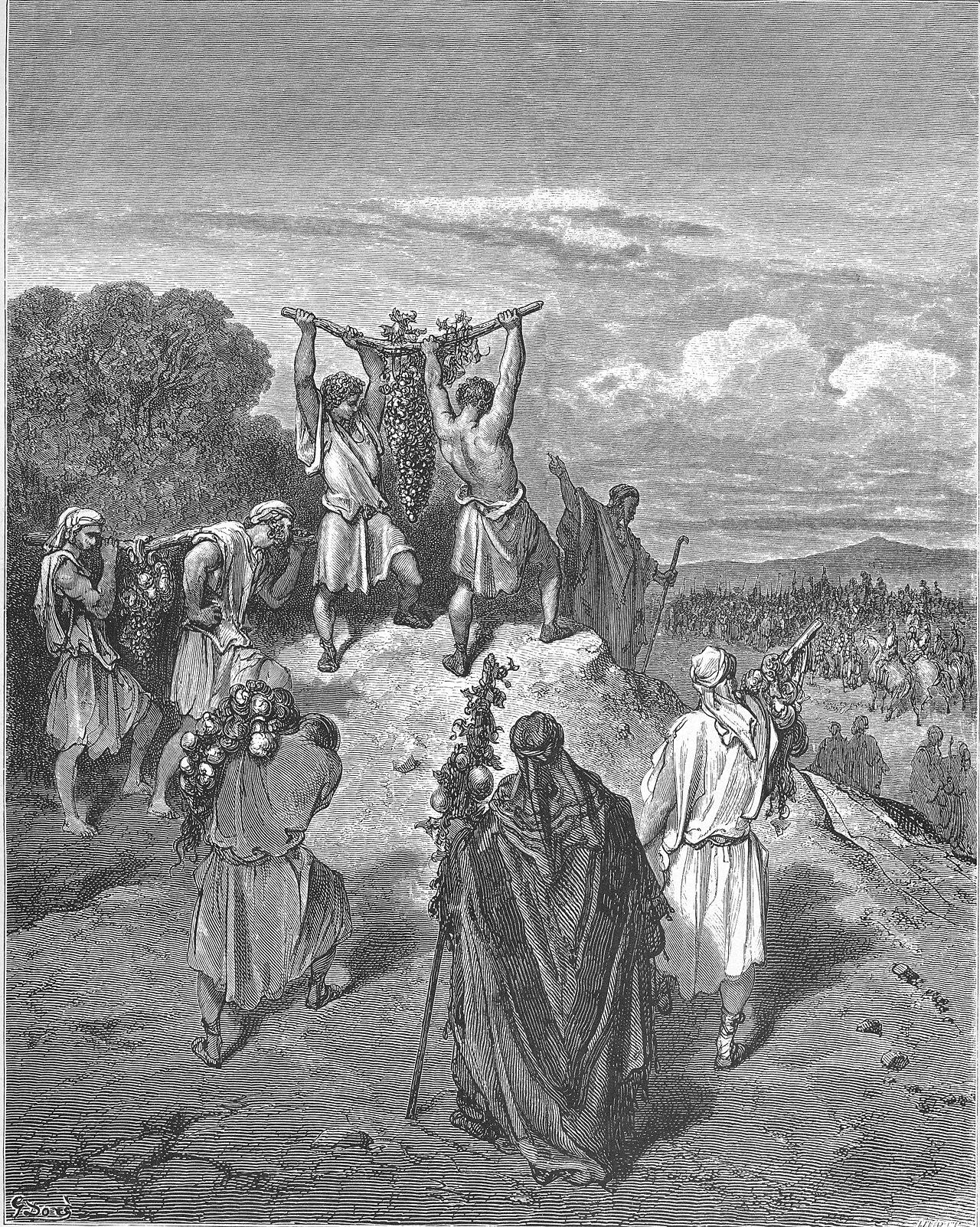
So they went up, and searched the land
on Numbers 13:21-22
They cover the whole country, from the wilderness of Zin in the south to Rehob near the approach to Hamath in the far north, so the search reached well beyond the border they would have had to cross first. At Hebron they meet three men named in the text, Ahiman, Sheshai and Talmai, the children of Anak. Joshua 15:13-14 records Caleb driving out those same three by name and Judges 1:10 records the same fight again, so one of the two men who kept faith here finished that business forty-five years later, as Joshua 14:10 reckons it. The parenthesis dating Hebron seven years before Zoan in Egypt is read by Clarke as an answer to Egyptian claims of the oldest cities.
The record, by era
The Puritans and the Awakening4 voices
Zin - In the south of Canaan, differing from the wilderness of Sin, which was nigh unto Egypt. To Hamath - From the south they passed through the whole land to the northern parts of it; Rehob was a city in the northwest part, Hamath, a city in the northeast.
Jehoshua - Oshea notes a desire of salvation, signifying, Save we pray thee; but Jehoshua, or Joshua, includes a promise of salvation, He will save. So this was a prophecy of his succession to Moses in the government, and of the success of his arms. Josh. is the same name with Jesus, of whom Joshua was a type.
So they went up and searched the land,....
It is probable that they did not go altogether in a body, lest they should be suspected and taken up, which there would be the more danger of if the Canaanites knew (and one would think they could not but know) how near the Israelites were to them; but they divided themselves into several companies, and so passed unsuspected, as way-faring men.
The Nineteenth Century1 voice
A commentator
Jamieson, Fausset & Brown1802–1910
Commentary Critical and Explanatory on the Whole Bible (1871)
proposed
So they . . . searched the land--They advanced from south to north, reconnoitering the whole land. the wilderness of Zin--a long level plain, or deep valley of sand, the monotony of which is relieved by a few tamarisk and rethem trees.
1 more voice on this verse
The Nineteenth Century1 voice
From the wilderness of Zin - The place called; צן Tsin, here, is different from that called סין Sin or Seen. Exo 16:1; the latter was nigh to Egypt, but the former was near Kadesh Barnea, not far from the borders of the promised land. “The spies having left Kadesh Barnea, which was in the desert of Paran, see Num 13:26, they proceeded to the desert of Tsin, all along the land of Canaan, nearly following the course of the river Jordan, till they came to Rehob, a city situated near Mount Libanus, at the northern extremity of the Holy Land, towards the road that leads to Hamath. Thence they returned through the midst of the same land by the borders of the Sidonians and Philistines, and passing by Mount Hebron, rendered famous by the residence of Abraham formerly, and by the gigantic descendants of Anak at that time, they passed through the valley of the brook of Eshcol, where they cut down the bunch of grapes mentioned Num 13:23, and returned to the Israelitish camp after an absence of forty days,” Num 13:25. See Calmet on this place.
How the passage was read
What the Jewish commentators add
On the verses either side of this one
היש בה עץ WHETHER THERE ARE TREES IN IT [OR NOT] — i.e. whether there is a righteous man amongst them who will protect them by his merits (cf. Bava Batra 15a).
This section is reception history: how the passage was read and kept in the Jewish tradition. Where a reading parts from an essential of the Christian faith, the section says so at that point.
Texts and citation data: Sefaria; each excerpt follows its version’s licence. 5 further sources are cited on this chapter that carry no English text this site may quote or only restate the verse.
The words behind it
10 Hebrew wordsEvery Hebrew word of this verse in the order it stands, with what it means and the door to its own study. The last column counts the times a word stands in the whole Bible: the rarer the word, the more the places it appears belong together.
| Hebrew | Sound | Meaning | Word study | In the Bible |
|---|---|---|---|---|
| וַֽיַּעֲל֖וּ | vaiyaalu | and they went up | H5927 → | 890 times |
| וַיָּתֻ֣רוּ | vaiyaturu | and they spied out | H8446 → | 24 times |
| אֶת־ | ʾet- | <obj.> | H853 → | 10935 times |
| הָאָ֑רֶץ | haaretz | the land | H776 → | 2504 times |
| מִמִּדְבַּר־ | mimidbar- | from [the] wilderness of | H4057 → | 270 times |
| צִ֥ן | tzin | Zin | H6790 → | 10 times |
| עַד־ | ʾad- | to | H5704 → | 1261 times |
| רְחֹ֖ב | recho | Rehob | H7340 → | |
| לְבֹ֥א | levo' | Lebo | H935 → | 2568 times |
| חֲמָֽת׃ | chamat | Hamath | H2574 → |
וַֽיַּעֲל֖וּand they went up
vaiyaaluH5927 →890 times
וַיָּתֻ֣רוּand they spied out
vaiyaturuH8446 →24 times
אֶת־<obj.>
ʾet-H853 →10935 times
הָאָ֑רֶץthe land
haaretzH776 →2504 times
מִמִּדְבַּר־from [the] wilderness of
mimidbar-H4057 →270 times
צִ֥ןZin
tzinH6790 →10 times
עַד־to
ʾad-H5704 →1261 times
רְחֹ֖בRehob
rechoH7340 →
לְבֹ֥אLebo
levo'H935 →2568 times
חֲמָֽת׃Hamath
chamatH2574 →
A shaded row is a word that stands 400 times or fewer in the Bible.
The walk
8 stopsEach card is a verse this one points to, and under it the verses that one points to in turn. Where several paths arrive at the same place, that place is listed first: the text keeps returning to it.
Through
Numbers 27:14for when the congregation contended in the Wilderness of Zin, both of you rebelled against My command to show My holiness in their sight regarding the waters.” Those were the waters of Meribah in…
it leads to
- Deuteronomy 1:37
The LORD was also angry with me on your account, and He said, “Not even you shall enter the land.
- Numbers 20:8–13
“Take the staff and assemble the congregation. You and your brother Aaron are to speak to the rock while they watch, and it will pour out its water. You will bring out water from…
- Exodus 17:7
He named the place Massah and Meribah because the Israelites quarreled, and because they tested the LORD, saying, “Is the LORD among us or not?”
- Deuteronomy 32:51–52
For at the waters of Meribah-kadesh in the Wilderness of Zin, both of you broke faith with Me among the Israelites by failing to treat Me as holy in their presence.
- Psalms 106:32–33
At the waters of Meribah they angered the LORD, and trouble came to Moses because of them.
- Deuteronomy 1:37
Through
Numbers 20:1In the first month, the whole congregation of Israel entered the Wilderness of Zin and stayed in Kadesh. There Miriam died and was buried.
it leads to
- Numbers 27:14
for when the congregation contended in the Wilderness of Zin, both of you rebelled against My command to show My holiness in their sight regarding the waters.” Those were the waters of Meribah in…
Reached by 2 separate paths from here.
- Numbers 27:14
Through
Joshua 13:5the land of the Gebalites; and all Lebanon to the east, from Baal-gad below Mount Hermon to Lebo-hamath.
it leads to
- 1 Kings 5:18
So Solomon’s and Hiram’s builders, along with the Gebalites, quarried the stone and prepared the timber and stone for the construction of the temple.
- 1 Kings 5:18
Through
Numbers 33:36They set out from Ezion-geber and camped at Kadesh in the Wilderness of Zin.
it leads to
- Numbers 20:1
In the first month, the whole congregation of Israel entered the Wilderness of Zin and stayed in Kadesh. There Miriam died and was buried.
- Numbers 20:1
Where this verse is studied
About Numbers
This page draws on Adam Clarke, Commentary on the Bible; Albert Barnes, Notes, Explanatory and Practical, on the Old and New Testaments (1832-1869); Albert Barnes, Notes on the Old Testament; Jamieson, Fausset & Brown, Commentary Critical and Explanatory on the Whole Bible; John Gill, Exposition of the Old Testament (1748-1763); John Wesley, Explanatory Notes upon the Old Testament and Matthew Henry, Commentary on the Whole Bible.