
Numbers 13:23
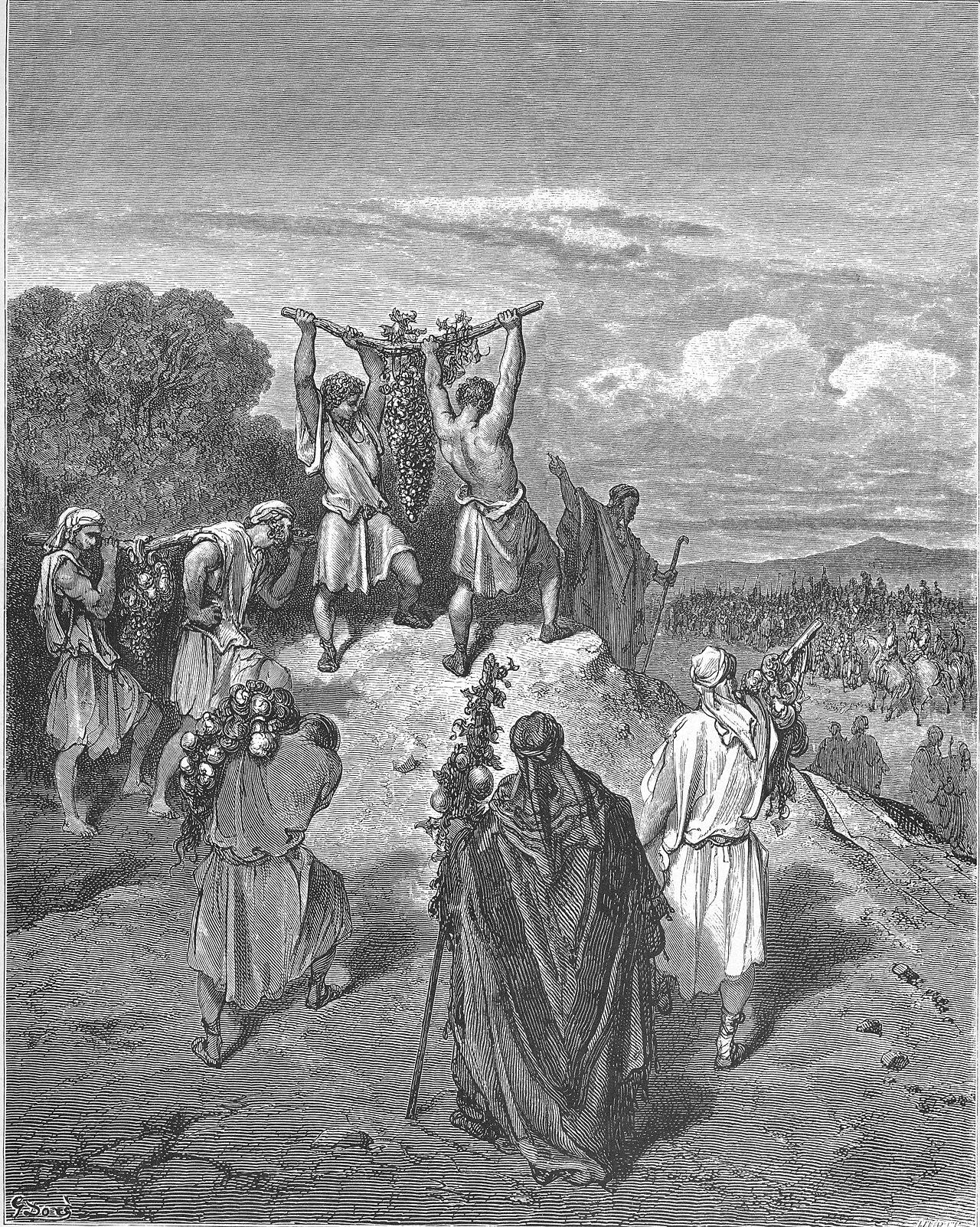
in Numbers 13When they came to the Valley of Eshcol, they cut down a branch with a single cluster of grapes, which they carried on a pole between two men. They also took some pomegranates and figs.
BSB
The same verse in ASV and KJV ▾
ASV
And they came unto the valley of Eshcol, and cut down from thence a branch with one cluster of grapes, and they bare it upon a staff between two; they brought also of the pomegranates, and of the figs.
KJV
And they came unto the brook of Eshcol, and cut down from thence a branch with one cluster of grapes, and they bare it between two upon a staff; and they brought of the pomegranates, and of the figs.
⋯
This verse in Numbers 13
Commentary
9 notes on this verseA commentator
Albert Barnes1798–1870
Notes, Explanatory and Practical, on the Old and New Testaments (1832-1869)
The brook of Eshcol is by some identified with the rich valley immediately to the north of Hebron; (but by others with Wady Hanein to the south of Hebron). The valley was, in all likelihood, originally named after one of the three chiefs who were confederate with Abraham Gen 14:24; but, as often came to pass, the Israelites, wittingly or unwittingly, took up in a new and significant sense the name which they found; and to them the valley thus became the Valley of the Cluster. Bunches of grapes are found in Palestine of many pounds weight.
This site's exposition
they bare it between two upon a staff
on Numbers 13:23-24
One cluster takes two men and a staff, and the pomegranates and figs come back with it, so the evidence for the promise is carried home on the shoulders of the men who will advise against acting on it. The valley takes its name from that cluster, and Genesis 14:13 and 14:24 had already given Eshcol as the name of an Amorite at Hebron who stood with Abram, which Albert Barnes reads as an older place name taken up in a new sense. Clement of Alexandria, in The Instructor, read the great cluster as the Word crushed for us, and that is a reading of the fathers rather than a statement the text makes.
The record, by era
The Puritans and the Awakening4 voices
Upon a staff - Either for the weight of it, considering the, length of the way they were to carry it, or for the preservation of it whole and entire. In those eastern and southern countries there are vines and grapes of an extraordinary bigness as Strabo and Pliny affirm.
Jehoshua - Oshea notes a desire of salvation, signifying, Save we pray thee; but Jehoshua, or Joshua, includes a promise of salvation, He will save. So this was a prophecy of his succession to Moses in the government, and of the success of his arms. Josh. is the same name with Jesus, of whom Joshua was a type.
And they came unto the brook of Eshcol,....
The major part discourage the people from going forward to Canaan; and justly are the Israelites left to this temptation, for putting so much confidence in the judgment of men, when they had the word of God to trust to. It is a righteous thing with God to give those up to strong delusions who will not receive his truth in the love of it.
The Nineteenth Century1 voice
A commentator
Jamieson, Fausset & Brown1802–1910
Commentary Critical and Explanatory on the Whole Bible (1871)
proposed
The valley and its sloping hills are still covered with vineyards, the character of whose fruit corresponds to its ancient celebrity. and cut down from thence a branch with one cluster of grapes--The grapes reared in this locality are still as magnificent as formerly--they are said by one to be equal in size to prunes, and compared by another to a man's thumb.
2 more voices on this verse
The Nineteenth Century2 voices
A commentator
Jamieson, Fausset & Brown1802–1910
Commentary Critical and Explanatory on the Whole Bible (1871)
proposed
So they . . . searched the land--They advanced from south to north, reconnoitering the whole land. the wilderness of Zin--a long level plain, or deep valley of sand, the monotony of which is relieved by a few tamarisk and rethem trees.
They bare it between two upon a staff - It would be very easy to produce a great number of witnesses to prove that grapes in the promised land, and indeed in various other hot countries, grow to a prodigious size. By Calmet, Scheuchzer, and Harmer, this subject has been exhausted, and to these I may refer the reader. Pliny mentions bunches of grapes in Africa each of which was larger than an infant. Radzvil saw at Rhodes bunches of grapes three quarters of an ell in length, each grape as large as a plum. Dandini saw grapes of this size at Mount Libanus; and Paul Lucas mentions some bunches which he saw at Damascus that weighed above forty-five pounds. From the most authentic accounts the Egyptian grape is very small, and this being the only one with which the Israelites were acquainted, the great size of the grapes of Hebron would appear still more extraordinary. I myself once cut down a bunch of grapes nearly twenty pounds in weight. Those who live in cold climates can scarcely have any conception to what perfection both grapes and other fruits grow in climates that are warm, and where the soil is suitable to them. From what is mentioned Num 23:20, Now the time was the time of the first-ripe grapes, it is very probable that the spies received their orders about the beginning of August, and returned about the middle of September, as in those countries grapes, pomegranates, and figs, are ripe about this time; see Harmer, vol. i., p. 108-110. At Sheeraz, in Persia, I find from a MS. […]
The words behind it
17 Hebrew wordsEvery Hebrew word of this verse in the order it stands, with what it means and the door to its own study. The last column counts the times a word stands in the whole Bible: the rarer the word, the more the places it appears belong together.
| Hebrew | Sound | Meaning | Word study | In the Bible |
|---|---|---|---|---|
| וַיָּבֹ֜אוּ | vaiyavou | and they came | H935 → | 2568 times |
| עַד־ | ʾad- | to | H5704 → | 1261 times |
| נַ֣חַל | nachal | [the] wadi of | H5158 → | 141 times |
| אֶשְׁכֹּ֗ל | ʾeshkol | Eshcol | H812 → | 6 times |
| וַיִּכְרְת֨וּ | vaiyikhretu | and they cut down | H3772 → | 288 times |
| מִשָּׁ֤ם | misham | from there | H8033 → | 834 times |
| זְמוֹרָה֙ | zemorah | a branch | H2156 → | |
| וְאֶשְׁכּ֤וֹל | veeshkol | and a cluster of | H811 → | |
| עֲנָבִים֙ | ʾanavim | grapes | H6025 → | 19 times |
| אֶחָ֔ד | ʾechad | one | H259 → | 971 times |
| וַיִּשָּׂאֻ֥הוּ | vaiyisauhu | and they carried it | H5375 → | 656 times |
| בַמּ֖וֹט | vamot | on the pole | H4132 → | 6 times |
| בִּשְׁנָ֑יִם | bishnayim | <in> two | H8147 → | 768 times |
| וּמִן־ | umin- | and some of | H4480 → | 1188 times |
| הָרִמֹּנִ֖ים | harimonim | the pomegranates | H7416 → | |
| וּמִן־ | umin- | and some of | H4480 → | 1188 times |
| הַתְּאֵנִֽים׃ | hateenim | the figs | H8384 → |
וַיָּבֹ֜אוּand they came
vaiyavouH935 →2568 times
עַד־to
ʾad-H5704 →1261 times
נַ֣חַל[the] wadi of
nachalH5158 →141 times
אֶשְׁכֹּ֗לEshcol
ʾeshkolH812 →6 times
וַיִּכְרְת֨וּand they cut down
vaiyikhretuH3772 →288 times
מִשָּׁ֤םfrom there
mishamH8033 →834 times
זְמוֹרָה֙a branch
zemorahH2156 →
וְאֶשְׁכּ֤וֹלand a cluster of
veeshkolH811 →
עֲנָבִים֙grapes
ʾanavimH6025 →19 times
אֶחָ֔דone
ʾechadH259 →971 times
וַיִּשָּׂאֻ֥הוּand they carried it
vaiyisauhuH5375 →656 times
בַמּ֖וֹטon the pole
vamotH4132 →6 times
בִּשְׁנָ֑יִם<in> two
bishnayimH8147 →768 times
וּמִן־and some of
umin-H4480 →1188 times
הָרִמֹּנִ֖יםthe pomegranates
harimonimH7416 →
וּמִן־and some of
umin-H4480 →1188 times
הַתְּאֵנִֽים׃the figs
hateenimH8384 →
A shaded row is a word that stands 400 times or fewer in the Bible.
The walk
6 stopsEach card is a verse this one points to, and under it the verses that one points to in turn. Where several paths arrive at the same place, that place is listed first: the text keeps returning to it.
Through
Judges 16:4Some time later, Samson fell in love with a woman in the Valley of Sorek, whose name was Delilah.
it leads to
- Proverbs 22:14
The mouth of an adulteress is a deep pit; he who is under the wrath of the LORD will fall into it.
- 1 Corinthians 10:6
These things took place as examples to keep us from craving evil things as they did.
- Proverbs 23:27
For a prostitute is a deep pit, and an adulteress is a narrow well.
- Nehemiah 13:26
Did not King Solomon of Israel sin in matters like this? There was not a king like him among many nations, and he was loved by his God, who made him king over all…
- Proverbs 26:11
As a dog returns to its vomit, so a fool repeats his folly.
- Proverbs 22:14
Through
Numbers 32:9For when your fathers went up to the Valley of Eshcol and saw the land, they discouraged the Israelites from entering the land that the LORD had given them.
it leads to
- Deuteronomy 1:24–28
They left and went up into the hill country, and came to the Valley of Eshcol and spied out the land.
- Deuteronomy 1:24–28
Where this verse is studied
About Numbers
This page draws on Adam Clarke, Commentary on the Bible; Albert Barnes, Notes, Explanatory and Practical, on the Old and New Testaments (1832-1869); Albert Barnes, Notes on the Old Testament; Jamieson, Fausset & Brown, Commentary Critical and Explanatory on the Whole Bible; John Gill, Exposition of the Old Testament (1748-1763); John Wesley, Explanatory Notes upon the Old Testament and Matthew Henry, Commentary on the Whole Bible.