
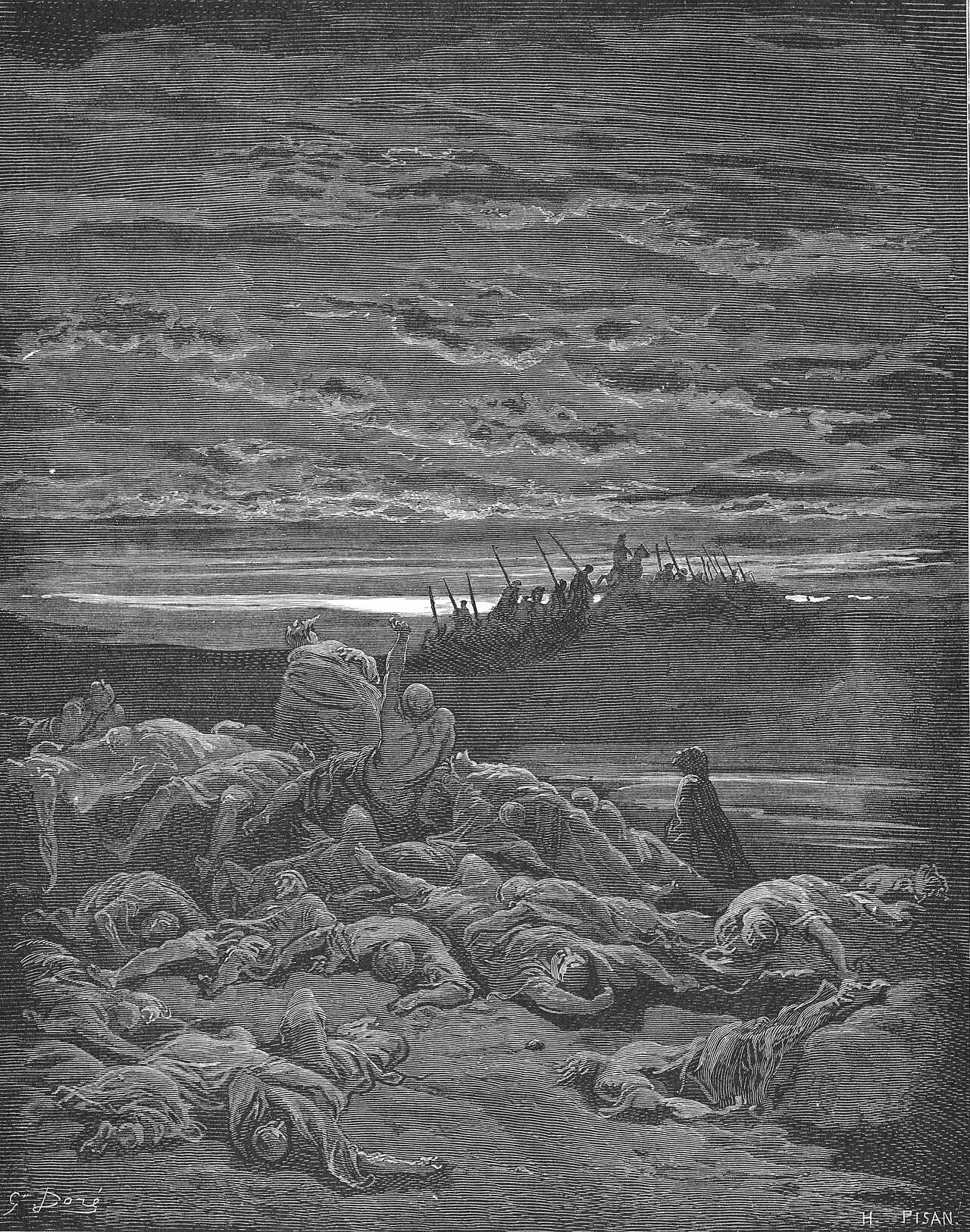
Judgeschapter 9
57 verses · Samuel, by tradition · 11th century BC · History
The trees went forth on a time to anoint a king over them; and they said unto the olive tree, Reign thou over us.
Introduction
Samuel, by tradition, History, Judges Overview.
Samuel, by tradition · Narrative with a fable · Judges, the Former Prophets · [The book of Judges](/book/judges) This chapter is the story of a son of Gideon who made himself king, and it is the longest chapter in the book. The writer is unnamed, and he gives this man none of the titles the book grants its judges. It was written for Israelites who would one day ask for a king and needed to see what a bad one looks like. Listen for the one speech in the chapter, a story about trees told from a mountainside. Watch how the violence turns back on those who began it. The chapter shows justice arriving slowly and exactly.
Context
- Who
- Israelites who lived within reach of Shechem and knew what the town had been
- What
- The account of Abimelech, who killed his brothers to rule at Shechem, and of Jotham's fable against him.
- Where
- Shechem between Mount Gerizim and Mount Ebal, with Arumah and Thebez nearby.
- When
- Three years, about 1120 to 1117 BC on the traditional reckoning, directly after Gideon's forty years of rest.
- Why
- To show what kingship taken by violence produces, and that God repaid the evil of both the man and the town.
Historical context
The man at the centre is Abimelech, son of Gideon by a concubine who lived at Shechem, named at Judges 8:31. He holds no office the book recognises, since Judges never calls him a judge and never says the Spirit came upon him.
Show the rest of the historical context, 7 more paragraphs
The three years fall about 1120 to 1117 BC on the traditional reckoning, directly after the forty years of rest that closed the Gideon account.
Shechem sits in a pass between Mount Gerizim and Mount Ebal, in the hill country of Ephraim, on the main north road. Thebez lies a few hours north of it, and Arumah, where Abimelech based himself, is nearby.
The occasion is a bid for a crown made among his mother's people, where the seventy sons of Gideon were outsiders and he was not.
A first hearer knew what Shechem was before this. Jacob camped there and bought ground at Genesis 33:19, Joshua 24 renewed the covenant there, and Joseph's bones were buried there at Joshua 24:32. It was the most covenant-laden town in the country.
He knew what the temple treasury of Baal-berith was, and what it meant that a shrine paid for a coup. The name means lord of the covenant, a covenant word fastened to a Canaanite god, and Judges 8:33 says Israel had taken that god up as soon as Gideon died.
He knew the weapon in verse 53. The upper millstone was the stone a woman turned by hand in her own house, light enough to lift and heavy enough to kill, so the thing that ends the chapter came off a roof and out of a kitchen.
And he knew what sowing a town with salt announced. Deuteronomy 29:23 describes a judged land as brimstone and salt, and the act declares that nothing is to grow on the site again.
Significance
For a first hearer this was the answer to the question the previous chapter raised. Israel had asked Gideon to rule them and he had refused; here is what happened when one of his sons took the crown anyway.
Show the rest of the significance, 2 more paragraphs
The fable of the trees was the part that travelled. It says that the people worth following are busy with work that matters, and that the candidate with nothing to lose is the one who accepts, and it says so about a specific town on the day it crowned a specific man.
The closing verses told them the account was settled. The narrator says in his own voice that God repaid both the man and the town, which is a thing this book rarely stops to say.
This chapter in Jewish lifeWhat this chapter is in Jewish life and reading.
How it is read
The classical Jewish reading of this chapter is carried by its fable, and Rashi reads the fable as an allegory of the judges themselves. He is quoted here from the Metsudah Tanach series of Lakewood, New Jersey, under CC-BY. At the eighth verse he says of the trees going out to anoint a king, "This is a parable", naming Yalkut as his source (Rashi on Judges 9:8:1). He then gives each tree a name. The fig tree "refers to Devorah", pointing back to the fourth chapter (Rashi on Judges 9:10:1). The vine refers to Gideon, a descendant of Joseph, of whom the blessing in Genesis speaks. Rashi takes the Targum's rendering of that blessing as a vine set over a spring (Rashi on Judges 9:12:1). On that reading the fable is Jotham's account of the men who had already refused the crown, and the bramble at the end is his half-brother.
One note in the fable explains a line that has puzzled readers of every tradition. Wine is said to gladden God, and Rashi grounds the phrase in the temple service. The Levites chanted the songs of praise only during the pouring of the wine, on the authority of tractate Berakhot (Rashi on Judges 9:13:1). The oil of the olive he glosses as richness (Rashi on Judges 9:9:1), and the sweetness of the fig as the honey of dates (Rashi on Judges 9:11:1). The bramble he names by its old French word (Rashi on Judges 9:14:1). The bramble's condition he reads as a claim of right, spoken because the speaker holds that he qualifies to reign (Rashi on Judges 9:15:1).
On Abimelech himself the notes are brief and hard. The men he hired are read as acting impetuously and without thought (Rashi on Judges 9:4:1). The place of his crowning Rashi takes from Targum Jonathan as a plain in which monuments stood (Rashi on Judges 9:6:1). Of his three years over Israel he says that he wielded his authority through repression and carried himself arrogantly (Rashi on Judges 9:22:1). That is how the classical reading answers the question of whether the book counts him among the judges. The spirit God sent between him and the men of Shechem Rashi glosses in one word, hatred, with the old French beside it (Rashi on Judges 9:23:1).
Twelve further notes stand on this chapter with no English text in the corpus and are cited here unquoted. They are Metzudat David on Judges 9:2:1, 9:3:1, 9:7:1, 9:16:1, 9:17:1, 9:19:1, 9:21:1 and 9:25:1, and Radak on Judges 9:5:1, 9:18:1, 9:20:1 and 9:24:1. One of those stands on the murder of the seventy brothers at the fifth verse, and one on the reckoning at the twenty-fourth.
What the rabbis say
The corpus carries forty rabbinic locators on this chapter, thirty-four Midrash and six Talmud, and the text of none, so each is cited and linked here rather than quoted. Abimelech's approach to his mother's family draws Midrash Tanchuma, Vayikra 3:1. The silver from the house of Baal-berith draws Midrash Sekhel Tov, Bereshit 49:4:1. The killing of his brothers on one stone draws Aggadat Bereshit 26:2 and Otzar Midrashim, Aharon, And These are the Generations of Aharon and Moshe 10. Jotham on Mount Gerizim draws Yalkut Shimoni on Torah 938:55, and the opening of the fable draws Otzar Midrashim, Baraita of The 32 Midot of Aggadah 1:31.
The trees of the fable are taken up one by one. The fig tree draws Midrash Tanchuma Buber, Vayera 29:2 and the vine Bereshit Rabbati, Parashat Vayera 18. The wine that gladdens God and man draws seven locators, the heaviest run in the chapter. They are Arakhin 11a:14, Berakhot 35a:3, Ein Yaakov, Berakhot 6:2, Jerusalem Talmud Sukkah 4:7:3, Mekhilta DeRabbi Yishmael, Tractate Shirah 2:9, Pirkei DeRabbi Eliezer 23:12 and Yalkut Shimoni on Torah 61:9. The bramble draws Jerusalem Talmud Sheviit 7:2:1, and Jotham's charge against Shechem draws Midrash Lekach Tov, Deuteronomy 32:52:1.
Abimelech's three years draw Aggadat Bereshit 26:1 and 26:3, Midrash Tanchuma Buber, Vayera 28:1 and 29:1, Otzar Midrashim, Midrashim on Missing and Extra Letters 2:8 and Seder Olam Rabbah 12:2. The evil spirit between him and Shechem draws Midrash Aggadah, Leviticus 1:1:2, Sifrei Zuta; Midrashah shel Lod, Place of Compilation of Sifrei Zuta and Its Final Redactor 69 and Yalkut Shimoni on Torah 427:2. The ambushes on the hilltops draw Bava Kamma 79b:5, Bereshit Rabbah 54:3, Ein Yaakov, Bava Kamma 7:6 and Midrash Sekhel Tov, Bereshit 21:34:2, and the coming of Gaal Midrash Sekhel Tov, Bereshit 34:25:5.
The end of the chapter is followed closely. The taunt at the gate draws Jerusalem Talmud Pesachim 6:3:2, the flight into the tower Yalkut Shimoni on Torah 168:2, and the branches carried to burn it Bereshit Rabbati, Parashat Miketz 33. The millstone that broke his skull draws five locators: Midrash Lekach Tov, Genesis 25:22:1, Midrash Sekhel Tov, Bereshit 25:22:1, Midrash Tanchuma Buber, Vayikra 13:1, Midrash Tanchuma, Bereshit 7:7 and Midrash Tanchuma, Vayikra 7:1. The verdict the chapter gives on his wickedness draws Bereshit Rabbati, Parashat Vayeshev 5. What each of them teaches is a saying of the rabbis, and is reported as theirs wherever this site quotes one. The quotations wait on a fetch that carries the text.
Sources: Rashi, Rashi on Judges 9:4:1 to 9:23:1, twelve notes, the Metsudah Tanach series, Lakewood, N.J, CC-BY; Metzudat David, Metzudat David on Judges 9:2:1, 9:3:1, 9:7:1, 9:16:1, 9:17:1, 9:19:1, 9:21:1 and 9:25:1, cited by ref because the corpus carries no English text; Radak, Radak on Judges 9:5:1, 9:18:1, 9:20:1 and 9:24:1, cited by ref because the corpus carries no English text; The Sefaria corpus, scripts/data/sources/sefaria/judges/9.json, the 40 rabbinic locators of this chapter, 34 Midrash and 6 Talmud.
The heads below are this chapter's scenes. The numbered points under each are its verses.
Seventy brothers killed on one stone
Judges 9:1-3
Gideon said at 8:23 that neither he nor his son would rule, and here his son canvasses for the crown. Abimelech argues from kinship rather than right, "I am your own flesh and blood," the formula Laban used of Jacob at Genesis 29:14 and the tribes used of David at 2 Samuel 5:1. Shechem is his mother's town, so there Gideon's seventy sons are outsiders and he is not.
Judges 9:1
“We are not told how soon after the death of Gideon these events happened. There must have been time for the apostacy and establishment of Baal-worship, and for the development of ill-will between Abimelech and his brethren.”
Jamieson, Fausset & Brown call the question a false insinuation, since Gideon had refused the crown for his house and no son is shown seeking it. Adam Clarke grants the argument its force, seventy tyrants or one. He adds that a ruler with no right must hold power by the sword.
Judges 9:2
“Whether is better for you, either that all the sons of Jerubbaal, . . . or that one reign over you--a false insinuation, artfully contrived to stir up jealousy and alarm. Gideon had rejected, with abhorrence, the proposal to make himself or any of his family king, and there is no evidence that any of his other sons coveted the title.”
Jamieson, Fausset & Brown · Commentary Critical and Explanatory on the Whole Bible (1871)reformed
1 more voice on this verse
Judges 9:2
“Whether is better for you, either that all the sons - This was a powerful argument: Whether will you have seventy tyrants or only one? For, as he had no right to the government, and God alone was king at that time in Israel; so he must support his usurped rule by whatever means were most likely to effect it: a usurped government is generally supported by oppression and the sword.”
Adam Clarke · Commentary on the Bible (1810-1826)evangelical
He is our brother: Albert Barnes reads the vote as Ephraimite pride turning from rulers of Gideon's clan, Abiezer, toward a man born in Shechem. He finds the same spirit later at 2 Samuel 20:1 and 1 Kings 12:16. The same tribe quarrelled with Gideon at 8:1.
Judges 9:3
“The Ephraimite pride revolted from Abi-ezrite rulers, and inclined them to one who was a Shechemite by birth. (Compare the same spirit in the time of David and Rehoboam, 2Sa 20:1; 1Ki 12:16.)”
Judges 9:4-5
The silver comes from the temple of Baal-berith, the god Israel took up when Gideon died at 8:33, so the shrine funds the coup. Seventy shekels buy seventy deaths, one a brother, and the "worthless and reckless men" hired are the following Jephthah gathers at 11:3. The killing "on one stone" reads as an execution, and Jotham survives by hiding, as Joash later does at 2 Kings 11:2.
Judges 9:4
“Threescore and ten pieces of silver - Probably shekels; and this was the whole of his exchequer. As he was now usurping the government of God, he begins with a contribution from the idol temple. A work begun under the name and influence of the devil is not likely to end to the glory of God, or to the welfare of man. Hired vain and light persons - אנשים ריקים ופחזים anashim reykim uphochazim, worthless and dissolute men; persons who were living on the public, and had nothing to lose. Such was the foundation of his Babel government.”
Adam Clarke · Commentary on the Bible (1810-1826)evangelical
1 more voice on this verse
Judges 9:4
“Pieces of silver - Not shekels, which were too small a sum for this purpose; but far larger pieces, the exact worth whereof it is not possible for us now to know. The house of Baal-berith - Out of his sacred treasury; having since Gideon's death built this temple (which he would never have suffered whilst he lived) and endowed it with considerable revenues.”
John Wesley · Explanatory Notes upon the Old Testament (1765)evangelical
John Gill offers two readings of the one stone: a convenient block for execution, or an altar on which the sons were offered to Baal, whose temple paid the killers. Adam Clarke calls this the usual way to secure a stolen throne, removing every man with a better right. Jotham's hiding keeps one witness alive.
Judges 9:5
“And he went to his father's house at Ophrah,.... Which, according to Bunting (a), was ten miles from Shechem: and slew his brethren the sons of Jerubbaal, being seventy persons, upon one stone: in which he was assisted by the ruffians he had hired with seventy pieces of silver; these were laid one after another upon one and the same stone, as being convenient for the execution of them; or as serving as an altar on which they were sacrificed to Baal, out of whose temple the money was taken to hire the executioners with.”
1 more voice on this verse
Judges 9:5
“Slew his brethren - His brothers by the father’s side, Jdg 8:30. This was a usual way of securing an ill-gotten throne; the person who had no right destroying all those that had right, that he might have no competitors. Yet Jotham - was left - That is, all the seventy were killed except Jotham, if there were not seventy besides Jotham.”
Adam Clarke · Commentary on the Bible (1810-1826)evangelical
Abimelech is crowned "beside the oak at the pillar in Shechem," where the King James reads plain. At Joshua 24:26 a great stone was set under an oak by the sanctuary here, when Israel swore to serve the LORD alone, and Keil and Delitzsch take the trees as one. Beth-millo is the citadel quarter, and in the Hebrew the name Millo returns in Jerusalem at 2 Samuel 5:9.
Judges 9:6
“Of the pillar - Or, by the oak of the pillar, by the oak, where Joshua erected a pillar as a witness of the covenant renewed between God and Israel, Josh. xxiv, 26. This place they chose, to signify that they still owned God, and their covenant with him; and did not worship Baal in opposition to God, but in conjunction with him, or in subordination to him.”
John Wesley · Explanatory Notes upon the Old Testament (1765)evangelical
Jotham's fable of the trees and the bramble
Gerizim is the mountain of blessing, appointed at Deuteronomy 11:29 and 27:12 and used at Joshua 8:33 when the nation stood between the two hills to hear the law. Jotham climbs the side of blessing and speaks a curse from it. His opening line, "Listen to me, O leaders of Shechem, and may God listen to you," sets what follows as testimony given before God.
Judges 9:7
“Mount Gerizim - Which lay near Shechem. The valley between Gerizim and Ebal, was a famous place, employed for the solemn reading of the law, and its blessings and curses: and it is probable it was still used, even by the superstitious and idolatrous Israelites for such occasions, who delighted to use the same places which their ancestors had used.”
John Wesley · Explanatory Notes upon the Old Testament (1765)evangelical
Judges 9:8-9
The only other fable of this kind in Scripture is the thistle and the cedar Jehoash sends at 2 Kings 14:9. The trees set out "to anoint a king," the Torah word for making a priest or a king, so the picture is a throne. The olive answers first, since its oil fills the lamps and anoints, and it refuses because ruling would cost it the work it already does.
Judges 9:8
“The trees went forth on a time to anoint a king over them,.... This is an apologue or fable, and a very fine and beautiful one; it is fitly expressed to answer the design, and the most ancient of the kind, being made seven hundred years before the times of Aesop, so famous for his fables, and exceeds anything written by him.”
ConnectionsDaniel 4:10
Adam Clarke would translate the Hebrew elohim here as gods, since the fable is told to a town that worshipped Baal-berith. He notes that the Latin Vulgate and the Arabic version read it that way. The BSB keeps God.
Judges 9:9
“Wherewith - they honor God and man - I believe the word אלהים elohim here should be translated gods, for the parable seems to be accommodated to the idolatrous state of the Shechemites. Thus it was understood by the Vulgate, Arabic, and others.”
Adam Clarke · Commentary on the Bible (1810-1826)evangelical
Judges 9:10-13
Olive, fig and vine are the crops of a settled land, listed at Deuteronomy 8:8 and pictured again at 1 Kings 4:25. Each refuses in the same terms, that ruling would cost it its fruit, and each names something it gives away freely. The vine's "wine that cheers both God and man" points at the drink offering of Numbers 15:5 as well as the table.
Judges 9:10
“And the trees said to the fig tree,.... Another useful and fruit bearing tree, and to which also good men are sometimes compared, see Son 2:13, come thou, and reign over us: which Jarchi applies to Deborah, but may be better applied to one of Gideon's sons, who, though they had not a personal offer of kingly government themselves, yet it was made to them through their father, and refused, as for himself, so for them; and had it been offered to them, they would have rejected it, as Jotham seems to intimate by this parable.”
my sweetness, and my good fruit: John Gill cites the emperor Julian, who gathered from Aristophanes, Herodotus and Homer that nothing is sweeter than figs except honey. Adam Clarke adds from his own experience that a ripe fig in its own climate is almost too sweet to eat fresh. The fig's refusal rests on that sweetness.
Judges 9:11
“And the fig tree said unto them,.... Rejecting the offer made: should I forsake my sweetness and my good fruit; for such the fruit of the fig tree is, sweet and good: so Julian (d) the emperor shows from various authors, Aristophanes, Herodotus, and Homer, that nothing is sweeter than figs, excepting honey, and that no kind of fruit is better, and, where they are, no good is wanting: and go to be promoted over the trees? the same is designed by this as the former. (d) Opera, par. 2. ep. 24. Sarapioni, p. 142.”
1 more voice on this verse
Judges 9:11
“But the fig tree said - Should I forsake my sweetness - The fruit of the fig tree is the sweetest or most luscious of all fruits. A full-ripe fig, in its own climate, has an indescribable sweetness; so much so that it is almost impossible to eat it, till a considerable time after it is gathered from the trees, and has gone through an artificial preparation. This I have often noticed.”
Adam Clarke · Commentary on the Bible (1810-1826)evangelical
The trees say to the vine the same words they said to the fig tree in verse 10, and they will say them once more to the thornbush in verse 14. The request never changes. Only the tree asked changes.
Adam Clarke reads gods here as he does at verse 9, and notes that heathen worship poured out large libations of wine in the belief that the gods drank them. Read that way, the vine speaks the language of Shechem's own shrine. Clarke names nectar as the wine of the pagan heaven.
Judges 9:13
“Which cheereth God and man - I believe אלהים elohim here is to be taken in the same sense proposed on Jdg 9:9. Vast libations of wine, as well as much oil, were used in heathenish sacrifices and offerings; and it was their opinion that the gods actually partook of, and were delighted with, both the wine and oil. The pagan mythology furnishes the most exquisite wines to its gods in heaven, and hence the nectar and ambrosia so much talked of and praised by the ancients.”
Adam Clarke · Commentary on the Bible (1810-1826)evangelical
Judges 9:14-15
The thornbush bears no fruit and no shade worth standing in, and dry thorn catches fire faster than anything in a field. It invites the trees to "find refuge in my shade," the Hebrew verb used of taking refuge in God at Psalm 2:12. Its threat to "consume the cedars of Lebanon," the tallest trees Scripture names, is carried out twice before the chapter ends.
Judges 9:14
“Then said all the trees unto the bramble - The word אטד atad, which we translate bramble, is supposed to mean the rhamnus, which is the largest of thorns, producing dreadful spikes, similar to darts. See Theodoret on Psa 58:10. There is much of the moral of this fable contained in the different kinds of trees mentioned. 1. The olive; the most profitable tree to its owner, having few equals either for food or medicine.”
Adam Clarke · Commentary on the Bible (1810-1826)evangelical
John Wesley reads the cedars as the nobles of Shechem, such as the house of Millo, who pushed hardest for the crowning. Adam Clarke calls the offer all promise and no performance. The condition, if you really are anointing me, is the test Jotham applies in verse 16.
Judges 9:15
“Come and put your trust in any shadow - The vain boast of the would-be sovereign; and of the man who is seeking to be put into power by the suffrages of the people. All promise, no performance. Let fire come out of the bramble - A strong catachresis. The bramble was too low to give shelter to any tree; and so far from being able to consume others, that the smallest fire will reduce it to ashes, and that in the shortest time.”
Adam Clarke · Commentary on the Bible (1810-1826)evangelical
1 more voice on this verse
Judges 9:15
“If in truth - If you deal truly and justly in making me king. Then trust - Then you may expect protection under my government. Devour the cedars - In stead of protection, you shall receive destruction by me; especially you cedars, that is, nobles, such as the house of Millo, who have been most forward in this work.”
John Wesley · Explanatory Notes upon the Old Testament (1765)evangelical
Judges 9:16-18
Jotham drops the picture and names the men standing below him. His charge has three parts: Gideon "risked his life to deliver you," they killed his seventy sons "on a single stone," and they crowned the son of his maidservant "because he is your brother". The speech turns the narrative of verse 5 back on the town that did the killing.
Judges 9:16
“Gideon had left many sons that were an honour to his name and family, and these they had barbarously murdered; one son he had left that was the blemish of his name and family, for he was the son of his maid-servant, whom all that had any respect to Gideon's honour would endeavour to conceal, yet him they made their king.”
Matthew Henry · Commentary on the Whole Bible (1707-1721)puritan
Matthew Henry notes that Gideon fought Shechem's battles at the risk of his own life, and calls it a shame that they needed reminding. The verse sets that debt against 8:35, where Israel showed no kindness to his house. The sentence runs straight on into the charge.
Judges 9:17
“He fought their battles, at the hazard of his own life, and to their unspeakable advantage. It was a shame that they needed to be put in mind of this.”
Matthew Henry · Commentary on the Whole Bible (1707-1721)puritan
the son of his maidservant: John Wesley hears reproach in the son of his maidservant, since 8:31 calls her a concubine. He also reads king over the leaders of Shechem as a pointed limit, because one city's leaders had no right to set a king over all Israel. Verse 22 shows him reigning over Israel anyway.
Judges 9:18
“Maidservant - His concubine, whom he so calls by way of reproach. Over Shechem - By which limitation of their power, and his kingdom, he reflects contempt upon him, and chargeth them with presumption, that having only power over their own city, they durst impose a king upon all Israel.”
John Wesley · Explanatory Notes upon the Old Testament (1765)evangelical
Judges 9:19-21
The curse is framed as a condition and it runs both ways, fire from Abimelech devouring Shechem and fire from Shechem devouring Abimelech. Both halves are reported as done by verse 49 and verse 53, and the narrator says so outright at verse 57. Jotham then runs to Beer and leaves the book, so the one survivor of the seventy never comes back to claim anything.
Adam Clarke takes the line as prophecy, with Abimelech kindling civil strife as a thorn kindles other wood. John Wesley reads it as an imprecation, a curse that took effect because its cause was just. Verse 57 calls it the curse of Jotham.
Judges 9:20
“Let fire come out from Abimelech - As the thorn or bramble may be the means of kindling other wood, because it may be easily ignited; so shall Abimelech be the cause of kindling a fire of civil discord among you, that shall consume the rulers and great men of your country. A prophetic declaration of what would take place.”
Adam Clarke · Commentary on the Bible (1810-1826)evangelical
1 more voice on this verse
Judges 9:20
“Devour Abimelech - This is not so much a prediction as an imprecation, which, being grounded upon just cause, had its effect, as others in like case had.”
John Wesley · Explanatory Notes upon the Old Testament (1765)evangelical
Adam Clarke reports the traveller Maundrell, who found a place called Beer on the road to Jerusalem and took it for Jotham's refuge. It lay on a gentle slope with a spring at its foot, and the spring gave the place its name. Clarke gives the site as towards the south.
Judges 9:21
“Went to Beer - Mr. Maundrell, in his journey from Aleppo to Jerusalem, p. 64, 5th edit., mentions a place of this name, which he thinks to be that to which Jotham fled, and supposed to be the same as Mishmash, 1Sa 14:5, 1Sa 14:31. It is situated, he says, towards the south, on an easy declivity; and has a fountain of excellent water at the bottom of the hill from which it has taken its name.”
Adam Clarke · Commentary on the Bible (1810-1826)evangelical
Shechem turns on the king it crowned
Judges 9:22-24
God sends "a spirit of animosity between Abimelech and the leaders of Shechem," and in the King James the words evil spirit first stand together here, then for Saul at 1 Samuel 16:14. Some read a created spirit on an errand, while Gill and Clarke lean toward suspicion stirred among men under God's rule. Verse 24 lays the blood on the town as well, because Shechem paid for the killing.
Judges 9:22
“None could "reign" in Israel, except by rebellious usurpation; and hence the reign of Abimelech is expressed in the original by a word signifying "despotism," not that which describes the mild and divinely authorized rule of the judge.”
Jamieson, Fausset & Brown · Commentary Critical and Explanatory on the Whole Bible (1871)reformed
1 more voice on this verse
Judges 9:22
“Had reigned - Rather, “had ruled.” It is not the phrase used in Jdg 9:6. It looks as if the Shechemites alone had made him king, and the rest of Israel had submitted to his dominion, without allowing his title of king.”
Matthew Henry locates the evil spirit in the men's own lusts, which God gave them up to. On his reading the sin becomes the punishment, and the punishment is from God. The partners in murder turn on each other.
Judges 9:23
“God sent an evil spirit - He permitted jealousies to take place which produced factions; and these factions produced insurrections, civil contentions, and slaughter.”
Adam Clarke · Commentary on the Bible (1810-1826)evangelical
1 more voice on this verse
Judges 9:23
“Their own lusts were evil spirits; they are devils in men's own hearts; from them come wars and fightings. These God gave them up to, and so might be said to send the evil spirits between them. When men's sin is made their punishment, though God is not the author of the sin, yet the punishment is from him.”
Matthew Henry · Commentary on the Whole Bible (1707-1721)puritan
John Gill lists the ways Shechem shared the guilt: the money for the hired men, perhaps words that urged them on, and perhaps killers drawn from the town itself. He reads the sequence as ordered in Providence so that the blood came home. Seventy deaths are laid on two parties.
Judges 9:24
“That the cruelty done to the seventy sons of Jerubbaal might come,.... That vengeance might come on the authors of it; so things were ordered in Providence that this might come to pass: and their blood be laid upon Abimelech their brother, which slew them; be charged to his account, and he suffer for shedding it: and upon the men of Shechem which aided him in killing of his brethren; by giving him money to hire men to go with him to do it, and perhaps by words encouraging the assassins, and who might be of the city of Shechem.”
Judges 9:25-27
Robbing the roads cuts off the tolls and traffic a ruler lives on. When Gaal son of Ebed arrives, "the leaders of Shechem put their confidence in him," as they had in Abimelech three years before. They curse Abimelech at the vintage festival in "the house of their god," so the break is sworn in the shrine that paid for him at verse 4.
Judges 9:25
“The men of Shechem set liers in wait - It pleased God to punish this bad man by the very persons who had contributed to his iniquitous elevation. So God often makes the instruments of men’s sins the means of their punishment. It is likely that although Abimelech had his chief residence at Shechem, yet he frequently went to Ophrah, the city of his father; his claim to which there was none to oppose, as he had slain all his brethren.”
Adam Clarke · Commentary on the Bible (1810-1826)evangelical
Matthew Henry notes that Ebed means servant, so Gaal, like Abimelech, is a servant's son, one by the father's side and one by the mother's. Adam Clarke, who notes that he appears only in this chapter, takes him for a Canaanite hoping to restore the old rule of Hamor. Verse 28 bears Clarke out.
Judges 9:26
“Gaal the son of Ebed - Of this person we know no more than is here told. He was probably one of the descendants of the Canaanites, who hoped from the state of the public mind, and their disaffection to Abimelech, to cause a revolution, and thus to restore the ancient government as it was under Hamor, the father of Shechem.”
Adam Clarke · Commentary on the Bible (1810-1826)evangelical
1 more voice on this verse
Judges 9:26
“This Gaal is said to be the son of Ebed, which signifies a servant, perhaps denoting the meanness of his extraction. As Abimelech was by the mother's side, so he by the father's, the son of a servant.”
Matthew Henry · Commentary on the Whole Bible (1707-1721)puritan
Albert Barnes marks this as the point where the robbery of verse 25 turned into open rebellion, and he notes that the men were excited with wine. He takes cursed to mean reviling, the sense it has at 2 Samuel 19:21. The vine's wine of verse 13 now feeds a revolt.
Judges 9:27
“Seditious and lawless acts Jdg 9:25-26 now broke out into open rebellion. It was at an idolatrous feast in the house of Baal-berith, on occasion of the vintage, and when they were excited with wine, that the rebellion was matured. Those present began to “curse Abimelech,” to speak insultingly of him, and to revile him (compare Lev 20:9; 2Sa 19:21; Isa 8:21).”
Judges 9:28-29
Who is Abimelech, and who is Shechem: Gaal tells the town to "serve the men of Hamor, the father of Shechem," calling up Genesis 33:19 and 34. Hamor's house is the family Simeon and Levi destroyed after Dinah, so the appeal reaches past Israel to the Canaanite city. He calls Abimelech "the son of Jerubbaal," the name given at 6:32 for fighting Baal, and makes it a reason for a Baal-berith town to be rid of him.
Judges 9:28
“This he might speak sincerely, as being himself a Canaanite and Shechemite, and possibly came from one of those little ones whom Simeon and Levi spared when they slew all the grown males, Gen. xxxiv, 29. And it may be that he was one of the royal blood, a descendent of Hamor, who hereby sought to insinuate himself into the government, as it follows, ver. 29.”
John Wesley · Explanatory Notes upon the Old Testament (1765)evangelical
Adam Clarke calls this the speech of a sly demagogue, and he reads Muster your army and come out as a challenge sent once Gaal felt strong enough. John Wesley infers from the wish that the town was still divided, with some still leaning to Abimelech. Zebul was one of them.
Judges 9:29
“Would to God this people were under my hand - The very words and conduct of a sly, hypocritical demagogue. Increase thine army, and come out - When he found his party strong, and the public feeling warped to his side, then he appears to have sent a challenge to Abimelech, to come out and fight him.”
Adam Clarke · Commentary on the Bible (1810-1826)evangelical
1 more voice on this verse
Judges 9:29
“My hand - That is, under my command; I wish you would unanimously submit to me, as your captain and governor; for he found them divided; and some of them hearkening after Abimelech, whom they had lately rejected, according to the levity of the popular humour.”
John Wesley · Explanatory Notes upon the Old Testament (1765)evangelical
Judges 9:30-33
Zebul holds the town for Abimelech and sends him word in secret, so the officer Gaal dismissed at verse 28 undoes him. The plan is the ambush of Joshua 8 in small compass: "lie in wait in the fields," rise at sunrise, let the city come out. No one asks God about any of it, and no priest, prophet or word from the LORD appears in the chapter's fifty-seven verses.
Judges 9:30
“And when Zebul the ruler of the city,.... Whom Abimelech had placed there under him: heard the words of Gaal the son of Ebed, his anger was kindled; because he spoke slightly of him, and wished to have his place; perhaps before Zebul was inclined to be on the side of the Shechemites against Abimelech, or at least dissembled that he was; but now, being incensed at the words of Gaal, determined to take the side of Abimelech, and let him know how things were carrying on against him.”
Albert Barnes notes that the Hebrew word read as covertly may be a place name, Tormah, which some take for the Arumah of verse 41. He also holds that Zebul hid his loyalty only because he was too weak to face Gaal alone. The ruler of the city works for its enemy.
Judges 9:31
“Privily - See the margin. The word is probably the name of a place in “Tormah”, some think the same as “Arumah” Jdg 9:41. Zebul was faithful to Abimelech, but dissembled his sentiments, from being too weak to oppose Gaal, until Abimelech came with his army Jdg 9:38.”
Matthew Henry asks how Shechem could hope to succeed while the ruler of its own city served the enemy. They knew where Zebul stood, he says, and took no care to secure him. The ambush is planned from inside the walls.
Judges 9:32
“How could the Shechemites hope to speed in their attempt when the ruler of their city was in the interests of their enemy? They knew it, and yet took no care to secure him. Gaal, that headed their faction, having been betrayed by Zebul, Abimelech's confidant, was most wretchedly bantered by him.”
Matthew Henry · Commentary on the Whole Bible (1707-1721)puritan
Zebul's plan counts on Gaal coming out, and verse 35 has him standing at the gate at the very hour the ambush rises. Do to them whatever you are able leaves the method to Abimelech. Sunrise matters again at verse 36.
Judges 9:33
“And it shall be, that in the morning, as soon as the sun is up, thou shalt rise early, and set upon the city,....”
Fire in the stronghold of the tower
Judges 9:34-36
Gaal stands "at the entrance of the city gate," where a town's leaders sat to judge, and sees men coming off the hills. Zebul answers, "The shadows of the mountains look like men to you," holding him there while the companies close in. In the Hebrew, shadows is the thornbush's word for its shade at verse 15, and the man the town trusted is told that armed men are shadows.
Judges 9:34
“And Abimelech rose up, and all the people that were with him, by night,.... According to the advice of Zebul: and they laid wait against Shechem in four companies; he divided his army into four parts, which he placed on the four sides of the city, at some distance from it, to act as they should have opportunity, to find ways and means of getting into it on either quarter.”
Adam Clarke supposes Gaal had some warning of the plan, which would explain why he stands watching at the gate. The verse times his arrival to the moment Abimelech's men leave their hiding places. The watcher and the ambush arrive together.
Judges 9:35
“Stood in the entering of the gate - Having probably got some intimation of the designs of Zebul and Abimelech.”
Adam Clarke · Commentary on the Bible (1810-1826)evangelical
John Wesley explains why the excuse could work, since in the morning the shadows are longest and move quickest. He also holds that Zebul hid his anger and feigned agreement so as to draw Gaal out where Abimelech could fight him. The ambush was set for sunrise at verse 33.
Judges 9:36
“To Zebul - Who concealed the anger which he had conceived, ver. 30, and pretended compliance with him in this expedition, that he might draw him forth into the field where Abimelech might have the opportunity of fighting with him, and overthrowing him. The shadow - For in the morning, as this was, and in the evening, the shadows are longest, and move quickest.”
John Wesley · Explanatory Notes upon the Old Testament (1765)evangelical
Judges 9:37-39
Meonenim means the soothsayers, so the second company comes past the "Diviners’ Oak," a landmark named for the practice Deuteronomy 18:10 to 14 forbids. Zebul asks, "Where is your gloating now," throws Gaal's own sentence back at him, and pushes him out of the gate to fight. Gaal goes out "before the leaders of Shechem," and the town he talked into rebellion is the only army he has.
Judges 9:37
“And Gaal spake again, and said,.... Looking towards the mountains, and taking another view of what he before saw, for further satisfaction: see, there come people down by the middle of the land; either in the valley between the two mountains; or rather those he first saw on the top of the mountains were now come down about the middle of them, called in the Hebrew text the navel, from the prominence of the mountains thereabout, or because the navel is in the middle of the body, as this part of them was the middle on which he saw them.”
1 more voice on this verse
Judges 9:37
“The plain of Meonenim - Translate “the oak of the soothsayers” (see the margin). Some well-known oak, so called, but which is not mentioned elsewhere.”
John Gill reads the taunt as the moment Zebul could no longer keep up the pretence, so he turned to reproach Gaal with his own words. The question of verse 28, Who is Abimelech, is now answered by an army on the hills. Gaal's own words send him out.
Judges 9:38
“Then said Zebul unto him,.... Not being able to put him off any longer, and willing to take the opportunity to upbraid him with what he had said: where is now thy mouth, wherewith thou saidst, who is Abimelech, that we should serve him? darest thou say the same thou hast done, and utter the contemptuous language concerning Abimelech, asking who he was, that he should be served?”
John Gill pictures Gaal at the head of whatever force he could gather in the time left, fighting outside the city. Matthew Henry calls the heavy losses the common fruit of popular tumults, where crowds follow men who promise glorious success. Gaal had promised much at verse 29.
Judges 9:39
“And Gaal went out before the men of Shechem,.... At the head of them, to meet Abimelech, having gathered together as many, and put them in as good order, as he could, and the time would admit of: and fought with Abimelech; without the city.”
1 more voice on this verse
Judges 9:39
“In this action the Shechemites' loss was considerable: Many were overthrown and wounded, the common effect of popular tumults, in which the inconsiderate multitude are often drawn into fatal snare by those that promise them glorious success.”
Matthew Henry · Commentary on the Whole Bible (1707-1721)puritan
Judges 9:40-41
The fighting ends where it began, with the wounded falling "all the way to the entrance of the gate". Abimelech stays in Arumah and leaves Zebul to drive Gaal and his brothers out of Shechem, which keeps the town standing another day. What comes next shows that the restraint was a matter of timing.
Matthew Henry notes the reversal, since the man who spoke of removing Abimelech at verse 29 is himself removed and never heard of again. John Wesley supposes the crowd turned on Gaal that same night, suspecting him of cowardice. Popular favour changed in a day.
Judges 9:41
“Most people judge of men's fitness for business by their success, and he that does not speed well is concluded not to do well. Well, Gaal's interest in Shechem is soon at an end, and he that had talked of removing Abimelech is himself removed, nor do we ever hear of him any more.”
Matthew Henry · Commentary on the Whole Bible (1707-1721)puritan
1 more voice on this verse
Judges 9:41
“Thrust out - It seems the same night. Probably the multitude, which is generally light and unstable, were now enraged against Gaal, suspecting him of cowardice or ill-conduct.”
John Wesley · Explanatory Notes upon the Old Testament (1765)evangelical
Judges 9:42-45
This time there are three companies, and the gate is held so the people in the fields cannot run back. Abimelech takes the city and "sowed it with salt," so nothing will grow there, as Deuteronomy 29:23 pictures a judged land as "a burning waste of sulfur and salt". Leviticus 2:13 puts "the salt of the covenant" in every offering, and here salt unmakes the town that crowned him.
Judges 9:42
“After Gaal’s expulsion, “the people went out into the field,” either to complete the vintage, or for some other agricultural operation. “They” (Zebul and his party) sent word of this to Abimelech.”
divided them into three companies: The people go out into the fields the day after Gaal is driven off, as verse 42 reports, and Abimelech is told of it. He lays the same kind of ambush he used at verse 34, lying in wait and rising when the city comes out. Shechem is caught twice by one method.
Albert Barnes reads this verse as the key to both divisions of Abimelech's forces, the four companies of verse 34 as well as the three here. On his reading one company always had the task of seizing the approach to the gate. Abimelech holds the gate in person.
Judges 9:44
“This verse explains the purpose of both the present and the former division of Abimelech’s forces into several companies, namely, that while some of the companies attacked the men of Shechem in the field, another company, starting from their ambush, might occupy the approach to the city gate, and so cut off their retreat.”
sowed it with salt: Albert Barnes reads the salt as hatred, a wish that the ruined city should not even become a fruitful field. The town is Abimelech's own, where his mother's brothers argued for him as flesh and blood at verses 2 and 3. The whole work took a single day.
Judges 9:45
“Sowed it with salt - Expressing by this action his hatred, and his wish, that when utterly destroyed as a city, it might not even be a fruitful field. Salt is the emblem of barrenness (see the marginal references).”
Judges 9:46-49
The survivors shut themselves in "the inner chamber of the temple of El-berith," the shrine that paid Abimelech at verse 4. He and his men cut branches on Mount Zalmon and burn about a thousand men and women. Jotham's curse at verse 20, "may fire come from Abimelech and consume the leaders of Shechem," is carried out with an axe, the trees of the fable as fuel.
Judges 9:46
“A hold of the house of the god Berith - This must mean the precincts of the temple, as we find there were a thousand men and women together in that place.”
Adam Clarke · Commentary on the Bible (1810-1826)evangelical
the tower of Shechem were gathered: John Gill supposes Abimelech kept spies watching the men in the tower, which is how the report reached him. He places them in the hold of the temple that verse 46 calls El-berith. The leaders take refuge in their god's house.
Judges 9:47
“And it was told Abimelech,.... Who had his spies about, and particularly to observe the motions of the men in this tower: that all the men of the tower of Shechem were gathered together; in the hold of the temple of Baalberith.”
Albert Barnes explains Zalmon as a thickly wooded hill near Shechem whose name means shady, perhaps Ebal itself. The branches come from a hill named for shade, the thing the thornbush promised at verse 15. The men copy their king.
Judges 9:48
“Zalmon - A lofty and thickly-wooded hill, as the etymology of the name (“shady”) implies, in the immediate neighborhood of Shechem: perhaps the same as Ebal. The setting fire to the hold, where the men of Shechem were all crowded together, with their wives and children, was the literal fulfillment of Jotham’s curse in Jdg 9:20.”
John Gill pictures the men carrying boughs on their shoulders, so that they looked like trees walking. He supposes the hold was built of wood, which would explain how it burned. The whole army shares the deed.
Judges 9:49
“And all the people likewise cut down every man his bough, and followed Abimelech,.... With their boughs on their shoulders, so that they were men that seemed to be as trees walking: and put them to the hold, and set the hold on fire upon them; upon the men in it, or with them, the boughs of trees; it is probable the hold was made of wood, and so could the more easily be set on fire.”
A millstone from the wall of Thebez
Judges 9:50-52
Thebez is named twice in the Bible, here and at 2 Samuel 11:21, and lies a few hours north of Shechem. Its people shut themselves in the strong tower as Shechem did, and Abimelech goes to the entrance to burn it as before. Joab's messenger is told the king will ask, "Why did you get so close to the wall," and this siege is the example he is given.
Judges 9:50
“Then went Abimelech to Thebez,.... Which, according to Ben Gersom, had rebelled against him; it was near to Shechem.”
Jamieson, Fausset & Brown, citing Goss, call every element of this siege true to life: the tower inside the city, the crowd on its roof, fire at the door and stones thrown down. The roof matters for what follows. From there a woman drops a millstone in verse 53.
Judges 9:51
“The besieged city--the strong tower within--the men and women crowding its battlements--the fire applied to the doors, and even the huge fragments of stone dropping from the hands of one of the garrison on the heads of the assailants, are all well represented to the life--just as they are here described in the narrative of inspired truth [GOSS].”
Jamieson, Fausset & Brown · Commentary Critical and Explanatory on the Whole Bible (1871)reformed
Albert Barnes calls the approach a plain danger, with the roof full of people ready to throw things down, and he holds that hatred made Abimelech despise it. Matthew Henry adds that one success makes the next desperate attempt look safe. Shechem's tower had fallen to fire.
Judges 9:52
“Went hard unto the door ... - i. e. went close to the door. An act of manifest danger, seeing the roof was covered with persons who would be likely to throw down missiles of all sorts on the heads of their assailants. But the hatred of Abimelech, and his thirst for revenge, made him despise danger.”
1 more voice on this verse
Judges 9:52
“Those who have escaped and succeeded well in one desperate attempt are apt to think the like attempt another time not desperate. This instance was long after quoted to show how dangerous it is to come near the call of a besieged city, 2 Sam. xi.”
Matthew Henry · Commentary on the Whole Bible (1707-1721)puritan
Judges 9:53-54
A stone killed seventy brothers at verse 5, and a stone from a woman's hand, the upper millstone of a kitchen, kills the man who used it. He dies "lest they say of me" that a woman killed him, though Judges 4:9 had already sold Sisera "into the hand of a woman." Joab recalls this death generations later at 2 Samuel 11:21.
Judges 9:53
“A piece of a millstone - פלח רכב pelach recheb, a piece of a chariot wheel; but the word is used in other places for upper millstones, and is so understood here by the Vulgate, Septuagint, Syriac, and Arabic. And all to break his skull - A most nonsensical version of ותרץ את גלגלתו vattarits eth gulgolto, which is literally, And she brake, or fractured, his skull. Plutarch, in his life of Pyrrhus, observes that this king was killed at the siege of Thebes, by a piece of a tile, which a woman threw upon his head.”
Adam Clarke · Commentary on the Bible (1810-1826)evangelical
1 more voice on this verse
Judges 9:53
“Mill-stone - Such great stones no doubt they carried up with them, whereby they might defend themselves, or offend those who assaulted them. Here the justice of God is remarkable in suiting the punishment to his sin.”
John Wesley · Explanatory Notes upon the Old Testament (1765)evangelical
Adam Clarke cites Seneca's lament that a woman was reported to have caused the death of Hercules, to show how deep the shame ran. He adds a second motive, that Abimelech feared cruelty and insult if he fell alive into his enemies' hands. Verse 53 still records the woman's stone.
Judges 9:54
“Draw thy sword, and slay me - It was a disgrace to be killed by a woman; on this account, Seneca the tragedian deplores the death of Hercules: - O turpe fatum! femina Herculeae necis Autor feritur. Herc. Oetaeus, ver. 1177. “O dishonorable fate! a woman is reported to have been author of the death of Hercules.” Abimelech was also afraid that if he fell thus mortally wounded into the hands of his enemies they might treat him with cruelty and insult.”
Adam Clarke · Commentary on the Bible (1810-1826)evangelical
Judges 9:55-57
The army goes home the moment he dies, which shows what had held it together. The narrator's judgment follows: "God repaid the wickedness that Abimelech had done," God brought the wickedness of Shechem "back upon their own heads," and "the curse of Jotham son of Jerubbaal came upon them". The chapter closes on the man who spoke from Gerizim and was never heard from again.
Judges 9:55
“And when the men of Israel saw that Abimelech was dead,.... That is, those that were with him, the men of his army, who were all Israelites: they departed every man to his place; disbanded themselves, and went everyone to their own home, and so the inhabitants of Thebez escaped the vengeance of Abimelech.”
John Gill notes that the verse counts the crime as done to his father, a wound to Gideon's name and house. He takes this closing remark to come from the book's writer, probably the prophet Samuel. Blood, he says, required blood.
Judges 9:56
“Thus God rendered the wickedness of Abimelech which he did unto his father,.... To the disgrace of his father's character, and to the hurt of his father's family: in slaying his seventy brethren; excepting one, which was a piece of unheard of wickedness, attended with most sad aggravations; the shedding such blood required blood to be shed again, and it was righteous judgment God rendered to him; this, and the following verse contain the remarks made upon this history by the writer of it, who, as we have seen, in all probability, was the Prophet Samuel.”
1 more voice on this verse
Judges 9:56
“Thus God rendered, etc. - Both the fratricide Abimelech, and the unprincipled men of Shechem, had the iniquity visited upon them of which they had been guilty. Man’s judgment may be avoided; but there is no escape from the judgments of God. I Have said that the fable of Jotham is the oldest, and perhaps the best, in the world; and referred for other particulars to the end of the chapter.”
Adam Clarke · Commentary on the Bible (1810-1826)evangelical
Matthew Henry notes that Abimelech survived the war with Shechem and fell at Thebez, a weak place by comparison, at a moment when he seemed secure and even triumphant. John Wesley reads the double repayment as a warning to all ages to expect blood for blood. The weak town ended the strong man.
Judges 9:57
“Render upon their heads - Thus God preserved the honour of his government, and gave warning to all ages, to expect blood for blood.”
John Wesley · Explanatory Notes upon the Old Testament (1765)evangelical
1 more voice on this verse
Judges 9:57
“No doubt this man was a murderer, whom, though he had escaped the dangers of the war with Shechem, yet vengeance suffered not to live, Acts xxviii. Evil pursues sinners, and sometimes overtakes them when they are not only secure, but triumphant. Thebez, we may suppose, was a weak inconsiderable place, compared with Shechem.”
Matthew Henry · Commentary on the Whole Bible (1707-1721)puritan
How this psalm is built
The form: Narrative prose carrying a fable, a conditional curse and the narrator's own report that the curse was discharged, as Keil and Delitzsch classes it.
The patterns in this chapter
| Device | What it does | Where to see it |
|---|---|---|
| The four trees asked in turn | Verses 8 to 15 put the same offer to the olive, the fig, the vine and the bramble. The first three refuse in the same terms, that ruling would cost each of them the fruit it already bears. The bramble alone accepts, and it is the one plant in the list that bears nothing and gives no shade a man would stand in. Olive, fig and vine are the three crops that stand for a settled land at Deuteronomy 8:8.John Gill, Exposition of the Old and New Testament, 1748 to 1763, on Judges 9:8 to 15. | Judges 9:8, Judges 9:9, Judges 9:10, Judges 9:11, Judges 9:12, Judges 9:13, Judges 9:14, Judges 9:15 |
| The curse stated as a condition and reported as done | Jotham's curse at verse 20 runs both ways, fire from Abimelech devouring Shechem and fire from Shechem devouring Abimelech. Verse 49 burns about a thousand of Shechem in the stronghold and verse 53 kills Abimelech at Thebez. Verses 56 and 57 are the narrator speaking in his own person, saying that God repaid the wickedness of Abimelech and the evil of the men of Shechem, and that the curse of Jotham came upon them.Keil and Delitzsch, Biblical Commentary on the Old Testament: Joshua, Judges, Ruth, 1863, on Judges 9:19 to 21 and 9:55 to 57. | Judges 9:20, Judges 9:49, Judges 9:53, Judges 9:56, Judges 9:57 |
| The stone that kills seventy and the stone that kills one | Verse 5 says the seventy sons of Jerubbaal were killed on one stone. Verse 53 has a woman drop an upper millstone from a tower and crush Abimelech's skull. The upper millstone was the stone a woman turned by hand, light enough to lift and heavy enough to kill, so the weapon comes off a roof and out of a kitchen.Matthew Henry, Commentary on the Whole Bible, 1708 to 1710, on Judges 9:53 to 54. | Judges 9:5, Judges 9:53 |
| The shadow offered and the shadow mistaken | The bramble's offer at verse 15 is that the trees take refuge in its shadow. At verse 36 Gaal sees armed companies coming down off the hills and Zebul tells him he is looking at the shadow of the mountains, which holds him in the gateway until the men arrive. The word the fable used for safety is the word used to keep a man standing still while his enemy closes.Keil and Delitzsch, Biblical Commentary on the Old Testament: Joshua, Judges, Ruth, 1863, on Judges 9:34 to 36. | Judges 9:15, Judges 9:36 |
The structure
10 more paragraphs on the patterns
The chapter is built as a charge and its discharge. Verse 24 is the rare case of the book giving its reason ahead of the events, saying that the violence done to the seventy sons would come back on Abimelech and on the men of Shechem who helped him. Everything from verse 25 to verse 55 is that sentence working itself out, and verses 56 and 57 say so.
The fable is the chapter in miniature. A town that would not be ruled by anyone useful takes the one candidate who offered nothing, and the fire in the thorn burns the wood that chose it.
The siege pattern repeats and then breaks. Shechem's survivors shut themselves in the stronghold of their god at verse 46 and Abimelech burns them with boughs cut on Mount Zalmon. Thebez does the same thing at verse 51, and the method that worked at Shechem kills him at the door.
Across the canon
The phrase Abimelech uses at verse 2, that he is their own flesh and blood, is the formula Laban uses of Jacob at Genesis 29:14 and the one the tribes use to make David king at 2 Samuel 5:1.
Gaal tells the town at verse 28 to serve the men of Hamor the father of Shechem, which reaches back past Israel altogether to Genesis 33:19 and Genesis 34, the Canaanite house that Simeon and Levi destroyed after Dinah.
Sowing a city with salt at verse 45 announces that nothing is to grow there. Deuteronomy 29:23 describes a judged land as brimstone and salt, and Leviticus 2:13 puts salt in every grain offering as the salt of the covenant.
Abimelech's last order at verse 54, that no one should say a woman killed him, stands beside Judges 4:9, where the honour of Sisera's death is given to a woman. Saul gives his armour-bearer the same order at 1 Samuel 31:4 and is refused. Joab quotes this death at 2 Samuel 11:21, naming the woman on the wall of Thebez, which shows how long the account was remembered.
In the New Testament
No New Testament writer quotes this chapter. Abimelech is absent from the list of Hebrews 11:32, which names Gideon, Barak, Samson, Jephthah, David and Samuel.
Keep studying
Studies1
Places1
Sources for this chapter
The summary
Jamieson, Fausset & Brown, Commentary Critical and Explanatory; John Wesley, Notes on the Old Testament and Matthew Henry, Complete Commentary.
The form and classifications
Barry G. Webb, The Book of Judges, New International Commentary on the Old Testament, 2012; Keil and Delitzsch, Biblical Commentary on the Old Testament: Joshua, Judges, Ruth, 1863, on Judges 9 and Matthew Henry, Commentary on the Whole Bible, 1708 to 1710, on Judges 9:1 to 6.
The exposition
Adam Clarke, Commentary on the Bible; Albert Barnes; Jamieson, Fausset & Brown, Commentary Critical and Explanatory on the Whole Bible; John Gill, Exposition of the Old Testament; John Wesley, Explanatory Notes upon the Old Testament; Keil and Delitzsch, Biblical Commentary on the Old Testament: Joshua, Judges, Ruth and Matthew Henry, Commentary on the Whole Bible.