
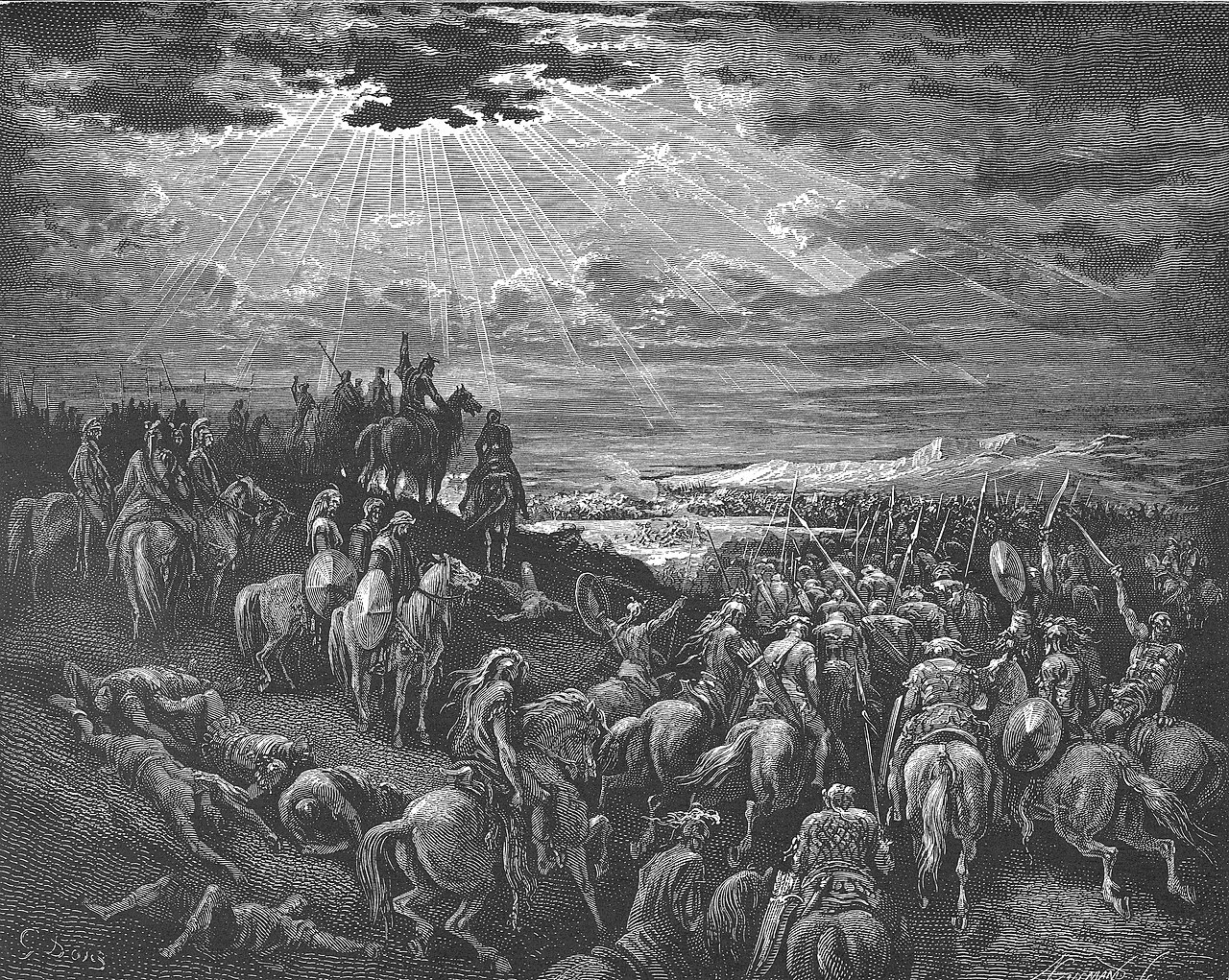
Joshuachapter 10
43 verses · Joshua, by tradition · 15th or 13th century BC · History
Then spake Joshua to the Lord in the day when the Lord delivered up the Amorites before the children of Israel, and he said in the sight of Israel, Sun, stand thou still upon Gibeon; and thou, Moon, in the valley of Ajalon.
Introduction
Joshua, by tradition, History, Joshua Overview.
This chapter tells of the battle that broke the southern kings of Canaan, and it holds one of the most discussed passages in the Old Testament. It was written for a people who needed to know that their victories came from the LORD. The fighting begins because Israel kept a promise it had made to a neighbour. Listen for the words quoted from an older book of songs, and for the unusual prayer they contain. Notice how often the text credits the victory to the LORD. The chapter ends with a long record of cities taken one after another.
Context
- Who
- A nation hearing how five kings fell in a single day
- What
- Joshua's defence of Gibeon against five Amorite kings, the hailstones and the long day at Beth-horon, and the conquest of the southern cities.
- Where
- Gibeon, the descent of Beth-horon, the cave at Makkedah, and the cities of the southern hill country and foothills.
- When
- Soon after the treaty with Gibeon, in the early years of the conquest; the year is argued as in chapter 1.
- Why
- To show that the LORD fought for Israel and gave it the southern part of the land.
Historical context
The book carries no superscription naming its writer, and it reports Joshua writing at least part of it at 24:26. The Babylonian Talmud at Bava Batra 14b to 15a assigns the whole book to him, while Martin Noth read it as the second volume of an exilic Deuteronomistic History.
Show the rest of the historical context, 3 more paragraphs
The occasion is the treaty of the chapter before, which brings five southern kings of the hill country and foothills against Gibeon for changing sides. Canaan then was a country of independent city states forming and breaking alliances, each writing to whoever could send troops. The Amarna letters show the same politics in the same towns, an Egyptian archive of about 1360 to 1330 BC carrying Canaanite rulers writing to Egypt for help.
Joshua marched all night up from Gilgal, a climb of several thousand feet from below sea level, and struck at dawn, which was old practice and worked. The rout ran down the descent of Beth-horon, a steep narrow ridge road dropping west toward the coastal plain and a real chokepoint used as a battlefield in later centuries. The text says a hailstorm on that descent killed more men than the sword, and large hail on the western slopes in that season is a real weather event.
The long day is quoted from an older collection called the Book of Jashar, so it is poetry set inside the narrative. The dossier carries three readings with their holders and no verdict: prolonged daylight, victory poetry quoted from that collection, and a request about celestial signs argued by John H. Walton and J. Harvey Walton.
Significance
The chapter's own summary is that the LORD fought for Israel. The timing, the hail and the light are all credited away from the army.
Show the rest of the significance, 1 more paragraph
The scene at the cave, with commanders putting their feet on the necks of captured kings, was a recognised image of total victory across the ancient world. Egyptian and Mesopotamian art shows it repeatedly. Joshua's word with it is the one that mattered to first hearers, that they should not be afraid, since the LORD would do the same to all their enemies.
This chapter in Jewish lifeWhat this chapter is in Jewish life and reading.
How it is read
The long day is the passage a Christian reader comes to this chapter for, and the classical Jewish reading of it is not the one he will expect. Rashi is quoted from the Metsudah Publications Book of Joshua of 1997, which Sefaria reports as CC-BY. He takes the verb at the twelfth verse as singing rather than speaking. Joshua "said a song in place of the sun", because he had told the sun to be silent (Rashi on Joshua 10:12:1). The sun on this reading recites praise at every moment of its orbit, and being silenced it stopped moving. The Metsudah note beside Rashi names Rambam and other commentators who hold that the sun, the moon and the spheres are living and intelligent. They read the verses of the Psalms about the heavens telling the glory of God as plain description. Rashi then gives the plain sense of the same word as waiting, and cites two other places where it carries that force.
So the classical reading has two layers in one note. The command is to a body that sings, and the plain sense is a command to wait. Christian teaching has read the passage mainly as prolonged daylight, and also as quoted victory poetry, and as a request about celestial signs. The holders of those three positions stand with their works in this repository, at src/components/book/dossier-content/joshua.ts. Neither tradition is flattened into the other here. The Jewish reading adds a reason for the silence that the Christian readings do not carry.
The book Joshua quotes from is identified, and the identification is worth knowing. Rashi holds that the book of Jashar is Genesis, so named because the word means upright and the upright are Abraham, Isaac and Jacob (Rashi on Joshua 10:13:1). What he finds there is Jacob's word to Joseph about the descendants of Ephraim, that their fame would fill the nations. Joshua was of Ephraim. On the day the sun stood still, Rashi says, the whole world was filled with the fame of Joshua. He adds that the sun stopped half way through its course and delayed a full day before setting.
Two short notes close the chapter for Rashi. The order at the eighteenth verse is to roll large stones to the mouth of the cave, and he reads the verb as the fuller form of rolling (Rashi on Joshua 10:18:1). The last clause of the twenty-first verse he treats as an abbreviated sentence with the subject left out, and supplies it. No sharp tongued man sharpened his tongue against a single Israelite (Rashi on Joshua 10:21:1). That reading takes a line about silence and makes it a line about speech.
The corpus carries twenty further notes on this chapter without an English text, and they are the bulk of the commentary here. Ten stand cited and unquoted at Radak on Joshua 10:1:1, 10:14:1, 10:17:1, 10:19:1, 10:20:1, 10:24:1, 10:27:1, 10:28:1, 10:32:1 and 10:37:1. Seven stand at Metzudat David on Joshua 10:2:1, 10:4:1, 10:6:1, 10:9:1, 10:10:1, 10:11:1 and 10:15:1. Three stand at Malbim on Joshua 10:8:1, 10:16:1 and 10:29:1.
What the rabbis say
The corpus carries forty rabbinic locators on this chapter and the text of none, so each is cited and linked here rather than quoted. On the first verse, the news reaching Adoni-zedek, it holds Bereshit Rabbah 43:6, Jerusalem Talmud Sheviit 6:1:13 and Midrash Lekach Tov, Numbers 10:1:1. Beside them stand Vayikra Rabbah 17:6, Yalkut Shimoni on Nach 19:5 and the sixth chapter of the book of Joshua in Sefer HaYashar. On the sixth, the call for help from Gibeon, it holds Bamidbar Rabbah 8:4 and Midrash Shmuel 28:5. On the eighth it holds two further parts of Sefer HaYashar, the book of Deuteronomy and the eighth chapter of the book of Joshua.
The hailstones draw a run of their own. On the tenth verse the corpus holds Midrash Shmuel 13:3, Midrash Tehillim 18:16 and Yalkut Shimoni on Torah 360:3. On the eleventh it holds Avodah Zarah 25a:10, Berakhot 54b:3, Aggadat Bereshit 1:1, Bamidbar Rabbah 11:7, Bereshit Rabbah 84:11 and Ein Yaakov (Glick Edition), Avodah Zarah 2:2.
The sun and the moon standing still is the most heavily worked passage in the chapter, and one tractate carries most of it. On the twelfth verse the corpus holds Avodah Zarah 25a:8, with Aggadat Bereshit 77:3, Bereshit Rabbah 5:5, Bereshit Rabbati, Parashat Vayetze 33, Devarim Rabbah 10:2 and Ein Yaakov (Glick Edition), Taanit 3:2. On the thirteenth, the verse that names the book of Jashar, it holds Avodah Zarah 25a:1 and 25a:2, Berakhot 58a:16, Aggadat Bereshit 8:2 and Bereshit Rabbah 6:9. On the fourteenth, the day with no day like it, it holds Midrash Lekach Tov at Deuteronomy 3:21:1 and 33:26:1 and at Genesis 48:19:3, which is the verse about Ephraim that Rashi reads here.
The cave at Makkedah carries the rest. On the eighteenth verse the corpus holds Midrash Sekhel Tov, Bereshit 29:3:6, and on the twenty-first Midrash Sekhel Tov, Shemot 11:7:1. On the twenty-fourth, where the captains set their feet on the necks of the kings, it holds Sifrei Devarim 356:14, Midrash Lekach Tov, Deuteronomy 33:29:1 and Midrash Tannaim on Deuteronomy 33:29:10. A passage of Otzar Midrashim on missing and extra letters, at 1:34, stands with them. On the thirty-third it holds Midrash Lekach Tov, Deuteronomy 7:15:2. What each of them teaches is a saying of the rabbis, and is reported as theirs wherever this site quotes one. The quotations wait on a fetch that carries the text.
Sources: Rashi, Rashi on Joshua 10:12:1, 10:13:1, 10:18:1 and 10:21:1, the Book of Joshua, Metsudah Publications, 1997, reported CC-BY; Rambam, the reading of the sun, the moon and the spheres as living and intelligent, reported in the Metsudah edition's note at Rashi on Joshua 10:12:1; Radak, Radak on Joshua 10:1:1, 10:14:1, 10:17:1, 10:19:1, 10:20:1, 10:24:1, 10:27:1, 10:28:1, 10:32:1 and 10:37:1, cited by ref because the corpus carries no English text; Metzudat David, Metzudat David on Joshua 10:2:1, 10:4:1, 10:6:1, 10:9:1, 10:10:1, 10:11:1 and 10:15:1, cited by ref because the corpus carries no English text; Malbim, Malbim on Joshua 10:8:1, 10:16:1 and 10:29:1, cited by ref because the corpus carries no English text; The Sefaria corpus, scripts/data/sources/sefaria/joshua/10.json, the 40 Talmud and Midrash locators of this chapter; The site's own files, src/components/book/dossier-content/joshua.ts, the contested point on the long day with the holders of each of the three positions.
The heads below are this chapter's scenes. The numbered points under each are its verses.
Five kings besiege Gibeon; great stones from heaven
Joshua 10:1-2
Jerusalem is named here for the first time in Scripture, after Genesis 14:18 called the place Salem. Albert Barnes sets its king’s name, Adoni-zedek, lord of righteousness, beside Melchizedek, king of righteousness, and reads it as a title of the Jebusite kings. A treaty moves the coalition, since Gibeon was “a great city” and “all its men were mighty”, and fear arms five kings.
Gibeon is compared to a royal city, and John Wesley notes that it seems to have had no king, since at 9:11 its elders send the envoys. Jamieson, Fausset and Brown explain why Jerusalem led the alliance. Gibeon lay only six miles from it.
Joshua 10:2
“This confederacy among the mountaineers of Southern Palestine was formed and headed by the king of Jerusalem, because his territory was most exposed to danger, Gibeon being only six miles distant, and because he evidently possessed some degree of pre-eminence over his royal neighbors.”
Jamieson, Fausset & Brown · Commentary Critical and Explanatory on the Whole Bible (1871)reformed
Joshua 10:3-5
The five cities, Jerusalem, Hebron, Jarmuth, Lachish and Eglon, lie in the hills and lowland south of Gibeon. This is the first alliance in the book, so from here Joshua meets armies instead of single towns. All five are called Amorites, a name Scripture uses of one people and of the land’s inhabitants at large, as at Genesis 15:16, and the same five are counted again at 12:10-12.
The kings aim first at Gibeon, the town that made peace with Joshua. Matthew Henry reads Joshua's answer in the light of that peace. His promise to let the Gibeonites live bound him, Henry says, to keep others from killing them when he had the power, and he cites Proverbs 24:11-12.
Joshua 10:4
“But Joshua knew that his promise to let them live obliged him, not only not to slay them himself, but not to stand by and see them slain when it was in the power of his hand to prevent it, Prov. xxiv. He knew that when they embraced the faith and worship of the God of Israel they came to trust under the shadow of his wings ( Ruth ii.”
Matthew Henry · Commentary on the Whole Bible (1707-1721)puritan
the five kings of the Amorites: Adam Clarke lists which peoples the five cities actually held. Jerusalem was Jebusite, by 15:63, and Hebron Hittite, by Genesis 23:2-3. He suggests the Amorite name covered them all because the Amorites were the strongest nation in the land, and John Wesley reads the name in the same broad way.
Joshua 10:5
“The five kings of the Amorites - This is a general name for the inhabitants of Canaan, otherwise called Canaanites; and it is very likely that they had this appellation because the Amorites were the most powerful tribe or nation in that country. The inhabitants of Jerusalem were Jebusites, Jos 15:63; those of Hebron were Hittites, Gen 23:2, Gen 23:3; Gen 25:9, Gen 25:10; and the Gibeonites were Hivites, Jos 9:7; and yet all these are called Amorites occasionally, probably for the reason already mentioned, viz., because that tribe was most numerous and powerful.”
Adam Clarke · Commentary on the Bible (1810-1826)evangelical
Joshua 10:6-7
Gibeon calls in the treaty of chapter 9, and the oath of 9:15 and 9:19 obliges Joshua to march for a city that won its treaty by lying. The oath outlives him, since 2 Samuel 21:1-2 lays a three-year famine in David’s reign on Saul for breaking it. Matthew Henry observes that the deceivers now lean wholly on Joshua’s word, and he brings his whole army.
Joshua 10:6
“The language reflects the urgency of the crisis. Accordingly Joshua made a forced march, accompanied only by his soldiers Jos 10:7, and accomplished in a single night the distance from Gilgal to Gibeon (about 15 miles in a direct line), which on a former occasion had been a three days’ journey Jos 9:17.”
John Wesley takes these men as a picked force. He doubts Joshua marched with the whole host, since so many would hinder each other and the camp at Gilgal needed defense. Matthew Henry reads the verse as Joshua's resolve to go, and thinks the word of encouragement in verse 8 came before he set out.
Joshua 10:7
“All the mighty men - That is, an army of the most valiant men picked out from the rest; for it is not probable, either that he would take so many hundred thousands with him, which would have hindered one another, or that he would leave the camp without an army to defend it.”
John Wesley · Explanatory Notes upon the Old Testament (1765)evangelical
Joshua 10:8-9
The promise, “I have delivered them into your hand”, is close to the word Moses received about Og at Deuteronomy 3:2, and Joshua heard the same before Ai at 8:1. It comes before the march, so the night climb carries out a settled outcome. Gilgal lies near the Jordan and Gibeon in the hills, so the army covers roughly twenty miles uphill in the dark and strikes by surprise.
The length of the night march is disputed. Adam Clarke puts Gilgal eighteen or twenty miles from Gibeon, while John Gill puts it at nine or ten, an easy night's march. Clarke holds that the surprise threw the five kings into confusion at once, which is how verse 10 begins.
Joshua 10:9
“Joshua therefore came unto them suddenly,.... Which no doubt threw them into consternation and confusion: and went up from Gilgal all night; he chose the night for secrecy and surprise, and that he might be the sooner with the enemy, and to the assistance and relief of Gibeon; and as it was about nine or ten miles from Gilgal to Gibeon, it was easily performed in a night's march; See Gill on Jos 9:6.”
1 more voice on this verse
Joshua 10:9
“Joshua - came unto them suddenly - This he did by a forced march during the night, for he went up from Gilgal all night; from Gilgal to Gibeon was about eighteen or twenty miles; and, having fallen so unexpectedly on these confederate kings, they were immediately thrown into confusion.”
Adam Clarke · Commentary on the Bible (1810-1826)evangelical
Joshua 10:10-11
The Hebrew verb for throwing into confusion is used of Joshua against Amalek at Exodus 17:13, and here the LORD does it while Israel chases. Hailstones are named here for the first time in Scripture. Verse 11 keeps the count, “more of them were killed by the hailstones than by the swords”, so the day is credited to the LORD.
Joshua 10:10
“And the Lord discomfited them before Israel,.... Disturbed, troubled, and frightened them, at the appearance and presence of the people of Israel; they were thrown into terror and confusion upon their approach, being so sudden and unexpected: and slew them with a great slaughter at Gibeon; by the Israelites, who came upon them suddenly: and chased them along the way that goeth up to Bethhoron; there were two places of this name, the upper and the nether, both built by Sherah, the daughter or granddaughter of Ephraim, 1Ch 7:24; therefore here so called by anticipation.”
1 more voice on this verse
Joshua 10:10
“Slew them with a great slaughter at Gibeon - Multitudes of them fell in the onset; after which they fled, and the Israelites pursued them by the way of Beth-horon. There were two cities of this name, the upper and lower, both in the tribe of Ephraim, and built by Sherah, the daughter of Ephraim, 1Ch 7:24. The situation of these two cities is not exactly known. To Azekah, and unto Makkedah - These two cities were in the tribe of Judah, Jos 15:35-41.”
Adam Clarke · Commentary on the Bible (1810-1826)evangelical
Adam Clarke weighs whether these were stones fallen from the sky, which had been seen in many countries, and judges true hail more likely. Albert Barnes grants that fierce storms cross the hills of Judea. He holds this one miraculous, like the hail on Egypt and the storm that fell on the Philistines at 1 Samuel 7:10.
Joshua 10:11
“Josephus affirms, that thunder and lightning were mixed with the hail, which may seem probable from Hab. iii, 11. They had robbed the true God of his honour, by worshipping the host of heaven, and now the hosts of heaven fights against them, and triumphs in their ruin.”
John Wesley · Explanatory Notes upon the Old Testament (1765)evangelical
Sun, stand thou still upon Gibeon
Joshua 10:12-13
Joshua’s words stand as poetry, to the sun over Gibeon and the moon over the Valley of Aijalon. The Book of Jashar is named only here and at 2 Samuel 1:18 and is lost, and books now printed under that title are later works. Keil and Delitzsch hold that a poet’s language is not to be pressed for astronomy, while Henry and Gill read a real lengthening of the day.
Joshua 10:12
“Now, First, It looked great for Joshua to say, Sun, stand thou still. His ancestor Joseph had indeed dreamed that the sun and moon did homage to him; but who would have thought that, after it had been fulfilled in the figure, it should be again fulfilled in the letter to one of his posterity?”
Matthew Henry · Commentary on the Whole Bible (1707-1721)puritan
3 more voices on this verse
Joshua 10:12
“Then spake Joshua to the Lord - Though Joshua saw that the enemies of his people were put to flight, yet he well knew that all which escaped would rally again, and that he should be obliged to meet them once more in the field of battle if permitted now to escape; finding that the day was drawing towards a close, he feared that he should not have time sufficient to complete the destruction of the confederate armies; in this moment, being suddenly inspired with Divine confidence, he requested the Lord to perform the most stupendous miracle that had ever…”
Adam Clarke · Commentary on the Bible (1810-1826)evangelical
Joshua 10:12
“Everywhere, therefore, he alone kept close to holy Moses amid all these wondrous works and dread secrets. In this way it happened that the one who had been Moses' companion in this intercourse with God succeeded to his power. Worthy surely was he to stand forth as a man who might stay the course of the river, and who might say, "Sun, stand still," and delay the night and lengthen the day, as though to witness his victory. Why?—a blessing denied to Moses—he alone was chosen to lead the people into the promised land.”
Ambrose of Milan · written before 397 · On the Duties of the Clergy 2.20.99patristic
Joshua 10:12
“It would seem, from Jos 10:14, that the command of Joshua was in reality a prayer to God for the performance of this miracle; and that, although the prayers of eminently good men like Moses often prevailed with God, never was there on any other occasion so astonishing a display of divine power made in behalf of His people, as in answer to the prayer of Joshua.”
Jamieson, Fausset & Brown · Commentary Critical and Explanatory on the Whole Bible (1871)reformed
the sun stood still: Matthew Henry sets this day beside the crucifixion. At Matthew 27:45 the sun was darkened at noon, and Henry says Christ needed no daylight to win his victory. John Wesley holds that the Book of Jashar was written before Joshua's own book, so the writer could fitly cite it.
Joshua 10:13
“Avenged them on their enemies - That is, till they bad utterly destroyed them. Book of Jasher - This book was written and published before Joshua wrote his, and so is fitly alluded here.”
John Wesley · Explanatory Notes upon the Old Testament (1765)evangelical
The verse weighs no mechanism: what it calls unrepeatable is that “the LORD listened to the voice of a man”, so the marvel is answered prayer. Adam Clarke canvasses the means and reaches no settled account, and John Gill sets it beside Hezekiah’s shadow at 2 Kings 20:11 and holds that this day stands alone. The tale of astronomers finding a missing day has no source behind it.
Joshua 10:14
“And there was no day like that - There was no period of time in which the sun was kept so long above the horizon as on that occasion. Some learned men have supposed that the Fable of Phaeton was founded on this historic fact. The fable may be seen with all the elegance of poetic embellishment in the commencement of the second book of Ovid’s Metamorphoses; but I confess I can see nothing in the pretended copy that can justify the above opinion.”
Adam Clarke · Commentary on the Bible (1810-1826)evangelical
Verse 15 sends Joshua back to Gilgal and verse 43 repeats it word for word, yet verse 16 has him still in the field at Makkedah. Two old answers stand: that it closes the extract from the Book of Jashar, or that the writer gives the outcome first and then fills in the day. Nothing in the chapter settles between them.
The kings brought out of the cave at Makkedah
Joshua 10:16-19
The five kings are sealed in the cave under guard while the pursuit goes on, so Joshua takes the fighting first and the trophy last. His order is “Do not let them reach their cities”, since a beaten army behind walls must be besieged town by town. Matthew Henry notes the watch costs men he could have used in the chase, and he sets it anyway.
Joshua 10:16
“Hid themselves in a cave - It is very likely that this cave was a fortified place among some rocks; for there were many such places in different parts of Palestine.”
Adam Clarke · Commentary on the Bible (1810-1826)evangelical
1 more voice on this verse
Joshua 10:16
“A cave - A place of the greatest secrecy; but there is no escaping the eye or hand of God. At Makkedah - Hebrew. in Makkedah, not in the city, for that was not yet taken; but in the territory of it.”
John Wesley · Explanatory Notes upon the Old Testament (1765)evangelical
Joshua hears of the kings by report. John Gill reads this as a sign that others found them, perhaps people of the land friendly to Israel. Soldiers of his own, Gill reasons, would have seized the kings at once unless they wanted his orders first.
Joshua 10:17
“And it was told Joshua,.... Either by some of his own people, or by some of the inhabitants of the land in his interest, who had observed it: saying, the five kings are found hid in a cave at Makkedah: this seems to make it appear that they were others, and not Joshua's soldiers, that found them; for had they, no doubt they would have seized them, and brought them before him, or slain them, unless they chose first to know his will concerning them, next expressed.”
Matthew Henry sees presence of mind in the order. He draws the lesson that those who try to hide from God only shut themselves in. Their refuge of lies, in the phrase of Isaiah 28:15-17, binds them over to judgment.
Joshua 10:18
“And Joshua said, roll great stones upon the mouth of the cave,.... To keep the kings in, that they might not make their escape, until he had convenient time to have them brought before him, and be treated by him as they deserved; and no doubt there were plenty of stones about the hill or mountain, in which this cave was, fit for this purpose: and set men by it for to keep them; as a guard upon them, to prevent their escape.”
1 more voice on this verse
Joshua 10:18
“And the care Joshua took to keep them there when they were there, as it is an instance of his policy and presence of mind, even in the heat of action, so, in the result of their project, it shows how those not only deceive themselves, but destroy themselves, who think to hide themselves from God. Their refuge of lies will but bind them over to God's judgment.”
Matthew Henry · Commentary on the Whole Bible (1707-1721)puritan
Henry reads the order as the choice of a prudent general, who deals first with what is most needful and leaves the captive kings in the cave for later. The pursuit keeps the scattered forces from rallying inside their walled cities. The reason Joshua gives is the promise of verse 8.
Joshua 10:19
“Like a prudent general, he does that first which is most needful, and defers his triumphs till he has completed his conquests; nor was he in such haste to insult over the captive kings but that he would first prevent the rallying again of their scattered forces. The result of this vigorous pursuit was, 1.”
Matthew Henry · Commentary on the Whole Bible (1707-1721)puritan
Joshua 10:20-21
Verse 20 grants what verse 19 tried to prevent, that survivors reached the fortified cities, and the rest of the chapter takes those cities one by one. Verse 21 closes with “no one dared to utter a word against the Israelites”, which answers to Exodus 11:7, where not even a dog would snarl at Israel. There it marked the plague of the firstborn, and here a country in arms.
Joshua 10:20
“The children of Israel - That is, a party of them by the command of Joshua; for Joshua himself went not with them, but abode in the siege before Makkedah, ver. 21.”
John Wesley · Explanatory Notes upon the Old Testament (1765)evangelical
The army returns to Makkedah in peace. John Gill, following the Vulgate, reads this as returning whole and in full number. Albert Barnes places Joshua by the guarded cave while the pursuit went on, and dates the execution of the kings and the capture of Makkedah to the following day.
Joshua 10:21
“And all the people returned to the camp to Joshua at Makkedah in peace,.... Sound and well, as not one killed or missing, so not one wounded, as the Vulgate Latin version,"sound and in full number:" none moved his tongue against any of the children of Israel; as to curse them, reproach them, and speak ill of them, for invading them, and using them in the manner they did, such was the terror that was upon them.”
1 more voice on this verse
Joshua 10:21
“Joshua himself remained at Makkedah with the guards set before the cave. The other warriors would not return from the pursuit until the evening of the overthrow of the Amorites; and the execution of the kings and the capture of Makkedah itself belong, no doubt, to the day following Jos 10:27-28. None moved his tongue - See the marginal reference and note.”
Joshua 10:22-24
Setting a foot on a beaten king’s neck is a known act in the ancient east, carved on Egyptian and Assyrian monuments as a statement of who now rules. Joshua calls the commanders forward to do it, the men who still have the land to fight. Psalm 110:1 uses the picture of enemies made a footstool, and Hebrews 10:12-13 applies it to Christ at God’s right hand.
Joshua 10:22
“Then said Joshua, open the mouth of the cave,.... That is, roll away the great stones that were laid at the mouth of it: and bring out those five kings unto me out of the cave; to receive their sentence in a public manner, for the encouragement of his troops and the terror of the Canaanites, particularly Makkedah, now besieged by him.”
The five kings are named again one by one. John Gill takes the order as their rank, set out to mark the size of the victory. Matthew Henry links what follows to Deuteronomy 33:29, the last words of Moses, where Israel is promised that it will tread on the high places of its enemies, which Henry reads as their great men.
Joshua 10:23
“And they did so,.... Opened the mouth "of" the cave, by rolling away the stones: and brought forth those five kings unto him out of the cave; who are next mentioned by name, one by one, according to their dignity, and in the order they were brought unto him: the king of Jerusalem, the king of Hebron, the king of Jarmuth, the king of Lachish, and the king of Eglon; who are particularly named for the greater glory of the conquest, and the triumph over them.”
Adam Clarke reads the act as a token of victories still to come, and points out that Joshua himself explains it that way in the next verse. Albert Barnes sets it beside 1 Corinthians 15:25. There Paul says Christ must reign until he has put all his enemies under his feet.
Joshua 10:24
But meanwhile Jesus [Joshua] destroyed the enemies, not teaching cruelty through this, as the heretics think, but representing the future sacraments in these affairs, so that when Jesus destroys those kings who maintain a reign of sin in us, we can fulfill that which the apostle said, "Just as we presented our members to serve iniquity for iniquity, so now let us present our members to serve righteousness for sanctification."What is it then that is condemned by them in this place as cruelty? It is this, it says, that is written, "Set your feet upon their necks and slay them."
Origen of Alexandria · written before 253 · HOMILIES ON JOSHUA 11.6patristic
1 more voice on this verse
Joshua 10:24
“Put your feet upon the necks of these kings - This act was done symbolically, as a token, not only of the present complete victory, but of their approaching triumph over all their adversaries, which is the interpretation given of it by Joshua in the succeeding verse.”
Adam Clarke · Commentary on the Bible (1810-1826)evangelical
The charge “Be strong and courageous” is the one Joshua was given by Moses at Deuteronomy 31:7 and 31:23 and by God at 1:6 and 1:9. Here alone he hands it on, and he hands it to his commanders. The ground he gives is the sight before them, “for the LORD will do this to all the enemies you fight”.
Joshua 10:25
“But Marcion and Valentinus and Basilides and the other heretics with them, since they refuse to understand these things in a manner worthy of the Holy Spirit, "deviated from the faith and became devoted to many impieties," bringing forth another God of the law, both creator and judge of the world, who teaches a certain cruelty through these things that are written.”
Origen of Alexandria · written before 253 · HOMILIES ON JOSHUA 12.3patristic
Joshua 10:26-27
The bodies come down at sunset, keeping Deuteronomy 21:23, as Joshua did with the king of Ai at 8:29. The cave that hid the kings becomes their grave, and “the stones are there to this day” places the writer where the spot could still be shown. Paul quotes that verse of Deuteronomy of the cross at Galatians 3:13.
Joshua 10:26
“Smote - slew - and hanged them on five trees - Hanging alive seems a barbarous custom: among the Hebrews, criminals were first deprived of life; this was the debt required by justice: then they were hanged up, perhaps generally by the hands, not by the neck; this was done by way of example, to deter others from committing the crimes for which those had suffered: but they were never permitted to hang thus exposed all night, as this could have answered no purpose, either of justice or example, as they could not be seen in the night-season.”
Adam Clarke · Commentary on the Bible (1810-1826)evangelical
John Wesley gives a further reason for moving the bodies into the cave. Wild beasts could not reach them there, and their own people could not give them an honorable burial. Jamieson, Fausset and Brown think the execution came the next day.
Joshua 10:27
“Took them down - That neither wild beasts could come to devour them, nor any of their people to give them honourable burial. Thus that which they thought would have been their shelter, was made their prison first, and then their grave.”
John Wesley · Explanatory Notes upon the Old Testament (1765)evangelical
The southern cities fall in one campaign
Joshua 10:28-30
From here the chapter runs as a formula, town after town, held together by the refrain “as he had done to the king of Jericho”. Makkedah falls the day the kings die and Libnah next, and Libnah revolts from Judah under Jehoram at 2 Kings 8:22. The repetition is the writer’s method, since 11:18 says plainly that Joshua waged war a long time with all those kings.
Joshua 10:28
“That day Joshua took Makkedah - It is very possible that Makkedah was taken on the evening of the same day in which the miraculous solstice took place; but as to the other cities mentioned in this chapter, they certainly were subdued some days after, as it is not possible that an army, exhausted as this must have been with a whole night’s march, and two days’ hard fighting, could have proceeded farther than Makkedah that night; the other cities were successively taken in the following days.”
Adam Clarke · Commentary on the Bible (1810-1826)evangelical
1 more voice on this verse
Joshua 10:28
“And that day - On which the sun stood still. Nor is it strange that so much work was done, and places so far distant taken in one day, when the day was so long, and the Canaanites struck with such a terror.”
John Wesley · Explanatory Notes upon the Old Testament (1765)evangelical
fought against Libnah: Libnah means white. Albert Barnes takes the name from a natural feature, perhaps the white cliffs on the eastern edge of the Philistine plain. The town fell to Judah at 15:42 and went to the priests at 21:13, and Adam Clarke adds that Sennacherib moved against it after departing from Lachish, at 2 Kings 19:8.
Joshua 10:29
“And Joshua passed from Makkedah,.... After he had taken it, and destroyed its inhabitants, and its king: and all Israel with him; that is, all the men of war he took with him from the camp at Gilgal, from whence he went to the relief of Gibeon: unto Libnah, and fought against Libnah; a city that fell to the tribe of Judah, Jos 15:42. Jerom (r) says, in his time it was a village, in the region of Eleutheropolis, and was called Libnah; according to Bunting (s) it was but two miles from Makkedah. (r) De loc. Heb. fol.”
1 more voice on this verse
Joshua 10:29
“Libnah - The word means “white” or “distinct,” and undoubtedly points to some natural feature of the spot, perhaps the “Garde Blanche” of the Crusaders, a castle which stood on or near the white cliffs which bound the plain of Philistia to the east opposite to Ascalon. It was in the southern part of the hill-country of Judah Jos 15:42, and was one of the cities afterward assigned to the priests Jos 21:13.”
Libnah's fall is credited to the LORD before any act of Joshua's is named. Verse 32 opens the same way for Lachish. Jamieson, Fausset and Brown read verses 28 to 42 as one rapid run of conquest, explained by the closing words of verse 42, that the LORD fought for Israel.
Joshua 10:31-33
Lachish alone in the run takes two days, and the account slows for it. Its mound is among the most excavated in the land, and its burn layers are part of the unsettled argument over the conquest’s date. Horam king of Gezer comes to relieve it and loses his army, yet Gezer stayed Canaanite at 16:10 and Judges 1:29 until Pharaoh gave it to Solomon’s wife at 1 Kings 9:16.
Joshua 10:31
“And Joshua passed from Libnah, and all Israel with him, unto Lachish,.... Which, according to Bunting (d), was eight miles from Libnah, and twenty miles from Jerusalem to the southwest of this city; see Jos 10:5, and encamped against it, and fought against it; for it seems this city stood out, and would not surrender at once, which obliged Joshua to encamp about it, and besiege it. (d) Travels of the Patriarchs, &c. p. 96.”
on the second day: John Gill, following Kimchi, counts the second day from the start of the siege. He also explains why no king of Lachish is named here. Its king, Japhia, was one of the five already hanged at Makkedah, so the city fell with no king to defend it.
Joshua 10:32
“And the Lord delivered Lachish into the hand of Israel, which he took on the second day,.... Either the second day from the slaughter of the kings, or rather the second day of the encampment or siege; so Kimchi: and smote it with the edge of the sword, and all the souls that were therein, according to all that he had done to Libnah; no mention is made of its king, because he was one of the five kings that had been hanged up; so that at the taking of this city there was no king.”
1 more voice on this verse
Joshua 10:32
“Lachish - It appears that this was anciently a very strong place; notwithstanding the people were panic-struck, and the Israelites flushed with success, yet Joshua could not reduce it till the second day, and the king of Assyria afterwards was obliged to raise the siege. See above, and see the note on Jos 10:3.”
Adam Clarke · Commentary on the Bible (1810-1826)evangelical
Horam king of Gezer: John Gill suggests Horam came because Lachish had lost its king. Albert Barnes places Gezer on the southern border of Ephraim, at 16:3, well north of Joshua's line of march. He reads the verse as a repulse of Horam's attack, with his death recorded again in the king list at 12:12.
Joshua 10:33
“Gezer lies on the southern border of the tribe of Ephraim Jos 16:3. It was considerably to the northward of Joshua’s present line of operations, and does not appear to have been captured at this time. He contented himself for the present with repulsing the attack made upon him, killed Horam (compare Jos 12:12), inflicting a severe defeat upon his people, and then continued to pursue his conquests over the confederated kings and their allies in south Canaan.”
Joshua 10:34-35
Eglon falls in a day, and its king had already died at Makkedah, so the city is taken without its ruler. The formula shifts one word each time, “just as he had done to Lachish”, chaining each town to the one before it. Keil and Delitzsch read the sequence as one southern campaign set down in the manner of a military report.
Joshua 10:34
“And from Lachish Joshua passed unto Eglon,.... Which, according to Bunting (f), was eight miles from Lachish, and twelve from Jerusalem southward, of which see Jos 10:5, and all Israel with him, and they encamped against it, and fought against it; it not surrendering at once, but attempted to hold out a siege. (f) Ut supra. (Travels of the Patriarchs, &c. p. 96.)”
John Gill reads that day as the same day the army camped against Eglon, since those inside judged they could not hold it. Lachish, at verse 32, took two days. The king of Eglon named at verse 3 is called Debir, the same name as the town taken at verse 38.
Joshua 10:35
“And they took it on that day,.... The same day they encamped about it and besieged it; the besieged finding they were not able to keep it: and smote it with the edge of the sword, and all the souls that were therein he utterly destroyed that day; made an utter devastation of all its inhabitants: according to all that he had done to Lachish; the last city he took; this having no king as that had not, its king being one of the five that had been hanged, Jos 10:26.”
Joshua 10:36-37
went up from Eglon: Hebron is taken here, given to Caleb to take again at 14:12 and 15:14, and taken by Judah at Judges 1:10 with the same three Anakim named. Some readers hold that this campaign broke the armies and the towns were reoccupied behind Israel, and others that the later passages record the settling of ground this raid swept. The city is Abraham’s burial place, called Kiriath-arba at Genesis 23:2.
Joshua 10:36
“And Joshua went up from Eglon, and all Israel with him, unto Hebron,.... Which lay in the hill country, and therefore they are said to go up to it from Eglon, which lay lower; and, according to Bunting (g), it was sixteen miles from it: and they fought against it; it making some resistance at first, and did not surrender at once, as demanded. (g) Ibid. (Travels of the Patriarchs, &c. p. 96.)”
1 more voice on this verse
Joshua 10:36
“Hebron - and the king thereof - See the note on Jos 10:3. From Jos 10:23 we learn that the king of Hebron was one of those five whom Joshua slew and hanged on five trees at Makkedah. How then can it be said that he slew the king of Hebron when he took the city, which was some days after the transactions at Makkedah?”
Adam Clarke · Commentary on the Bible (1810-1826)evangelical
Hebron's king was among the five killed at Makkedah, so Albert Barnes takes the king struck down here as his successor. The villages are the smaller towns that depended on Hebron. John Wesley reads them as the mark of a royal city with towns under it, as Gibeon was in verse 2.
Joshua 10:37
“The king thereof - No doubt the successor of the king slain at Makkedah Jos 10:23. All the cities thereof - i. e. the smaller towns dependent upon Hebron. The expression marks Hebron as the metropolis of other subject towns.”
Joshua 10:38-39
and fought against it: Debir is Kiriath-sepher, and at 15:15-17 Caleb offers his daughter to the man who takes it, and Othniel, the first judge at Judges 3:9, does. The same doubling stands here as at Hebron, the town falling in this chapter and fought for again in the allotment. Verse 39 ties Debir back to Hebron and Hebron to Libnah, so the last verse of the run recites the whole.
Joshua 10:38
“Joshua returned - The words mark a change in the direction of the march. Joshua from Hebron turned to the southwest, and attacked Debir or Kirjath-sepher and its dependencies Jos 15:15.”
Adam Clarke takes the Hebrew behind devoted to destruction as putting every person under an anathema. In his reading that meant death or slavery. He asks whether those found in arms were killed and the rest made slaves.
Joshua 10:39
“Destroyed all the souls - ויחרימו את כל נפש vaiyacharimu eth col nephesh, they brought every person under an anathema; they either slew them or reduced them to a state of slavery. Is it reasonable to say those were slain who were found in arms, of the others they made slaves?”
Adam Clarke · Commentary on the Bible (1810-1826)evangelical
Joshua 10:40-42
The summary divides the south into four zones, the hill country, the Negev, the foothills and the slopes, and 11:16 draws the same map. The words “everything that breathed” answer Deuteronomy 20:16, so the campaign is measured against the command. The Goshen of verse 41 is a district of Judah listed at 15:51, and “one campaign” in verse 42 stands beside 11:18, where Joshua made war a long time.
Joshua 10:40
“All the country of the hills - See the note on Deu 1:7. Destroyed all that breathed - Every person found in arms who continued to resist; these were all destroyed, - those who submitted were spared: but many no doubt made their escape, and afterwards reoccupied certain parts of the land. See Jos 10:36, Jos 10:37.”
Adam Clarke · Commentary on the Bible (1810-1826)evangelical
1 more voice on this verse
Joshua 10:40
“When the heathen are to be cast out to make room for this vine ( Ps. lxxx. 8 ) divine justice appears more prodigal than ever of human blood, that the Israelites might find themselves for ever obliged to spend their lives to the glory of that God who had sacrificed so many of the lives of his creatures to their interest.”
Matthew Henry · Commentary on the Whole Bible (1707-1721)puritan
Albert Barnes reads the verse as two boundary lines. Kadesh-barnea to Gaza marks the limit of the conquest on the west, and Goshen to Gibeon marks it on the east. Kadesh-barnea is the camp to which the twelve spies brought their report at Numbers 13:26.
Joshua 10:41
“From Kadesh-barnea unto Gaza - Num 13:26 This limits Joshua’s conquests on the west, as the other line, “all the country of Goshen unto Gibeon,” does on the east. Goshen Jos 15:51 has not been identified. It was in the southern part of the territory of Judah, and is, of course, quite distinct from the Goshen of Gen 46:28.”
Adam Clarke holds that conquests this fast were beyond the generalship of Joshua or the courage of Israel. The writer, he says, supplies the true reason. John Gill notes that the Targum renders that reason as the LORD fighting by his Word for Israel.
Joshua 10:42
“And all these kings, and their land, did Joshua take at one time,.... Not in one day, but in a very short time, in a few days, as the history clearly shows: because the Lord God of Israel fought for Israel; which is the true reason of such quick dispatch being made, otherwise in all probability much longer time must have been consumed in subduing them. The Targum is,"because the Lord God of Israel fought by his Word for Israel.''”
1 more voice on this verse
Joshua 10:42
“Did Joshua take at one time - That is, he defeated all those kings, and took all their cities, in One campaign; this appears to be the rational construction of the Hebrew. But these conquests were so rapid and stupendous, that they cannot be attributed either to the generalship of Joshua, or the valor of the Israelites; and hence the author himself, disclaiming the merit of them, modestly and piously adds, because the Lord Good of Israel fought for Israel.”
Adam Clarke · Commentary on the Bible (1810-1826)evangelical
The army returns to Gilgal, the camp pitched in chapter 5, and Gilgal remains the base until the tabernacle is set up at Shiloh in 18:1. Nothing is garrisoned and nothing is settled, which is why several of these towns are fought for again in the allotment chapters. The verse repeats verse 15 word for word and shuts the day the chapter opened.
Joshua 10:43
“He had a good name (it signifies lord of righteousness ), being a descendant perhaps from Melchizedek, king of righteousness; but, notwithstanding the goodness of his name and family, it seems he was a bad man, and an implacable enemy to the posterity of that Abraham to whom his predecessor, Melchizedek, was such a faithful friend.”
Matthew Henry · Commentary on the Whole Bible (1707-1721)puritan
How this psalm is built
The form: Narrative carrying a quoted poem, with a southern campaign report at its close, as This site's published book sections table for the narrative frame, and the chapter's own words at verse 13 for the quotation classes it.
The patterns in this chapter
| Device | What it does | Where to see it |
|---|---|---|
| The two lines quoted from the Book of Jashar | Verse 12 stands as verse inside a chapter of prose. Joshua speaks one line to the sun over Gibeon and a second to the moon over the Valley of Aijalon. Verse 13 names the Book of Jashar as the place the lines are written, and then quotes a further line from it. The published exposition of Joshua 10 states on verses 12 and 13 that the words Joshua speaks stand as poetry. It states that the sun and the moon are the two ends of the sky from a man on that battlefield. The same note records that the Book of Jashar is named here for the first time in Scripture, and once more at 2 Samuel 1:18. It records that the book itself has not survived. It states that the volumes printed under that title today are later compositions with no line back to the one this writer cites.The published exposition of Joshua 10, the note on verses 12 and 13, the note cites Keil and Delitzsch, Biblical Commentary on the Old Testament: Joshua, Judges, Ruth, and Matthew Henry, Commentary on the Whole Bible. | Joshua 10:12, Joshua 10:13 |
| As he had done to the king of Jericho | From verse 28 the chapter runs as a formula, town after town, and one clause holds the list together. The published exposition of Joshua 10 states on verses 28 to 30 that the refrain as he did unto the king of Jericho binds the list. It states that the repetition is the writer's method rather than a shortage of material. It notes that Joshua 11:18 says plainly that Joshua made war a long time with all those kings. Its note on verses 34 and 35 adds that the formula moves by one word each time, chaining each town to the one before it rather than to a single command.The published exposition of Joshua 10, the notes on verses 28 to 30 and on verses 34 and 35, the notes cite Keil and Delitzsch, Biblical Commentary on the Old Testament: Joshua, Judges, Ruth, Albert Barnes, Notes on the Old Testament, and John Gill, Exposition of the Old Testament. | Joshua 10:28, Joshua 10:30, Joshua 10:32, Joshua 10:35, Joshua 10:37, Joshua 10:39 |
| The return to Gilgal, said twice in the same words | Verse 15 sends Joshua back to the camp at Gilgal and verse 43 says it again word for word, with the whole Makkedah account standing between them. The published exposition of Joshua 10 states on verse 15 that readers have long asked what it is doing there. It gives two old answers. The first is that the verse closes the extract taken from the Book of Jashar. The second is that the writer gives the outcome first and then returns to fill in the day. The same note states that nothing in the chapter settles between them. Its note on verse 43 states that the verse repeats verse 15 word for word and shuts the day the chapter opened.The published exposition of Joshua 10, the notes on verse 15 and on verse 43, the notes cite Keil and Delitzsch, Biblical Commentary on the Old Testament: Joshua, Judges, Ruth, Albert Barnes, Notes on the Old Testament, and Matthew Henry, Commentary on the Whole Bible. | Joshua 10:15, Joshua 10:43 |
| The kings named, the towns walked and the country divided | The chapter counts three times. Four kings are summoned by name at verse 3 and the five cities are listed at verse 5 and again at verse 23. The towns are then walked in order from verse 28 to verse 39, Makkedah, Libnah, Lachish, Eglon, Hebron and Debir. The summary at verses 40 and 41 divides the south into its zones. The published exposition of Joshua 10 states on verses 3 to 5 that this is the first alliance in the book, since Jericho and Ai each fell as a single city. The same note states that the five kings are counted again in the king list at Joshua 12:10 to 12. Its note on verses 40 to 42 states that the summary divides the south into four zones and that Joshua 11:16 draws the same map.The published exposition of Joshua 10, the notes on verses 3 to 5 and on verses 40 to 42, the notes cite Keil and Delitzsch, Biblical Commentary on the Old Testament: Joshua, Judges, Ruth, John Gill, Exposition of the Old Testament, and Albert Barnes, Notes on the Old Testament. | Joshua 10:3, Joshua 10:5, Joshua 10:23, Joshua 10:28, Joshua 10:40, Joshua 10:41 |
| The charge Joshua was given, handed on to his captains | At verse 25 Joshua tells the commanders standing over the necks of five kings to be strong and courageous. The published exposition of Joshua 10 states on that verse that this is the charge Joshua himself was given. It names Moses at Deuteronomy 31:7 and 31:23, and God at Joshua 1:6 and 1:9. It states that this is the one place in Scripture where Joshua hands the charge on, and that he hands it to his captains rather than to the nation. It states that the ground he attaches to it is the sight in front of them.The published exposition of Joshua 10, the note on verse 25, the note cites Matthew Henry, Commentary on the Whole Bible, and Keil and Delitzsch, Biblical Commentary on the Old Testament: Joshua, Judges, Ruth. | Joshua 10:25 |
The long day, and the three readings of it
19 more paragraphs on the patterns
The book's published dossier asks what happened on the long day of Joshua 10 and sets out three positions with their holders, stating no verdict on any of them (src/components/book/dossier-content/joshua.ts, the difficulties section). The dossier's own note on the question is that whatever the mechanism, the text's own point is the last clause of verse 14.
Prolonged daylight. Held by the traditional reading across most of church history and by conservative commentators, taking the narrator's summary at 10:13 and 10:14 as a report of an actual extended day. Its strength is the narrator's own sentence. The writer moves out of the quoted poem and speaks in his own voice. He says that the sun stopped in the middle of the sky and delayed going down about a full day, and that there has been no day like it before or since. A summary in a prose narrator's voice that reports an event as unrepeatable is asking to be read as a report of something that happened.
Victory poetry quoted from the Book of Jashar. Held by commentators who note that 10:12 and 10:13 are set as verse. The lines are explicitly a quotation from a poetic collection, so the language works the way a psalm's language works. Its strength is the chapter's own framing. The writer names his source. The published exposition of Joshua 10 states on verses 12 and 13 that Keil and Delitzsch make the quotation the governing fact. The same note reports them as holding that a poet's language should not be pressed for astronomy. The same note records that Habakkuk 3:11 uses the same picture of the sun and moon standing still inside a poem, which shows the idiom was available to Hebrew poetry.
A request about celestial signs rather than about daylight. Held by John H. Walton and J. Harvey Walton, The Lost World of the Israelite Conquest, 2017, reading the words against Mesopotamian omen texts in which the sun and the moon at particular positions carry a message about a battle's outcome. Its strength is the setting. The words are addressed to a sun over Gibeon and a moon over the Valley of Aijalon at the same time. That is a statement about where the two bodies stand in relation to each other. In the omen literature of the region such a relation was itself read as a message. On this account Joshua asks for a sign the enemy could read.
The published exposition of Joshua 10 states on verse 14 that the verse weighs no mechanism. It states that what the verse calls unrepeatable is the LORD listening to the voice of a man, and that the marvel is placed in answered prayer. The same note records that Adam Clarke canvasses the means at length and reaches no settled account. Clarke includes the question whether the light was prolonged rather than the earth halted. The note records that John Gill raises the shadow that went backward for Hezekiah at 2 Kings 20:11. Gill holds that this day stands alone by the reason the verse itself gives. The note also records that the tale of modern astronomers finding a missing day in their calculations has no source behind it and is evidence for nothing here.
The historical value
The chapter names places that have been dug. The published exposition of Joshua 10 states on verses 31 to 33 that Lachish is the only city in the run that takes two days. It is the one town the account slows for. The same note states that its mound has been excavated more thoroughly than almost any site in the country. It states that its burn layers are the ground of the argument over when the conquest happened, and that the argument is not settled.
The book's published dossier states the two datings with their holders. The fifteenth century reading puts the conquest at about 1406 BC. It rests on the four hundred and eightieth year of 1 Kings 6:1 and the three hundred years of Judges 11:26. Its named holders include Bryant Wood and John Bimson, Redating the Exodus and Conquest, 1978. The thirteenth century reading puts the conquest at about 1230 to 1200 BC. It is held by Kenneth Kitchen, On the Reliability of the Old Testament, 2003, and the majority of current archaeologists. It reads the store cities of Exodus 1:11, the destruction layers at Hazor and Lachish, and the Merneptah Stele's mention of Israel in Canaan by 1208 BC. The dossier records the Merneptah Stele of about 1208 BC, discovered by Flinders Petrie in 1896. It is the earliest mention of Israel outside the Bible, and it fixes an outer limit, since Israel was in the land and identifiable before that date.
Jerusalem enters Scripture in this chapter. The published exposition of Joshua 10 states on verses 1 and 2 that Jerusalem is named here for the first time in Scripture. It states that Genesis 14:18 had called the place Salem. It records that Albert Barnes sets the name Adoni-zedek, lord of righteousness, beside the Melchizedek of that verse, king of righteousness. Barnes reads it as a title carried by the Jebusite kings rather than a personal name. The dossier's Amarna Letters entry records letters from Abdi-Heba of Jerusalem complaining that the land is being lost, in an archive of about 1360 to 1330 BC that shows a Canaan of many small kings. The dossier states that the habiru of those letters are a social category rather than an ethnic name, so the archive describes the same kind of world without identifying Israel in it.
The foot on the neck, and where the New Testament takes it
The published exposition of Joshua 10 states on verses 22 to 24 that setting the foot on the neck of a beaten king is a known act in the ancient east. It records that the act is carved on Egyptian and Assyrian monuments and was meant as a public statement of who now rules. It states that Joshua calls the captains forward rather than doing it himself, so the sign is given to the men who have the rest of the land still to fight. The same note states that Psalm 110:1 uses the picture of enemies made a footstool and that Hebrews 10:12 to 13 applies that verse to Christ seated at the right hand of God.
The execution of the kings is measured against the law in the same way. The published exposition states on verses 26 and 27 that the bodies come down at sundown, which keeps Deuteronomy 21:23 exactly. It states that Joshua had done the same with the king of Ai at 8:29. It records that Paul quotes that verse of Deuteronomy of the cross at Galatians 3:13.
The towns taken here and fought for again
Hebron and Debir fall in this chapter and are taken again in the allotment chapters. The published exposition of Joshua 10 states on verses 36 and 37 that Hebron is given to Caleb to take again at 14:12 and 15:14. It states that Judah takes it a third time at Judges 1:10, with the same three Anakim named, and that both accounts stand as they are written. It sets out the two ways readers carry them together. The first is that this campaign broke the field armies and the towns were reoccupied behind Israel, since Joshua garrisons nothing. The second is that the later passages record the settling of ground this raid only swept. Its note on verses 38 and 39 states that Debir is Kiriath-sepher. It states that Joshua 15:15 to 17 has Caleb offering his daughter to the man who takes it, and that Othniel takes it and becomes the first judge of Israel at Judges 3:9.
The published exposition also states on verse 43 that the army returns to Gilgal. It states that Gilgal remains the base until the tabernacle is set up at Shiloh in 18:1. It states that nothing is garrisoned and nothing is settled, which is why several of these towns are fought for again in the allotment chapters.
The reach of the summary
The chapter's closing summary is absolute in its terms, and the book itself sets other sentences beside it. The published exposition of Joshua 10 states on verses 40 to 42 that all that breathed answers to Deuteronomy 20:16. The writer therefore measures the campaign against the command rather than against the gain. The same note states that at one time in verse 42 means one campaign, and that Joshua 11:18 sets beside it a long war. The dossier's entry on whether the land was taken or much of it left reads the two kinds of statement as describing two different things. The first is the decisive defeat of organized Canaanite coalitions. The second is the tribe by tribe occupation that the same generation did not finish. The argument over the idiom of such summaries is the second position in the dossier's difficulty on the conquest commands, held by K. Lawson Younger Jr., Ancient Conquest Accounts, 1990, and Kenneth Kitchen, On the Reliability of the Old Testament, 2003, and the fuller case stands behind the door at /featured/the-canaanite-conquest.
The echoes the chapter carries
The published exposition of Joshua 10 states on verses 10 and 11 that hailstones occur here for the first time in Scripture. It records that the last time hail fell on an army, Exodus 9:26 noted that where the children of Israel were there was no hail. It states that Isaiah 28:21 later names the valley of Gibeon as the place of a strange work of God. Its note on verses 20 and 21 states that verse 21 closes with a line carried over from the night Israel left Egypt. The line answers to Exodus 11:7, and what belonged there to the plague of the firstborn is here said of a whole country in arms.
Keep studying
Studies1
People1
Sources for this chapter
The summary
Jamieson, Fausset & Brown, Commentary Critical and Explanatory; John Calvin, Commentaries; John Wesley, Notes on the Old Testament and Matthew Henry, Complete Commentary.
The form and classifications
K. Lawson Younger Jr., Ancient Conquest Accounts, 1990, as the book's published dossier states the position (src/components/book/dossier-content/joshua.ts, the ancient Near East section and the difficulty on the conquest commands); Keil and Delitzsch, as the published exposition of Joshua 10 reports them on verses 34 and 35, Biblical Commentary on the Old Testament: Joshua, Judges, Ruth, 1863; This site's published book sections table for the narrative frame, and the chapter's own words at verse 13 for the quotation, src/lib/bible/book-sections.ts, the entry "Joshua": "history"; and Joshua 10:13, which names the Book of Jashar as the place the lines are written and This site's published guide to Joshua, which takes the three campaigns from the book dossier's first section and the outline's second movement, src/components/book/guides/joshua/JoshuaGuide.tsx, the campaigns at lines 128 to 146.
The exposition
Adam Clarke, Commentary on the Bible; Albert Barnes, Notes on the Old Testament; Jamieson, Fausset & Brown, Commentary Critical and Explanatory on the Whole Bible; John Gill, Exposition of the Old Testament; John Wesley, Explanatory Notes upon the Old Testament; Keil and Delitzsch, Biblical Commentary on the Old Testament: Joshua, Judges, Ruth and Matthew Henry, Commentary on the Whole Bible.