
Joshua 10:12
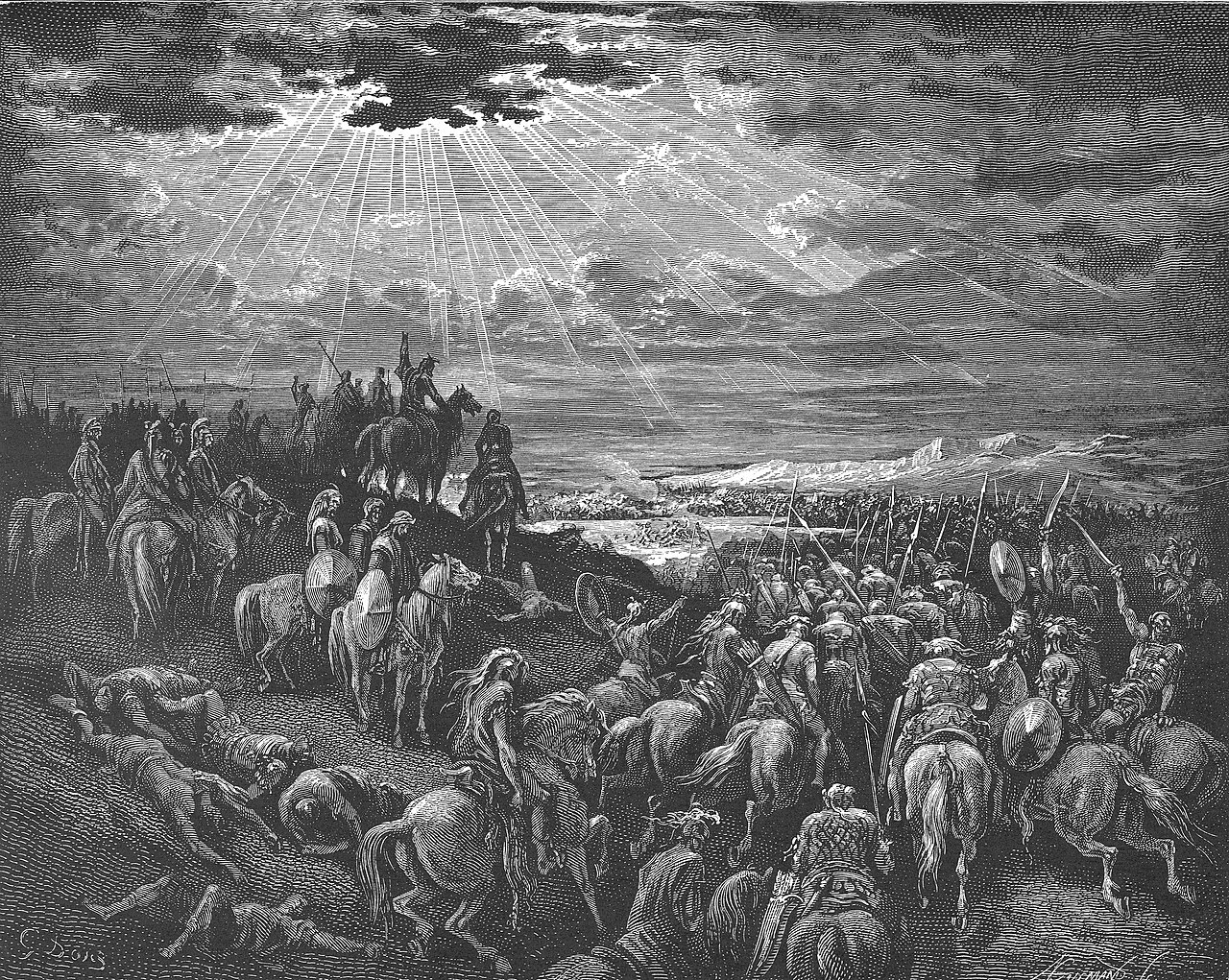
in Joshua 10On the day that the LORD gave the Amorites over to the Israelites, Joshua spoke to the LORD in the presence of Israel: “O sun, stand still over Gibeon, O moon, over the Valley of Aijalon.”
BSB
The same verse in ASV and KJV ▾
ASV
Then spake Joshua to Jehovah in the day when Jehovah delivered up the Amorites before the children of Israel; and he said in the sight of Israel, Sun, stand thou still upon Gibeon; And thou, Moon, in the valley of Aijalon.
KJV
Then spake Joshua to the Lord in the day when the Lord delivered up the Amorites before the children of Israel, and he said in the sight of Israel, Sun, stand thou still upon Gibeon; and thou, Moon, in the valley of Ajalon.
⋯
This verse in Joshua 10
Commentary
17 notes on this verseEverywhere, therefore, he alone kept close to holy Moses amid all these wondrous works and dread secrets. In this way it happened that the one who had been Moses' companion in this intercourse with God succeeded to his power. Worthy surely was he to stand forth as a man who might stay the course of the river, and who might say, "Sun, stand still," and delay the night and lengthen the day, as though to witness his victory. Why?—a blessing denied to Moses—he alone was chosen to lead the people into the promised land.
This site's exposition
O sun, stand still over Gibeon
on Joshua 10:12-13
Joshua’s words stand as poetry. The Book of Jashar is named only here and at 2 Samuel 1:18 and is lost. Keil and Delitzsch hold a poet’s language is not to be pressed for astronomy, while Henry and Gill read a real lengthening of the day.
The record, by era
The Church Fathers5 voices
Let no one tell me, therefore, that the motions of the heavenly bodies constitute time. For when the sun stood still at the prayer of a certain man in order that he might gain his victory in battle, the sun stood still but time went on. For in as long a span of time as was sufficient the battle was fought and ended.I see, then, that time is a certain kind of extension.
Actually, as we have recorded in our Scriptures, the sun itself stood still when the holy man, Joshua the son of Nun, asked that favor of God, and it remained where it was until a battle, already begun, ended in victory.… Such are the miracles which God grants as favors to his saints; although our adversaries would attribute them—if they believed them—to the arts of magic.…In regard, then, to human knowledge of the natures of things, the unbelievers have no right to becloud the issue by their assumption that nothing, even by the power of God, can happen to a nature beyond what is known already by human experience. And remember, too, that there are qualities and powers in the natures of the commonest things that are nothing less than stupendous and would, in fact, be reckoned portents by anyone who examined them, except that humans have accustomed themselves to have no wonder to spare save for things that are unusual.
In this manner, therefore, Jesus [Joshua] with his chiefs and princes comes to those who are attacked for his name by opposing powers, and not only does he furnish assistance in war, but also he extends the length of the day and, prolonging the extent of light, dispels the approaching night.Therefore, if we are able, we want to disclose how our Lord Jesus prolonged the light and made a longer day, both for the salvation of humans and for the destruction of opposing powers. Immediately after the Savior appeared, it was already the end of the world. Even he himself said, "Repent, for the kingdom of heaven has drawn near." But he restrained and checked the day of consummation and forbade it to come. For God the Father, seeing that the salvation of the nations can be established only through him, says to him, "Ask from me, and I shall give you the nations for your inheritance and the ends of the earth for your possession."11 Therefore, until the promise of the Father is fulfilled and the churches spring forth in the various nations and "the whole fullness of the nations" enter so that then "all Israel may be saved," the day is lengthened and the setting is deferred and the sun never sinks down but always rises as long as "the sun of righteousness" pours the light of truth into the hearts of believers. But when the measure of believers is complete and the already weaker and depraved age of the final generation arrives, when "the love of many persons will grow cold by increasing iniquity" and very few persons remain in whom faith is found, then "the days will be shortened."15 In the same way, therefore, the Lord knows to extend the day when it is time for salvation and to shorten the day when it is time for tribulation and destruction. […]
A commentator
Philoxenus of Mabbug13 Ascetic Discourses, Discourse 2 -- On Faith · Written before 523.
proposed
Thus also with power did Joshua, the son of Nun, command the sun and the moon, and they were restrained, and each of them stood still in its course. Joshua stretched out his hand and spake with the power of faith, saying, "Thou sun, tarry …
But perhaps renown in war keeps some so bound to itself as to make them think that fortitude is to be found in battle alone and that therefore I had gone aside to speak of these things, because that was lacking in us. But how brave was Joshua the son of Nun, who in one battle laid low five kings together with their people! Again, when he fought against the Gibeonites and feared that night might stop him from gaining the victory, he called out with deep faith and high spirit: "Let the sun stand still"; and it stood still until the victory was complete.
10 more voices on this verse
The Church Fathers1 voice
Consider how great of value is the righteous man. Joshua the son of Nun said, "Let the sun stand still at Gibeon, the moon at the valley of Elom [Aijalon]," and it was so. Let then the whole world come, or rather two or three, or four, or ten, or twenty worlds, and let them say and do this; yet they shall not be able. But the friend of God commanded the creatures of his friend, or rather he besought his friend, and the servants yielded, and the one below gave command to those above. Do you see that these things are fulfilling their appointed course for service?
The Medieval Church1 voice
A commentator
BonaventureCollations on the Hexaemeron, Collation 13 · Written in the 13th century.
proposed
"God made the two great lights, the smaller light to rule the night," that is, the Old Testament, "and the greater one to rule the day," that is, the New Testament. As the moon receives its light from the sun, so does the Old Testament …
The Puritans and the Awakening3 voices
Now, First, It looked great for Joshua to say, Sun, stand thou still. His ancestor Joseph had indeed dreamed that the sun and moon did homage to him; but who would have thought that, after it had been fulfilled in the figure, it should be again fulfilled in the letter to one of his posterity?
The prayer is thus exprest with authority, because it was not an ordinary prayer, but the prayer of a prophet, divinely inspired at this very time for this purpose. And yet it intimates to us the prevalency of prayer in general, and may mind us of that honour put upon prayer, concerning the work of my hands command you me.
Then spake Joshua to the Lord,....
The Nineteenth Century4 voices
Then spake Joshua to the Lord - Though Joshua saw that the enemies of his people were put to flight, yet he well knew that all which escaped would rally again, and that he should be obliged to meet them once more in the field of battle if permitted now to escape; finding that the day was drawing towards a close, he feared that he should not have time sufficient to complete the destruction of the confederate armies; in this moment, being suddenly inspired with Divine confidence, he requested the Lord to perform the most stupendous miracle that had ever been wrought, which was no less than to arrest the sun in his course, and prolong the day till the destruction of his enemies had been completed!
A commentator
Jamieson, Fausset & Brown1802–1910
Commentary Critical and Explanatory on the Whole Bible (1871)
It would seem, from Jos 10:14, that the command of Joshua was in reality a prayer to God for the performance of this miracle; and that, although the prayers of eminently good men like Moses often prevailed with God, never was there on any other occasion so astonishing a display of divine power made in behalf of His people, as in answer to the prayer of Joshua.
A commentator
Jamieson, Fausset & Brown1802–1910
Commentary Critical and Explanatory on the Whole Bible (1871)
proposed
It would seem, from Jos 10:14, that the command of Joshua was in reality a prayer to God for the performance of this miracle; and that, although the prayers of eminently good men like Moses often prevailed with God, never was there on any other occasion so astonishing a display of divine power made in behalf of His people, as in answer to the prayer of Joshua.
A commentator
Albert Barnes1798–1870
Notes, Explanatory and Practical, on the Old and New Testaments (1832-1869)
proposed
These four verses seem to be a fragment or extract taken from some other and independent source and inserted into the thread of the narrative after it had been completed, and inserted most probably by another hand than that of the author of the Book of Joshua. It is probable that Jos 10:12 and the first half of Jos 10:13 alone belong to the Book of Jasher and are poetical, and that the rest of this passage is prose. The writer of this fragment seems to have understood the words of the ancient song literally, and believed that an astronomical miracle really took place, by which the motion of the heavenly bodies was for some hours suspended. (Compare also Ecclesiasticus 46:4.) So likewise believed the older Jewish authorities generally, the Christian fathers, and many commentators ancient and modern. It must be allowed, indeed, that some of the objections which have been urged against this view on scientific grounds are easily answered. The interference, if such there were, with the earth’s motion was not an act of blind power ab extra and nothing more. The Agent here concerned is omnipotent and omniscient, and could, of course, as well arrest the regular consequences of such a suspension of nature’s ordinary working as He could suspend that working itself. It is, however, obvious, that any such stupendous phenomenon would affect the chronological calculations of all races of men over the whole earth and do so in a similarly striking and very intelligible manner. Yet no record of any such perturbation is anywhere to be found, and no marked and unquestionable reference is made to such a miracle by any of the subsequent writers in the Old or New Testament. For reasons like these, many commentators have explained the miracle as merely optical. The various explanations show how strongly the difficulties which arise out of the passage have been felt. […]
Modern Voices1 voice
The idea of liberty has ultimately a religious root; that is why men find it so easy to die for and so difficult to define. It refers finally to the fact that, while the oyster and the palm tree have to save their lives by …
How the passage was read
What the Jewish commentators add
On the verses either side of this one
Is it not written [in the Seifer Ha Yoshor.] This subject is recorded in the Torah, 8 What is the Seifer Ha Yoshor that is mentioned in this verse? We do not have any book that is called by that name.
This section is reception history: how the passage was read and kept in the Jewish tradition. Where a reading parts from an essential of the Christian faith, the section says so at that point.
Texts and citation data: Sefaria; each excerpt follows its version’s licence. 7 further sources are cited on this chapter that carry no English text this site may quote or only restate the verse.
The words behind it
21 Hebrew wordsEvery Hebrew word of this verse in the order it stands, with what it means and the door to its own study. The last column counts the times a word stands in the whole Bible: the rarer the word, the more the places it appears belong together.
| Hebrew | Sound | Meaning | Word study | In the Bible |
|---|---|---|---|---|
| אָ֣ז | ʾaz | then | H227 → | 141 times |
| יְדַבֵּ֤ר | yedaber | he spoke | H1696 → | 1141 times |
| יְהוֹשֻׁעַ֙ | yehoshua' | Joshua | H3091 → | 218 times |
| לַֽיהוָ֔ה | layahweh | to Yahweh | H3068 → | 6520 times |
| בְּי֗וֹם | beyom | on [the] day | H3117 → | 2304 times |
| תֵּ֤ת | tet | delivered up | H5414 → | 2011 times |
| יְהוָה֙ | yahweh | Yahweh | H3068 → | 6520 times |
| אֶת־ | ʾet- | <obj.> | H853 → | 10935 times |
| הָ֣אֱמֹרִ֔י | haemori | the Amorite[s] | H567 → | 87 times |
| לִפְנֵ֖י | lifnei | <to> before | H6440 → | 2123 times |
| בְּנֵ֣י | benei | [the] people of | H1121 → | 4930 times |
| יִשְׂרָאֵ֑ל | yisrael | Israel | H3478 → | 2507 times |
| וַיֹּ֣אמֶר׀ | vaiyomer | and he said | H559 → | 5305 times |
| לְעֵינֵ֣י | leeinei | to [the] eyes of | H5869 → | 887 times |
| יִשְׂרָאֵ֗ל | yisrael | Israel | H3478 → | 2507 times |
| שֶׁ֚מֶשׁ | shemesh | O sun | H8121 → | 134 times |
| בְּגִבְע֣וֹן | begivon | at Gibeon | H1391 → | 38 times |
| דּ֔וֹם | dom | be still | H1826 → | |
| וְיָרֵ֖חַ | veyareach | and O moon | H3394 → | |
| בְּעֵ֥מֶק | beemek | in [the] valley | H6010 → | 69 times |
| אַיָּלֽוֹן׃ | ʾaiyalon | Aijalon | H357 → | 10 times |
אָ֣זthen
ʾazH227 →141 times
יְדַבֵּ֤רhe spoke
yedaberH1696 →1141 times
יְהוֹשֻׁעַ֙Joshua
yehoshua'H3091 →218 times
לַֽיהוָ֔הto Yahweh
layahwehH3068 →6520 times
בְּי֗וֹםon [the] day
beyomH3117 →2304 times
תֵּ֤תdelivered up
tetH5414 →2011 times
יְהוָה֙Yahweh
yahwehH3068 →6520 times
אֶת־<obj.>
ʾet-H853 →10935 times
הָ֣אֱמֹרִ֔יthe Amorite[s]
haemoriH567 →87 times
לִפְנֵ֖י<to> before
lifneiH6440 →2123 times
בְּנֵ֣י[the] people of
beneiH1121 →4930 times
יִשְׂרָאֵ֑לIsrael
yisraelH3478 →2507 times
וַיֹּ֣אמֶר׀and he said
vaiyomerH559 →5305 times
לְעֵינֵ֣יto [the] eyes of
leeineiH5869 →887 times
יִשְׂרָאֵ֗לIsrael
yisraelH3478 →2507 times
שֶׁ֚מֶשׁO sun
shemeshH8121 →134 times
בְּגִבְע֣וֹןat Gibeon
begivonH1391 →38 times
דּ֔וֹםbe still
domH1826 →
וְיָרֵ֖חַand O moon
veyareachH3394 →
בְּעֵ֥מֶקin [the] valley
beemekH6010 →69 times
אַיָּלֽוֹן׃Aijalon
ʾaiyalonH357 →10 times
A shaded row is a word that stands 400 times or fewer in the Bible.
The walk
8 stopsEach card is a verse this one points to, and under it the verses that one points to in turn. Where several paths arrive at the same place, that place is listed first: the text keeps returning to it.
Through
Isaiah 60:20Your sun will no longer set, and your moon will not wane; for the LORD will be your everlasting light, and the days of your sorrow will cease.
it leads to
- Revelation 21:4
‘He will wipe away every tear from their eyes,’ and there will be no more death or mourning or crying or pain, for the former things have passed away.”
- Psalms 84:11
For the LORD God is a sun and a shield; the LORD gives grace and glory; He withholds no good thing from those who walk with integrity.
- Isaiah 35:10
So the redeemed of the LORD will return and enter Zion with singing, crowned with everlasting joy. Gladness and joy will overtake them, and sorrow and sighing will flee.
- Psalms 27:1
The LORD is my light and my salvation— whom shall I fear? The LORD is the stronghold of my life— whom shall I dread?
- Malachi 4:2
“But for you who fear My name, the sun of righteousness will rise with healing in its wings, and you will go out and leap like calves from the stall.
- Revelation 21:4
Through
Joshua 10:13So the sun stood still and the moon stopped until the nation took vengeance upon its enemies. Is this not written in the Book of Jashar? “So the sun stopped in the middle of…
it leads to
- Habakkuk 3:11
Sun and moon stood still in their places at the flash of Your flying arrows, at the brightness of Your shining spear.
- Isaiah 38:8
I will make the sun’s shadow that falls on the stairway of Ahaz go back ten steps.’” So the sunlight went back the ten steps it had descended.
- Habakkuk 3:11
Through
Isaiah 28:21For the LORD will rise up as at Mount Perazim. He will rouse Himself as in the Valley of Gibeon, to do His work, His strange work, and to perform His task, His disturbing…
it leads to
- 1 Chronicles 14:11
So David and his men went up to Baal-perazim, where he defeated the Philistines and said, “Like a bursting flood, God has burst out against my enemies by my hand.” So they called that…
- 1 Chronicles 14:11
Where this verse is studied
On this page
About Joshua
Who and where
1 name in this verse with a page on the site.
This page draws on 16 works. Open the list of works
This page draws on Adam Clarke, Commentary on the Bible; Albert Barnes, Notes, Explanatory and Practical, on the Old and New Testaments (1832-1869); Ambrose of Milan, On the Duties of the Clergy 2.20.99; Ambrose of Milan, On the Duties of the Clergy 1.40.196; Augustine of Hippo, Confessions 11.23.30; Augustine of Hippo, City of God 21.8; Bonaventure, Collations on the Hexaemeron, Collation 13; GK Chesterton, The Free Man (A Miscellany of Men); Jamieson, Fausset & Brown, Commentary Critical and Explanatory on the Whole Bible; John Chrysostom, ON THE EPISTLE TO THE HEBREWS 27.6; John Gill, Exposition of the Old Testament (1748-1763); John Wesley, Explanatory Notes upon the Old Testament; Keil and Delitzsch, Biblical Commentary on the Old Testament: Joshua, Judges, Ruth; Matthew Henry, Commentary on the Whole Bible; Origen of Alexandria, HOMILIES ON JOSHUA 11.2-3 and Philoxenus of Mabbug, 13 Ascetic Discourses, Discourse 2 -- On Faith.