
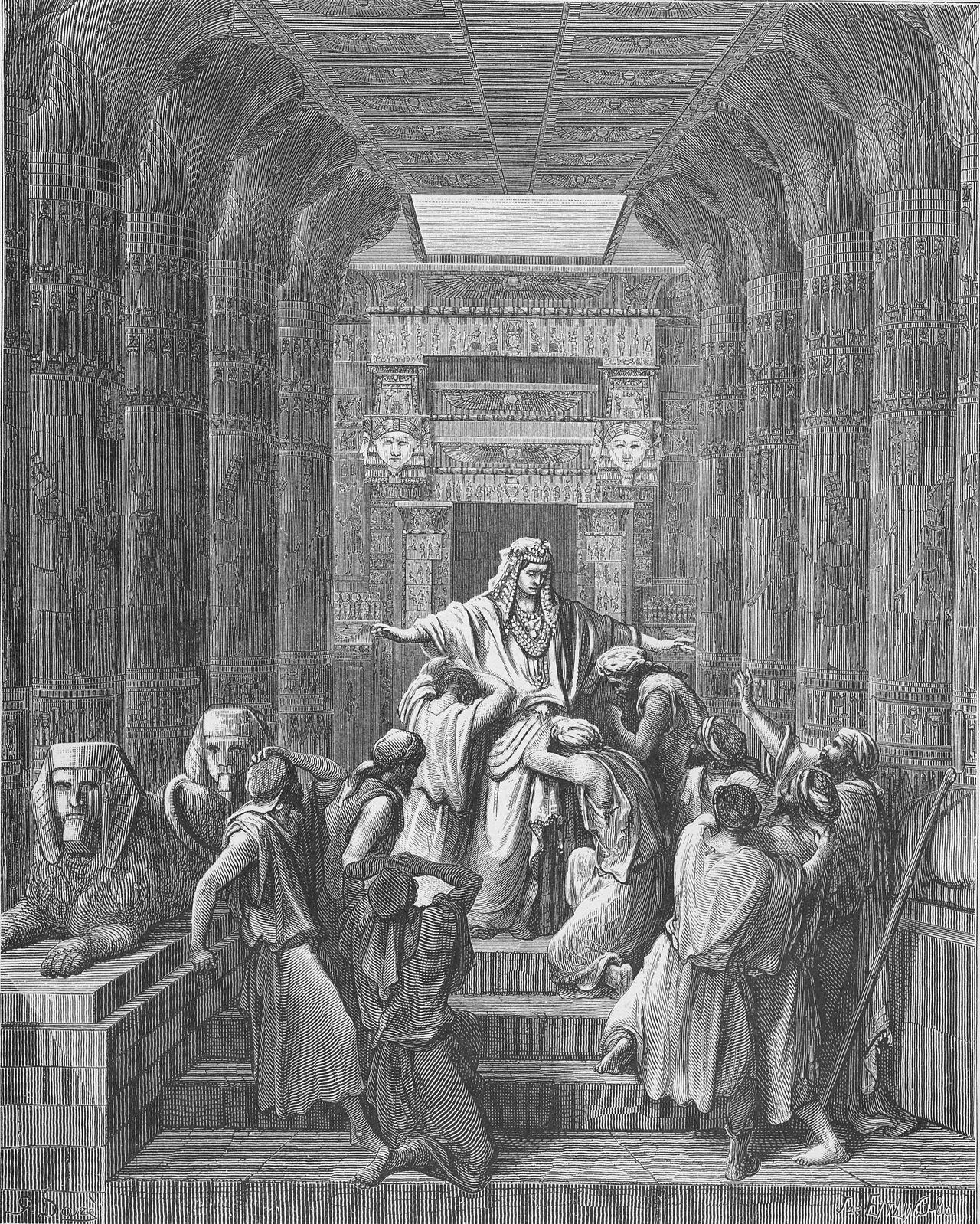
Genesischapter 45
28 verses · Moses, by tradition · 15th to 13th century BC · The Law
Joseph said to his brothers, “I am Joseph! Is my father still alive?” But they were unable to answer him, because they were terrified in his presence.
Introduction
Moses, by tradition, The Law, Genesis Overview.
The disguise that has held for two chapters comes down in this one, and the long quarrel between brothers reaches its end. Joseph speaks more about God here than anywhere else in his story. Israel kept his reading of these events as the key to how their people came to be in Egypt. Listen for how he names both what his brothers did and what God did through it. Watch the gifts sent north, since an old father needs proof before he can believe. It is a reconciliation that costs everyone something.
Context
- Who
- Israel in the wilderness, who had just been carried out of the country their fathers were invited into
- What
- A narrative in which Joseph makes himself known to his brothers and sends for his father.
- Where
- Joseph's house in Egypt, Pharaoh's court, and the road north to Canaan.
- When
- The second of the seven famine years, about 1875 BC on the traditional chronology.
- Why
- To show God's purpose in the brothers' evil, that Joseph was sent ahead of them to preserve life.
Historical context
The chapter is Joseph's, and what he does in it is tell eleven men who he is and then send for his father. The time is still the second famine year, with five years of it left by his own count at verse 6. The places are his own house in Egypt, Pharaoh's court and the road up to Canaan.
Show the rest of the historical context, 3 more paragraphs
The occasion is the disclosure and the invitation that follows it. Joseph clears the room before he speaks and then weeps loudly enough for the Egyptians outside to hear, which is how the court learns of it.
What a first hearer understood is the weight of the gifts. Egyptian wagons sent up into Canaan were state transport and a substantial provision, since families in that region moved with pack animals, and the carts are what finally convince Jacob the message is real.
The changes of clothing follow the standard honour gift of the region. The instruction to leave their goods behind, because the best of the land of Egypt is theirs, is a formal grant of resettlement.
Significance
Joseph's own reading of the whole account is the sentence Israel kept, that God sent him ahead of them to preserve a remnant and to save lives by a great deliverance.
Show the rest of the significance, 1 more paragraph
The nation that heard this had come back out of the same country. They knew both halves of the story, the invitation and the bondage, and this chapter told them who had been steering from the start.
This chapter in Jewish lifeWhat this chapter is in Jewish life and reading.
How it is read
Rashi reads the clearing of the room as a kindness done to the brothers rather than a demand for privacy: "He could not bear that the Egyptians should stand by him" while his brothers were shamed (Rashi on Genesis 45:1:1, the Pentateuch with Rashi's commentary by M. Rosenbaum and A. M. Silbermann, 1929 to 1934, public domain), and their silence at his words he explains in three words, "out of shame" (Rashi on Genesis 45:3:1). Joseph's title before Pharaoh he takes as an office, "he made me his colleague and he bestowed on me the dignity of" father to the king (Rashi on Genesis 45:8:1), and the command to go up he explains by the land itself, "because the land of Israel is situated higher than all the neighbouring countries", on Kiddushin 69a (Rashi on Genesis 45:9:1). The weeping on Benjamin's neck he reads as a sight of what would come, "for the Temples which were to be in Benjamin's territory and which would ultimately be laid in ruins" (Rashi on Genesis 45:14:1), and he marks the moment the brothers could speak at last, "after they saw that he wept and realized that he was peaceably inclined towards them" (Rashi on Genesis 45:15:1). Joseph's parting word to them on the road he takes as advice about study rather than about quarrelling, in the first of two explanations: "Do not busy yourselves with Halachic discussions lest the road become unsteady for you" (Rashi on Genesis 45:24:1). Ramban reads the choice of Goshen as Joseph knowing his father: "Joseph knew that his father would not want to stay in that part of the land of Egypt where the royal palace was" (Ramban on Genesis 45:10:1, the Commentary on the Torah by Ramban, translated and annotated by Charles B. Chavel, Shilo Publishing House, New York, 1971 to 1976, CC-BY). Sforno reads Joseph's command to hurry as a son's wish for his father, "in order to afford him the joy to see all this with his own eyes" (Sforno on Genesis 45:13:1, translated by Eliyahu Munk, HaChut Hameshulash, CC-BY), and Radak keeps to the plain report, that the brothers "They loaded their beasts and they were quick about it in order to get started on the way home to Canaan" (Radak on Genesis 45:21:1, Munk translation, CC-BY). One comment of Rashi at 45:4:1 and one of Ibn Ezra at 45:22:1 stand without English in the corpus, so both are citations.
What the rabbis say
The corpus records forty rabbinic locators on this chapter, thirty-six of them Midrash and four Talmud. Midrash Lekach Tov is the densest work here, cited at Genesis 45:4:1, 45:4:2, 45:5:1, 45:7:1, 45:7:2, 45:10:1, 45:11:1, 45:13:1, 45:15:1 and 45:20:1, which is the disclosure and the message to Jacob almost sentence by sentence. Bereshit Rabbah is cited at 25:3, 90:1, 93:2, 93:8, 93:10, 93:11, 93:12, 94:2, 94:3 and 95:3, Bereshit Rabbati at Parashat Vayigash 3, 4, 27 and 29, Aggadat Bereshit at 37:2, 61:2, 65:3, 73:3 and 79:4, and Midrash Aggadah at Genesis 45:2:1 and 45:27:1. Bamidbar Rabbah 14:8, Esther Rabbah 7:25, Midrash Sekhel Tov at Bereshit 45:10:1 and 45:11:1 and Ein Yaakov (Glick Edition), Taanit 1:43 each stand once. The four Talmud locators are Chagigah 4b:8 at the brothers' dismay, Avodah Zarah 9b:3 at the count of the famine years, Jerusalem Talmud Eruvin 3:1:8 at the gifts sent to Jacob, and Avot DeRabbi Natan 30:4 at the news reaching the father. Rashi hands on further sayings with their locators, among them Genesis Rabbah 93:10 and 93:12 and Kiddushin 69a.
Sources: Rashi, Rashi on Genesis 45:1:1, 45:2:1, 45:3:1, 45:5:1, 45:6:1, 45:8:1, 45:9:1, 45:11:1, 45:12:1, 45:14:1, 45:15:1, 45:16:1, 45:17:1, 45:18:1, 45:19:1, 45:23:1, 45:24:1 and 45:26:1, the Pentateuch with Rashi's commentary by M. Rosenbaum and A. M. Silbermann, 1929 to 1934, public domain; Rashi on Genesis 45:4:1, cited only; Ramban, Ramban on Genesis 45:10:1, the Commentary on the Torah by Ramban (Nachmanides), translated and annotated by Charles B. Chavel, Shilo Publishing House, New York, 1971 to 1976, CC-BY; Sforno, Sforno on Genesis 45:13:1, translated by Eliyahu Munk, HaChut Hameshulash, CC-BY; Radak, Radak on Genesis 45:20:1 and 45:21:1, translated by Eliyahu Munk, HaChut Hameshulash, CC-BY; Ibn Ezra, Ibn Ezra on Genesis 45:22:1, cited only, no English version in the corpus under a licence permitting quotation; Midrash, Midrash Lekach Tov, Genesis 45:4:1, 45:4:2, 45:5:1, 45:7:1, 45:7:2, 45:10:1, 45:11:1, 45:13:1, 45:15:1 and 45:20:1; Bereshit Rabbah 25:3, 90:1, 93:2, 93:8, 93:10, 93:11, 93:12, 94:2, 94:3 and 95:3; Bereshit Rabbati, Parashat Vayigash 3, 4, 27 and 29; Aggadat Bereshit 37:2, 61:2, 65:3, 73:3 and 79:4; Midrash Aggadah, Genesis 45:2:1 and 45:27:1; Midrash Sekhel Tov, Bereshit 45:10:1 and 45:11:1; Bamidbar Rabbah 14:8; Esther Rabbah 7:25; Ein Yaakov (Glick Edition), Taanit 1:43; Babylonian Talmud, Chagigah 4b:8, Avodah Zarah 9b:3; Kiddushin 69a as Rashi cites it; Jerusalem Talmud, Jerusalem Talmud Eruvin 3:1:8; Avot DeRabbi Natan, Avot DeRabbi Natan 30:4.
The heads below are this chapter's scenes. The numbered points under each are its verses.
I Am Joseph, Your Brother
Genesis 45:1-2
Joseph sends every attendant away before he speaks, and he makes himself known to his brothers alone. He wept loudly enough for the Egyptians to hear, and the news reached Pharaoh's household. The privacy is for the brothers. The sound that escaped it starts the rest of the chapter at verse sixteen.
Genesis 45:1
“The private conversations of friends are the most free. When Joseph would put on love he puts off state, and it was not fit his servants should be witnesses of this. Thus Christ graciously manifests himself and his loving-kindness to his people, out of the sight and hearing of the world.”
Matthew Henry · Commentary on the Whole Bible (1707-1721)puritan
1 more voice on this verseWhat preachers and commentators have said about this verse, in their own words.
Genesis 45:1
“And whereas it thus bursts forth in tears, this softness or tenderness is more deserving of praise than if he had maintained an equable temper. Therefore the stoics speak foolishly when they say, that it is an heroic virtue not to be touched with compassion.”
John Calvin · Commentaries (1554)reformed
he wept so loudly: This is the third time Joseph weeps over his brothers. At 42:24 he turned away from them to weep, and at 43:30 he hurried into a private room. Now the weeping can no longer be hidden.
Genesis 45:2
“And he wept aloud,....; Or "gave forth his voice in weeping" (r); as he wept he cried aloud; for having put such a violent restraint on himself, as the flood of tears was the greater, so his voice was the stronger and louder for it: and the Egyptians and the house of Pharaoh heard; the Egyptians, that were in the room or rooms adjoining to that where Joseph was, heard his cry, and perhaps a great deal of what was said; which they soon reported to others, and it quickly reached Pharaoh's court, which might not be at any great…”
Genesis 45:3-4
His first question is about the old man at home, whether his father is still alive. The brothers were unable to answer, terrified in his presence. He calls them near and names the crime with the kinship, I am Joseph, your brother, the one you sold into Egypt. Ambrose of Milan read come near me as the voice of Christ calling a people who had refused him, and Acts 7:13 marks the timing, the second visit.
Genesis 45:3
“And Joseph ordered all to withdraw so that he could be recognized by his brothers. For, even as Jesus said, he had not come except to the lost sheep that were the lost of the house of Israel. And lifting up his voice with weeping he said, "I am Joseph. Is my father still alive?" This means, Jesus stretched out his hands to an unbelieving and contradicting people, for he did not seek an envoy or messenger but, as their very Lord, desired to save his own people.”
Ambrose of Milan · written before 397 · ON JOSEPH 12.67patristic
1 more voice on this verse
Genesis 45:3
“I am Joseph - They knew him only by his Egyptian name, Zaphnath-paaneah, his Hebrew name being lost and forgot in Egypt; but now he teaches them to call him by that, I am Joseph: nay, that they might not suspect it was another of the same name, he explains himself.”
John Wesley · Explanatory Notes upon the Old Testament (1765)evangelical
The brothers had drawn back in terror at verse 3, and Joseph closes the distance himself. The words about the sale are spoken at close range, with every Egyptian already sent out at verse 1. The shame stays inside the family.
Genesis 45:4
"Come to me," because I have come near to you, yes, even so far that I made myself a sharer in your nature by taking on flesh. At least do not flee a partaker of your fellowship, if you do not know the Author of your salvation. "And they came to him, and he said, 'I am Joseph your brother, whom you sold into Egypt.
Ambrose of Milan · written before 397 · ON JOSEPH 12.68-69patristic
Genesis 45:5-6
it was to save lives that God sent me before you: The comfort and the crime stand in one sentence, do not be distressed, and you sold me into this place. Three times in four verses he says that God sent him before them to save lives. He fixes the clock as well. Two years of the famine are gone and five more come without plowing or harvesting.
Genesis 45:5
“God's Israel is the particular care of God's providence. Joseph reckoned that his advancement was not so much designed to save a whole kingdom of Egyptians as to preserve a small family of Israelites: for the Lord's portion is his people; whatever becomes of others, they shall be secured.”
Matthew Henry · Commentary on the Whole Bible (1707-1721)puritan
without plowing or harvesting: The figures date the scene. Joseph was thirty when he stood before Pharaoh at 41:46, so seven years of plenty and two of famine make him thirty-nine, twenty-two years after his brothers sold him at seventeen. At 47:19 the Egyptians beg for seed to sow, a sign that plowing had stopped.
Genesis 45:6
“There shall neither be earing nor harvest - Earing has been supposed to mean collecting the ears of corn, which would confound it with harvest: the word, however, means ploughing or seed-time, from the Anglo-Saxon erian, probably borrowed from the Latin aro, to plough, and plainly means that there should be no seed-time, and consequently no harvest; and why? Because there should be a total want of rain in other countries, and the Nile should not rise above twelve cubits in Egypt; See Clarke on Gen 41:31 (note).”
Adam Clarke · Commentary on the Bible (1810-1826)evangelical
Genesis 45:7-8
to preserve you as a remnant on the earth: Remnant is the word for the part of a people left alive after a judgment, and Joseph uses it of his own family. The second saying and the third reach further than the first, a remnant on the earth, then a great deliverance. He ends by giving the sending to God, who made him lord of Pharaoh's household and ruler of the land of Egypt. The sending is God's and the selling stays theirs.
A father to Pharaoh is a title for the king's chief adviser, the man whose counsel the throne leans on. Joseph names three offices in rising order, adviser, lord of the household and ruler of the land. Each one answers the pit at Dothan.
Genesis 45:8
“He hath made me a father to Pharaoh - It has already been conjectured that father was a name of office in Egypt, and that father of Pharaoh might among them signify the same as prime minister or the king’s minister does among us. Calmet has remarked that among the Phoenicians, Persians, Arabians, and Romans, the title of father was given to certain officers of state. The Roman emperors gave the name of father to the prefects of the Praetorium, as appears by the letters of Constantine to Ablavius. The caliphs gave the same name to their prime ministers.”
Adam Clarke · Commentary on the Bible (1810-1826)evangelical
Genesis 45:9-10
God has made me lord of all Egypt: The message home is that God has made him lord of all Egypt and that his father is to come down without delay. The second dream of 37:9 arrives in daylight, and the father who asked whether he would bow is the one told to pack. Goshen is named, so the household will settle near him with children, grandchildren, flocks and herds. Jacob is being sent for.
Genesis 45:9
Indeed they are expressed in the same words, so that we may know that Jesus is the same who spoke before in Joseph and afterward in his own body, seeing that he did not change even the words. For at that time Jesus said, "Be not grieved," and later, "Go up to my father and say to him, 'Thus says your son Joseph: God has made me master of the whole land of Egypt.' " And in the Gospel Christ says, "Do not be afraid. Go, tell my brothers to go into Galilee, and there they shall see me."
Ambrose of Milan · written before 397 · ON JOSEPH 12.70-73patristic
settle in the land of Goshen: Goshen is usually placed in the eastern Delta, the side of Egypt nearest Canaan. Its grazing suited the flocks and herds, and it kept the children and grandchildren near Joseph and apart from the cities of Egypt. The words be near me make the settlement his own pledge.
Genesis 45:10
“Thou shalt dwell in the land of Goshen - Probably this district had been allotted to Joseph by the king of Egypt, else we can scarcely think he could have promised it so positively, without first obtaining Pharaoh’s consent. Goshen was the most easterly province of Lower Egypt, not far from the Arabian Gulf, lying next to Canaan, (for Jacob went directly thither when he came into Egypt), from whence it is supposed to have been about fourscore miles distant, though Hebron was distant from the Egyptian capital about three hundred miles.”
Adam Clarke · Commentary on the Bible (1810-1826)evangelical
Genesis 45:11-13
there I will provide for you: Goshen and five more years of food are offered to a family that owns one piece of ground in the world, the burial cave Abraham bought at Machpelah. Joseph points at his own mouth, and the brothers see that the man speaking is Joseph. The wall of the interpreter at 42:23 is down. He tells them to bring his father down quickly and to report all his splendor in Egypt.
Genesis 45:11
“This is showing piety at home, 1 Tim. v. 4 . Our Lord Jesus being, like Joseph, exalted to the highest honours and powers of the upper world, it is his will that all that are his should be with him where he is, John xvii. This is his commandment, that we be with him now in faith and hope, and a heavenly conversation; and this is his promise, that we shall be for ever with him.”
Matthew Henry · Commentary on the Whole Bible (1707-1721)puritan
my brother Benjamin can see: Benjamin is named apart from the other ten. He had no share in the sale, and he is the son Jacob has loved most since Joseph was lost. His word would carry weight at home that theirs had lost with the bloodied coat.
Genesis 45:12
“That it is my mouth that speaketh unto you - The Targum of Jonathan ben Uzziel renders the place thus: - “Your eyes see, and the eyes of my brother Benjamin, that it is my own mouth that speaketh with you, in the language of the house of the sanctuary.” Undoubtedly Joseph laid considerable stress on his speaking with them in the Hebrew tongue, without the assistance of an interpreter, as in the case mentioned Gen 42:23.”
Adam Clarke · Commentary on the Bible (1810-1826)evangelical
all my splendor in Egypt: Splendor translates kavod, the Hebrew word for weight and glory, used at 31:1 of the wealth Jacob gained in Laban's house. Joseph wants his father told everything the brothers have seen. Jacob will need strong proof before he comes down from Canaan.
Genesis 45:13
“He knew it would be a refreshing oil to his hoary head and a sovereign cordial to his spirits. If any thing would make him young again, this would.”
Matthew Henry · Commentary on the Whole Bible (1707-1721)puritan
Genesis 45:14-15
Joseph threw his arms around his brother Benjamin and wept: The book that opened with a man killing his brother now has a man weeping on the neck of the brother who sold him. Benjamin wept as they embraced, and Joseph kissed each of the others as he wept over them. At verse three they could not answer him. Afterward his brothers talked with him.
Genesis 45:14
“He fell upon his brother Benjamin’s neck - Among the Asiatics kissing the beard, the neck, and the shoulders, is in use to the present day; and probably falling on the neck signifies no more than kissing the neck or shoulders, with the arms around.”
Adam Clarke · Commentary on the Bible (1810-1826)evangelical
1 more voice on this verse
Genesis 45:14
“And he fell upon his brother Benjamin's neck and wept,.... On his neck first, because he was his own brother by father and mother's side; and he wept over him for joy that he had a sight of him once more: the word for "neck" is in the plural number, and being used, may signify that he fell first on one side of his neck, and then on the other, to show his great affection for him: and Benjamin wept upon his neck; their love and the tokens of it were reciprocal.”
his brothers talked with him: At 37:4 the brothers hated Joseph and could not speak a kind word to him. The same Hebrew verb for speaking returns here, and a silence of twenty-two years ends. The kiss comes first, from the brother who was wronged.
Genesis 45:15
“After the tokens of true reconciliation follow the instances of a sweet communion. Pharaoh's Kindness to Joseph. 16 And the fame thereof was heard in Pharaoh's house, saying, Joseph's brethren are come: and it pleased Pharaoh well, and his servants.”
Matthew Henry · Commentary on the Whole Bible (1707-1721)puritan
Pharaoh Sends Wagons for Jacob
Genesis 45:16-18
the news reached Pharaoh’s house: Pharaoh and his servants are pleased at the news, and the invitation comes from Pharaoh himself. He gives them the best of Egypt's land and the fat of the land to eat. Exodus 1:8 has a king of Egypt who did not know Joseph, and he holds this same family in. This one sends for them.
Genesis 45:16
“And Pharaoh rejoiced because Joseph had known his brothers. From there the news spread in Pharaoh's house, and he urged the holy Joseph to invite his brothers to come with their father. He also gives orders that their packs be filled with grain and loaded onto wagons. What can account for such consideration shown to a stranger? Only that a great mystery was being revealed, a mystery the church today does not deny.”
Ambrose of Milan · written before 397 · ON JOSEPH 13.74patristic
2 more voices on this verse
Genesis 45:16
“He engaged Joseph to send for his father down to Egypt, and promised to furnish them with all conveniences both for his removal thither and his settlement there.”
Matthew Henry · Commentary on the Whole Bible (1707-1721)puritan
Genesis 45:16
“When the things that needed to be said between them were finished, the doors of that judgment room were opened. The princes entered rejoicing and the army commanders full of gladness.”
Ephrem the Syrian · written before 373 · COMMENTARY ON GENESIS 40:1patristic
Load your animals and return: The order now comes from Pharaoh himself, who sets his authority behind Joseph's word of verse 9. The brothers had come to Egypt twice as buyers of grain. They leave the third time as the king's invited guests.
Genesis 45:17
“It displays the character of this Pharaoh to advantage, that he was so kind to the relatives of Joseph; but indeed the greatest liberality he could show could never recompense the services of so great a benefactor of his kingdom.”
Jamieson, Fausset & Brown · Commentary Critical and Explanatory on the Whole Bible (1871)reformed
Pharaoh makes the grant before he has seen one of them. The promise is kept at 47:6, when he settles the family in the best part of the land, in Goshen. The fat of the land means its choicest produce.
Genesis 45:19-21
Pharaoh orders wagons for the young children and the wives, and tells them to pay no regard to their belongings. Abram had gone down into Egypt in a famine at 12:10 and come up richer than he went. It happens to a household before it happens to a nation. Adam Clarke reads the wagons as a road already open and travelled between Egypt and Canaan.
pay no regard to your belongings: The Hebrew says, let your eye not grieve over your goods. A family leaving Canaan might hold back over what it could not carry. Pharaoh answers that worry in advance, and 46:6 shows they brought their livestock and possessions anyway.
Genesis 45:20
“Regard not your stuff - Literally, Let not your eye spare your instruments or vessels. כליכם keleychem, a general term, in which may be included household furniture, agricultural utensils, or implements of any description. They were not to delay nor encumber themselves with articles which could be readily found in Egypt, and were not worth so long a carriage.”
Adam Clarke · Commentary on the Bible (1810-1826)evangelical
1 more voice on this verse
Genesis 45:20
“Thus those for whom Christ intends shares in his heavenly glory ought not to regard the stuff of this world: The best of its enjoyments are but stuff, but lumber; we cannot make sure of it while we are here, much less can we carry it a way with us; let us not therefore be solicitous about it, nor set our eyes or hearts upon it.”
Matthew Henry · Commentary on the Whole Bible (1707-1721)puritan
Joseph gave them wagons: Joseph acts on Pharaoh's order, so every wagon on the road carries the king's authority. The brothers came down with donkeys and sacks. They go home with carts for the old man, the wives and the children, and food for the road.
Genesis 45:21
“Joseph gave them wagons - עגלות agaloth, from עגל agal, which, though not used as a verb in the Hebrew Bible, evidently means to turn round, roll round, be circular, etc., and hence very properly applied to wheel carriages. It appears from this that such vehicles were very early in use, and that the road from Egypt to Canaan must have been very open and much frequented, else such carriages could not have passed by it.”
Adam Clarke · Commentary on the Bible (1810-1826)evangelical
Genesis 45:22-23
to Benjamin he gave three hundred shekels of silver: A coat had set Joseph apart from his brothers, and they stripped it off him and dipped it in a kid's blood. Now he hands out the clothes, and Benjamin gets five sets of them and three hundred shekels of silver while the rest get one apiece. The same lopsided favour stands in front of the same men. This time nobody moves against the boy.
Genesis 45:22
“Changes of raiment - It is a common custom with all the Asiatic sovereigns to give both garments and money to ambassadors and persons of distinction, whom they particularly wish to honor. Hence they keep in their wardrobes several hundred changes of raiment, ready made up for presents of this kind. That such were given by way of reward and honor, see Jdg 14:12, Jdg 14:19; Rev 6:11. At the close of a feast the Hindoos, among other presents to the guests, commonly give new garments.”
Adam Clarke · Commentary on the Bible (1810-1826)evangelical
ten donkeys loaded with the best of Egypt: At 43:11 Jacob sent the man a little balm and honey, spices and nuts from a hungry land. The best of Egypt now comes back to him on twenty animals. The son answers the father's small gift many times over.
Genesis 45:23
“And presents are also sent on ahead to the father. The son does honor to the father; so Christ invites his people with promises and invites them with presents. The presents are carried on asses that before were profitless and fit only for toil but now are profitable. They carry in a figurative way the presents of Christ, and in the gospel the donkeys are going to carry the giver of the presents.”
Ambrose of Milan · written before 397 · ON JOSEPH 13.77patristic
1 more voice on this verse
Genesis 45:23
“Meat for his father by the way - מזון mazon, from זן zan, to prepare, provide, etc. Hence prepared meat, some made-up dish, delicacies, confectionaries, etc. As the word is used, 2Ch 16:14, for aromatic preparations, it may be restrained in its meaning to something of that kind here. In Asiatic countries they have several curious methods of preserving flesh by potting, by which it may be kept for any reasonable length of time sweet and wholesome.”
Adam Clarke · Commentary on the Bible (1810-1826)evangelical
Joseph's last word, as the brothers are leaving, is do not quarrel on the way. Adam Clarke reads the warning as guarding two things at once, the blame they would lay on each other for selling him, and the envy of what Benjamin was given. The fear outlived the meeting in Egypt. In chapter 50, with Jacob buried, the brothers still expect Joseph to pay them back.
Genesis 45:24
Now "he sent away his brothers, and they departed. And Joseph said to them, 'Be not angry on the way.' " How well he teaches us to guard against anger, for that can separate even brothers who love one another.… Is this not what our Lord Jesus said when he was about to depart from this body, when he was sending away his disciples, that they should not be angry on the way? For he says, "Peace I leave with you, my peace I give to you."
Ambrose of Milan · written before 397 · ON JOSEPH 13.78patristic
1 more voice on this verse
Genesis 45:24
“See that ye fall not out by the way - This prudent caution was given by Joseph, to prevent his brethren from accusing each other for having sold him; and to prevent them from envying Benjamin, for the superior favor shown him by his brother. It is strange, but so it is, that children of the same parents are apt to envy each other, fall out, and contend; and therefore the exhortation in this verse must be always seasonable in a large family. But a rational, religious education will, under God, prevent every thing of this sort.”
Adam Clarke · Commentary on the Bible (1810-1826)evangelical
Jacob's Spirit Revives
Genesis 45:25-26
the brothers went up out of Egypt: The phrase went up out of Egypt is what the rest of the Bible uses of a whole nation. Here it is eleven brothers with wagons. They tell their father that Joseph is alive and rules all the land of Egypt. Jacob was stunned and did not believe the men who had brought him a bloodied coat.
Genesis 45:25
“And they went up out of Egypt,.... That lying lower than the land of Canaan: and came into the land of Canaan unto Jacob their father; they found him alive and well.”
3 more voices on this verse
Genesis 45:25
What is the land of Canaan? A land that was faltering. Is it not clear that the time of the apostles is being described? They entered the faltering synagogues of the Jews and preached the power of the Lord Jesus, as we find in the Acts of the Apostles, when Peter says, "This Jesus God has raised up, and we are all witnesses of it. Therefore, exalted by the right hand of God and receiving from the Father the promise of the Holy Spirit, he has poured forth this gift which you see."
Ambrose of Milan · written before 397 · ON JOSEPH 13.79patristic
Genesis 45:25
“12 And, behold, your eyes see, and the eyes of my brother Benjamin, that it is my mouth that speaketh unto you. 13 And ye shall tell my father of all my glory in Egypt, and of all that ye have seen; and ye shall haste and bring down my father hither.”
Matthew Henry · Commentary on the Whole Bible (1707-1721)puritan
Genesis 45:25
We should observe in reading the holy Scriptures how "to go up" and "to go down" are employed in each individual passage. For if we were to give diligent consideration, we would discover that almost never is anyone said to have gone down to a holy place, nor is anyone related to have gone up to a blameworthy place. These observations show that the divine Scripture was not composed, as it seems to most, in illiterate and uncultivated language but was adapted in accordance with the discipline of divine instruction.
Origen of Alexandria · written before 253 · HOMILIES ON GENESIS 15.1patristic
But Jacob was stunned: Stunned renders a Hebrew phrase that says Jacob's heart went numb. At 37:33 he believed the false report of Joseph's death at once, from a torn robe. Now his sons tell him Joseph is alive and ruler of Egypt, and he cannot believe them.
Genesis 45:26
“Jacob’s heart fainted - Probably the good news so overpowered him as to cast him into a swoon. He believed them not - he thought it was too good news to be true; and though it occasioned his swooning, yet on his recovery he could not fully credit it. See a similar case, Luk 24:41 (note).”
Adam Clarke · Commentary on the Bible (1810-1826)evangelical
Genesis 45:27-28
the spirit of their father Jacob was revived: A garment had all but put the old man's light out. Origen noticed that Genesis says the spirit of their father revived. The wagons came out of Egypt, and no one in that family could have built one. He is Jacob through the fainting, and Israel when he says his son Joseph is still alive.
Genesis 45:27
“When he saw the wagons - the spirit of Jacob - revived - The wagons were additional evidences of the truth of what he had heard from his sons; and the consequence was, that he was restored to fresh vigor, he seemed as if he had gained new life, ותחי vattechi, and he lived; revixit, says the Vulgate, he lived afresh.”
Adam Clarke · Commentary on the Bible (1810-1826)evangelical
2 more voices on this verse
Genesis 45:27
“But at length Jacob is convinced of the truth of the story, especially when he sees the waggons which were sent to carry him (for seeing is believing), then his spirit revived. Death is as the waggons which are sent to fetch us to Christ: the very sight of it approaching should revive us.”
Matthew Henry · Commentary on the Whole Bible (1707-1721)puritan
Genesis 45:27
“But not even this is to be neglected idly, that the text says not the soul, but the spirit as its better part, was revived or rekindled. For indeed the brightness of the light that was in him, even if it was not completely extinguished then when his sons showed him Joseph's robe stained with the blood of a kid.”
Origen of Alexandria · written before 253 · HOMILIES ON GENESIS 15.3patristic
Enough translates the single Hebrew word rav, meaning much or plenty. A living son is all Israel asks, and the splendor of Egypt goes unmentioned. He wants to see Joseph before he dies, and 46:30 is that meeting.
Genesis 45:28
“It is enough; Joseph my son is yet alive - It was not the state of dignity to which Joseph had arisen that particularly affected Jacob, it was the consideration that he was still alive. It was this that caused him to exclaim רב rab; “much! multiplied! my son is yet alive! I will go and see him before I die.” None can realize this scene; the words, the circumstances, all refer to indescribable feelings. 1. In Joseph’s conduct to his brethren there are several things for which it is difficult to account.”
Adam Clarke · Commentary on the Bible (1810-1826)evangelical
How this psalm is built
The form: Narrative, a recognition scene followed by an invitation from the throne, as Henry classes it.
The patterns in this chapter
| Device | What it does | Where to see it |
|---|---|---|
| God sent me before you | The sending is given to God three times in four verses, at verses 5, 7 and 8, counted in the Berean text in the store, and each time the selling is left with the brothers in the same breath. John Calvin reads the speech as comfort and accusation held together, since Joseph tells them not to be distressed and names what they did in the same sentence.John Calvin, Commentaries, 1554, on Genesis 45:5. | Genesis 45:5, Genesis 45:7, Genesis 45:8 |
| I am Joseph | He says it twice, at verse 3 as a question about his father and at verse 4 with the crime attached, I am Joseph, your brother, the one you sold into Egypt. The brothers cannot answer the first. Ambrose of Milan read the call to come near at verse 4 as the voice of one who had been refused calling his own people to him.Ambrose of Milan, On Joseph, on Genesis 45:4. | Genesis 45:3, Genesis 45:4 |
| The three titles | Verse 8 lists what God has made him, a father to Pharaoh, lord of all his household and ruler over all the land of Egypt. John Gill and John Calvin both read the titles as the proof of the sentence they stand in, since a slave sold at seventeen holds none of them by his own arrangement.John Calvin, Commentaries, 1554, on Genesis 45:8. | Genesis 45:8 |
| The clothes, given back | A robe set Joseph apart from his brothers at 37:3 and they stripped it off him and dipped it in a goat's blood at 37:31. At verse 22 Joseph hands out clothing to all of them and gives Benjamin five sets and three hundred shekels of silver, and this time nobody moves against the favoured younger son.Adam Clarke, Commentary on the Bible, 1832, on Genesis 45:22. | Genesis 45:22, Genesis 37:3, Genesis 37:31 |
How the rest of Scripture reads this chapter
7 more paragraphs on the patterns
Stephen gives the chapter one line at Acts 7:13, that on their second visit Joseph revealed his identity to his brothers and his family became known to Pharaoh, which is the order Genesis follows at verses 1 to 15 and then 16 to 20.
The invitation at verses 17 to 20 is the beginning of what Exodus takes up. A Pharaoh who is pleased at the arrival of Joseph's family settles them on the best of the land, and Exodus 1:8 records a new king of Egypt who did not know Joseph. Genesis 45 and Exodus 1 are the two ends of the same residence.
The debated concept
How far verse 8 reaches is the question the chapter raises. Joseph puts the sending under God and the selling stays a sale, and readers have divided over how much of the brothers' guilt the sentence absorbs. John Calvin holds both halves together and reads the comfort as offered to men who are still being told what they did. The plainest control on the question is Joseph's own summary at 50:20, where the brothers intend evil and God intends good, and the two intentions are named in the same verse without either cancelling the other.
The divine connection
The chapter states its own providence and does it twice, at verses 5 to 8 and again at 50:20. The claim is modest as Joseph makes it: God sent him ahead to preserve lives during a famine with five years still to run, and the preserving is the thing the text says was intended. Nothing in the speech says the brothers were moved by God to sell him, and nothing in it excuses the sale.
The word remnant at verse 7 is the first of its kind in this book for the family of promise. The household that God had promised Abraham would become a great nation is described by Joseph as the part of a people kept alive, which is how the prophets will speak of Israel long after.
Keep studying
Studies1
Sources for this chapter
The summary
Jamieson, Fausset & Brown, Commentary Critical and Explanatory; John Calvin, Commentaries; John Wesley, Notes on the Old Testament and Matthew Henry, Complete Commentary.
The form and classifications
Ambrose of Milan, On Joseph, on Genesis 45:4; John Calvin, Commentaries, 1554, on Genesis 45:5 and Matthew Henry, Commentary on the Whole Bible, 1710, on Genesis 45:1.
The exposition
Adam Clarke, Commentary on the Bible; Ambrose of Milan, On Joseph; Jamieson, Fausset & Brown, Commentary Critical and Explanatory on the Whole Bible; John Calvin, Commentary on Genesis; John Gill, Exposition of the Old Testament; Matthew Henry, Commentary on the Whole Bible and Origen of Alexandria, Homilies on Genesis.