
Genesis 45:2
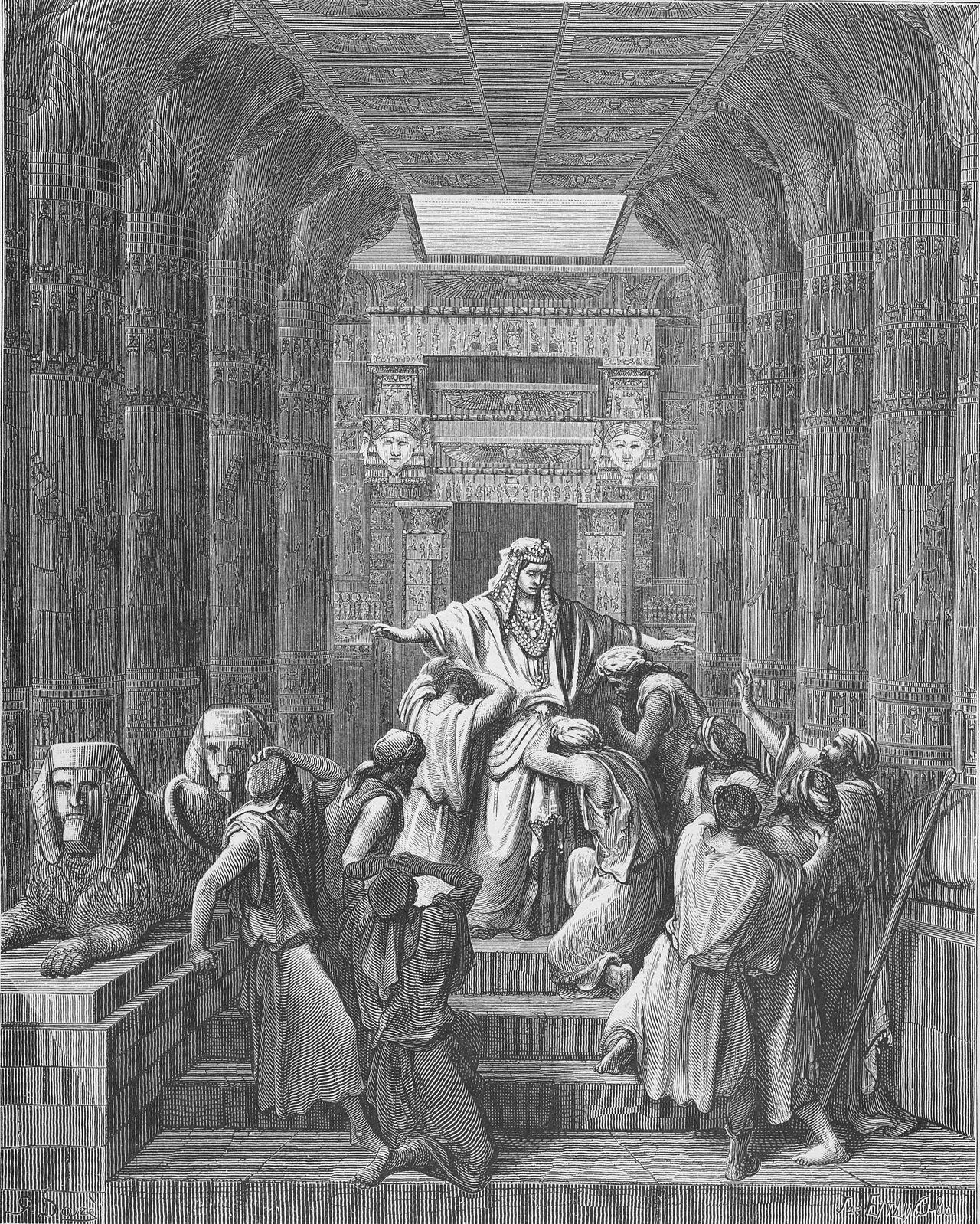
in Genesis 45But he wept so loudly that the Egyptians heard him, and Pharaoh’s household soon heard of it.
BSB
The same verse in ASV and KJV ▾
ASV
And he wept aloud: and the Egyptians heard, and the house of Pharaoh heard.
KJV
And he wept aloud: and the Egyptians and the house of Pharaoh heard.
⋯
This verse in Genesis 45
Commentary
8 notes on this verseAnd he wept aloud,....; Or "gave forth his voice in weeping" (r); as he wept he cried aloud; for having put such a violent restraint on himself, as the flood of tears was the greater, so his voice was the stronger and louder for it: and the Egyptians and the house of Pharaoh heard; the Egyptians, that were in the room or rooms adjoining to that where Joseph was, heard his cry, and perhaps a great deal of what was said; which they soon reported to others, and it quickly reached Pharaoh's court, which might not be at any great distance. (r) ויתן את קלו בבכי "et dedit vocem suam in fletu", Montanus; so Junius & Tremellius, Piscator, Schmidt.
This site's exposition
Send everyone away from me
on Genesis 45:1-2
Joseph sends every attendant away before he speaks, and he makes himself known to his brothers alone. He wept loudly enough for the Egyptians to hear, and the news reached Pharaoh's household. The privacy is for the brothers. The sound that escaped it starts the rest of the chapter at verse sixteen.
This site's exposition
he wept so loudly
This is the third time Joseph weeps over his brothers. At 42:24 he turned away from them to weep, and at 43:30 he hurried into a private room. Now the weeping can no longer be hidden.
The record, by era
The Puritans and the Awakening1 voice
He very abruptly (as one uneasy till it was out) tells them who he was: I am Joseph. They knew him only by his Egyptian name, Zaphnath-paaneah, his Hebrew name being lost and forgotten in Egypt; but now he teaches them to call him by that: I am Joseph; nay, that they might not suspect it was another of the same name, he explains himself (
quarantine:debris (2026-07-29) — unbalanced-parens
The Nineteenth Century4 voices
A commentator
Jamieson, Fausset & Brown1802–1910
Commentary Critical and Explanatory on the Whole Bible (1871)
proposed
he wept aloud--No doubt, from the fulness of highly excited feelings; but to indulge in vehement and long-continued transports of sobbing is the usual way in which the Orientals express their grief.
quarantine:debris (2026-07-29) — starts-lowercase
A commentator
Charles Spurgeon1834–1892
The Metropolitan Tabernacle Pulpit, Sermon No. 2516: “Jesus and His Brethren” (lightly modernized text, CCEL edition) · Written before 1892.
proposed
I NEED not say to you, Beloved, who are conversant with Scripture, that there is scarcely any personal type in the Old Testament which is more clearly and fully a portrait of our Lord Jesus Christ than is the type of Joseph. You may run the parallel between Joseph and Jesus in very many directions, yet you need never strain the narrative so even much as once. I am not about to attempt that task on the present occasion, but I am going to take this memorable portion of the biography of Joseph and show you how, in making himself known to his brethren, he was a type of our Lord revealing himself to us. It seems that, at last, Joseph could bear the suspense no longer. He knew who his brethren were, he knew which was Benjamin and which was Reuben, Simeon, Levi, Judah and the rest, and he remembered all the story of their early days together. But they did not know him. They thought him some mysterious potentate, some great ruler of the land of Egypt—as indeed he was—but they did not know so much about him as he knew about them. Consequently, there was a distance between him and them and his loving heart ached to bridge that gulf by manifesting himself to them. It is the way of love to desire to make itself known. Now, in a still higher sense, the Lord Jesus Christ knows all about those in this place whom He has redeemed with His precious blood. The Father gave them to Him from before the foundation of the world and He took them into Covenant relationship with Himself before the earth was. Often has He thought of these as His beloved ones. His delights have been with the sons of men and He has looked forward and foreseen all that would happen to them.
A commentator
Charles Spurgeon1834–1892
The Metropolitan Tabernacle Pulpit, Sermon No. 2516: “Jesus and His Brethren” (lightly modernized text, CCEL edition) · Written before 1892.
proposed
I NEED not say to you, Beloved, who are conversant with Scripture, that there is scarcely any personal type in the Old Testament which is more clearly and fully a portrait of our Lord Jesus Christ than is the type of Joseph. You may run the parallel between Joseph and Jesus in very many directions, yet you need never strain the narrative so even much as once.
The Egyptians and the house of Pharaoh heard - It seems strange that Joseph should have wept so loud that his cries should be heard at some considerable distance, as we may suppose his dwelling was not very nigh to the palace! “But this,” says Sir John Chardin, “is exactly the genius of the people of Asia - their sentiments of joy or grief are properly transports, and their transports are ungoverned, excessive, and truly outrageous.
How the passage was read
What the Jewish commentators add
On the verses either side of this one
THEN JOSEPH COULD NOT ‘L’HITHAPEIK’ (REFRAIN HIMSELF) BEFORE ALL THEM THAT STOOD BY HIM. He could not bear that the Egyptians should stand by him witnessing how his brothers would be put to shame when he makes himself known to them. This is the language of Rashi.
1 more on this passage, in their own words ▾
Yoseif could not contain his emotions in the presence of all who stood before him, and he cried out Let everyone leave my presence.
This section is reception history: how the passage was read and kept in the Jewish tradition. Where a reading parts from an essential of the Christian faith, the section says so at that point.
Texts and citation data: Sefaria; each excerpt follows its version’s licence. 2 further sources are cited on this chapter that carry no English text this site may quote or only restate the verse.
The words behind it
9 Hebrew wordsEvery Hebrew word of this verse in the order it stands, with what it means and the door to its own study. The last column counts the times a word stands in the whole Bible: the rarer the word, the more the places it appears belong together.
| Hebrew | Sound | Meaning | Word study | In the Bible |
|---|---|---|---|---|
| וַיִּתֵּ֥ן | vaiyiten | and he gave | H5414 → | 2011 times |
| אֶת־ | ʾet- | <obj.> | H853 → | 10935 times |
| קֹל֖וֹ | kolo | voice his | H6963 → | 506 times |
| בִּבְכִ֑י | bivkhi | in weeping | H1065 → | |
| וַיִּשְׁמְע֣וּ | vaiyishmeu | and they heard | H8085 → | 1159 times |
| מִצְרַ֔יִם | mitzrayim | Egypt | H4713 → | 70 times |
| וַיִּשְׁמַ֖ע | vaiyishma' | and it heard | H8085 → | 1159 times |
| בֵּ֥ית | beit | [the] household of | H1004 → | 2046 times |
| פַּרְעֹֽה׃ | paroh | Pharaoh | H6547 → | 274 times |
וַיִּתֵּ֥ןand he gave
vaiyitenH5414 →2011 times
אֶת־<obj.>
ʾet-H853 →10935 times
קֹל֖וֹvoice his
koloH6963 →506 times
בִּבְכִ֑יin weeping
bivkhiH1065 →
וַיִּשְׁמְע֣וּand they heard
vaiyishmeuH8085 →1159 times
מִצְרַ֔יִםEgypt
mitzrayimH4713 →70 times
וַיִּשְׁמַ֖עand it heard
vaiyishma'H8085 →1159 times
בֵּ֥ית[the] household of
beitH1004 →2046 times
פַּרְעֹֽה׃Pharaoh
parohH6547 →274 times
A shaded row is a word that stands 400 times or fewer in the Bible.
The walk
8 stopsEach card is a verse this one points to, and under it the verses that one points to in turn. Where several paths arrive at the same place, that place is listed first: the text keeps returning to it.
Through
Ruth 1:9May the LORD enable each of you to find rest in the home of your new husband.” And she kissed them as they wept aloud
it leads to
- Acts 20:37
They all wept openly as they embraced Paul and kissed him.
Reached by 2 separate paths from here.
- Ruth 3:1
One day Ruth’s mother-in-law Naomi said to her, “My daughter, should I not seek a resting place for you, that it may be well with you?
- Genesis 29:11
Then Jacob kissed Rachel and wept aloud.
- Genesis 27:27
So he came near and kissed him. When Isaac smelled his clothing, he blessed him and said: “Ah, the smell of my son is like the smell of a field that the LORD has…
- Acts 20:37
Through
Genesis 46:29Joseph prepared his chariot and went there to meet his father Israel. Joseph presented himself to him, embraced him, and wept profusely.
it leads to
- Luke 15:20
So he got up and went to his father. But while he was still in the distance, his father saw him and was filled with compassion. He ran to his son, embraced him, and…
Reached by 2 separate paths from here.
- Luke 15:20
Through
2 Kings 20:3“Please, O LORD, remember how I have walked before You faithfully and with wholehearted devotion; I have done what was good in Your sight.” And Hezekiah wept bitterly.
it leads to
- Nehemiah 13:22
Then I instructed the Levites to purify themselves and guard the gates in order to keep the Sabbath day holy. Remember me for this as well, O my God, and show me mercy according…
- Nehemiah 13:14
Remember me for this, O my God, and do not blot out my deeds of loving devotion for the house of my God and for its services.
- Nehemiah 5:19
Remember me favorably, O my God, for all that I have done for this people.
- Nehemiah 13:22
About Genesis
This page draws on Adam Clarke, Commentary on the Bible; Charles Spurgeon, The Metropolitan Tabernacle Pulpit, Sermon No. 2516: “Jesus and His Brethren” (lightly modernized text, CCEL edition); Jamieson, Fausset & Brown, Commentary Critical and Explanatory on the Whole Bible; John Gill, Exposition of the Old Testament (1748-1763); John Gill, Exposition of the Old Testament and Matthew Henry, Commentary on the Whole Bible.